The Scleroderma Chronicles: Be a Rose.

So, I got a little testy in one of my Facebook support groups for systemic sclerosis this morning. A member of the group kind of disparaged me and another person for not being positive enough. It was “you need to refuse to let scleroderma define you” in response to the first person sadly saying that she missed her old life, and me giving her an online hug with the comment that if only a positive attitude was enough…

In my defense I had just experienced a Kaiser employee visibly reacting to my lack of wrinkles. As in, wow, that’s great! Like not having wrinkles makes this all worth it.

I lost another 4 pounds at my last check-in, which is concerning, but the nurse was thrilled for me. Me, I was a little teary at the continued loss.

Um, people… do you think that you might be a little shallow here?

I was out on the deck/catio with the cats drinking my morning latte when I hit this emotional wall, and after I had fired off the somewhat testy response, I spent some time in the garden. There were my roses, blooming like the utter champs that they are.

This is my Princess Alexandra of Kent rose.

This rose is looking great this year. Never before has the plant been able to hold up the blooms without the weight pulling the stems over. The problem is our semi-arid climate with hard winters; the plant grows back from the roots every year and it doesn’t have time to put in enough supportive tissue to hold up the blooms. This year, with all the rain and cool weather that we have had, the plant was able to put in enough of this tissue to do the job. The tissue that I’m talking about, a type of ground tissue, is called sclerenchyma. If you’re ever snapped a celery stalk in half and pulled out the strings, you were pulling out sclerenchyma tissue. This tissue is made of dry, hardened cells in the stem of the rose and I suspect that the “scler” part of the word is of the same origin as scleroderma. Look at that. The hardened cells are doing something good for this rose!

In me, not so much. Things have been a little difficult as my poor heart and lungs are not benefiting from the hardening and thickening going on in the cells and tissues of those organs. All of my tendons are seriously pissed off at the moment. Edema has become a problem, and it is becoming increasing clear that I need to stay on oxygen 24/7.

That’s my arm with the imprint of a quilt in it, in case you didn’t immediately recognize it… Edema is kind of a tip off that my heart is struggling and that’s new. The weight loss is also related to my heart/lungs because if oxygen isn’t getting down to my cells like it should, they can’t use energy efficiently, and then, you know, weight loss occurs. The tendon issue is scleroderma actively attacking them and gradually hardening them to bone. Bad scleroderma, bad!!

But look at how great these roses look!

So, what did I say in my testy response? Reality bites. Some of us have progressed to the point where we have to admit that no amount of positive thinking will allow us to attend that family function that we were invited to, or to visit the annual Wool Market in the mountains, or to even walk to the mailbox. To suggest that we could do things if we just had a more positive attitude is hurtful and not supportive. No matter how much you want to believe otherwise, scleroderma does define me and everyone else who is dealing with it. Courage requires us to face down the monster and to accept the reality of our disease. How we choose to function within that framework is up to us.

I may no longer be as mobile as I once was, and the life that I used to have is now mostly gone, but I choose to continue to bloom in place.

Like a rose.

Updates/Notes from the ScleroFront:

  • Do you like to wear linen? Those fibers are from the water tubes (xylem) in the flax plant, and made of sclerenchyma.
  • The bunny-murdering neighbor put her house up for sale!!
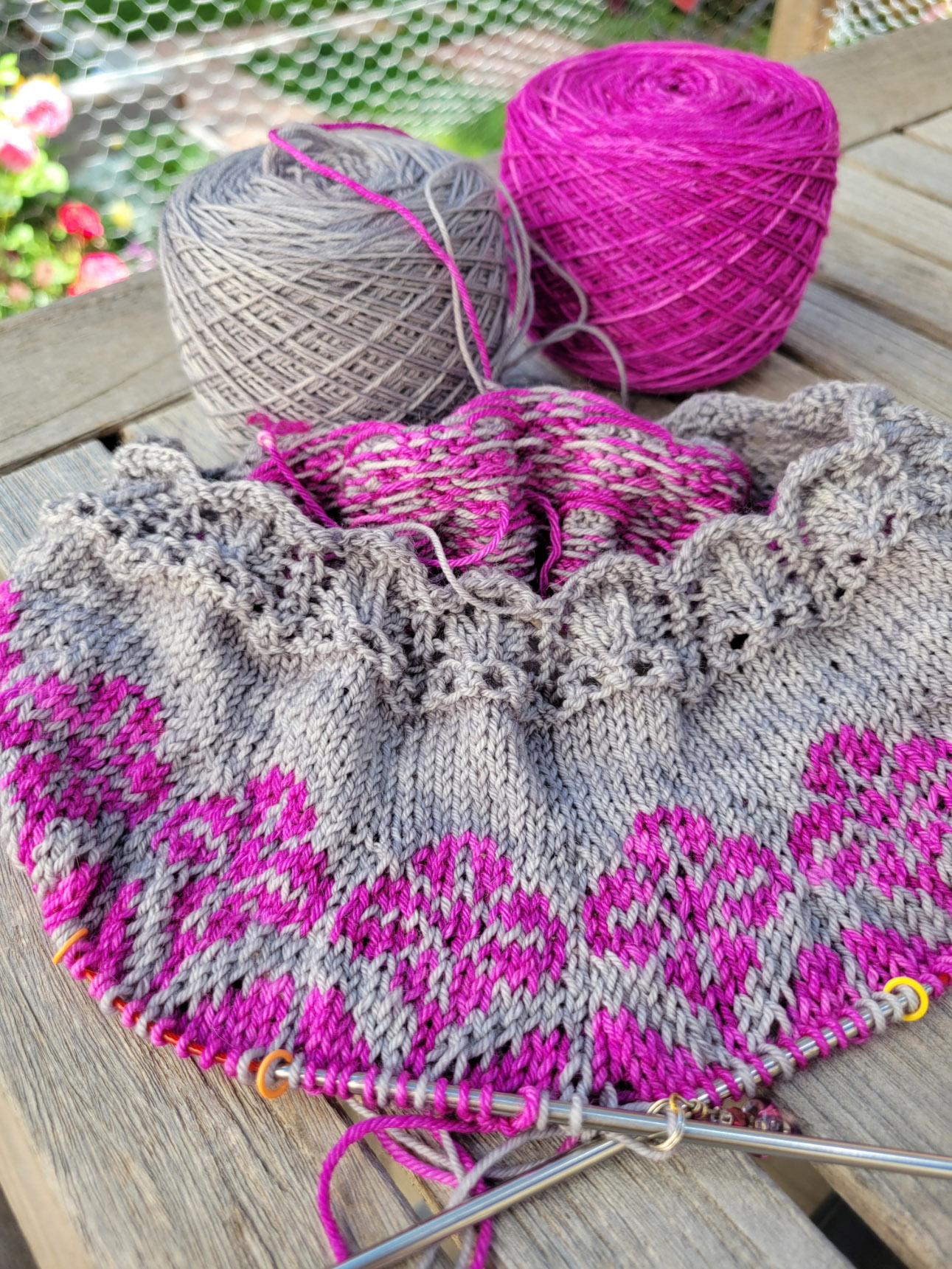
  • My Alpine Bloom sweater is coming right along!
The Scleroderma Chronicles: Carrying Light

You know, I think that synchronicity is a real thing; you just have to pay attention to what is going on around you. Sometimes, if you take notice, the world hands you just what you need at that moment.

Scleroderma has been kicking my butt lately. Having improved dramatically over the summer and sailing through my heart/lung testing last fall, my doctors were pretty upbeat when I reported worsening symptoms while visiting them in late winter. They ordered some testing, but they were also very reassuring.

A week ago I arrived at a Kaiser facility bright and early for a routine echocardiogram and 6-minute walk test. The echocardiogram did not go well (usually they don’t hurt, and what was up with having to pause so I could pant a little to catch my breath…) and I was in the red zone (the pulse oximeter starts glowing red if your oxygen drops below 90%) after a minute of walking. The test was halted after 3 minutes, and the concerned nurse walked me out to the elevator.

Ugh. Not good, little BLZ, not good. Refusing to overreact, I went to my favorite yarn store on my way home, bought some great yarn, and then hit Starbucks by my house. It was a bright, blue day and I headed out to the deck to knit.

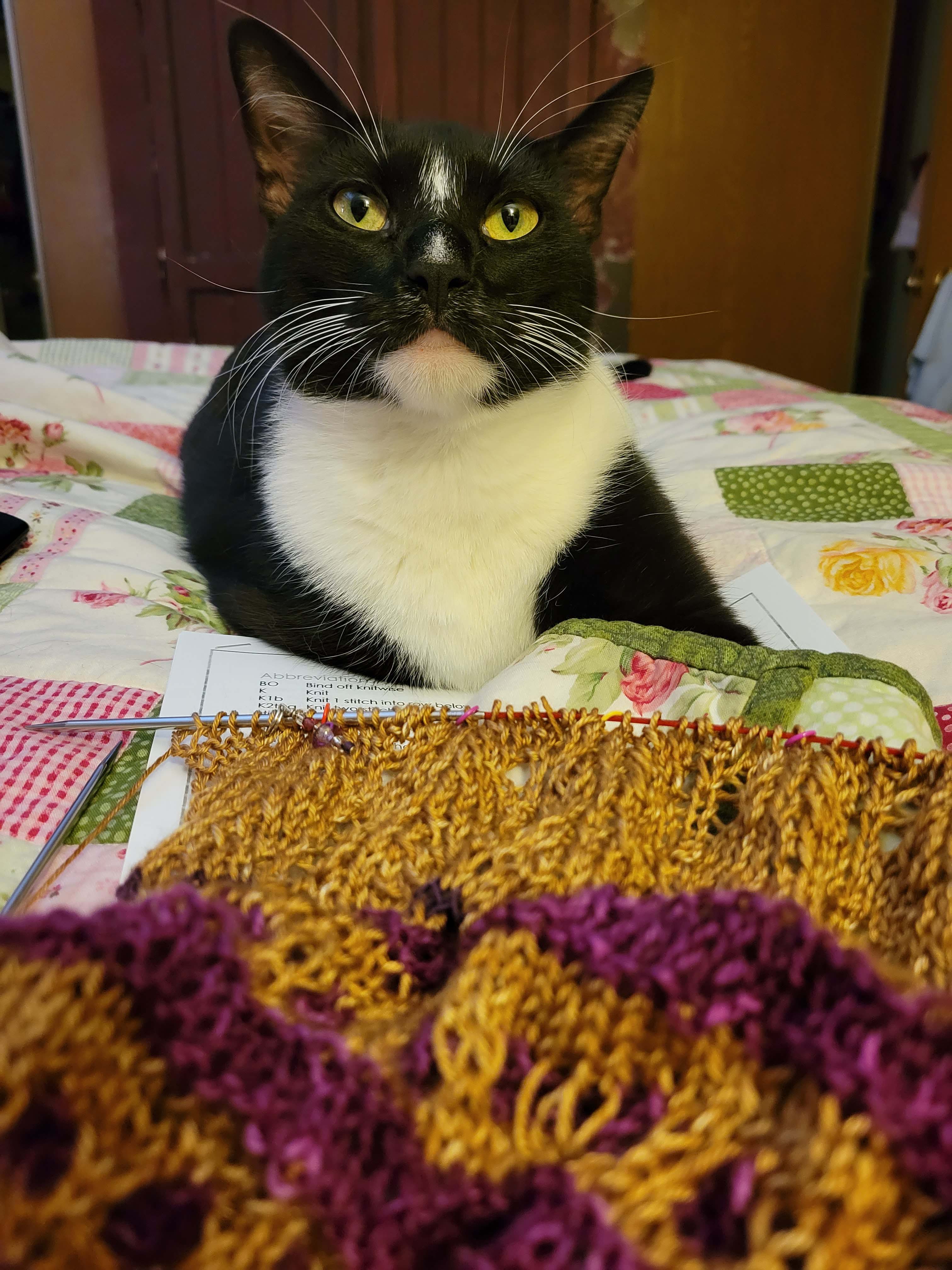
I took this picture of Hannah. Look at that bright, blue sky!

Do you know the quote by Elizabeth Zimmerman that goes “Knit on, with confidence and hope, through all crises.”? Yep. That is a quote to live by! I cast on a new hexagon for my blanket and started knitting. I felt myself settle inside, my breathing steadied, I began to process what had happened, and my anxiety faded away. Scleroderma is a monster, and by the time I was casting off the hexagon, I was ready to once again face it down.

This post had appeared in my knitting group on Facebook from Michelle Obama a few days before:

Well, look at that: Michelle Obama is a knitter! Yay! It looks like she also knows about the Zen of knitting and the ability it has to bring calm and purpose to a simple activity while you reflect upon and process problems large and small. I knitted every night to finish my teaching days. I knit in hospitals. I knit in meetings. I knit just about everywhere I can, and I especially knit to deal with the rolling shitshow that is my chronic illness. I went and bought Michelle’s book.

Thursday morning the results from the echocardiogram were posted and a couple of hours later my cardiologist called me. I was knitting and ready for the call.

For the first time the words stage 3 heart failure were used in the discussion with my doctor. My pulmonary pressure is higher than ever before and there is more fluid around my heart. It is not clear if my symptoms are caused by worsening pulmonary hypertension or pericarditis, but the only way to sort this out is to go back into the cath lab and directly measure the pressures with a right heart catherization. It may be both. I will need a different treatment regimen. An emergency referral was put in and tomorrow I’m heading back to the hospital for the procedure. This is what happened the last time I did this.

My pulmonologist, who works closely with my cardiologist and rheumatologist, saw me on Friday for a lung function test and office visit. My lungs are hanging in there, but my ability to diffuse oxygen into my bloodstream has dropped significantly. I told him about the upcoming trip to the cath lab, and he started checking those test results. I’m not going to lie, it is a little alarming when your doctor says, “No, no, this is not good. I am not happy with this at all.” More testing has been ordered. He emailed the other doctors on the team to start the discussion about what changes should be made with my meds.

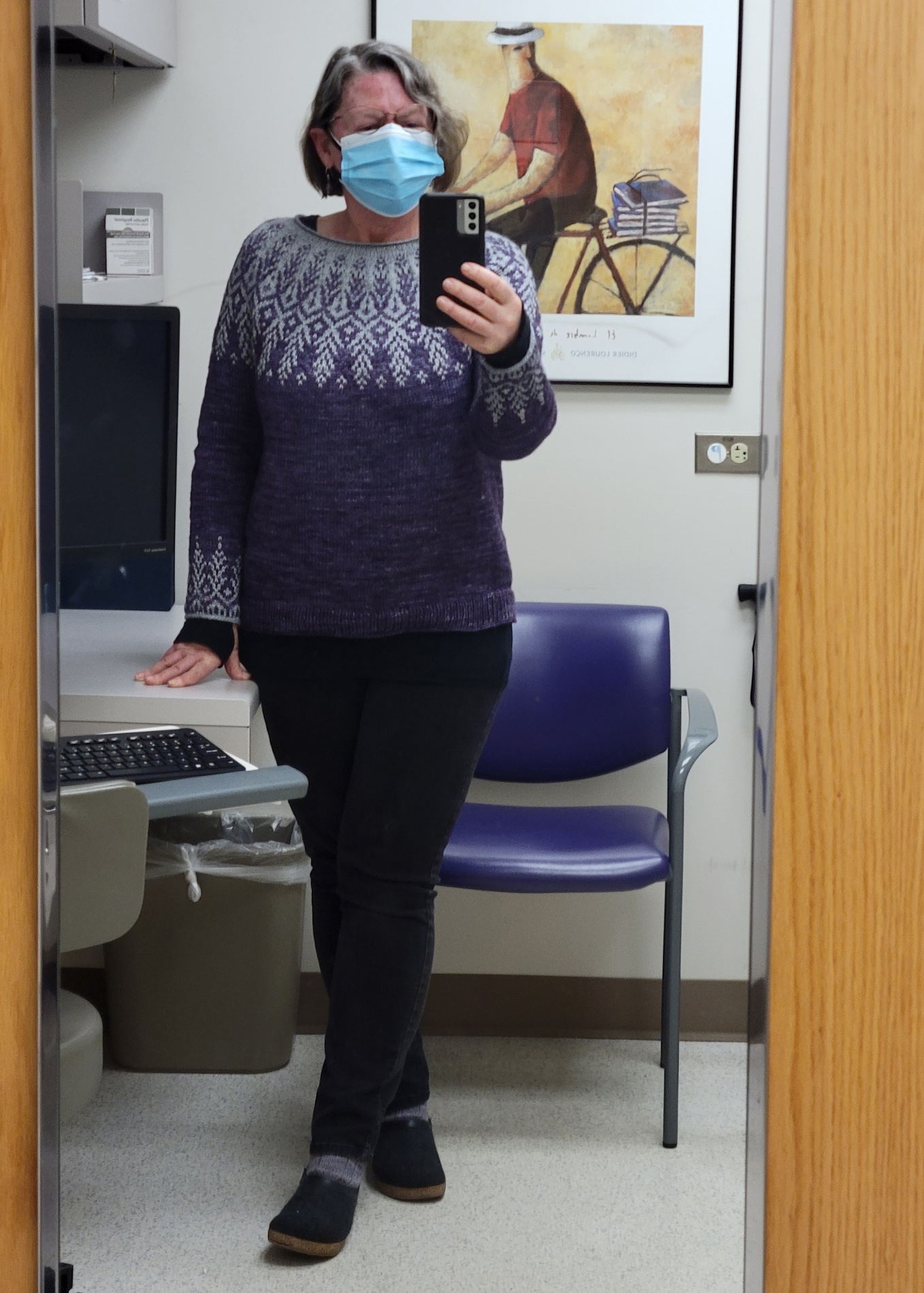
I took this picture of my new Goldwing sweater in his office the day that I met him. If you are going to scary appointments, armor yourself in your favorite knits!

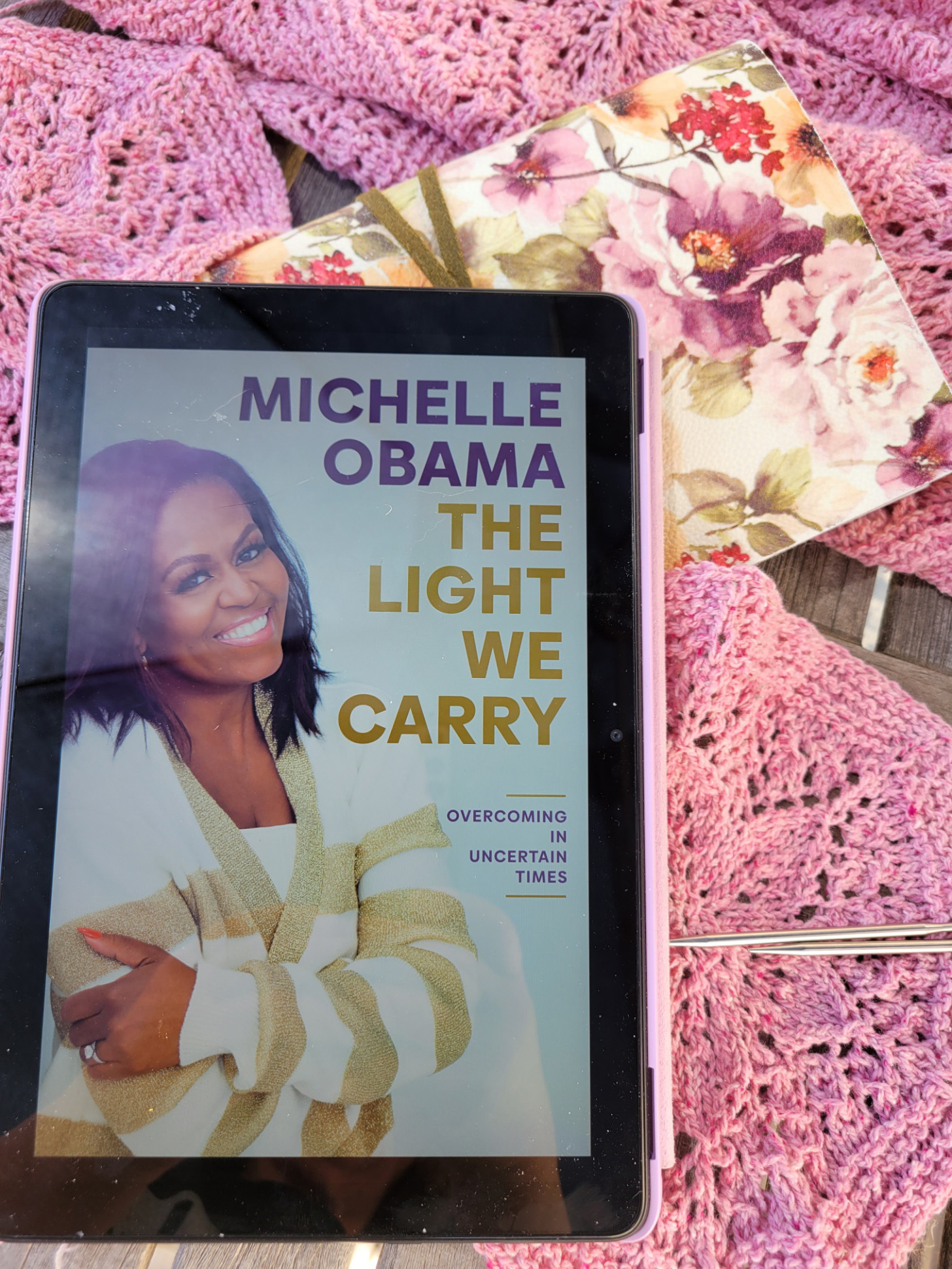
This weekend I started reading The Light We Carry and was amazed that it starts with… knitting. Serendipity strikes!! Michelle Obama began knitting at the start of the pandemic as she struggled with the lockdown: grief, isolation, loss, and everything else that happened in that time. It became an important vehicle for processing, recovery, and perspective for her. The daughter of a father with MS, she is very aware of disability and how it absolutely impacts how someone like me can view myself and the rest of the world. She talked about using tools such as the cane that her father needed to empower ourselves to deal with what comes our way. Her book appears to be a toolbox of different strategies to cope with the challenges in life.

For the first time since all this started happening last week, I cried. This book is absolutely, positively, what I needed to read right now as I pack my bag for the hospital and prepare for what is coming my way in the upcoming days and weeks. It’s like someone could see right into my heart and lit a light for me. I will carry that light along with its warmth and glow tomorrow as I join my doctor and the pit crew in the cath lab. Whatever happens, I am positive, I will glow, and my light will shine.

So, Michelle, whatever can I show off as a favorite knit? Every single item that I cast off my needles has left me with a sense of purpose, accomplishment, and fed my creative needs. Knitting helps me cope with adversity, plan my day, and work through problems. Knitting delivers calm in a time of crisis. Knitting allows me to deal with an unpredictable autoimmune disease that delivers an uncertain future. Knitting connects me to all the knitters in the past and provides gifts for others as I pay forward. It is essential for my being and a vehicle to connect with others.

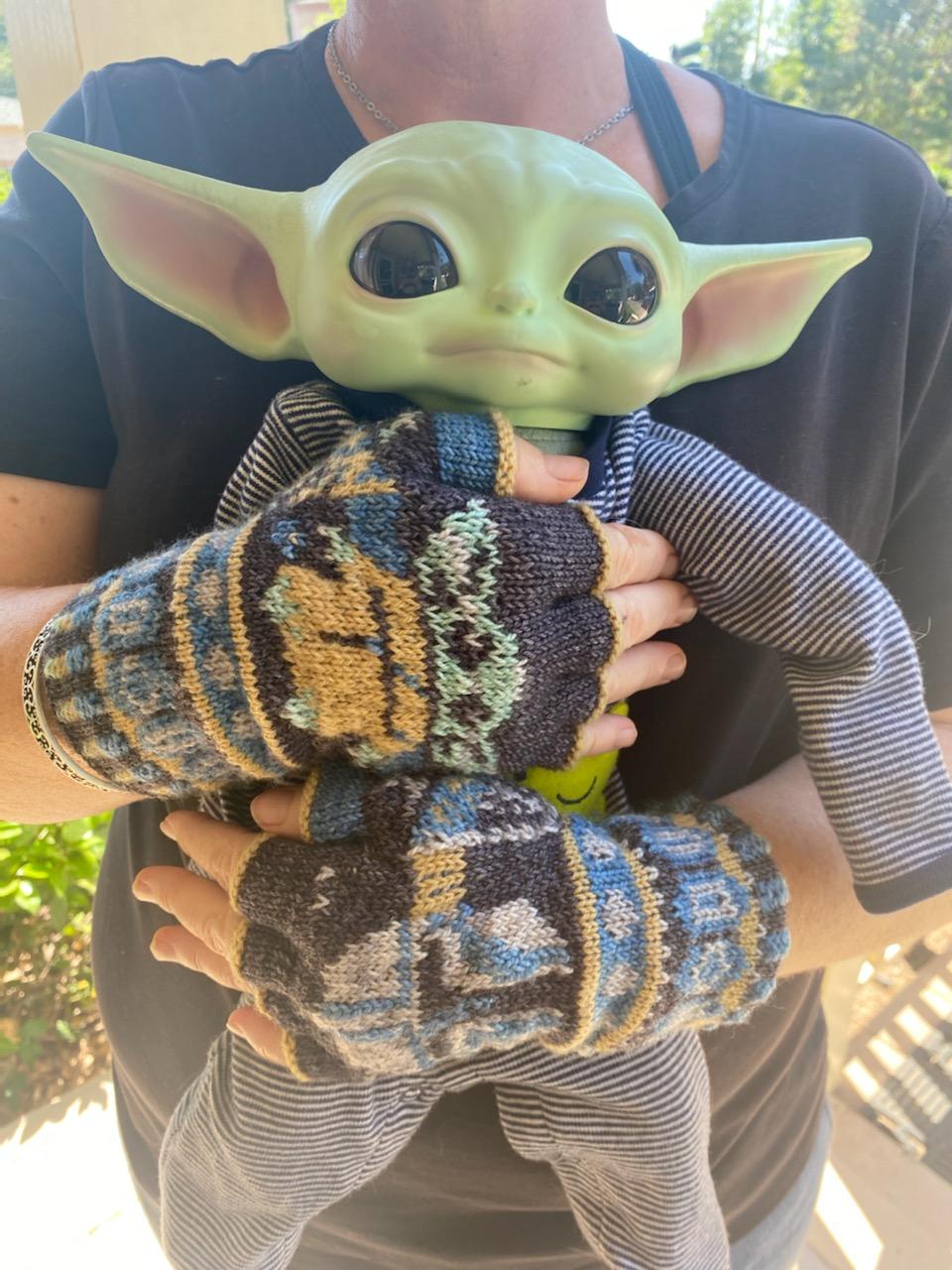
Here are some things I’m really pleased with: Goldenfern, a knitted copy of a beloved (and lost) cat, baby booties gifted to a neighbor knitted from a pattern handed down through 4 generations of my family, the hats and PICC line covers that are donated to Kaiser infusion centers in my area, and Mando (and Grogu) mitts for a knitworthy niece.

Tomorrow I’m wearing arm warmers and knitted socks into the cath lab. Take that, scleroderma.

Behold, I carry my (knitted) light with me!

Did you wonder what a BLZ is? That’s me, the Blue-Lipped Zebra!

Hannah and the CoalBear: Mateo does Caturday.

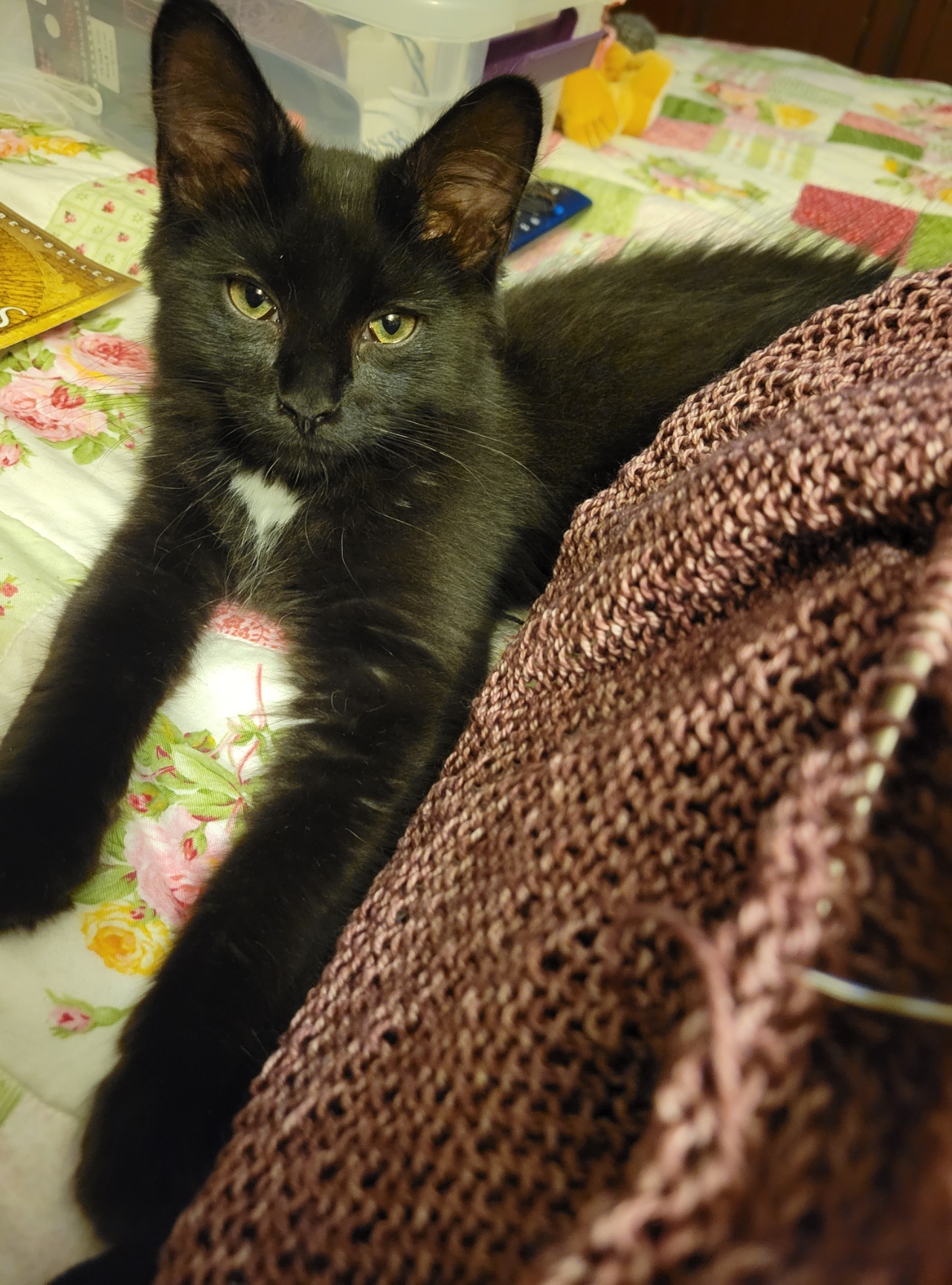
Hi. I’m Mateo (AKA the CoalBear).

I’m almost 10 months old now. What do you think of my ruff?

The Mother of Cats isn’t feeling well today so I am hanging around with her on her bed. I’m helping her write on her computer right now! I’m such a good boy!

I’ve been bringing toys onto the bed so she can watch me play with them.
I chewed on the palm plant downstairs to keep up my energy.
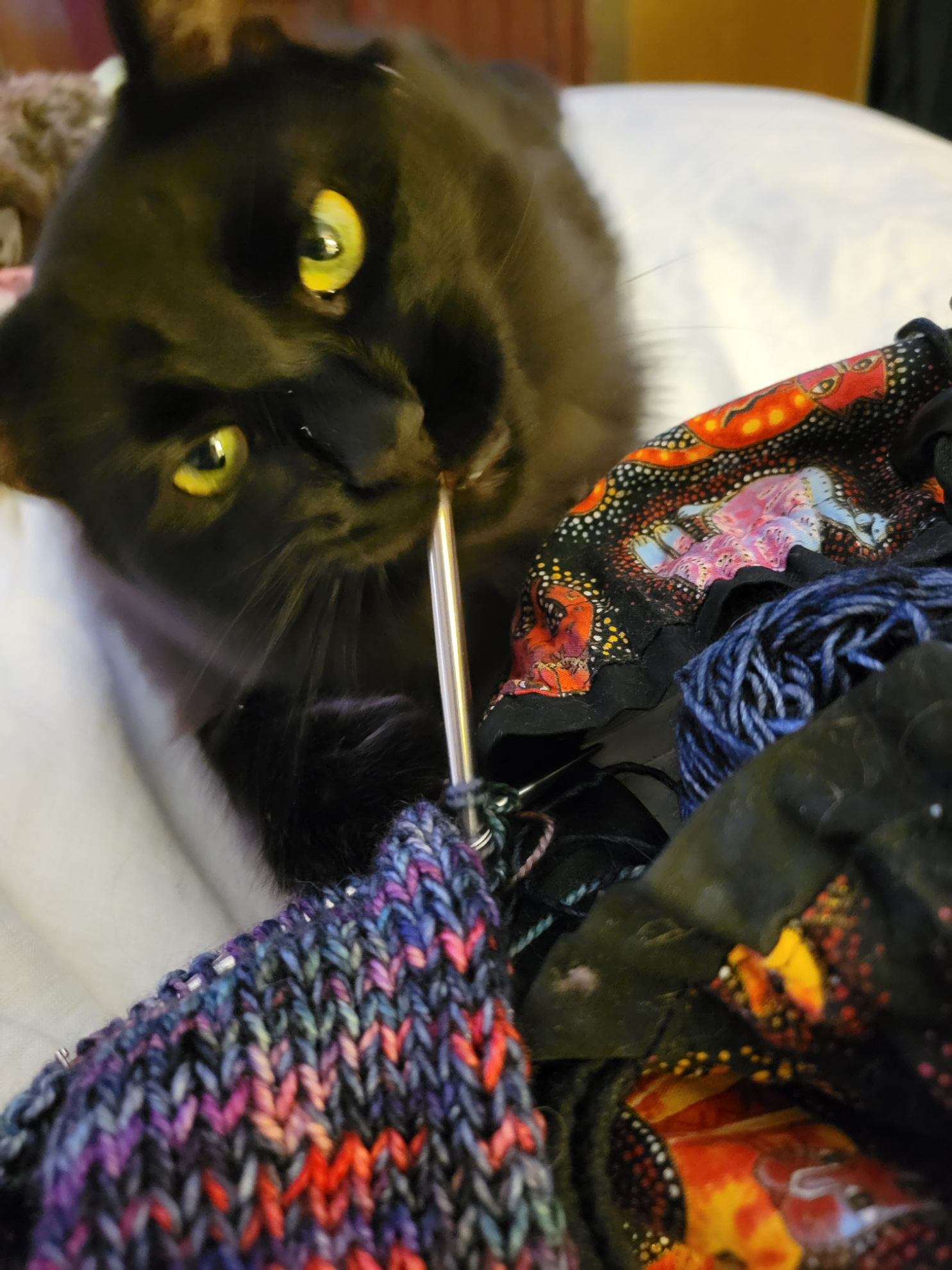
I then helped the Mother of Cats with her knitting. I’m such a great helper!!
I groomed my sister so she would let me sleep on the cat tree with her.
I’m the best CoalBear ever!!

Happy Caturday everyone!!

May you all have an excellent day!

Notes from the Mother of Cats:

I’ve gone off my immunosuppressant drug so that I can get my Covid booster on Monday. Sigh. There was a big pressure change yesterday with a cold front that triggered some symptoms along with the predictable flare of my disease that has me back in bed for the weekend.

I’ve been in lockdown for two years and I desperately want the booster because my next round of medical appointments starts in another week. I also want to start knitting with my new-found groups, too. I want some of my life back!!

Please think of me and the other people in a situation like my own (high risk, immunosuppressed or immunocompromised, and struggling with chronic conditions that complicates their lives on the best of days) when you are out in public.

And wear your mask!

ps: I threw out the palm last night. It wasn’t a match for the CoalBear and I was afraid it would make him sick. Next up: a Boston fern.

The Scleroderma Chronicles: A Trip to the Cath Lab

The BLZ has been waiting a long time for this…

Five years ago I came down with the flu and ended up in Urgent Care struggling to breathe. I scored some antibiotics, steroids, and cough medicine. To fight the virus I was told to go off my immunosuppressant drugs for a few weeks until I got better, stay in bed, and load up on chicken soup: it took a couple of months but eventually I got back on my meds. Except… things weren’t quite right. I panted for air every time I came up the stairs and I noticed that my lips were turning blue. My blood pressure was too low and I had to stop taking my hypertension medicine. I felt dizzy and light headed sometimes.

I was a newly diagnosed systemic sclerosis patient and my doctors began running tests to see if my disease was impacting my lungs. Nope. Not my lungs. Tests were run to see if scleroderma was attacking my heart. Nope: my heart seemed to be normal. There were some anomalies, but my doctors decided to just monitor me through routine testing and see if things changed down the road. My red blood cell counts were way too high, and I had nocturnal hypoxia, so I was started on overnight oxygen. I was tested for various conditions that could account for the weird test results, but I always had a normal result.

I struggled on, battling for more testing, as my doctors kept reassuring me that I was okay. Hey, I had a blue face and panted for air when I climbed stairs; vacuuming could put me on the floor. How could this be “normal”? Ugh. Welcome to scleroderma, I thought.

I began to think of myself as the Blue-Lipped Zebra (BLZ). If I didn’t have a rare disease confusing the issue I would be getting better health care, it seemed. If doctors didn’t tend to apply most-common-cause thinking to my condition they might get to the bottom of things faster. It was, in my mind, a huge complicated mess as my doctors applied best practice (and rigid) diagnostic parameters to my symptoms or zeroed in on specific complications of my scleroderma and ignored other possible (and to be fair, rare) causes for my symptoms. I worried that my doctors had just parked me in a holding pattern as I slowly got worse; it is hard to advocate for yourself when you are sick and dependent on your doctors for help, even if you think that they are dismissive and borderline disparaging.

I struggled on as my face became more blue, my red blood cell count higher, my panting for air more common, and the occasional near-fainting event left me collapsed on the floor. I began to ask for a right heart catherization procedure to directly measure the pressure in the right side of my heart. “Oh. You don’t want that,” I was told. “That is really invasive testing.” Umm… I think I do, I would reply. Nope. Nope, nope, nope!! “Not even on the table,” one pulmonologist said.

During lockdown last year I got much worse; ironically lockdown also gave me the opportunity to reboot, fire my old doctors and acquire new ones. My new team of doctors this spring ordered up testing that showed definite issues with my heart and lungs. I am now a heart failure patient (the wall of my left ventricle are too stiff and scarred to beat well) and there were concerning findings that suggested that I had developed pulmonary arterial hypertension (PAH): there are areas of cell death in my lungs and my pulmonary artery is too big. There is too much fluid around my heart, a suggestion of ongoing inflammation. I have a hole in my heart between the atriums (a cardiac shunt) that is impacting blood flow. I was gently prepared for the PAH diagnosis, assured that there were great drugs that could help me, and a right heart catherization was ordered by my new cardiologist.

Yay!! About time!!!

Finally, after 5 years of struggle, I was yesterday wheeled into a procedure room to a waiting team of specialists who hooked me up to equipment and took me though testing to get a better look at my heart: I learned in recovery that this team calls themselves “the pit crew”, and that is exactly what it was like. Within 5 minutes I had completed a breathing test, was on oxygen, wired up to a heart monitor, hooked up to an IV, medicated, prepared with surgical drapes, and swathed in warm blankets with a heater by my feet. There was music playing and the crew was cracking jokes as they darted in and out from the table getting me ready. I was knocked out for the echocardiogram imaging of the back of my heart that was done using a probe in my esophagus, but they woke me up for the main event: the right heart catherization. My cardiologist inserted a probe into the carotid vein in my neck and threaded it into my heart by way of the superior vena cava (blue side of the heart diagram above). People, this was the most amazing experience ever! There was a huge screen showing the progress of the probe and I could watch and ask questions as the line snaked through my heart; there was absolutely no pain. “Well, this is interesting,” said my cardiologist at one point, and there were more measurements happening and a flurry of new activity from the team. The BLZ felt a surge of elation: they had found something, and it was NOT what they expected.

Back in recovery my cardiologist caught up with me again. I had done great, he said, and he just beamed as he told me that I absolutely did not have PAH. This is great news, he assured me, great news!! There is another circulation problem in the lower part of my heart, between the ventricles. There is blood coming in from the left side of my heart and mixing with the blood on the right, disrupting the flow through the heart and robbing me of oxygen to my body. I have a second, more serious, cardiac shunt, and now it is a question of locating that pesky little guy and doing something to fix the problem.

It has been FIVE YEARS, people. If I hadn’t had my trip into the cath lab yesterday my doctors would still be nagging me to get more exercise (the BLZ just barks in laughter), offering me antidepressants, or insisting that I must have sleep apnea. I feel so validated!

My cardiologist is now going over my previous imaging to find the hole now that he knows what to look for. I was told that I may need to go through more testing to definitively characterize the opening, but this is huge forward progress. I suspect that I am facing open heart surgery down the road, but I am elated that the progressive and eventually fatal diagnosis of PAH is now off the table. Things are looking up since my heart failure will now be much easier to treat.

I am reminded of Elizabeth Zimmerman’s admonishment: “Knit on with confidence and hope, through all crisis.” Also, when the going gets tough, get a kitten!

Today I am waiting to hear back from my cardiologist who is going to email me with follow up instructions after he has finished going through the data and past test results. I’m on oxygen, knitting, and feeling pretty calm about all the new developments.

Almost exactly 7 years ago (August 28th was the anniversary day) I was diagnosed with Limited Systemic Sclerosis and Sjogren’s Disease. I have learned a lot along the way, but the best, most important lessons have been about self-advocacy, facing down the worst case scenarios, communicating with your doctors, and maintaining a good attitude.

Yesterday this all paid off for me big time.

Note: The fabulous BLZ graphic was made for me by my exceptionally knitworthy niece Melissa and her beautiful and talented daughter Eleanor.

The Scleroderma Chronicles: Matters of the Heart

The Blue-Lipped Zebra (BLZ for short) has been busy the last three months (once she was fully vaccinated for Covid-19) and lots of testing and doctor appointments have happened. Lots of diagnostic hypothesis have been pursued and tested; the BLZ has received several emails from doctors that let her know about good news: you don’t have pneumonia!! your heart looks good!! your kidneys are maintaining!!

All is good. Go visit your baby bunny and don’t worry about it…

Hello. BLUE-LIPPED Zebra. Chest hurts. Zebra is dizzy. Zebra pants as soon as she moves around. Zebra is absolutely sure that everything is not fine at all!

Did I mention that the BLZ got fully vaccinated? Ever since that happened (and the BLZ got a steroid injection for her ill-behaved hip) her fatigue and brain fog have receded into the background. Quite frankly, the BLZ is feeling pretty frisky and clear-headed these day between bouts of dizziness and panting episodes. She has decided that enough is enough and she is on the move to get to the bottom of what is going on!

She contacted her doctors and health providers and had them forward her the entire text of her test results. She read these results carefully and then spent some time consulting with Dr. Google to figure out what some of these words meant. The BLZ is so grateful for that biology degree and years of related job experiences.

The BLZ has limited systemic sclerosis. What she learned was…

  • A general rule of thumb, the 15% Rule, can be used to describe the number of systemic sclerosis patients with serious complications associated with their illness. For example, 15% of patients will have Sjogren’s Disease, or digital ulcers, or lung disease, or maybe pulmonary arterial hypertension. These complications are sometimes rare in the general public, but for systemic sclerosis patients they can be common.
  • A large European study found that the majority of systemic sclerosis related deaths were from heart complications (26%) or were pulmonary arterial hypertension (26%) related.
Time to stop and smell the roses. This is a little disappointing… my doctors have been reassuring me that all is fine because they are focused on lung disease. There are a lot of bread crumbs in the test results that suggest heart problems.

Then then BLZ made an appointment with her internist (the primary care physician) to go over the test results with her and to help her prep for her cardiologist appointment next week. Don’t you think that was smart?!!!

Mateo: Very smart!!

Here’s the summary of my appointment with my wonderful internist. My face was blue and I struggled with dizziness in her office: she entered a new diagnosis into my chart that says I’m cyanotic and told me to press the cardiologist for a prescription for day time oxygen so I can carry portable oxygen with me. (“Now we’re talking!!!” barked the BLZ.) She read the test results for my CT lung scan and echocardiogram and agreed with my understanding of what the test results were saying. She told me what tests to ask for from the cardiologist at my appointment. Here’s the summary:

  • I have physical findings in my lungs that consistent with pulmonary arterial hypertension. The summary results of that test say “mild to moderate” and even say that the loss of lung tissue and an enlarged pulmonary artery are due to PAH. Huh. Look at that. (“I’m just shocked, shocked!” snarks the BLZ).
  • The tissue of the heart (the muscle) is scarred and too stiff to beat well. This condition is called diastolic dysfunction and is a type of heart failure. The echocardiogram states that my diastolic dysfunction is Grade II, which is moderate. Scleroderma is attacking my heart; 15% of systemic sclerosis patients have diastolic disfunction. While there are lots of reasons why people develop diastolic dysfunction, for me the picture is different as it is a common complication of my systemic sclerosis and not a result of say… uncontrolled high blood pressure.
  • The estimated pulmonary pressure from the echocardiogram is difficult to measure in my case (Dr. Google had to teach me about incomplete TR jet and other obscure heart-related terms) and is most likely being undermeasured. The number now is the upper limit of normal; twice in the past it couldn’t even be estimated.
  • I have a newly developed hole in my heart called a cardiac shunt.
  • My heart is broken damaged by scleroderma.

So what should the BLZ do about all of this? The internist and the BLZ hatched a plan in which she should insist request direct measurement of the pressure in the right side of her heart (right heart catherization) and another echocardiogram that looks at that cardiac shunt while she is exercising standing up. Like, maybe the BLZ needs to be climbing stairs… The BLZ is just thrilled… Also, the BLZ wants day time oxygen-to-go. Yes, please. Right now, please.

Also, the BLZ is considering taking someone with her to the appointment and will have the cardiologist send the internist his notes following the appointment.

Also, when life get tough, get a kitten!! BLZs love kittens!

So, this is an adventure in progress, but I do have some gems to share with others struggling with their own medical misadventures. Get your own copies of your test results and physician notes after appointments. Google like crazy to learn what the obscure medical terms mean. Educate yourself about your illness/condition. Stay off social media as you do this and read journal articles from legitimate sources like the Rheumatic Disease journals and articles posted by the NIH. Ask another knowledgeable person to review your test results to help clarify/validate your thinking. If my journey here can serve as a roadmap for even one other person battling their way to a diagnosis, then this post was a success.

And remember to be brave.

It is good to have a diagnosis, even if it is a shame.

Zebras are brave!!

The Scleroderma Chronicles: The cardiac test results have arrived…

Spoiler Alert: there’s a happy ending!

It has really been kind of a rocky month. Following several episodes of shortness of breath, chest pain, heart palpitations and blue lips my doctors decided that I was due for a full round of testing. My primary care physician ordered up a battery of cardiac testing and sent me off to see my specialists.

Cookies
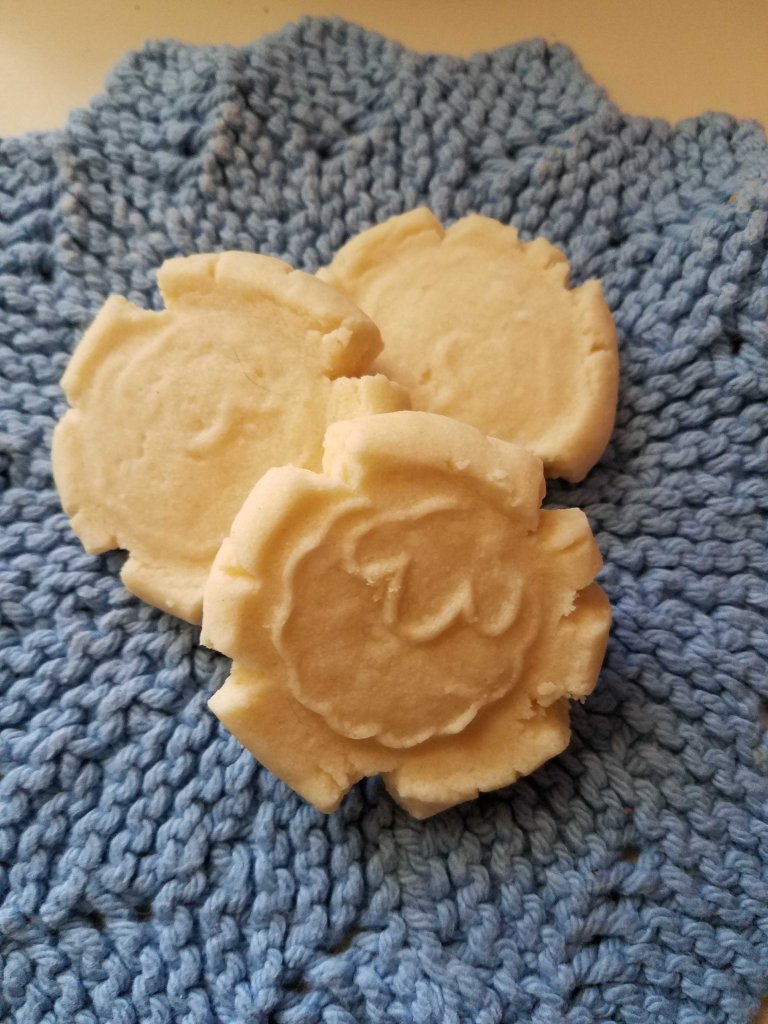
First up: the pulmonologist. I made these cute little sheep cookies to take to the office staff when I went in for my appointment.

I really like my pulmonologist. She is thorough, direct, and answers all of my questions without sugar coating things. I had chest pain in her office and while I was talking to her my lips turned blue right on cue. Wow. It’s like having a trick pony that performs for the audience! We talked about the possible causes, all of which were pretty serious heart conditions, and she decided that I needed to complete my cardiac testing before I did her pulmonary function tests.

I’m not going to lie, it was sounding pretty serious. She thought that I either was developing heart failure, pulmonary hypertension (a fatal complication of scleroderma), or my heart was being starved due to blood vessel constriction.

Next up: my rheumatologist. We discussed increasing my immunosuppressant dosage to crush my Sjogren’s, which has been pretty active, into submission. She hated to up the dosage unless there was no other choice due to the risk of infection, especially since she thought that it was probable that I was experiencing pulmonary hypertension symptoms, and that meant that the pulmonologist should be the lead on treatment.

What was needed, clearly, was some test results to clarify the situation. And knitting. Lots of knitting.

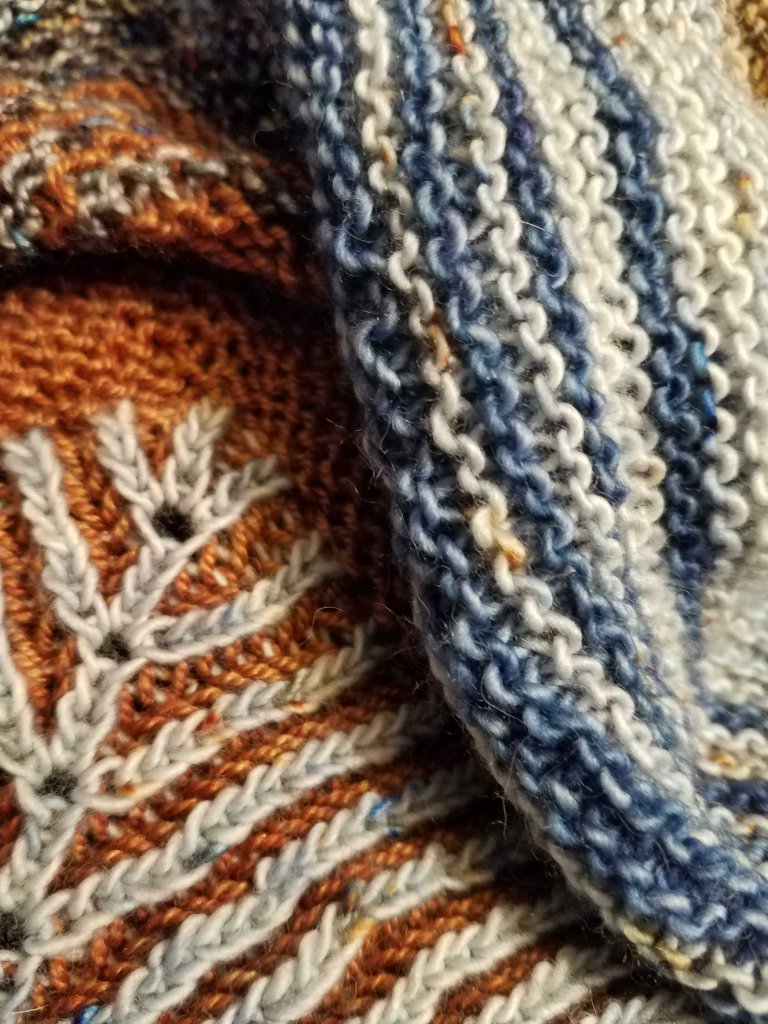
Knitted fabric.
I knitting like crazy all month on the What the Fade?! shawl and finished it yesterday. There has been research that shows that knitting has calming benefits greater than yoga. Since yoga is out of the question right now, I knit.

Are you familiar with Holter monitors? That’s the test where you are hooked up to sensors and wires that go to a device that records your heart’s electrical activity for 72 hours. 72 long, itchy, forced to sleep on your back, OMG, how did this sensor get attached to my hair, hours. Whew. It was done. The results: my heart was normal. Still short of breath and feeling dizzy, I went back to knitting.

Next up was the echocardiogram.  Dizzy and feeling faint, I went for the test one morning last week and then headed on over to my LYS for some knitting action. Following my BKB Deb around the store looking for the yarn to knit a Tegna sweater I felt faint and ended up sitting on the floor at one point. This was getting ridiculous! Especially since the technician who did the echocardiogram test told me that she thought I would be very happy with the result…

I began to wonder if the problem could be my blood pressure. After years of battling hypertension that was hard to control I was posting some really low numbers at my checks. Maybe I was getting too low?

I did a little searching on the internet, and discovered that there was some research that suggested that it was important to keep diastolic pressure above the 60s. Oh. I was often in the 60s. Maybe I was sending my pressure down too low every time I took my morning medication. My doctors were so happy with the current numbers, but maybe things had changed. Maybe I didn’t have hypertension any more… maybe the pulmonologist was right about the blood starved heart, but it was due to low blood pressure. I decided that I should check my pressure every morning before taking my meds.

Blood pressure.
Tbis was my blood pressure reading the next morning before my medication.

I skipped my meds and started recording my pressure readings several times a day. The chest pain and dizziness disappeared. I sent an email to my primary physician with the BP log attached and we set an appointment to talk yesterday as she had just received the echocardiogram results.

Surprise!! My heart is in better shape now than it was at the time of my diagnosis. My pulmonary hypertension is gone and my heart is now pumping normally. She agreed that my high blood pressure seems to have reversed and that the medications that I have been taking are too much for me now. We agreed to try a quarter dose for a few weeks to see what happens.

The immunosuppressant drug that I am taking has been shown to reverse scarring in lungs, and the high blood pressure drug that I was taking (in too high a dose) also may have positively impacted my heart. My skin isn’t as tight as it was a couple of years ago; it looks like my blood vessels are also now in better shape. Less stiff blood vessels means lower blood pressure. Yay!!

My doctor thinks that the drugs have caused these improvements.

My neighbor, who mows my lawn and prays for a miraculous cure, is sure that God has intervened.

I’m convinced that it was the knitting. 🙂

Next week: the lung testing begins.