The Mother of Cats says that the seasons changed today and that fall has arrived. Whatever. Is that a type of cookies?
The Mother of Cats and I went outside to water all of the plants today and I must say that the flowers all look the same to me, and the squirrels are as frisky as ever, but there IS something going on with the trees…
The leaves are starting to look funny!!
I’m not sure why fall is a big deal, but the Mother of Cats is knitting faster then ever. She says crazy stuff like Winter is Coming! and I need more sweaters! The Mother of Cats can be really confusing sometimes… Anyway, she worked like crazy over the weekend and look at what she got finished:
If the Mother of Cats loved me she would let me have these socks to put in my bed, but NOPE! she won’t take them off her feet. Why is the Mother of Cats so very selfish? She says that they are for her to sleep in on cold nights, but it isn’t even a little cold and she is wearing them right now. Selfish Mother of Cats!! I want my own cashmere sleeping socks, too!! Well, I want them to sleep on, but you get the idea.
I’m such a good boy!
Can I have some cookies now?
>^..^<
Notes from the Mother of Cats:
These socks are a mash up of three other socks patterns. The details are on my Ravelry project page.
Check out the garter stitch heel on these babies. They aren’t sturdy, but boy are they soft, comfy, and warm! Look at that cashmere halo on them!
To MacKenzie’s disgust I haven’t started knitting the second sleeve on my Koivua sweater. I went crazy and cast on another sweater. It’s too soon to talk about it, but here’s a teaser showing off the knitted fabric and one of the stitch markers I made to go with it.
I had to start this sweater right away because it kind of screams “Fall!” Seriously. I need this sweater immediately. I’ll get that other sleeve finished before the end of the month…
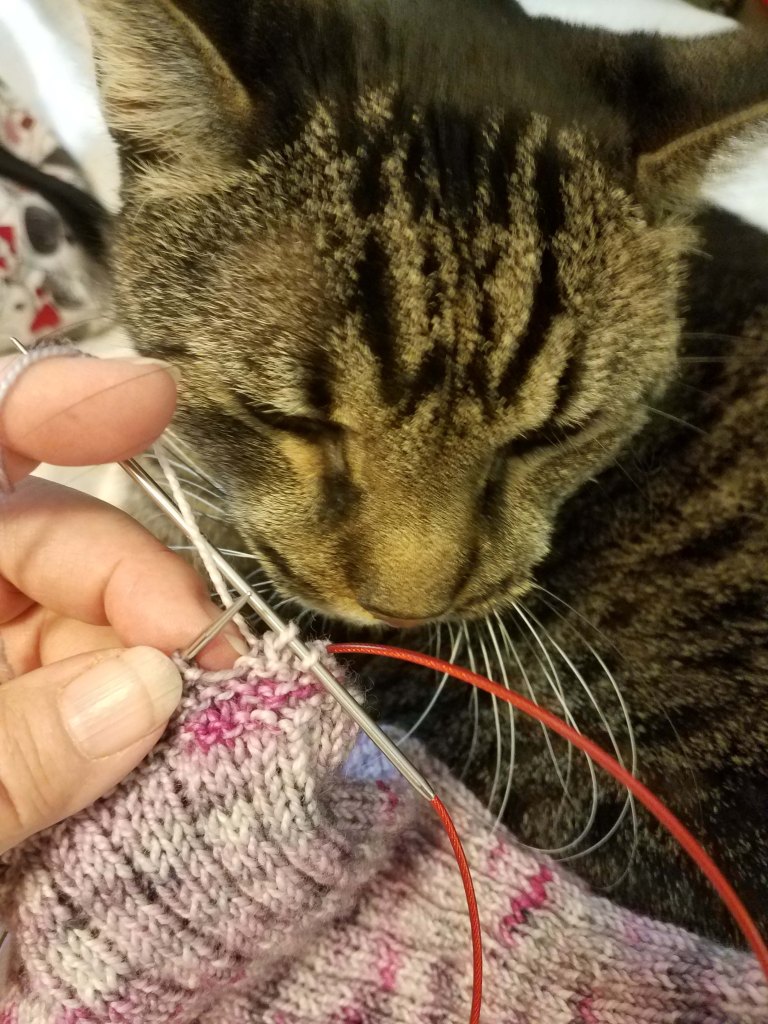
I have been really helping the Mother of Cats with her knitting this week. Look at how carefully I am inspecting this sock that she is working on. We have been listening to an audiobook every evening while she stitches away on the sock, with lots of breaks to give me attention, of course. I think that she would get bored and fall asleep if I didn’t keep standing on her and head butting her work. It is a hard job, but someone needs to do it.
See how much progress she has made? This is what you get when you have an attention-to-detail cat helping you out.
The Mother of Cats is calling this another Mash-Up sock that combines elements of three other socks that she has made in the past. Whatever. Like I would remember details like that?! What I do remember is that I sent her to the store to buy me tuna flavored cookies and she came back with some kind of substandard chicken flavored ones. This is just typical of the Mother of Cats. So thoughtless. I don’t know why I exhaust myself helping her when she doesn’t treat me the way she should…
Especially when I helped her knit this sleeve this week too!!
I can’t believe how exhausting all this knitting supervision has been. Luckily the sweater is now so big the Mother of Cats can’t keep me off of it any longer. Which is pretty nice since I need a nice place to nap after all of this work.
The Mother of Cats needs to share her things more often!!
Last night the Mother of Cats started ANOTHER SWEATER before she was done with this one. Something about the second sleeve syndrome… Whatever. I think that she just wanted to let me nap a little longer. I deserve it after all. Maybe the Mother of Cats does think a little about my needs after all.
I’m such a good boy.
Can I have some cookies now?
>^..^<
Notes from the Mother of Cats:
The sweater is a Koivua by Caitlin Hunter. My project notes are here. I made modifications to the sleeve to make it less bell shaped at the bottom and am pretty happy with how it came out. I put the details into my project notes if you want to see what I did.
Oh, yeah. That sock is a total mashup masterpiece. The top is the edging from the Geology socks. The ribbing is kind of an Emily’s Favorite socks deal, and the garter stitch heel and toe are inspired by the Om Shanti Bed Socks.
Yep. I did cast on another sweater last night. I also had to made a new set of stitch markers to use with it because a) they had to all be different from each other, and, b) they had to coordinate with the sweater. What?! Doesn’t everyone do this? There’s no problem here, people. There is, however, another post brewing…
The book that MacKenzie and I are listening to is A Better Man by Louise Penny. I love these books!!
This post is going to be something of a mess as I’m having trouble distilling all of the issues I’m having with my disease(s) into specific themes. I’ve been pondering and trying to make sense of everything for the last couple of days (while knitting, of course!) and here are the main threads of thought.
When you are chronically ill it is hard to be assertive with medical professionals upon whom you depend.
In a life with constant symptoms and annoyances, when is it time to insist that something must be done to help you?
How should I respond when medical professionals insist that test results prove that the symptoms I’m experiencing aren’t really happening?
But before I start whining about all my woes I would like to offer up this picture of the bee party going on in my garden. I definitely need to plant more of these plants!!
I’d like to set the stage for the little adventure I’ve been on for the last 6 months. Actually, I need to go back farther in my odyssey for this to make any sense. It has been 5 years since I was first diagnosed with systemic sclerosis (scleroderma), Sjogren’s Disease, and fibromyalgia. For the last 3 years I’ve been experiencing painful and burning muscles, joint pain, and swollen bursa. I am just miserable and struggle to walk on some days, and I’ve noticed that I have many other symptoms on these bad days: fatigue, brain fog, edema, eczema, GI woes, hair loss, and shortness of breath. I keep checking to see if I’m running a fever, and I feel so sore and sick it feels like I must be coming down with influenza. I call these surges of symptoms “flares”.
If I break down and take an NSAID (ibuprofen) , a drug I’m forbidden to use as it might damage my kidneys, I can buy myself 2 good days as my flare symptoms fade into the background. Other supplements and medications that I’ve taken also make my symptoms subside, and when I checked they all had anti-inflammatory properties (doxycycline and tart cherry extract, I’m talking to you!). Hmmm… it’s almost like I’m struggling with inflammation, huh.
Because of my observations I’ve been suspecting that I’m in the grips of some type of systemic inflammatory event, and for three years I’ve been consistently reporting to my rheumatologist and others that I’m struggling and that I need help. Mostly I’m told that I have a chronic illness and that there is nothing that can be given to me that will not cause damage to my stomach or kidneys. I’ve cried. I’ve been bounced between doctors. I finally got a referral to physical therapy but I continued to struggle. Mostly I just maintained and accepted my fate, trying to make the best of things. My world closed in as I retreated to my “safe house” to manage my symptoms.
Time for another trip to my garden, don’t you think? One of my mini-roses, attacked by spider mites and reduced to a couple of twigs, has recovered and started blooming this week. It just goes to show, it is not unreasonable to wish for improvement!
In February I tried to raise the pain issue with my rheumatologist again, and she just snapped at me that I was on the best medications available, I didn’t have inflammation because my C-reactive protein was normal, and that I was always complaining, and that maybe she should prescribe me some anti-depressants! Simultaneously outraged and heartbroken, I refused. I got out of there and cried in the car. I clearly needed a new doctor, but I didn’t know of a better one, and I needed more than my own observations to press my case.
Here’s the deal: I used to do medical research on, ironically, scleroderma. I’ve sat through lots and lots of presentations by physicians struggling to treat patients with rheumatic conditions. I know to be skeptical of cookie-cutter treatment plans, and to always follow the data wherever it takes you, even if it seems to be unreasonable at first. I know to remember that even if 90% of patients respond to specific medications and treatment plans, there are still the others who need something different.
Struggling to walk, in pain, and short of sleep, I made appointments with other doctors in my care team. I also began to collect data to support my inflammation hypothesis. I also began to hunt for another rheumatologist.
My physical therapist told me my joints were too swollen for me to go to the gym. Or to do yoga. Maybe I could do a stationary bike… carefully.
The dermatologist, shocked by my swollen face, immediately prescribed an anti-inflammatory ointment and doxycycline, an antibiotic with anti-inflammatory properties. Wow! Big improvement. Better than ibuprofen!
My internist stepped in and prescribed inhaled steroids and another anti-inflammatory gel to put on my hip. Wow, wow, wow!!! Huge improvement. I can breathe again!! Brain fog went out the door, energy came up, and I had less joint and muscle pain. My hair started to grow back in and my stomach pain stopped. This was just darn thrilling, people!
This week an orthopedic hip specialist that my internist referred me to told me that I have IT band syndrome and bursitis. I now need to double down on the anti-inflammatory gel, there is more physical therapy in my future, and injections of steroids into that hip bursa will happen if my immune system, already suppressed, can handle it. Because I’m on high risk medications to crush my immune system into submission these things have to go slowly, but the process is now in motion.
I don’t know about you, but it sure seems crystal clear that I’m dealing with inflammation, right? Imagine my shock (NOT) to read a research study last night that showed that C-reactive protein, the inflammatory marker that my rheumatologist uses to assess my disease, does not become elevated in scleroderma’s fibrotic process. You know, the process that made my IT band become so thickened and inflamed that it is clearly visible on my x-rays and responsible for causing my bursitis. “We can’t be sure that scleroderma caused this,” said the orthopedic specialist. “Well, I’m pretty sure I didn’t get this from knitting,” I snarkily replied. We also discussed if I might have bursitis on the inside of my hip joint. “Well, that would be unusual,” he said. “Please, you’re talking to someone with a rare disease,” I replied. He acknowledged the point. This is how normal doctors talk with to their patients.
Shame on my rheumatologist who doesn’t let me talk to her, who used inappropriate data to dismiss my symptoms, and then finally disparaged me as I pressed for acknowledgement and help. I don’t know if an earlier intervention could have saved me from bursitis and scarred tendons, but now I have a clearly established track record that documents inflammation and I feel empowered to move on to another doctor. I talked to some patients active in our local Scleroderma Foundation chapter, and I have the name of a rheumatologist who is treating several other patients with my battery of conditions.
Which takes me back to my original points that I have been pondering for weeks:
When you are chronically ill it is hard to be assertive with medical professionals upon whom you depend. Yes, it is. I forgive myself for crying in the car. I was blindsided and ill-prepared to argue with a specialist who deliberately places patients on the defensive to fend off requests for help. Who could have imagined such a thing? I now recognize that this is a defensive tactic by the physician, it is inappropriate, and I will no longer tolerate it. She took advantage of my dependence upon her to victimize me. If her test results do not account for my observed symptoms, then we need other tests and different thinking. That’s what I learned as a scientist, it is valid, and I will stick to my guns if this happens again. But not with this doctor: I’m moving on!
In a life with constant symptoms and annoyances, when is it time to insist that something must be done to help you? Sadly, things are not rosy when living with a chronic disease that has no direct treatment and piecemeal strategies for symptoms. When you can no longer tolerate the life you are living it is time to speak up!!
How should I respond when medical professionals insist that test results prove that the symptoms I’m experiencing aren’t really happening? Well, that is poppycock, right? If you are vomiting blood, so to speak, it doesn’t matter what their little image is showing them on the computer! I responded by going to other members of my medical team and securing medical interventions from them (and thereby building a cascade of supporting evidence), getting full copies of all my test results, doing a literature search on the drugs and tests the rheumatologist was relying on, and activating my network to get the name of a doctor more appropriate for my medical circumstances.
Another rose break.
Today I am 5 days into the increased dose of anti-inflammatory gel to get my bursitis under control and I’ve started my physical therapy again. I am better: I actually lifted my leg to get into the car without assistance! Once again I need to wait a few weeks/months to make sure my kidneys and cell counts are stable before adding another drug like a cortisone injection into that bad-boy hip bursa, but I am making progress and am comfortable with what is happening now.
Believe it or not, after all of this I still don’t have a title for this post. Ugh. What was this about?
Refusing to be a victim!
Manipulating the health care system for fun and (pain-reducing) profit?
Fighting for your mojo when no one else can?
That’s it. Fighting for my mojo. Because, at the end of the day, that’s what I did, and my mojo is back!!
Days are good, my hip is starting to feel better (but I’m still taking it easy), and the cat has calmed down. Okay, I had to give him several of my little knitted projects to sleep on, but the cat trap worked and I’m knitting in peace.
Socks and some knitted mitts make an effective cat trap as it turns out.
With two evenings of peaceful knitting I’ve made a lot of progress on the Koivua sweater that I’m knitting. Check it out!
Now that I’m working my way down a sleeve I’m starting to get excited about the sweater!! My project notes are here.
I did an additional repeat of the knit/purl textured section at the bottom of the sweater and then decided to do corrugated ribbing and an I-cord bind off instead of the all white ribbing that the pattern called for. The ribbing at the top of the sweater really pulled in, and I decided that I didn’t want that going on in my sweater since the patterned section is going to try to balloon out and misbehave as it is. Hopefully the corrugated ribbing will tame things once I’m wearing this baby.
I’m now tacking some sleeve modifications as I’m not sure that I want them to bell out as much as the pattern has. Stay tuned for more pattern trickery!
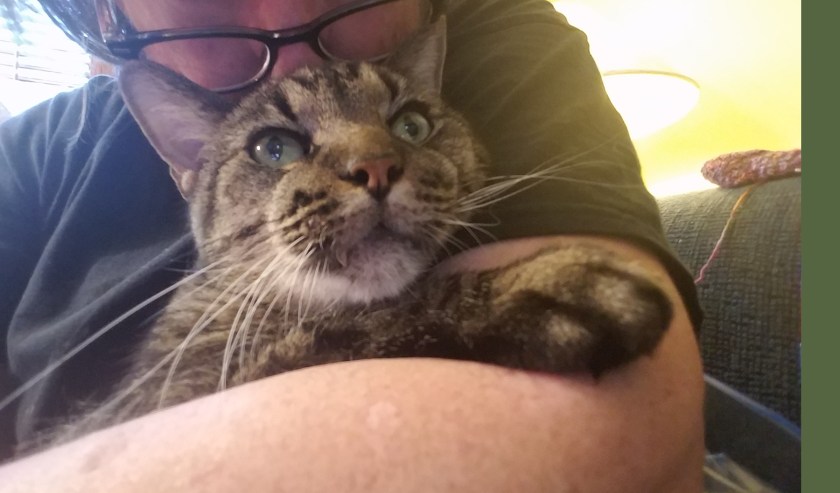
My hip is in full rebellion these days and I am spending a lot of time off my feet trying heal up. For reasons beyond my understanding MacKenzie views this as an invitation to make constant demands: Pet me! Feed me!! More cookies! Let me go outside!! I must be on your lap!! You exist to serve me!!!!!
He stands next to me as I knit crying sadly, trying to move onto my lap and into the yarn and knitting. It is sad. So sad. Right up to the point when the yarn chomping starts and the claws start flashing. Sigh.
There is nothing for it but to put the knitting aside, gather the cat up onto my lap and deliver unto him all the hugs and attention that he is craving. Then some cookies!
Caught between a ill behaved hip and a demanding cat I have abandoned the sweater that I’ve been working on and switched to small projects that are easy to move away from chomping teeth and flashing claws. Projects that can be worked on in bed, outside in the garden swing, and downstairs by the television. Projects that can be easily moved to safety or stuffed into a project bag.
Ta-daa! I finished these cashmere blend yummy socks to wear while lounging around and in bed. These socks are knit a little loosely and sport garter stitch heels and toes, so they aren’t suitable for daily wear, but they sure are perfect for my cold feet while babying my ill behaved hip, and were easy to complete while evading a cat.The socks were knit from the toe up and have cleverly shaped garter stitch heels and toes. I added the garter band to the top of the sock before putting on a K1P1 ribbing at the top. Please ignore the little gap there in the ribbing… I took the picture before the final finishing as I was losing the light. Here are my Ravelry notes. The sock pattern is Om Shanti Bed Socks by Alice Yu and the yarn is Serenity 20 from Zen Yarn Garden in the colorway “Burning Bush.”my Washing Stones socks.
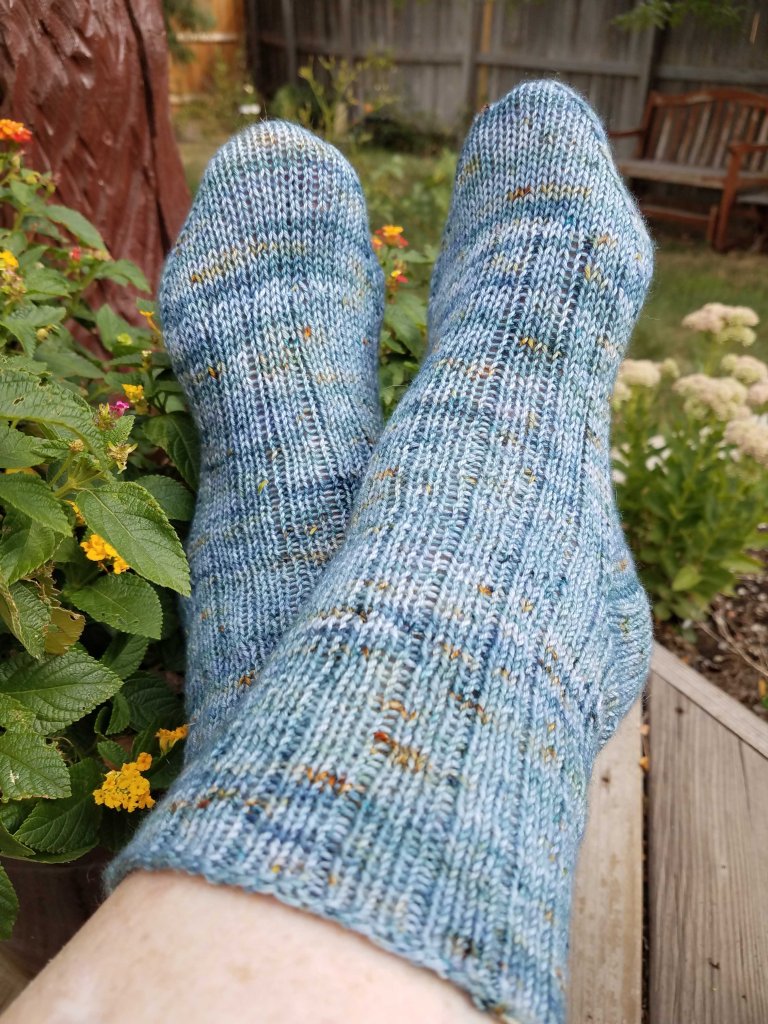
Do you remember the light blue ribbed socks that I made a couple of weeks ago? They were just simply ribbed socks based on my rote 64 stitch vanilla sock that is basically the Dave sock by Rachel Coopey with a different rib that I liked when I knitted the No. 5 Union Street socks and then saw again in the Emily’s Favorite Socks pattern in the book “Knits About Winter.” Hey, when you are immobilized by a cranky hip and hounded by a demanding cat, you start to just invent new combinations of socks, right? In this circumstance it is just frankly impossible to have any charts or patterns involved in the knitting, so it is “have some fun” time. Anyway, there was some yarn left over from the socks, so I kept knitting…
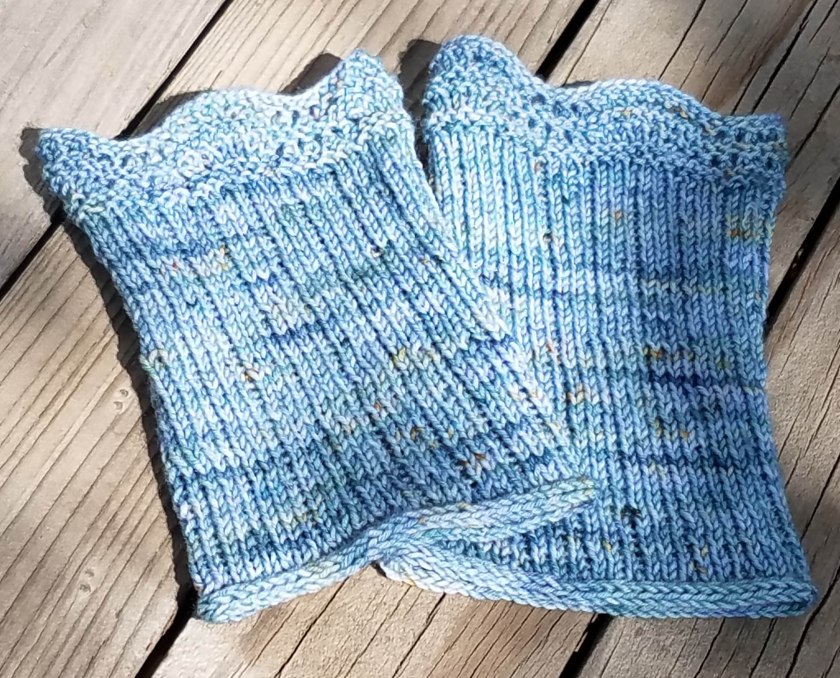
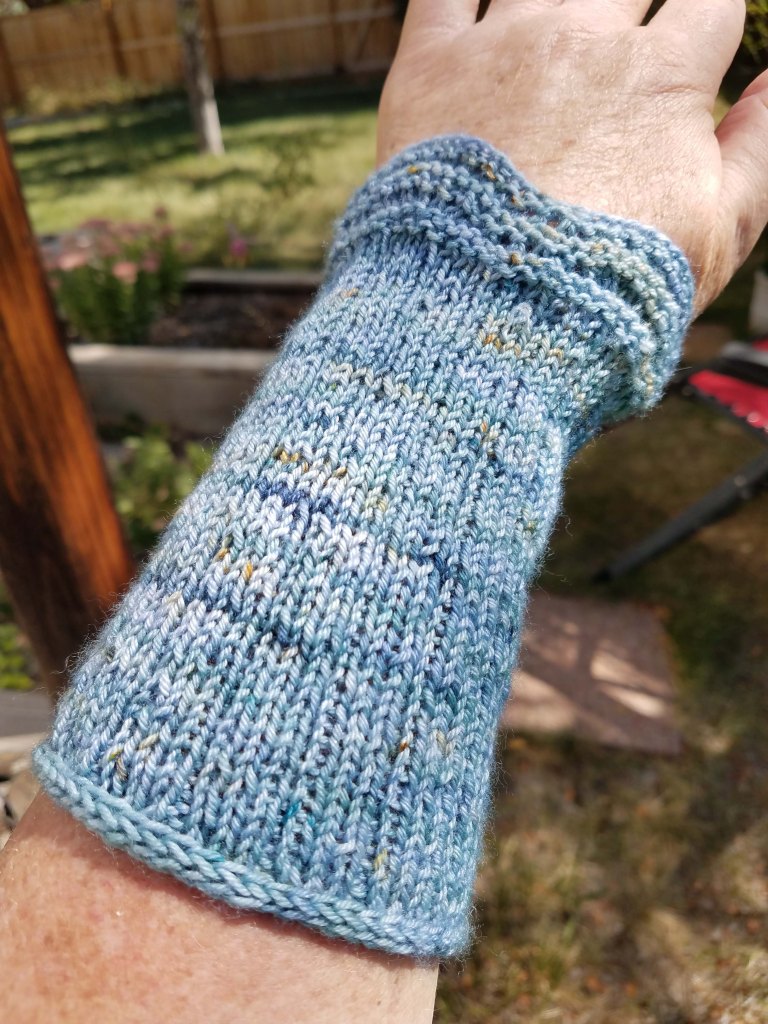
And these simple wristers (short arm warmers) just fell off my needles.
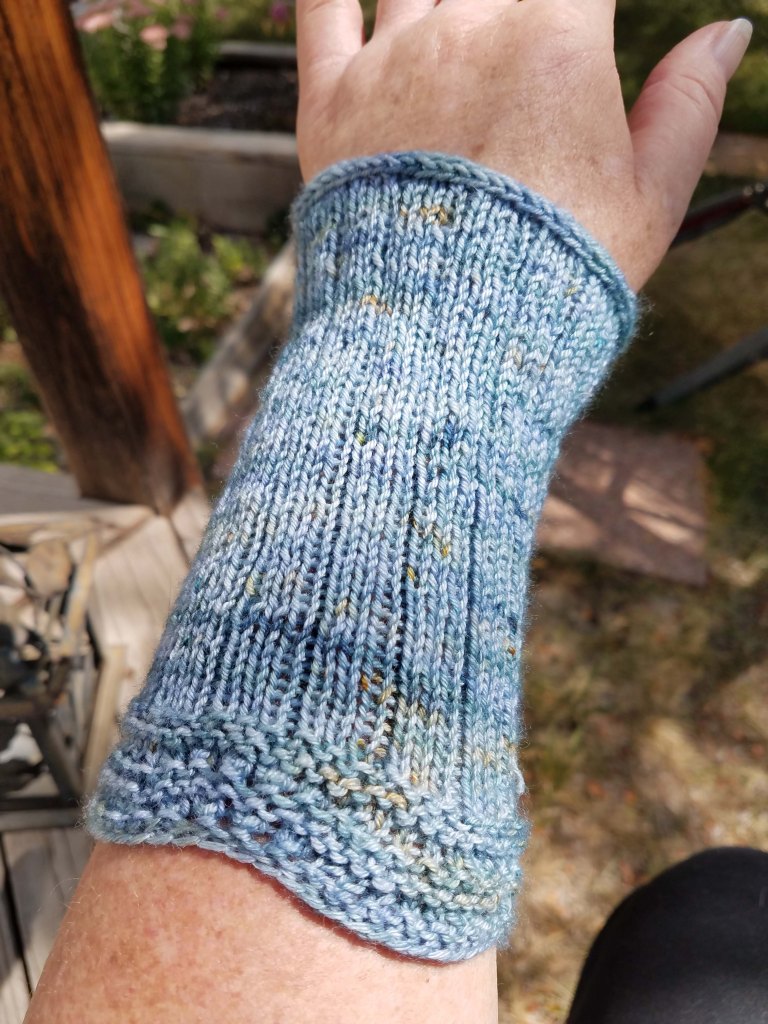
To make the wristers I just kept expanding on my theme of stealing design ideas from other projects and smashing them together to make something that works for me. I had made some Geology Socks recently, and the top edging was a nice use of the feather and fan pattern, so I re-used it for the top of these warmers. Then I knitted the body of the wrister using the K3P1 ribbing and finished off with an I-cord BO.
I kind of like to wear these with the I-cord edging down by my hand.But I think that they look pretty good with the lace at the wrist also.
These wristers will work well this winter under sweaters and over long sleeved shirts in my usual struggle to keep my fingers warm, but I’m wearing them alone right now whenever I get exposed to air conditioning. Pleased with my sock pattern inventiveness I cast on another sock last night…
There is that lacy edging again!
This is another mash-up of ideas and patterns that grew from my earlier projects. This yarn, Fancy Monkey sock, is another cashmere blend for my cold feet. The edging is the same one used for the wristers, but I’m making K3P1 ribbed socks again once I’m past the edging. I’m debating putting on garter stitch heels and toes like the Om Shanti socks. It will be fun! It’s a knitting adventure, I tell MacKenzie.
Who has been watching me steadily from the foot of the bed, waiting for an opening to move onto my lap, computer or no computer. He resents the computer even more then the knitting. Let’s not even start talk about books and reading…
Isn’t it cute that MacKenzie still likes his mouse? The tail has been chomped off at this point, but he still likes to bat it around.
Hopefully my hip will start behaving better in a few days, MacKenzie will become less needy, and I will be able to get back to the Kouvia sweater. I’m getting adventurous with that project, too. I can’t wait to blog about the sweater, and I’m working myself up to a couple of hip/scleroderma posts as I’ve been racking up adventures in that part of my life also.
The heat here in Colorado has been unbelievable: we hit 100°F on Monday and it is still hot. My garden, however, is recovering in the lower light intensity and flowers are starting to bloom again. Feeling pretty good about things I’ve taken to knitting outside in the garden again in the cool of the mornings and late evening.
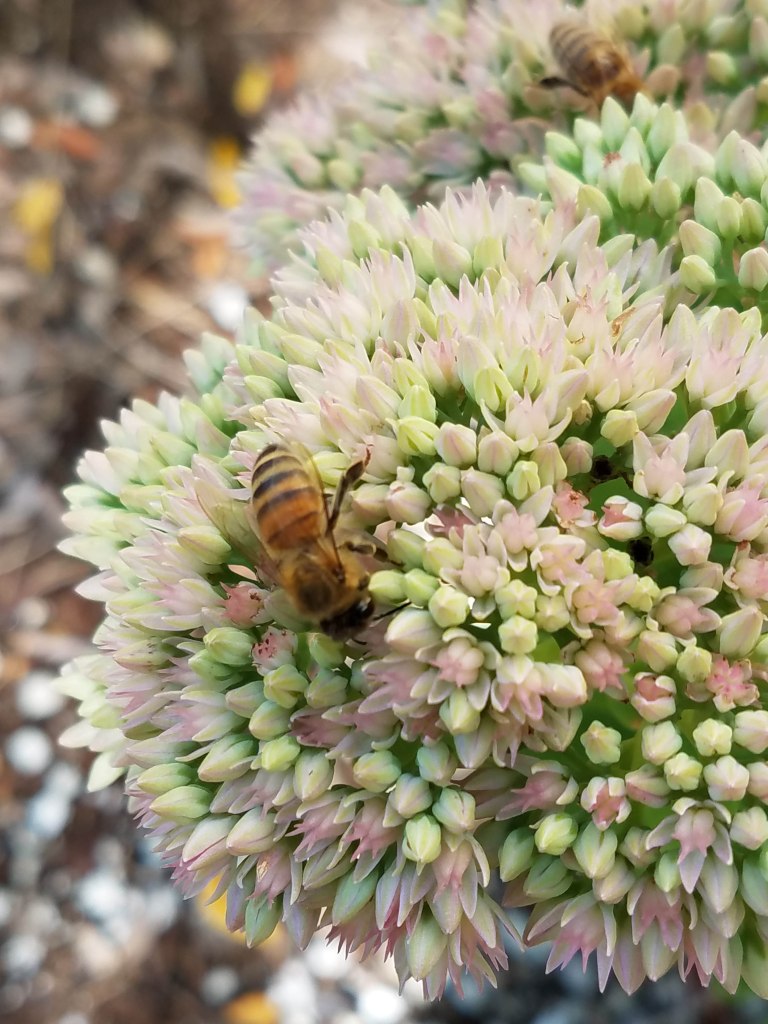
Knitting outside can be entertaining again. My sedum is blooming now and the garden where they are planted is abuzz with a steady parade of bees. This sedum is called “Autumn Joy Stonecrop” and I’m really impressed with the blooms. So are the bees, evidently!
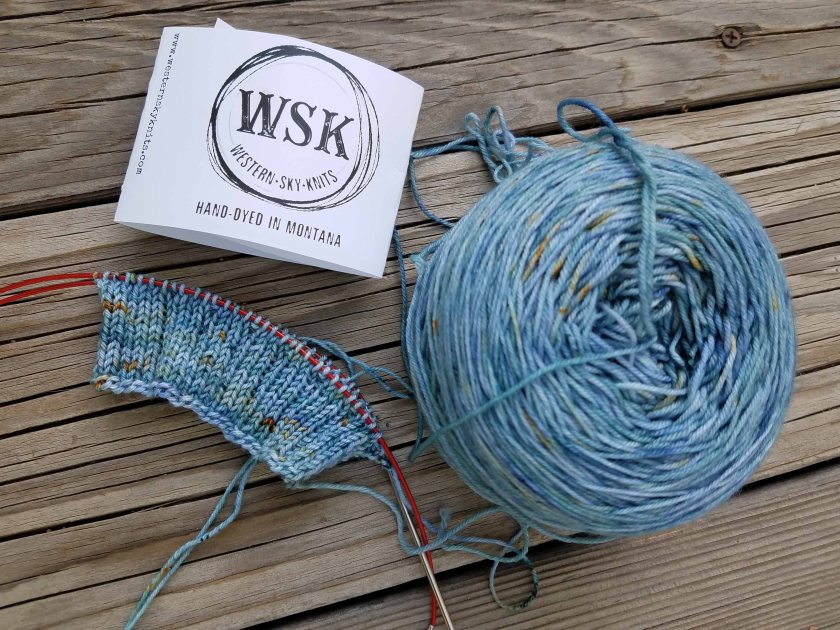
Today while knitting and sipping my morning latte I got my latest pair of socks done.
Easiest knitting ever! I made these socks in a simple K3P1 ribbing that makes then fit well while providing mindless easy knitting in the evenings while listening to audiobooks. My project notes are here.
The yarn I used is from Western Sky Knits and I’m really becoming a fan of this smooth sock yarn. I still have enough yarn left over for some arm warmers. I think that I’ll put an interesting lace edge on then and use some Icord, but keep that simple ribbing. Adventures in knitting, people!
Here’s the book that I’ve been listening to while knitting.
My latest audiobook has been wonderful! Seriously, I knit way too long into the night because I had to get to the next chapter to discover what would happen next. It’s a book about family, ghosts, dreams, invisible ties, and, of course, a tiger that isn’t all it appears to be. The audio is done by the author and that made things even better. I loved it.
My potted roses are all doing well after recovering from spider mite attacks early in the summer. This pink bloom makes me especially happy. I’m still debating whether I will plant these roses into the ground or bring them inside for the winter again. There’s lots of time, right?
I do love the colors of fall, but right now I’m really enjoying the bits of pink going on in my life. There is pink in my garden right now…
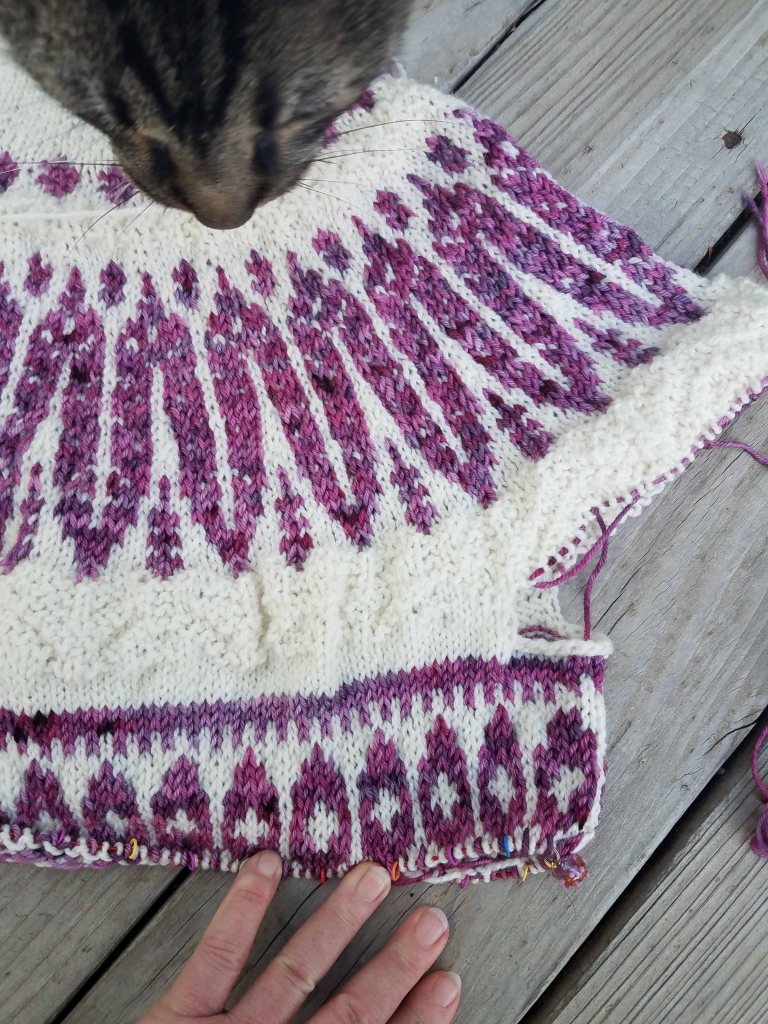
All of the flowers in pots on my deck have recovered and are putting out blooms. These, I think, are verbena.I’m knitting with pink yarn using my favorite pink stitich marker.And the sweater being knit in the pink (and cream) yarns is finally far enough along to get checked for size. A few more inches, don’t you think? Heavens, this sweater sure needs to be blocked, doesn’t it, but I’m really pleased that it looks like it will fit okay. This is Koivua by Caitin Hunter, and my project notes are here.
Today is the last day of high heat for awhile; a front is pushing in and tomorrow will be much cooler. Okay, it will be hot, but not blazing hot. Hopefully there will also be some rain. There’s lots of time yet for roses, knitting in the garden, and days watching bees.
Oops. A flock of geese just flew over my house at the treetops, honking like crazy. It’s like they are laughing at me. No matter what is happening right now with the weather and in my garden, autumn is coming, and the first snow is on the way.
The Mother of Knits and I have been working really hard lately and we have been making progress on her projects.
She whipped up a simple pair of socks with this yarn that she really likes: Concrete Sunset sock yarn dyed by Western Sky Knits. Her project notes are here.I’ve been closely supervising her work on the Koivua sweater all week. This is starting to look pretty good, huh. Will the Mother of Cats let me sleep on this stunning and fluffy new cat bed? No. She will not. I keep trying to explain it to her, but she is so self absorbed! Always, it is about her needs and she never leaves it out for me to nap on.
This week the Mother of Cats realized that she had NOTHING to knit in bed while listening to audiobooks. There was a panicky search of the yarn stash (woohoo! I love helping the Mother of Cats in the stash room!) and a search for patterns on the computer and in her pattern notebooks. I helped her look for patterns by plopping my body down on all of the ones that I thought looked good. Why does the Mother of Cats get so emotional while I’m helping her? I only scratched her a little bit while scrabbling through the papers… Anyway, after finding the yarns and patterns we were ready to wind the yarn and get going on casting on lots of new knitting fun. I love winding yarn!!! The Mother of Cats needs to do things like this that I like more often. She can be so boring sometimes…
We picked these two yarns to make a Mount Moran Lace Cowl. I can’t wait to make this!The Mother of Cats’ feet get cold all the time now. We decided that this yarn would be perfect to make her some yummy cashmere bed socks. Oh. Now that I look at this again it would also be good to make another Mount Moran Lace Cowl. Hmmm… maybe we need to go look through the stash for some more yarn for socks. Woohoo! More play time!!The Mother of Cats and I decided to make another Suburban Wrap by Joji Locatelli with this yarn. I can’t wait to get started on this one!But the project that got started right away was another simple pair of socks that can be knitted while listening to audiobooks in bed in the evenings. I always sleep on the Mother of Cats legs and help her keep track of her rows while she works. It is my favorite time of the day/night.
Do you notice that any of these projects are for me? No, you DO NOT!! Not one of these projects is for me after all that work I did to help her find patterns and yarn. There is no mouse here! Where is the new cat bed or kitty blanket? Why is the Mother of Cats so very, very selfish!!
Okay, I’m calm again. I do love knitting with the Mother of Cats. Okay, it isn’t as good as going outside to play in the yard, but she does remember to pay attention to me in the evenings. I get my favorite cat food for dinner, she pets me while we knit, I usually get to chomp yarn, Little Miss Pitty Pat comes out to play and eat her dinner, and I get to sleep on the down comforter on the bed. Life is okay with the Mother of Cats.
Why does she do these HORRIBLE THINGS to me?
That’s right. Today she crammed me into the pet carrier and took me to the vet’s office for SHOTS!!! The horror. The betrayal. There were dogs there!!!! Why does the Mother of Cats do these things to me? She did give me some kitty cookies when I got back, but it was just AWFUL!!!
I have been sleeping since getting back from the horrible adventure this afternoon, but I’m going to get up in a few minutes to demand that I have another yummy serving of cat food and then a trip outside to play with the bugs and squirrels. She owes me! Then it will be knitting time and I’ll be chomping yarn overtime because… she owes me!!
I’m such a good boy!
Can I have some cookies now?
>^..^<
Notes from the Mother of Cats: I’ve got nothing, MacKenzie said it all! Let’s hope he stays sleepy from his vaccinations so I can cast on a couple of new projects this evening because this yarn is too stupendous to ignore. 🙂
What a wonderful week it has been. I’ve been out in the yard for a couple of hours every day with MacKenzie and a book or my knitting. The buzz of cicadas echo in the trees over my head, the squirrels frolic along the fence, and the flowers are starting to bloom again after the blazing heat of July. Life is good, I’ve raced through two books and last week started a couple of new knitting projects that are keeping my interest and making me happy. Let me show off my current knitting love, Koivua.
How beautiful is this!! I’ve just separated the arms from the body of the sweater and it is time for me to attach the rose yarn again to start the next colorwork chart for the body. Here are my project notes if you want more info about the yarns. The flowering plant is lantana, and it just burst back into bloom this week. This is what happens when you give plants some Miracle Gro… I’m wondering if this plant will survive the winter if I plant it at the end of the season. It will be a plant experiment!Sturgill sweater.Original yarn choices… NOPE!
I had some issues with the planning of this sweater. The pink is left over from this sweater that I knitted last winter, Sturgill by Caitlin Hunter. I really liked the contrast of the rose variegated yarn with the grey, so I ran right out and bought some grey tweed yarn to use with my leftover rose yarn to make a Koivua. Good plan, right? Then I thought about things a little more. Looking at my Sturgill you can see that the variegated nature of the two yarns made it hard to see the colorwork pattern in the sweater. I liked that effect in Sturgill, but maybe I shouldn’t make another sweater that had the same fuzzy pattern effect going on with the same colorways. I snuck out to the yarn store and bought some yarn that would give me more contrast with the variegated rose yarn. I was on the hunt for a nice neutral cream yarn.
Bingo! Look at what I found at the yarn store that opened just a few miles away from me. This Kelbourne Scout is a new yarn for me, but this won’t be the last time I buy it! It isn’t superwash, but it is really bouncy and soft. Just what I needed to show off the pattern.
Buying 5 skeins of yarn puts me back a little on my yarn destash project, so I need to really start knitting fast now. I casted right on and after a couple of days I had this:
The cream yarn knitted up wonderfully: it is bouncy, has a slight halo, and shows off the pattern well. I’m happier than ever about the yarn color switch as this cream really brightens up the rose yarn.
I’m much happier with the cream colored yarn than I thought I would be. I tend to avoid light colors in yarns, but this time it was the right decision as the colors in the rose yarn are just shining. The yarn is such a joy to handle I’ve been working outside in my garden swing in the late mornings with little gardening breaks.
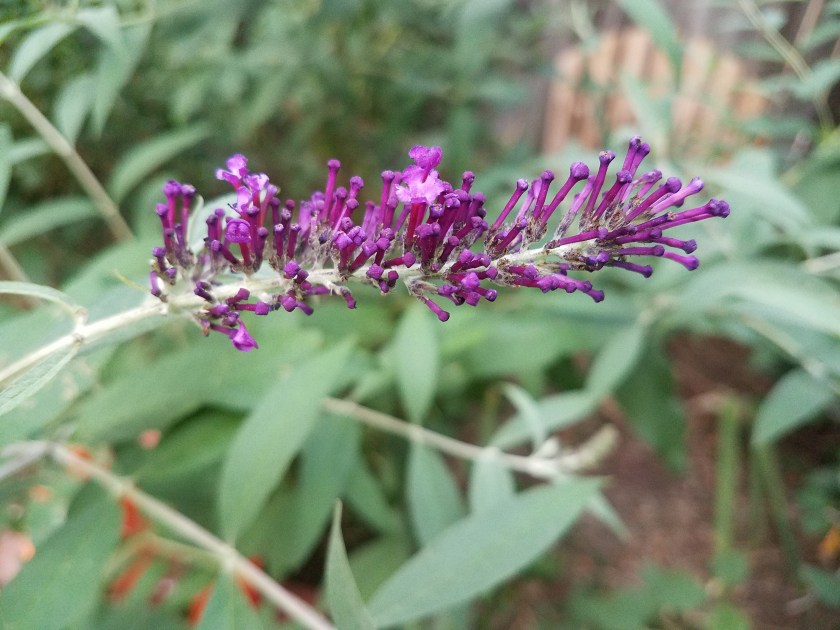
My butterfly bush is finally getting its act together and producing some blooms. Okay, I had to baby it a little bit; I sprayed all the baby blooms with Neem oil to protect them from insects and then started deep soaking the bush a couple times a week using a big bucket and a drip line. Success! Doesn’t this bloom remind you of the yarn in my new sweater? I probably should give this bush some Miracle Gro too.
I am on fire to get the sweater done by the end of the month, but that probably won’t happen since I need to keep on babying my wrists (which are much better), and life keeps on getting in the way. Still, I am hopeful that the next report on my destash project will be a good one. 50 skeins… I can do it… must stay out of the yarn stores…
It feels like the height of summer with the flowers and the buzz of insects, but there are a lot of crickets and some of the leaves on the trees are starting to turn yellow. The kids in the neighborhood have all returned to school, and it is only a few weeks away from the colors of fall. Yep. Must knit faster!!
Update on the Suburban Wrap:
The wrap arrived safely in California earlier this week and it has already gone to school!
My knitworthy niece is a music teacher, and the wrap traveled to school with her as she met her students this week.Where it also looks pretty good on my grandniece, who is a student at the school where my niece teaches. How fitting that this wrap should be in a classroom devoted to artistic expression and worn by such knitworthies!
I have finally finished the Suburban Wrap for my totally Knitworthy niece and popped it into the mail today. Check out this piece of wonderfulness!
I am so happy with the looks and drape of this wrap. Do you remember the Knitworthy niece? Here she is flashing the fabulous mitts that I made her last winter. Yep, that it winter in California in the background there. Green grass… how odd! We won’t even talk about that tree trunk next to her!
My niece saw the Suburban Wrap by Joji Locatelli on her facebook feed, shared the post with me, and the rest was history. As soon as I saw it I knew that this was a knit that was calling my name. I dug in the stash, sent her some yarn choices, and after finishing up some works in progress I cast on and got to work several weeks ago.
My niece loves color (did you notice her hair?), and as soon as I showed her this yarn combo it was the one. All of these yarns were already in the stash… win!
This project was just one chunk of fun knitting after another. So much fun, in fact, that I got into a little tendonitis trouble because I knit too long at a time as I raced along to get to the next color section. Lace. Stripes. Textured knitting. An interesting shape and rows that were a manageable stitch count. In other words, everything that a knitter’s heart could want. My project notes on Ravelry are here.
This afternoon I popped the wrap into a box and mailed it off to California where I hope it will be useful in the cool evenings to come. It made my heart happy to send it off. I can’t wait to hear that it has arrived safely.
Then I hit the yarn stash hunting for some yarn, in more sedate colors, to make one for myself.
A few weeks ago I went to see my primary care physician for help with shortness of breath and joint pain. I totally scored! I walked out of there with a tetanus shot (fail), inhaled steroids to control my small airway disease (win) and an anti-inflammatory gel to put on my swollen, painful joints (huge win). What a difference to my life these new medications have made. I can breath! I can walk without pain! I can sleep through the night! This is huge, people. Take that Sjogren’s and scleroderma! Feeling so much better I began to spend more hours up and about, and there was a lot more knitting happening too.
I got some socks finished right up. Here are my project notes.I made a lot of progress on my Suburban wrap and was lured into knitting more than usual because I just had to get into the next section of the wrap. This is such a fun project with lots of color, texture and lace interest. So addictive. So hard to walk away from…
Oops. Then this happened.
Tendonitis!
One of the problems of getting better is that swelling is going down and the tissue is tightening up on some of my joints. My knees are really tight. My wrists are stiff. When I knit my joints loosen, so I thought I was helping them stay flexible. That is probably true to a certain point, but I guess I now need to be careful to not overdo things. Sigh. I am using the tendons in my left hand the most since I knit continental, and I push the yarn over the needle with my middle finger for each purl stitch. I’m really fast that way, but my tendons have totally rebelled in my left hand and wrist. To make things worse I can’t take NSAIDS or any other anti-inflammatory drug because of my scleroderma-battered kidneys and stomach. Sigh. My doctor ordered a knitting hiatus.
I want to be a compliant patient, really I do. I read a couple of books, managed to get through a couple of days without knitting, and then I snapped. I must knit!! Want knit now!! Knit, knit, knit. Why go on if I can’t knit? Sniff. Obviously this is totally unacceptable and I am going to figure out how to knit in spite of this bad boy wrist. Really, my left hand is the one having trouble, so maybe I can work around that. I tried to tension the yarn in lots of creative ways before I remembered that lots of people on the planet hold the yarn in their right hands. English knitting. I have never mastered purling English style, but now I’m really motivated!
I was in the last striped section of the wrap when disaster struck; stockinette means I have to purl back every other row. I managed to continental knit with the brace on (okay, it is a little loose) and am moving my left hand very little by working slowly and relying on my right hand.Working very slowly I am also managing to purl back English style. So slow. So awkward. So much safer for babying rebellious tentons.
Last night I finished the stripes and am ready to enter the last section of garter eyelet. Yay. Knit all the way! I can do this! Then it is into the last, ribbed section of the wrap.
Ribbing. That is going to be slow going. I think that I will check out Norwegian purling. Somehow I need to do this without moving my fingers too much. Yay. A new stitch to learn.
I’m on it!
Take that, scleroderma. You are messing with the wrong knitter!!






















 Yarn, Books & Roses