The Scleroderma Chronicles: Thoughts on the Night of the Strawberry Moon

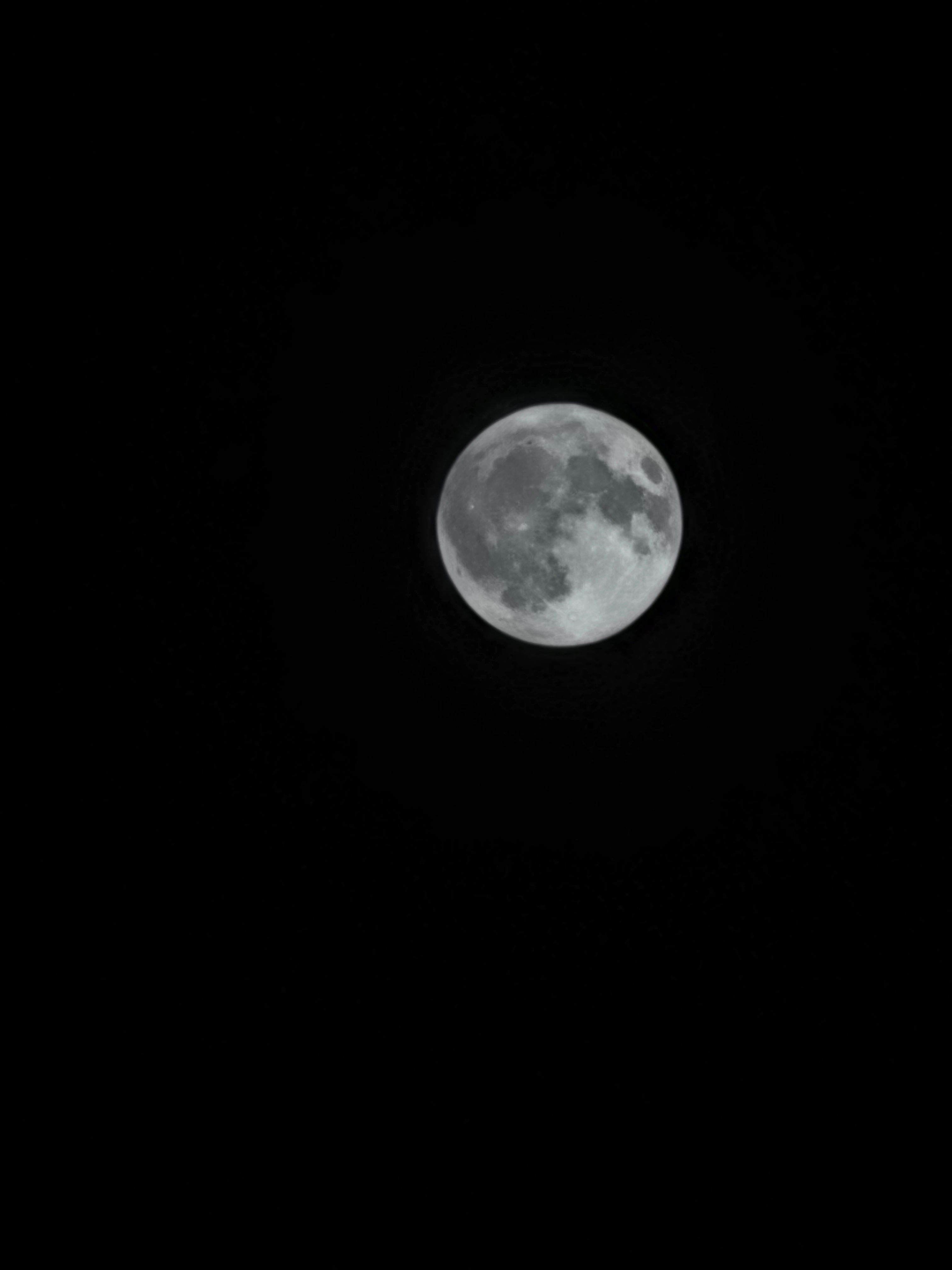
There it is, the Strawberry Moon. I snapped this shot around midnight last night while the kitties chased moths on the catio.

It’s June. I can hardly believe it. June is Scleroderma Awareness Month. June is the month of thunderstorms and tornado watches. June is the month of the miller moth migration (Mateo’s favorite time of year!) June is the month that Hannah came home to live with me. June is the month, year after year, that my scleroderma begins to improve after a long, cold winter. This year June has been just great! After a very rainy May hot, sunny weather finally arrived this week and the yard began to burst into bloom. First, let me show you the weather…
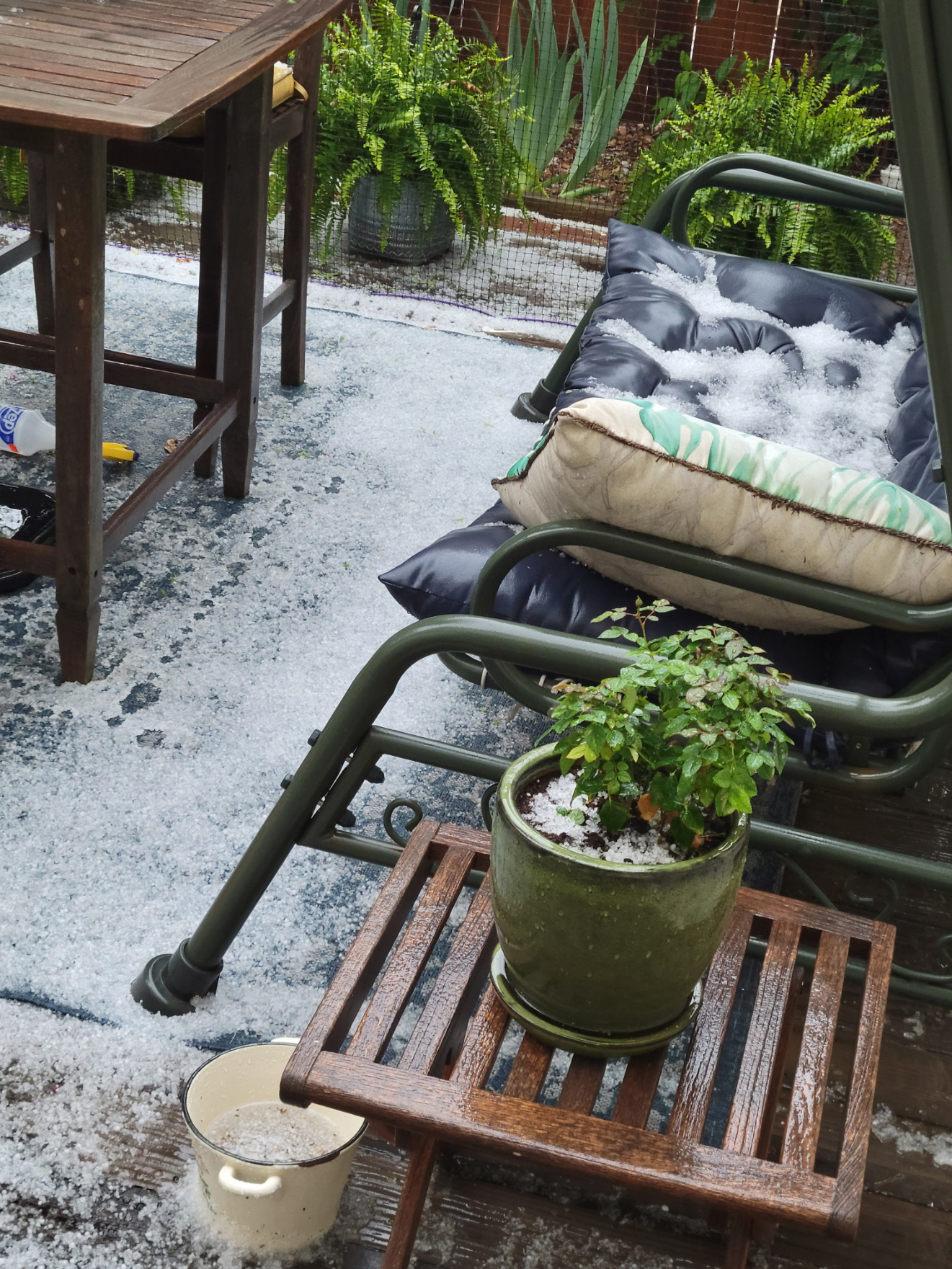
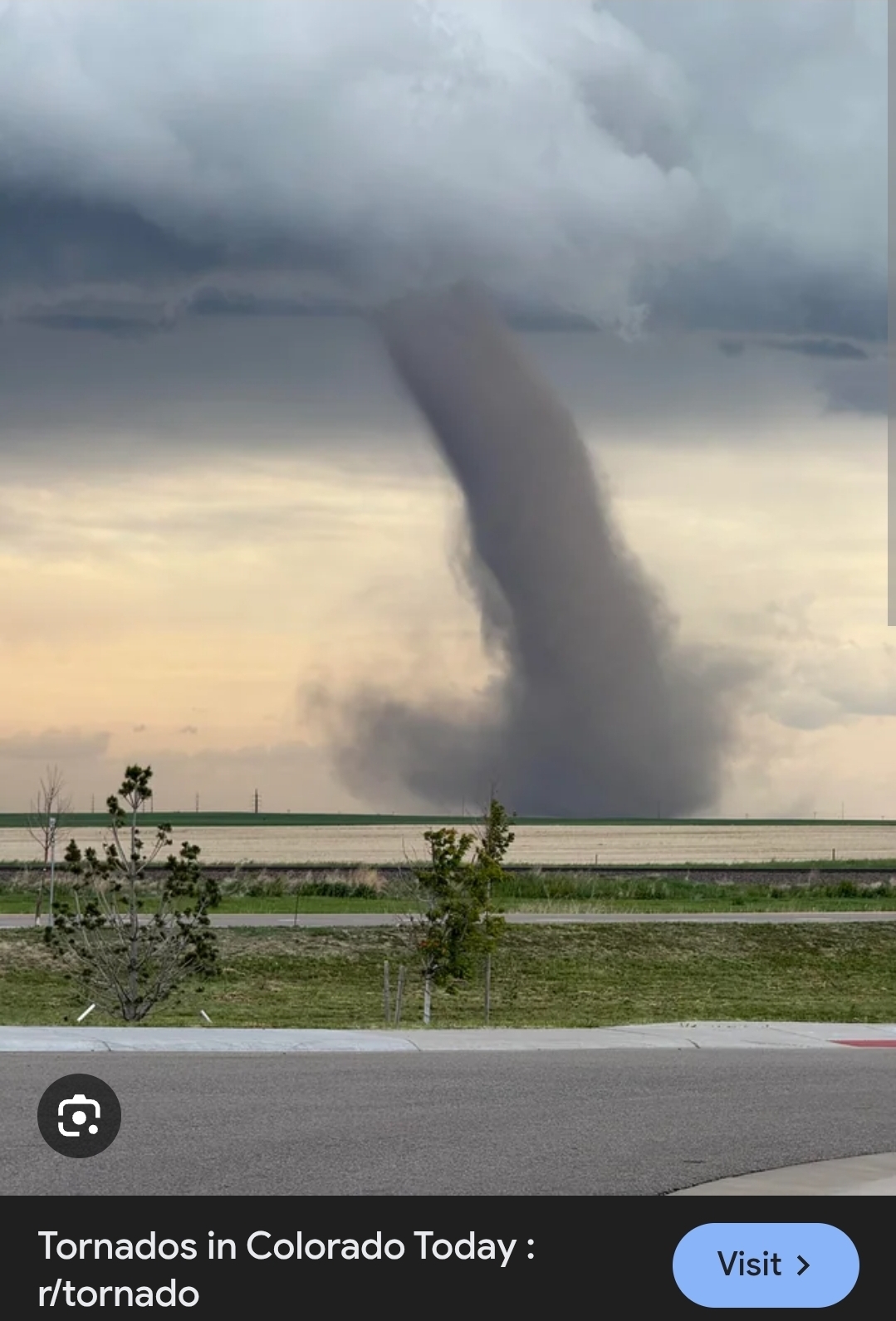
Crazy weather May!! That is hail on the catio, all of that rain appeared in my pot on the deck (you can see it in the first picture… the pot was partially covered by the table above it…) in just 48 hours, and then there was an exciting outbreak of tornados just east of me. Whew! In the breaks between the storms I managed to give the lawns their first mowing of the year, and I made great progress pulling weeds out of all of my gardens. I kept thinking of a saying someone said to me recently as I worked in the yard and gardens: How do you eat an elephant? One bite at a time. How do you clear a weedy wilderness? One clump of grass at a time.
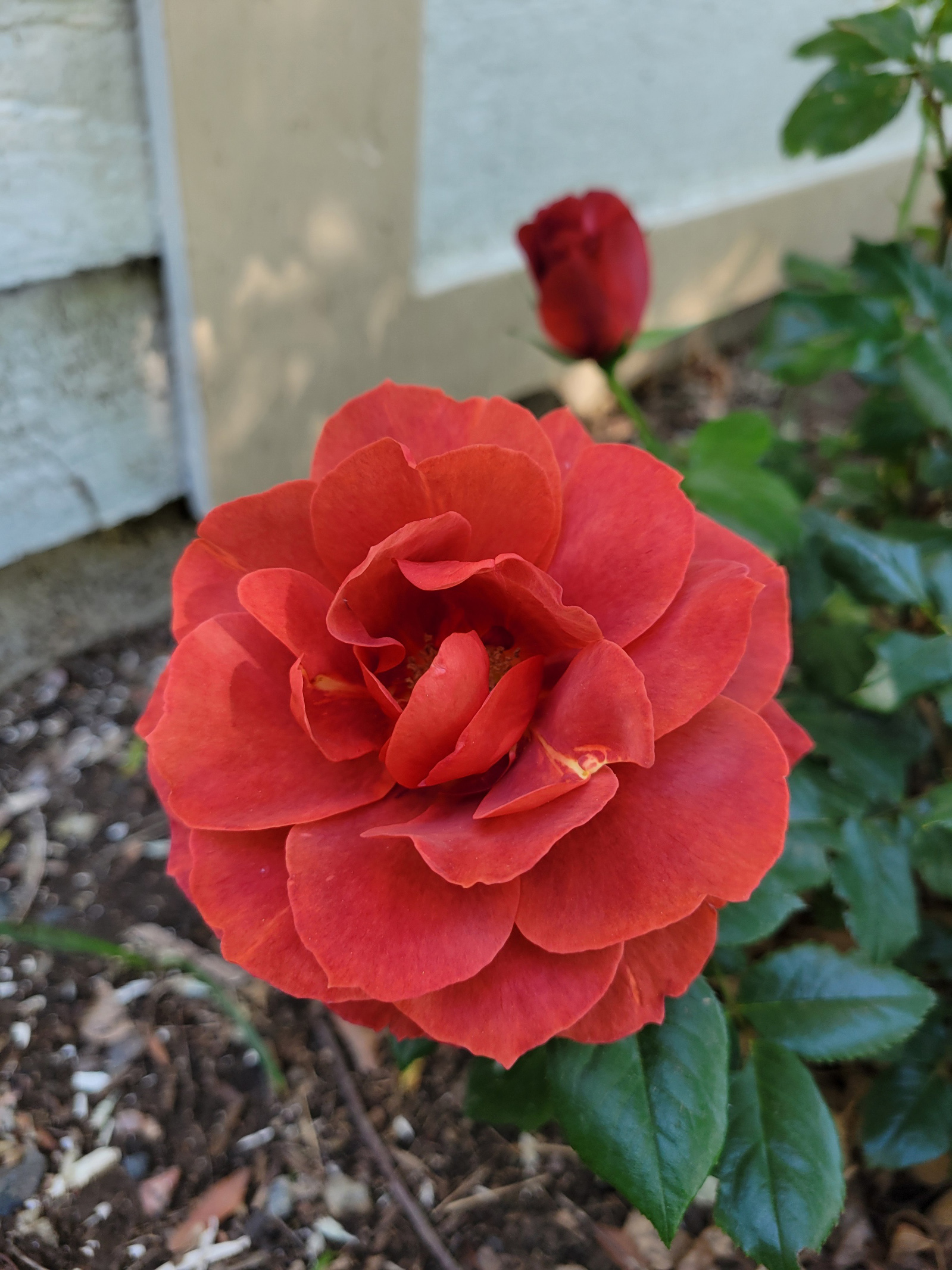
Look at how great the yard is starting to look! The grass is growing like crazy after the deep soaks, and there is lots of wildlife. I managed to get the catio all finished, and the cats and I are outside every day now enjoying the show and soaking up some sun.

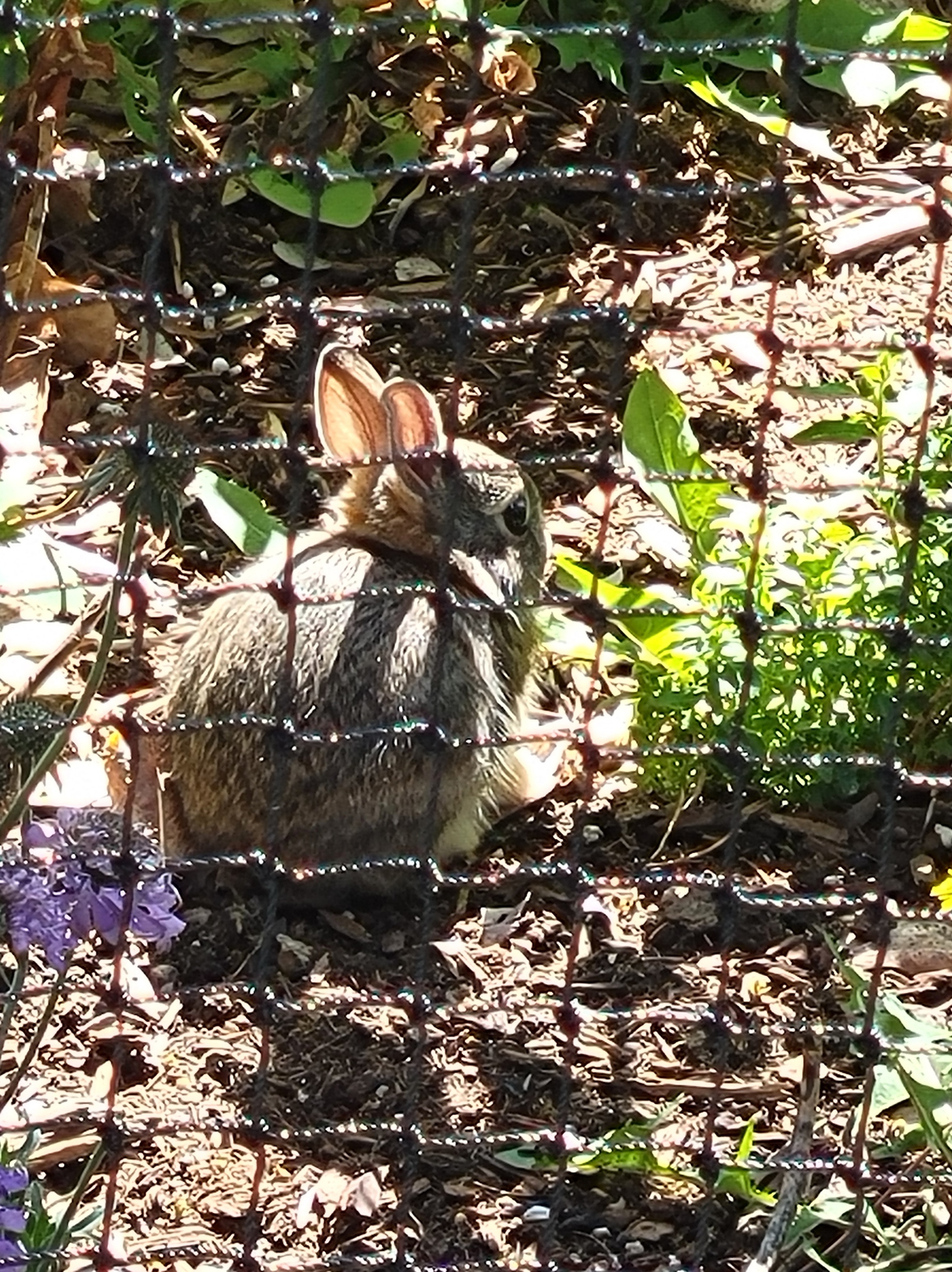
Mateo is enjoying the emergence of a new, tiny baby bunny!

So, here is the crazy thing. I have been struggling big time with my symptoms. I have been unable to knit (or type for that matter) for several months now. I rely on the knitting to help me keep my hands functional, and also for mental health reasons; the loss of knitting has been hard. Even cranking the knitting machine has been too much for my healing ribs and sternum. My other joints are so bad I have spent most of my time moving a heating pad from joint to joint trying to manage the symptoms. My heart has been misbehaving again, and my lungs have been unhappy. It has been a hard winter, and I have to admit, I’ve been concerned that I may be through the tipping point and on the downward slide of my scleroderma journey.

Then June arrived.

Like magic, after every morning in the sunshine drinking my latte, after every afternoon clearing out a small section of the gardens, I have been getting slowly better. My joints are recovering. My heart has stopped having tachycardia events. My oxygen levels have improved. My hands and wrists are much better. I am writing this post. I am better. I am knitting again. I’ve started a simple summer tee in a happy pink yarn, and my wrists are letting me knit for an hour a night. I usually bristle up when people suggest that I can just get better with some sunshine and exercise, but in this case it did help.

Other fun that I’ve been enjoying on the internet is the journey of Sunny and Gizmo, two Bald Eaglets that fledged early in June from their nest by Big Bear lake in the San Bernardino mountains in California. Sisters, the two have remained with each other in various trees and have returned to the nest several times. The other fun was the adventures of Ed as he ran free in Tennessee for a week. Yay Ed!! You know that I had to cheer the zebra running wild!!

I do hope that you saw the strawberry moon. It was a happy, bright object in the sky, lighting up the back yard and the bunnies chasing each other over the lawn. The moths entertained the cats, and I sat in the dark with them on my swinging patio chair last night feeling pretty upbeat. This full moon was the last of the spring; what is coming now is the heat of summer. Usually, I kind of dread the summer heat, but last night I felt absolutely sure that I was up for the days to come. How do you eat an elephant? One bite at a time. How do you knit a sweater? One hour at a time. How do you face down the scleroderma monster? One beautiful day in the yard/catio at a time.

This is scleroderma awareness month. I went to a scleroderma conference in Denver last month, and this Saturday I will go on a fundraising walk with all of my sclero-friends. I plan to rock the teal! Bring it sclero-monster! I am ready for you!!
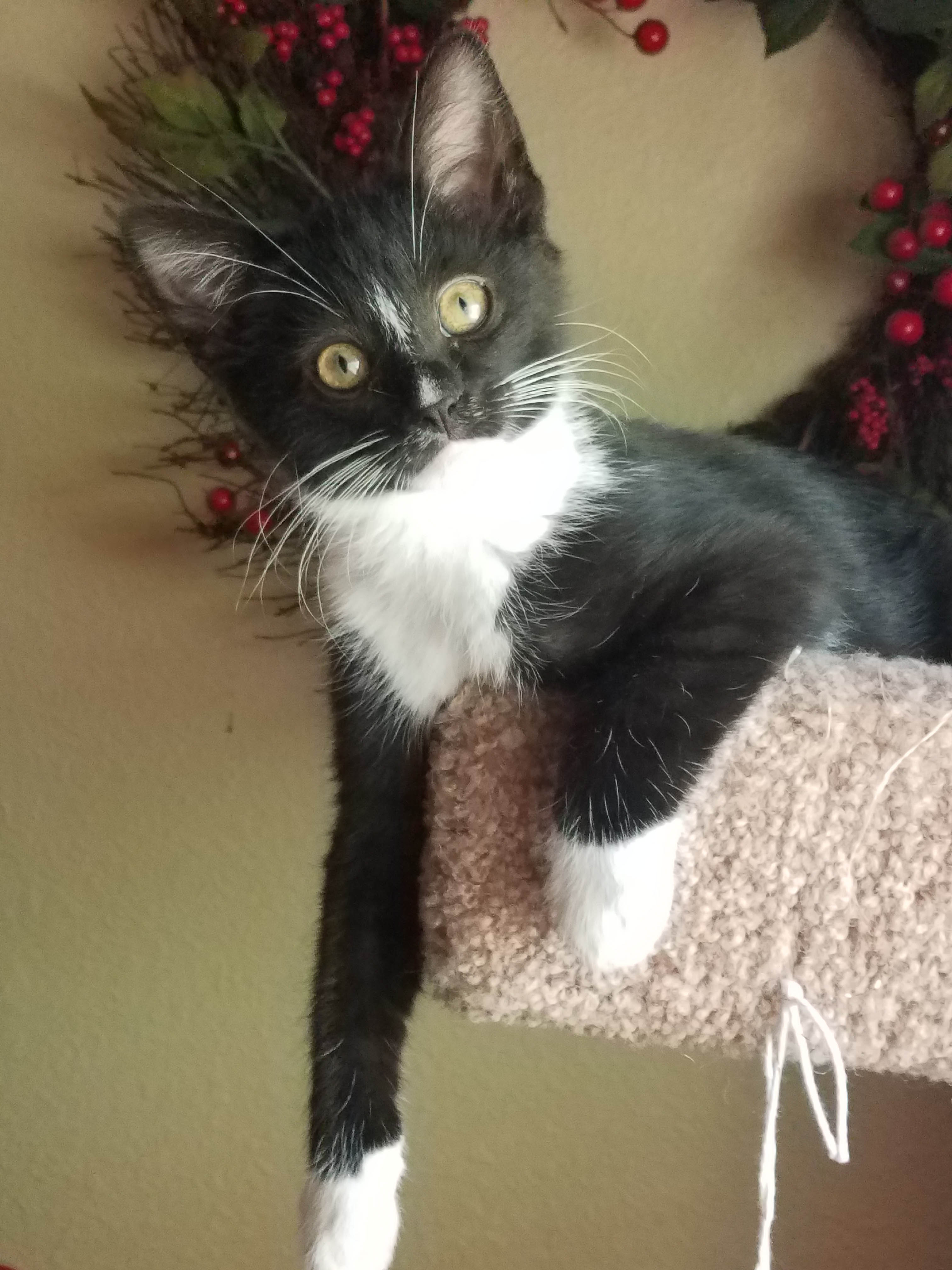
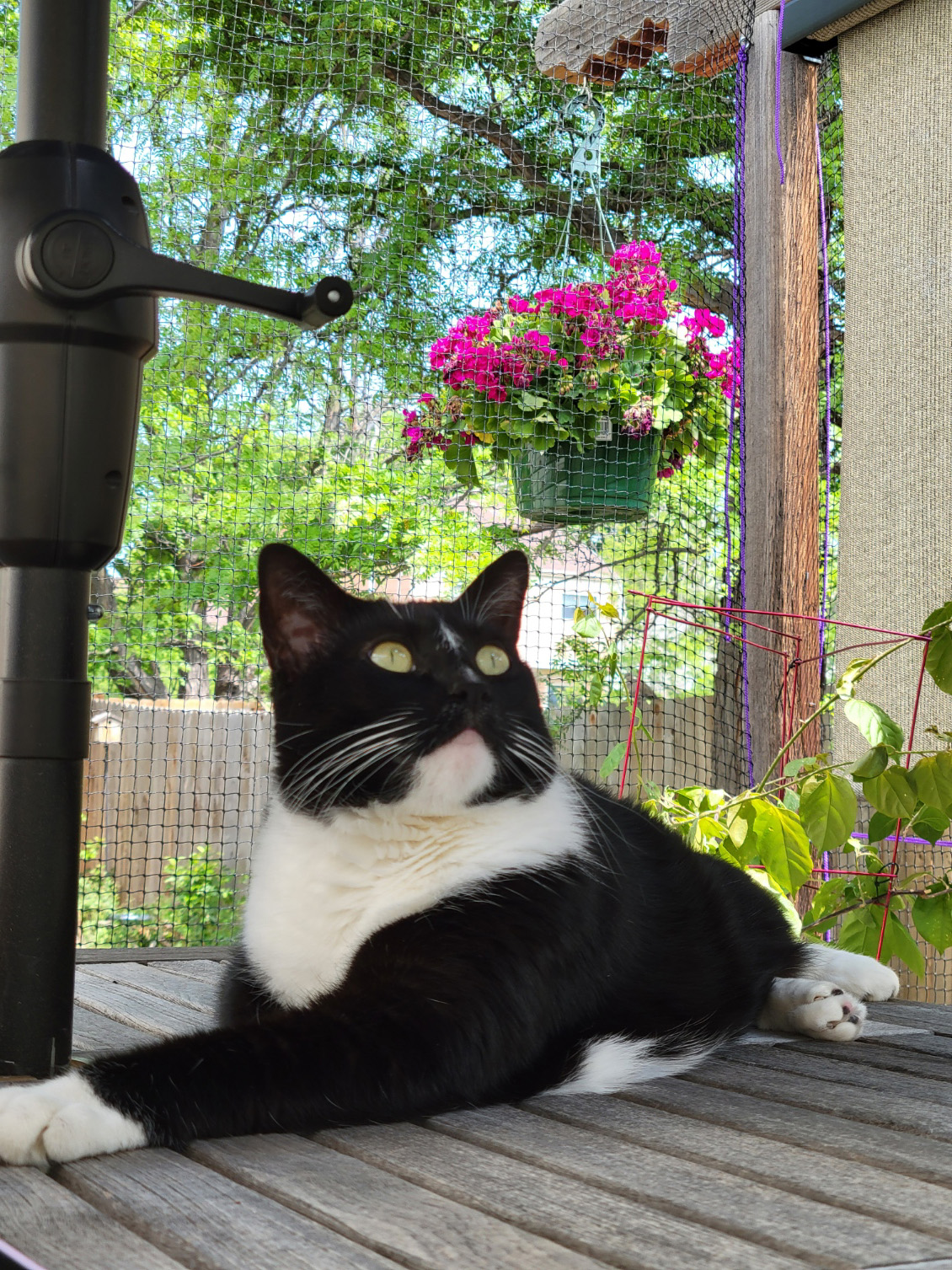
Friday is Hannah’s gotcha day. She is now 5 years old.

Last night I started reading the latest edition of Scientific American Magazine. The cover article is about new research that shows… wait for it… sunshine can suppress the immune system and make autoimmune diseases improve. Look at that! I’m kind of thinking that happened to me over the last few weeks. Evidently, it is a balancing act: sunshine can also make things worse. Yay! Once again, I get to use myself as an experimental animal as I figure out how much I can tolerate. 🙂

Zebra running wild!!

Hannah and the CoalBear: She bought all the yarn!!!

Hi. I’m Hannah.

The Mother of Cats brought me this wonderful new box this week. I love this box!!!

The Mother of Cats started out the week being really busy. She worked in her gardens, she knitted on her chickens, and she even did some yummy cooking. I know it was yummy because I dragged off some of her steak when she wasn’t looking. I mean, it was a big piece; if she shared more, I wouldn’t be forced to take matters into my own paws like that. After a couple of days of sun and knitting fun, though, everything came to a screeching halt.

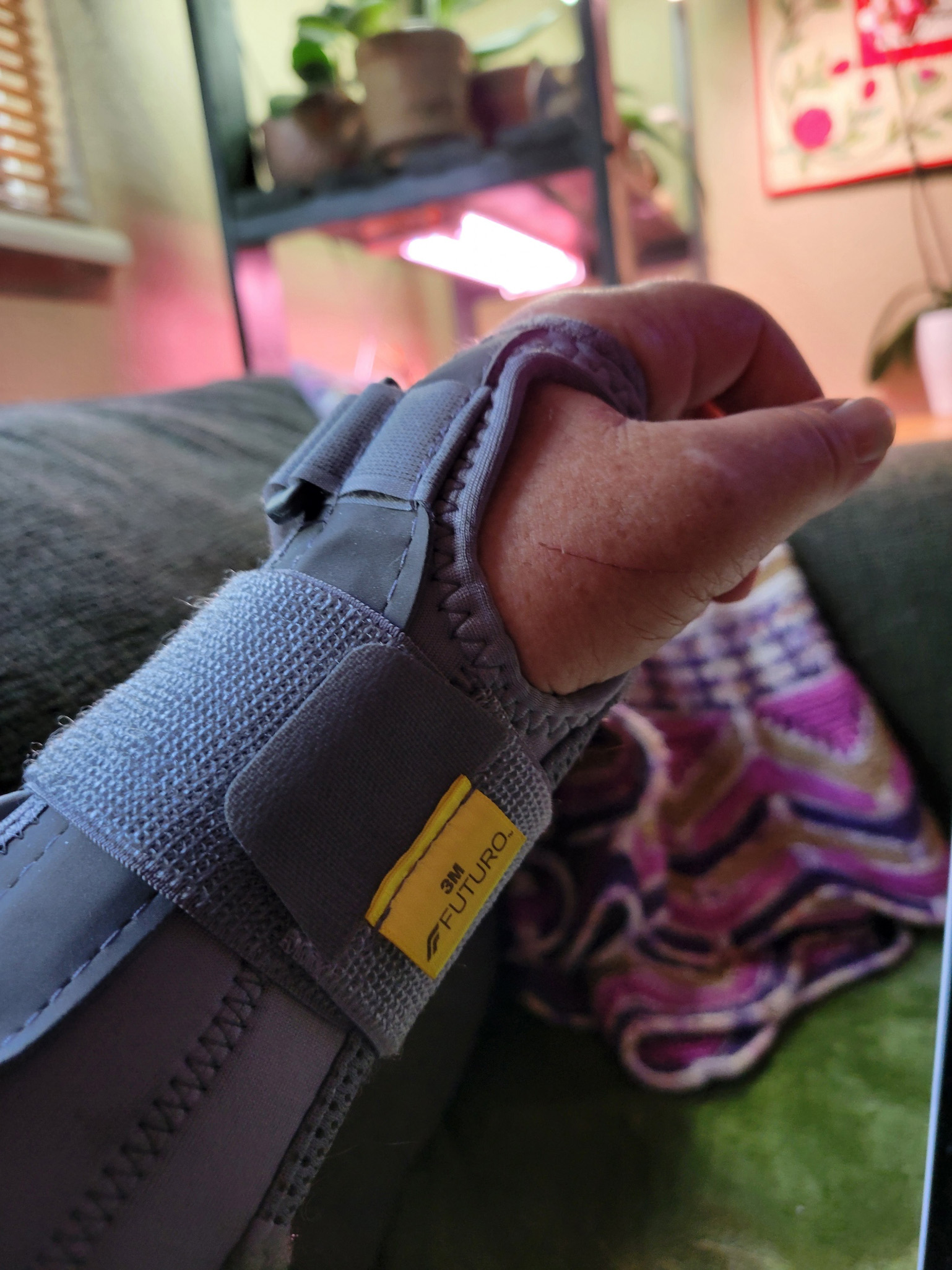
The Mother of Cats hands got all puffy and she had to put on her braces. I hate the braces because it feels funny when she pets me. She also gets crabby when she is wearing the braces because she says everything hurts. Poor Mother of Cats.

I bet if she ate some tuna with avocado, she would feel better…

Anyway, after spending a whole day reading books and doing laundry, the Mother of Cats bounced back and headed out to the yarn store. I think it was a little crazy of her, but we couldn’t stop her. The yarn store had put some videos showing off the yarns on Facebook, and she pretty much lost all control.

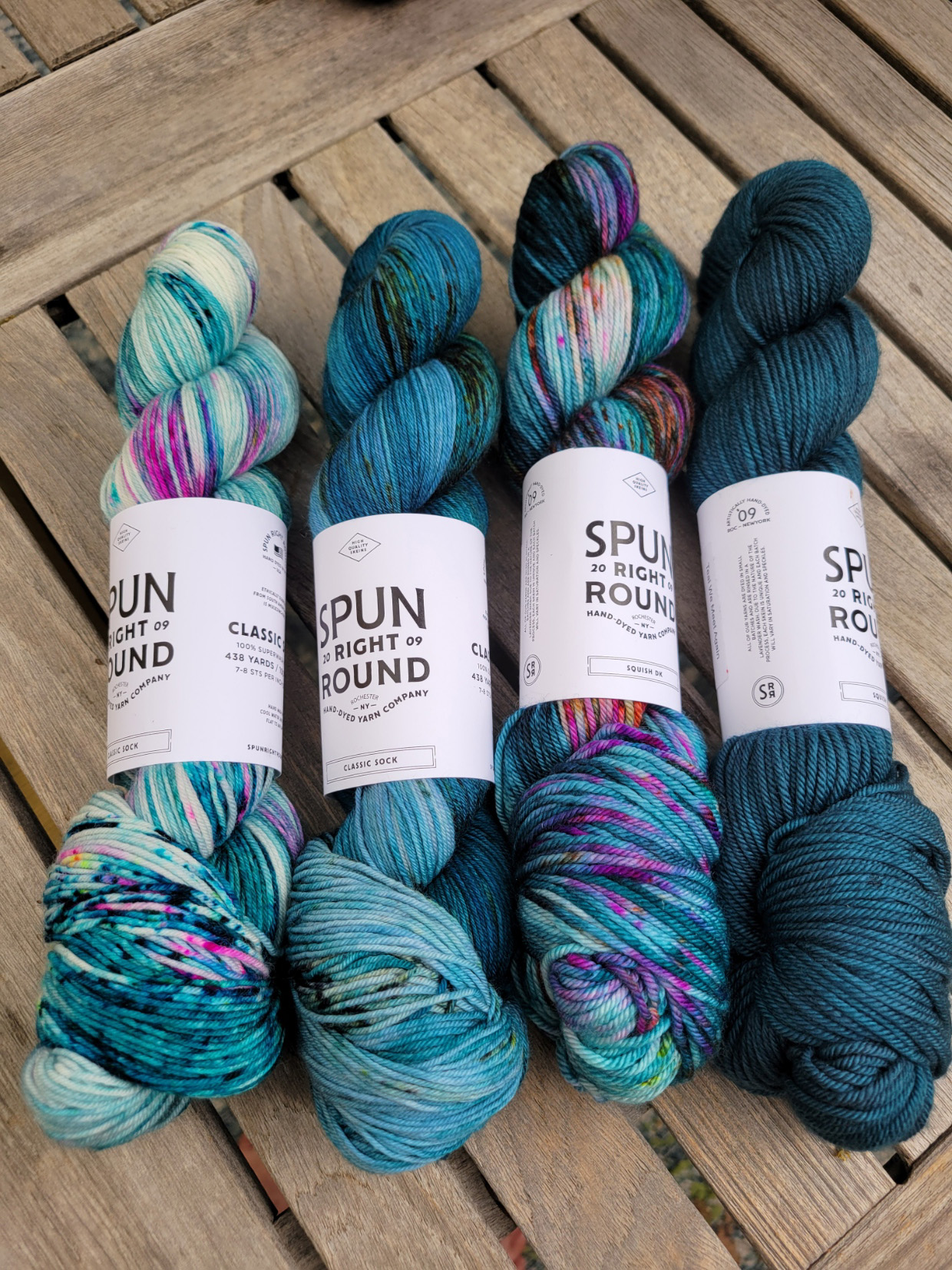
Look at this yarn!!! She had to get teal colored yarn because it is scleroderma month, and the store chose teal as the color of the month (!). As she explained it to Mateo, when the universe puts teal yarn out on sale, you just do what the universe wants. She also got the pink/plum yarns because she loves them the most. I tried to sleep on the yarns, but she got a little cranky about that. Silly Mother of Cats. When is she going to learn to share? Anyway, she says that the yarn is for MORE CHICKENS!!!!! She is going to share this yarn with some people, so why not me too?

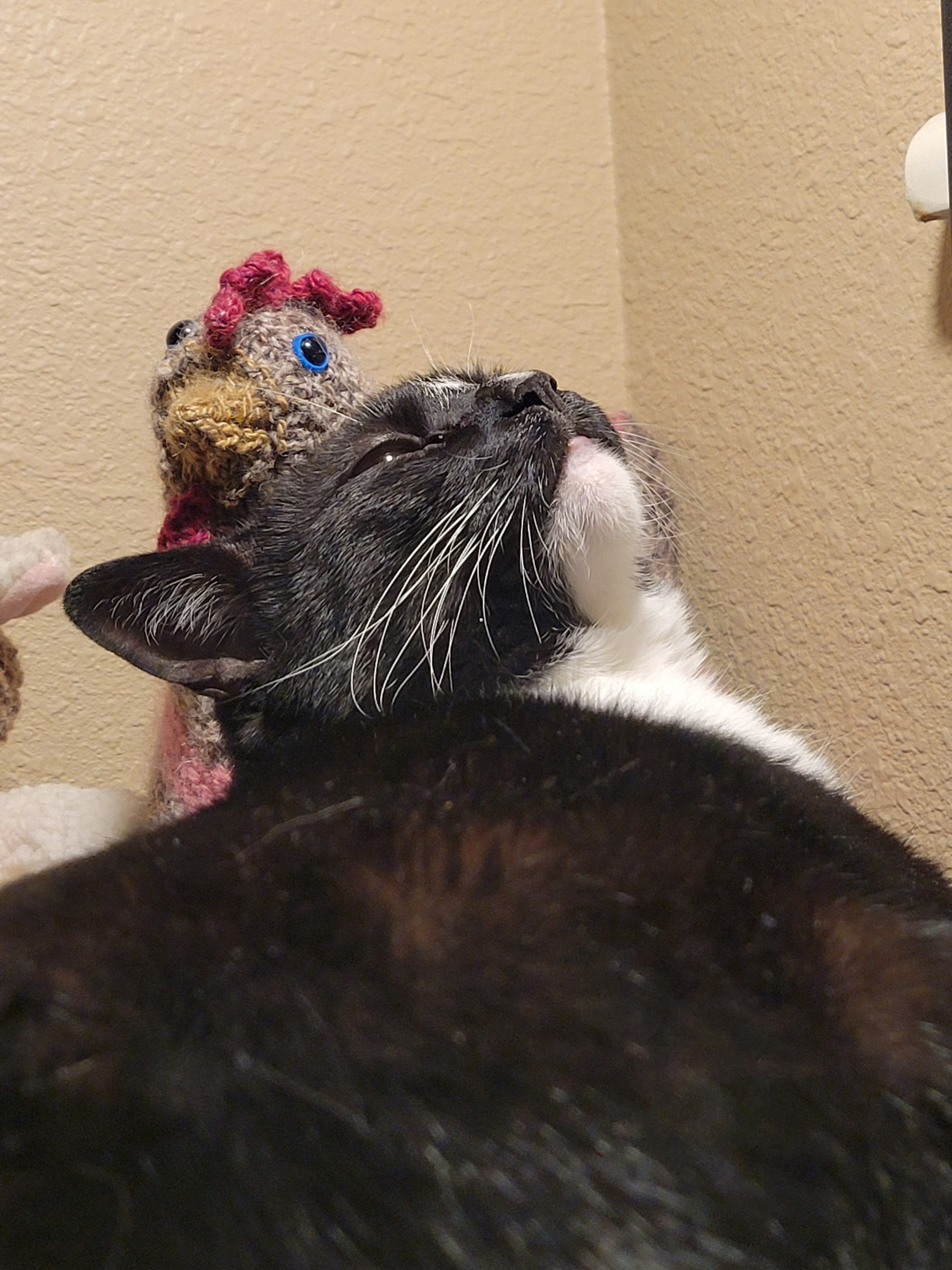
I do have to admit, I love my chicken. She is really nice to sleep with.

Just when I thought we had reached the height of ridiculousness, more yarn arrived in the mail. This yarn, evidently, just had to be bought because it is… ZEBRA yarn.

Behold the zebra yarn. It gets that name because the undyed yarn is white with black stripes.

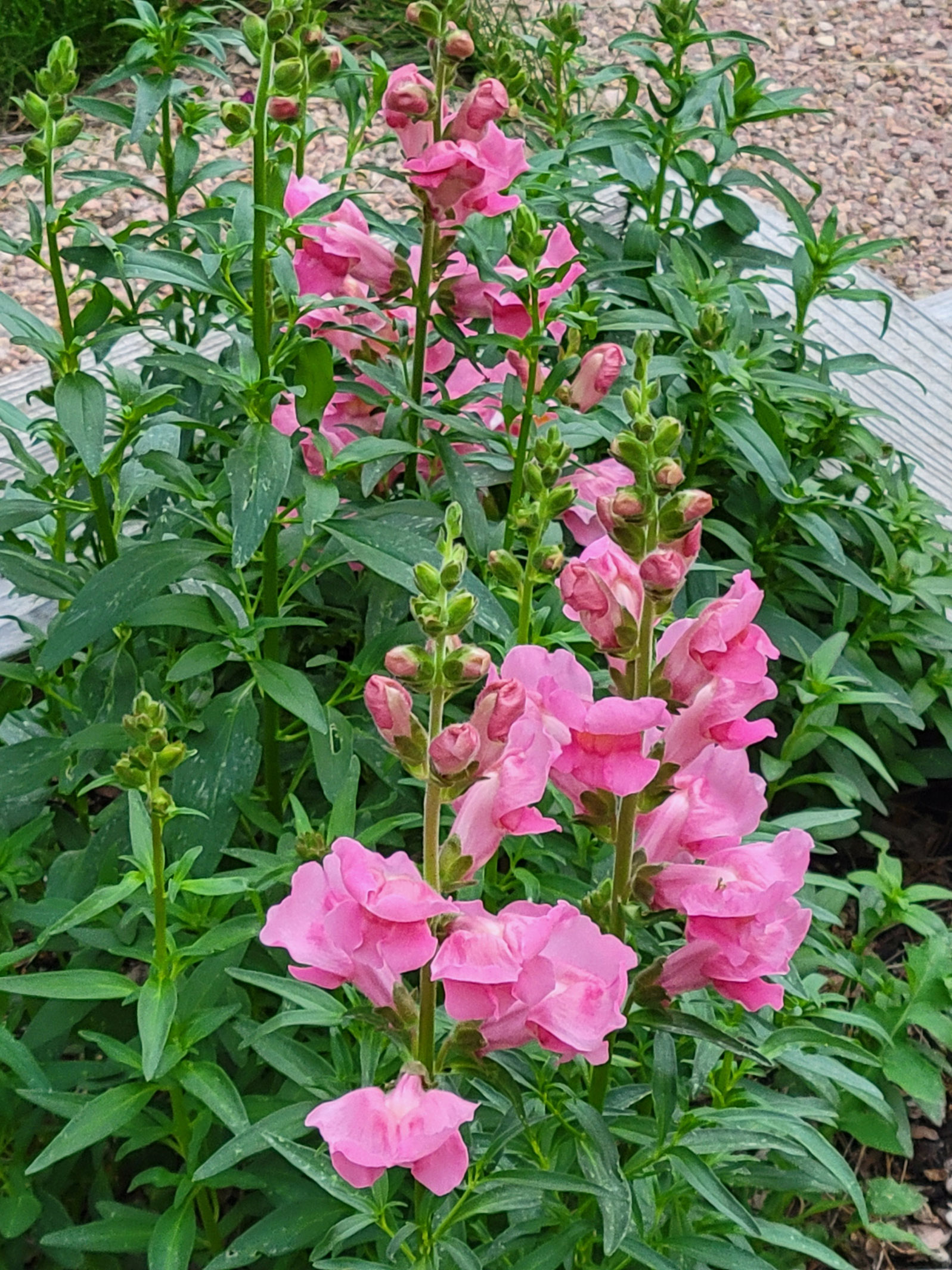
So, I can truthfully say, the Mother of Cats seems to have bought all the yarn. It seems a little crazy for her to lose all control like this when SHE CAN’T EVEN KNIT right now, but that’s the Mother of Cats for you. She believes that the world needs more chickens, and she is going to get them knitted after a few more days of rest. In the meantime, she gets to read her books, play with us, and take pictures of her roses. More of her rose plants started blooming this week and they are looking pretty good.

Well, that’s about all that is going around here except for the really big news if you are a cat. IT IS MOTH SEASON!!!! That’s right those crazy miller moths are back, migrating through our back yard, and Mateo has been steadily catching them and bringing them into the house to play with. Then it is fun, fun, fun all night long!

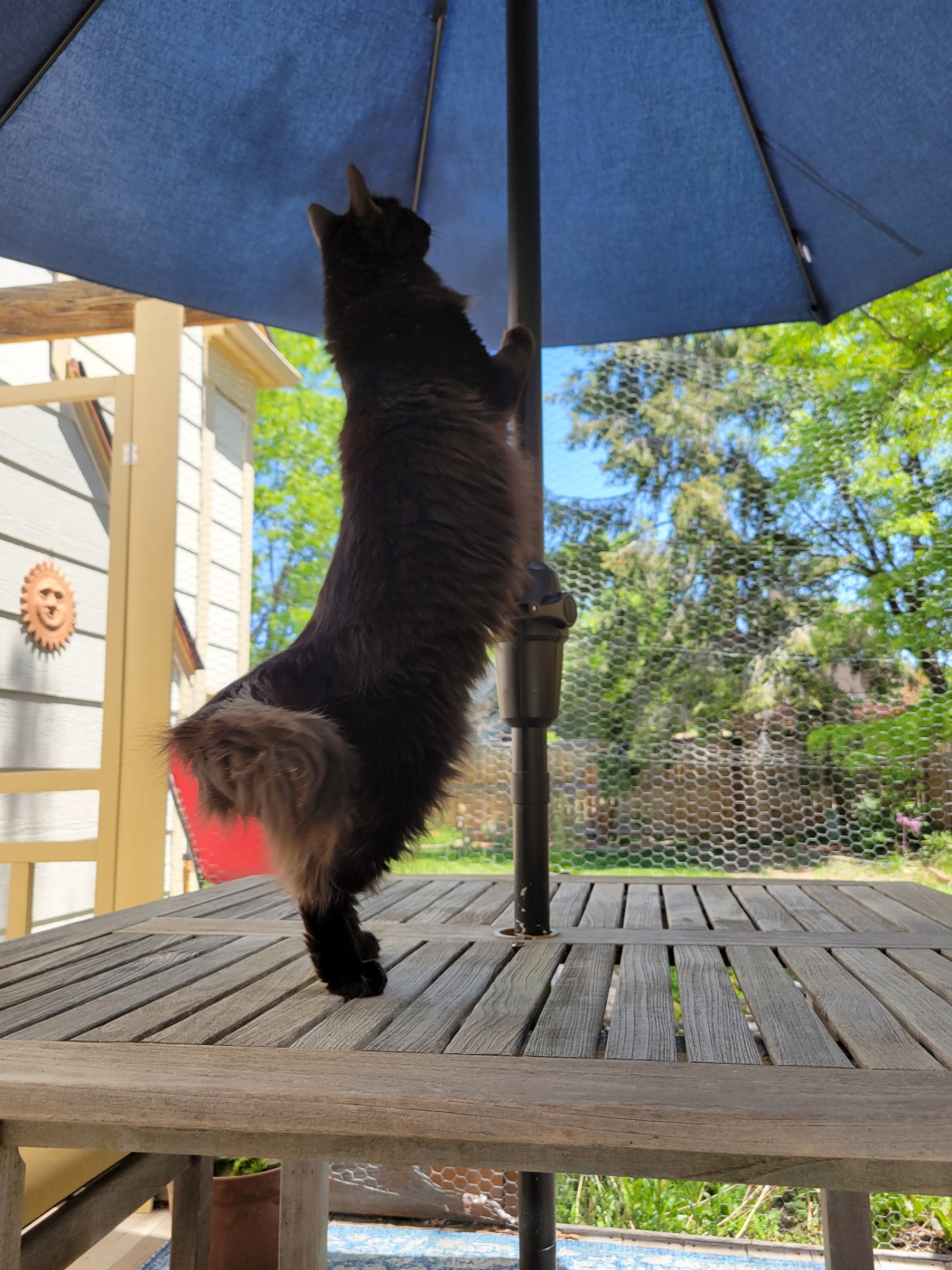
The moths like to hide in the umbrella shade, and when the Mother of Cats opens it up, he grabs them. Then, when it is about time to go to bed… bazinga!!! There’s a moth for me to chase up on the ceiling. This is so much fun. The Mother of Cats isn’t completely on board with all of the moth fun, but I’m sure that if she ate more tuna (with avocado!) she’d be a better fan of moth-o-mania.

That’s all for now. I’m going to take a little cat bath and then it is time for a nap. Later on, around 2am, it will be Miller Moth Time!!!

This is Hannah, signing off.

>^..^<

Notes from the Mother of Cats:

  • I’ve had swelling and tendonitis like this before, and the only thing to do is to rest the tendons and wait it out.
  • The chicken pattern is the Emotional Support Chicken.
  • I have 4 more chickens knitted that I need to sew up.
  • My scleroderma support group met today and 4 people asked me for a chicken. Well, I did offer. There are days when you really, really need a chicken to hug.
  • My latest blood results are in, and I am finally back in the normal ranges for iron levels, and my anemia symptoms are better. I’m at the dead bottom, but I will take it! Still eating steak, tuna, peanut butter, and taking iron supplements. Did you know that there is iron in avocado?
  • The miller moths migrate west every year across the plains to the Rocky Mountains for the summer. My yard is on the flight path.
  • Almost all of that yarn came from Spun Right Round. I love the quality of the yarn, and you can see how wonderful the colors are!
  • I tried to knit while wearing the braces. Nope. Not happening.
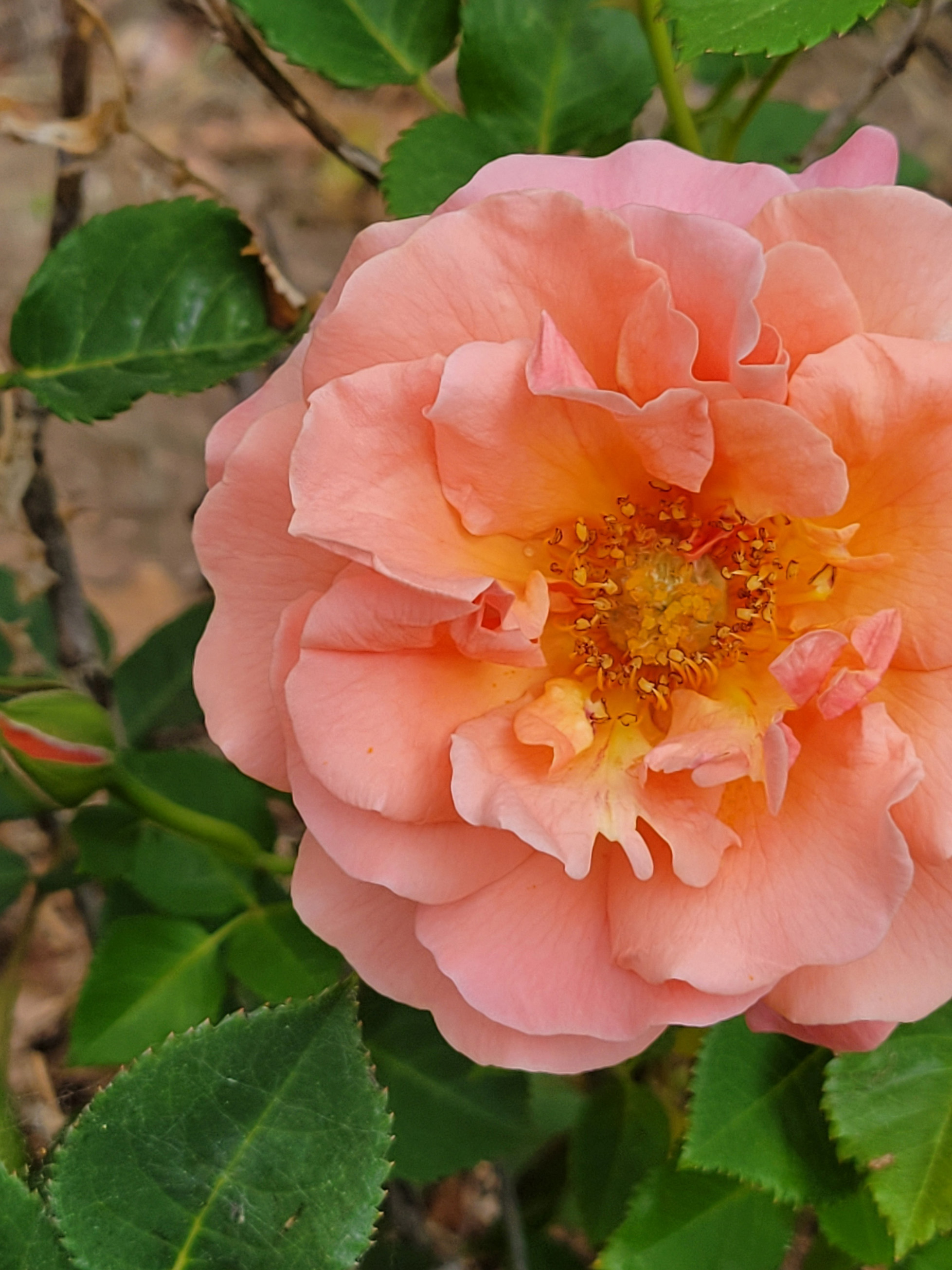
  • The beautiful apricot rose is Easy Does It, and this is its second year in my yard. The pink rose is a mostly wild rose that I bought a looooong time ago at the hardware store, and the chicken is with the Princess Alexandra of Kent rose.

The Scleroderma Chronicles: June is Scleroderma Awareness Month

I plan to shine like a sunflower this month.

My local garden center had sunflowers for sale.

I am still thinking about resiliency. I went for a drug infusion a couple of weeks ago, and the lady in the chair next to me and I talked about what resiliency means. She is a liver transplant recipient, and she is also taking the immunosuppressant that I take to control my systemic sclerosis. Like a lot of patients in my scleroderma community, she has had to roll with a series of escalating complications tied to her original liver disease. We both now have osteoporosis, walk with canes, struggle with anemia, and are on a lot of drugs. We laughed about the canes and drug side effects: we’re still here, we crowed. Unlike me, she never checks for drug side effects or interactions; if she knew about them, she figured that she would just worry and imagine she was developing them. Instead, she just cruises along and if something comes up, she contacts her doctors.

Resilience.

Welcome to Scleroderma Awareness Month. I’m spending the month organizing my thought about resilience into some type of logical order. I have a Word document going with an organizational table, a ton of links, and everything scleroderma in it. It will be good for me, I think.

This is a pygmy sunflower. How cute it that!

By the way, my new friend also wants an emotional support chicken.

Welcome to June.

The BioGeek Memoirs: Sunflower

Okay, I need to be complete upfront about this: this is a crossover post. It is going to be a total amalgamation of the Scleroderma Chronicles and The BioGeek Memoirs because I just couldn’t come up with anyway to make them separate posts. Hey, I’m a biogeek with scleroderma. It was bound to happen eventually…

So, let’s get this ball rolling by talking about bean plants. That makes a lot of sense, right? When I was a biology teacher struggling to make plants interesting and to help students understand experimental design, I came up with the genius idea of letting the students design an experiment looking at the effect of fertilizer concentration on the growth of bean plants. The students had solutions with different concentrations of Miracle Gro fertilizer available to them, and then they had to struggle with planting and growing 6 bean plants while holding all the other variables constant. The plants grew, the students measured their growth, and then they charted the growth to make decisions about the best fertilizer amount.

I had the hot idea of using an Excel spreadsheet to display the student data to the whole class. That worked great! I then combined the data from all 5 classes together and… it was a huge mess. The plants were all different heights depending on which class was collecting the data. The students weren’t making any errors; the bean plants were raising and lowering their leaves each day in circadian rhythm. Depending on the time of day, the plants were a different height. Oh. Plants can move!

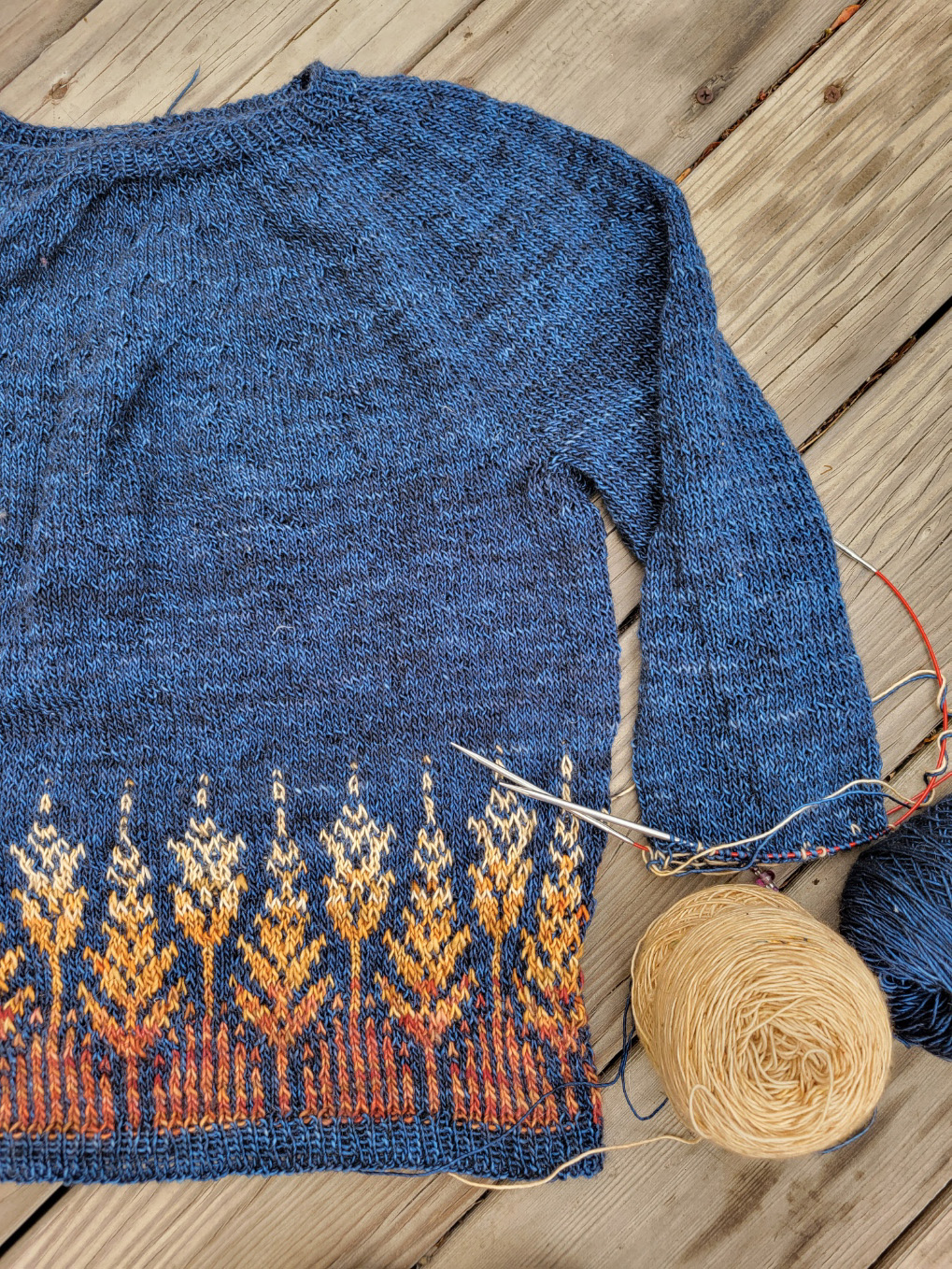
Sunflowers have been on my mind a lot recently. Beautiful sunflowers, whose faces turn throughout the day to follow the sun. My cousin grew enormous sunflowers one year that towered over the other plants in the garden. Sunflowers are the symbol of Ukraine. The sweater that I am knitting right now is in the colors of a field of sunflowers with their faces in the sun.

Those aren’t sunflowers, but the colors remind me of all the “Support Ukraine” knitting that is going on right now.

There are enormous fields of sunflowers near the airport in Denver that are just spectacular in the late summer. Early one morning in late August,2014, I drove past them on my way to my first appointment with a rheumatologist; my primary care physician had referred me to a specialist after some concerning bloodwork results. I was pretty sure that this morning was going to be a turning point in my life, and I was nervous and kind of fighting off tears. Behind me the rising sun poured light onto the glowing faces of sunflowers ahead of me as far as I could see; the sight was just thrilling, and I settled right down. An hour later the rheumatologist explained that I had limited systemic sclerosis (a form of scleroderma) and Sjogren’s disease. I was prescribed medication, sent for more testing, and told to stay off the internet. I looked for the sunflowers as I drove home that afternoon, but I couldn’t see them; the fields were too far from me as I drove east. Still, just knowing they were there sort of helped. Sunflowers. They were kind of a symbol of hope and the promise that I could handle anything.

Are you ready for this? The sunflower has been chosen as a symbol for scleroderma by Scleroderma Australia. Shine like a Sunflower is their campaign this June to bring scleroderma into the light of awareness.

Just like that the sunflower became an international symbol for scleroderma. I swiped this shirt image off of Amazon.

Why a sunflower? Well, like sunflowers, we scleroderma people follow the sun. Strong sunlight is actually a problem, but the warmth… bring on the warmth! For the last few weeks, I have been recovering from surgery and waiting for my biopsy results. I have been sitting outside on my deck out of the direct sun, soaking up the heat and light. Day by day, I have been improving and no longer need daytime oxygen support. My cardiologist has restarted the medication that was halted while I was in the hospital, and it hasn’t even caused a bump in my recovery. Heat and sunlight are really making a difference.

My biopsy results arrived on the first day of June. I have developed a type of interstitial lung disease that presents as hypersensitivity pneumonia. I also have the characteristics of what the report called a vascular/collagen autoimmune disease, which is pretty much a descriptor for scleroderma. Yep. What my pulmonologist prepared me for. This is interstitial lung disease associated with system sclerosis (SSc-ILD) and I am going to get started on an increased dosage of immunosuppressants and a new drug to prevent scarring in my lungs called OFEV. This drug is really new; it has been developed in the years since my diagnosis, and now it is here just when I need it.

June is Scleroderma Awareness Month. Here in the US the theme of the campaign is Know Scleroderma. Oh, I know scleroderma, and so do some of you through my blog. Let’s put scleroderma aside for the time being and go back to sunflowers. And science. Remember that this post started with a little story about doing a science experiment with bean plants and my students? As simple as that was in my classroom, the heart of that process, curiosity, scientific experimentation, and data manipulation, is serving me well now. Ironically, new therapies and treatment approaches are being developed because of the lung scarring caused by Covid-19. Science. It rocks!

Today I planted these sunflowers along my side fence.

This afternoon I am once again outside in the warmth and light, knitting on my new sweater in the colors of sunflowers against the sky, admiring my beautiful newly planted sunflowers. They have their little faces angled to the southwest, following the sun as it starts to dip towards the Rocky Mountains.

Beautiful, tough, follow-the-sun sunflowers, reminding me to also follow the sun and to shine when I can. They remain a symbol of hope and a promise that I can handle anything.

Shine like a Sunflower.

June is Scleroderma Awareness Month. You can learn more about scleroderma at these links.

The Scleroderma Chronicles: June is Scleroderma Awareness Month

Five years ago the course of my life altered forever when some blood test results ordered by my doctor arrived: the results showed that I definitely had two autoimmune diseases. Specifically, I was producing antibodies that were diagnostic for scleroderma and Sjogren’s disease. I was expecting lupus, so this was kind of a surprise shock. After a quick trip to Google to establish what type of scleroderma was associated with my positive test results I burst into tears. It was worse, much worse, then I expected.

The scleroderma diagnosis was the problem. Through an unbelievable sequence of serendipitous life events I was more knowledgeable then the average newly diagnosed patient, and I knew that scleroderma was a disease that impacted connective tissue, that it was progressive, disabling, and that there was no cure. This was a life-altering diagnosis, and I was in for a long fight that would last the rest of my life.

You see, I used to work in a rheumatology research lab, and I did research in scleroderma. I was a member of the research team that found the first identified antigen associated with scleroderma. I had visited scleroderma patients in the hospital. Later in my life I taught AP Biology and spent years trying to explain connective tissue to students.  It’s a type of tissue that we just never think of, but it is critical in organizing and operating our bodies. Connective tissue makes your skin elastic and strong. It organizes your muscles and makes up your tendons and ligaments. It is a critical layer in your blood vessels, and is part of the essential structure of all of your organs.  In scleroderma all or parts of this connective tissue is under attack by your immune system.

As white blood cells invade my tissues and attack this connective tissue it produces too much collagen in response. The built up collagen produces thick layers of tissue and scarring. My fingers look really swollen, but it is actually very thick hard skin. My skin is also getting really shiny which means that the collagen is hardening up and losing flexibility. Must knit faster!!

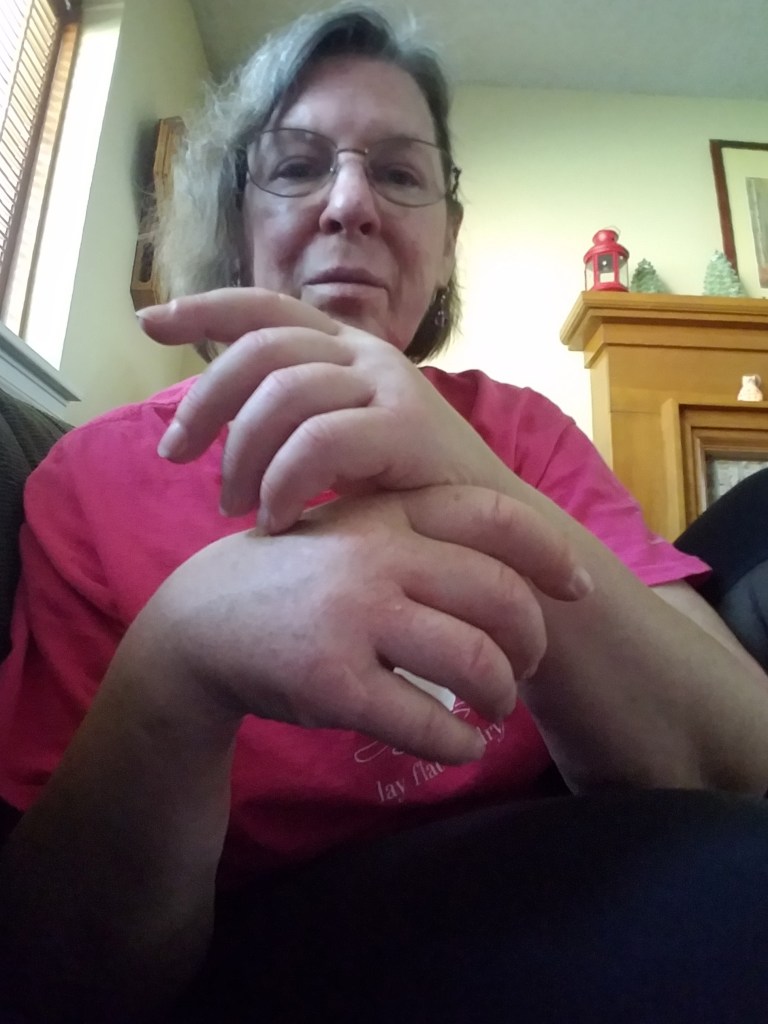
You can perhaps see that same thickness on my face, especially on my cheeks. It means that I don’t have wrinkles, but it is also hard to open my mouth, my smile is mostly gone, and I can’t turn my neck well. Crazy, huh.

That is the most ironic aspect of scleroderma: you look pretty darn good, especially if you are a senior citizen like myself, but you actually struggle daily with your illness. For many scleroderma patients their disease just  involves the skin, but for others, the disease is more than skin deep.

As it turns out, my skin is the least of my worries. The rare type of scleroderma that I have, systemic sclerosis, also causes scarring of internal organs. The muscles of my stomach and esophagus have lost function. My kidneys are damaged and I have chronic kidney disease (stage 3). My lungs are scarred and my diaphragm isn’t exactly happy any more. Part of my stomach herniated up into my chest this year… whatever was it thinking of?! My tendons are getting calcified due to inflammation and at least one has partially ruptured. My muscles are sore to the touch and I have bruises everywhere. I have nerve damage and trouble controlling my body temperature. It’s hard to walk. Blood vessel damage affects circulation to my hands and feet and I’m starting to develop open sores (ulcers)… There is a long list of diagnosed conditions linked to my scleroderma, but you get the idea. Pretty much I’m a walking limping train wreck. Well, a knitting train wreck for sure!

There is no cure for systemic sclerosis, but there are treatments that really help a lot. I am taking four different drugs to crush my immune system into submission; it’s a balancing act as I need my white blood cell count to stay high enough to protect me, but low enough to control my symptoms and prevent more damage. I take a drug to shut off the acid produced in my stomach so I won’t accidently inhale it in my sleep since the muscle barrier that usually keeps it in my stomach is now gone. I take a couple more drugs that help control inflammation, and some supplements that help with nerve damage. I’m on oxygen at night. All of these drugs/supplements have made a huge difference for me: my last lung scan showed improvement and my high heart pressure, the most concerning complication that I had, has returned to normal ranges. My kidney damage continues, but it has slowed way down. There is something funky going on with my red blood cell count, but you can’t win them all, right? The main point is that I continue to manage and live independently.

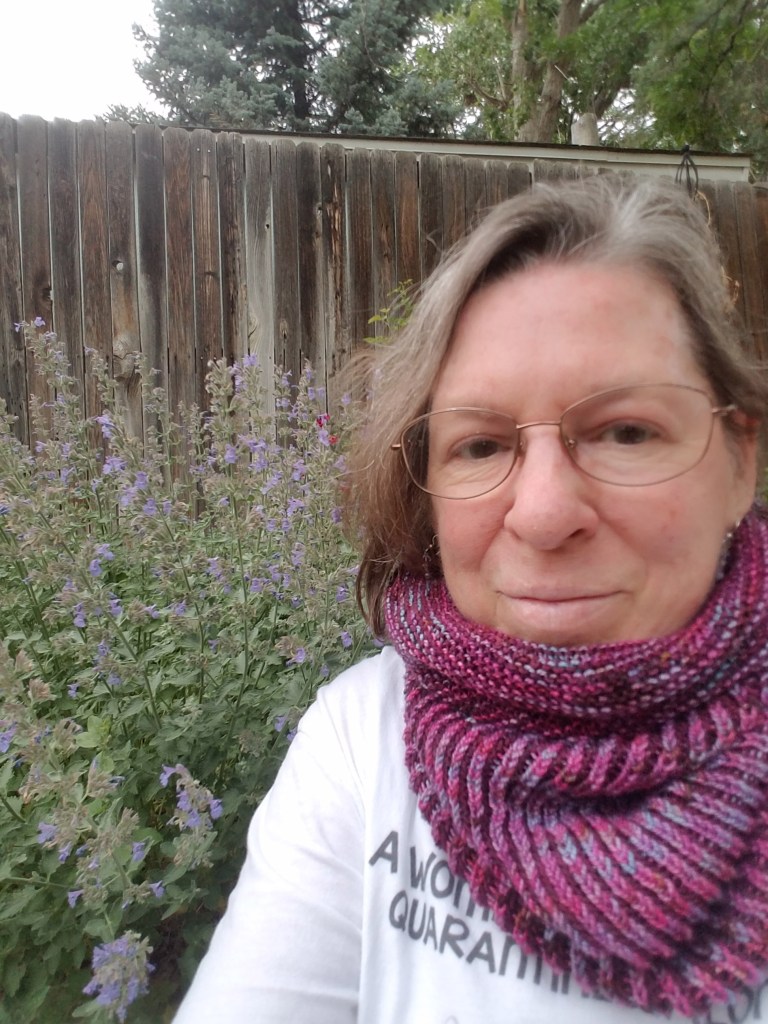
MacKenzie and I last year when I posted this online as part of the “Face of Scleroderma” campaign.
In short, I am a mess. And yet, to the joy of my doctors, I continue to do really well. Okay, I have blue lips, am short of breath, and struggle with tissue damage, but I also continue to thrive compared to other scleroderma patients that they treat. I have had to make many changes to my life, but I have found work-arounds and I still do things that I love. Attitude is all!

Well, knitting, the cat, and the garden are pretty darn essential, too!

So, there it is. What an annoying disease, right? How dare it make you look younger while shortening your life? How dare it do all of this invisible internal damage that makes people think that you are lazy or an attention-seeking hypochondriac when actually you view each day that you are able to leave the house as a personal victory? I’m in several online support groups and there are people dealing with crushing negativity like that. I can see how it can happen; it is so hard to understand something beyond your own experience that is hidden from view.

That’s why there is Scleroderma Awareness Month. It is hard to have a rare disease, especially when it is one that is hard to pronounce (Sclero… what?!). It’s harder still to have one that has no cure and a pretty high fatality rate (hey, with all of the drugs that I’m on my 10 year survival rate is now up to 80%!!). It makes you learn to laugh in the face of terminal complications while forcing you to take every possible precaution to avoid contracting Covid-19. It messes with your head; it gives you power, but it’s also strange and a little lonely.

That’s why we scleroderma patients share our journey with all of you every year so you can get a glimpse of our lives.


If you look harder you will see the signs of my scleroderma on my face. The small red spots are called telangiectasia and are symptomatic of my form of systemic sclerosis. The skin of my forehead is tight and shiny, my hair is falling out,  and my dimples are now buried under my thick skin. My upper lip is trying to decide if it wants to turn blue… 

I am the Face of Scleroderma.

Footnote: In addition to scleroderma I also have Sjogren’s Disease and fibromyalgia. The symptoms from these three diagnosed conditions overlap and always make things interesting in sorting out my treatment plan. You can learn more about any of these autoimmune disease by checking out the links in my post.

Science and the Scleroderma Girl: The AP Therapy Rant

Antibiotic Protocol is an alternative medicine therapy for autoimmune disease. It certainly has a following. Check this out.  There is more information on it at the Arthritis Foundation. It seems to be loosely associated with “Leaky Gut” as it links chronic autoimmune illness to microbial sources originating in our intestines. The shaky model and vague language involved in leaky gut has landed it on the pseudoscience list at Wikipedia.

This has been a really hard post to put together. I have all these little memories and reactions rolling around in my mind, and I struggle to link them together in a meaningful way. Here are some of the things that have happened and my gut reaction (did you see what I did there?) to them:

  • I have a friend with lupus. She has been struggling for years, is on disability, and is clearly in trouble. She is losing weight, her hair is falling out; she is in the care of a nutritionist who has her on severe dietary restrictions and antibiotics to treat her condition. She eats no dairy, gluten, meat, alcohol, or sugar, and continues to take her antibiotics without fail. She is not getting better. My heart breaks every time I see her.
  • My dermatologist placed me on doxycycline (one of the antibiotics used to treat scleroderma in AP Therapy) right after my diagnosis. A year later my lung disease was moving so quickly that I was actually referred to palliative care. I stopped the doxycycline, my rheumatologist boosted the immunosuppressive drug dose,  I was given a new drug for my vascular disease, these new drugs kicked in, and today my lungs look great. Good bye, palliative care!
  • I visit an online support group for scleroderma patients where some people are just devoted to antibiotic therapy. They can be very aggressive in promoting their message and have even private messaged me trying to convince me to switch treatment protocols. Huh? This is kind of extreme. I’m always wary of fanatics because it is more about “winning” and gaining converts…
  • Cat face.
    The Mother of Cats has an active early warning system for fanatics. There is no evidence on Earth that will change their minds…

    So, I already have my back up about AP Therapy. The diagnostic antibodies that I have are to a specific region on my chromosomes (centromeres and kinetochores) that is involved in cell division. Bacteria have their genetic machinery organized very differently from me; why would the defining antibody in my illness be towards an antigen not found in bacteria? (Goodbye leaky gut… it was nice to know you!) That doesn’t mean that I can’t have the medical condition of increased intestinal permeability; correlation doesn’t necessarily mean causation. It also doesn’t mean that antibiotic use doesn’t help some people as the drugs also have anti-inflammatory and cartilage protecting properties, and there is research that shows it helps some patients with rheumatoid arthritis.

Here’s the deal: there are better drugs and treatment options. If you have a mild form of the disease, maybe AP Therapy is what you need. On the other hand, systemic sclerosis is a potentially fatal disease and if it is advancing rapidly the correct response is to go big: use the drugs that have the highest success rate. I feel like I’m a walking poster child for the success of current treatment options. The three drug cocktail (Myfortic, Plaquenil, Losartan)that my doctors are maintaining me on has reversed my lung and heart damage.

Crap, do I sound like a fanatic? Darn. I was worried that this would happen.

I told you, this is a hard post to write. Let me just say I would never, never PM someone insisting that they need to change their treatment plan. Who am I to project my reality onto another person?

What I really mean to say is to think like a scientist: collect data, keep a symptom log, ask questions, assemble a team of doctors to help you, and pursue treatment options that have solid research-backed results that you are comfortable with. Keep collecting data, and don’t be afraid to change if things aren’t going well. There is no best one-size-fits-all treatment plan, but play the odds that are the highest until you get better information. If what you are doing is working, keep going!!

Tomorrow is World Scleroderma Day.

This is a hard, hard disease. All of us with this disease face hard choices.

Hugs to all.

Science and the Scleroderma Girl: The Only Point in Common

Two years ago I was getting bounced around between several doctors as they tried to figure out why I was struggling to breath. The rheumatologist felt I should see a cardiologist. The pulmonologist felt that I needed to be treated by the rheumatologist. The internist insisted that the pulmonologist needed to intervene. The rheumatologist was very reluctant to give me an inhaler even though he had ordered the PFT that indicated that I needed one.

I was getting close to pulling out my hair! Literally, there were too many cooks in the kitchen and no one could manage to get the meal assembled. I was the cake in the oven, and I had just collapsed into an ugly, doughy mess…

“Look”, said the rheumatologist in the middle of this, “you are the only point in common between all of your doctors. Each one of us sees just one slice of your health, but you are the one getting all the info…” In effect, she was telling me to take charge of my health. Uh…

Spock: He is intelligent, but not experienced. His pattern indicates two-dimensional thinking… (Star Trek II: The Wrath of Kahn)

Seriously? I’m expected to organize this circus? I have skills, but to suggest that I should run this show is ludicrous…

Except, from a certain viewpoint, I am running the show; I AM the show. I have a serious illness, and I have a team of doctors to address my symptoms and halt my disease’s progression. I need to be proactive and ensure that I get the treatment that I need. Clearly, I needed help to sort through the conflicting advice and to assign priorities to the elements of my treatment plan.

There needed to be one doctor who knew me well, understood the big picture, who could also cut through the red tape and facilitate immediate medical response from the most appropriate provider if needed.

I made an appointment with my internist, who was also my primary care physician, and laid out the problem. I told her that I needed someone to review all the notes and test results from the other doctors on a regular basis to understand the big picture. I shared with her my concerns about differing information from the other physicians: I needed an expert to work with me to coordinate my treatment plan. There needed to be a doctor who saw me on a regular basis, who knew me and my situation, who could take a “snapshot” of my health situation, and who could see me almost immediately if I got into trouble. One of the problems that I struggle with is knowing which doctor to call when I develop problems; with this arrangement I have a designated first contact who will decide which specialist needs to be contacted next.

We agreed that I should come in every three months for the medical review and snapshot of my current status.

Everything changed for me. My internist reads everything from the other doctors at these appointments, and she answers questions that I have in a cross-disciplinary way that the other specialists can’t. It’s more like a consultation than the usual medical appointment. She looks to see what has been missed by the other doctors, and facilitates communication between the doctors. She has sent me for immediate testing, cut through the red tape so I could get oxygen when I needed it, and makes sure I get the complete text of all testing reports.

I make an appointment with her before I see the specialists to plan for those appointments, and then I see her afterwards to debrief on what happened and to see if anything was missed. When I go to my appointments with the specialists I can talk about test results, my prescriptions, and the symptoms that are concerning me; I have become an informed patient. Because of this I am a better conduit of information between the doctors, and the coordination of care and smooth communication has greatly increased. My doctors and I are now collaborative partners working to manage my disease.

From a collection of 6 doctors I now have a smoothly coordinated team to jointly treat my illness. For me, this is a huge difference! I’m now in much better shape, and I feel more in control of what is happening. I AM the only point in common, so I had to activate my hidden superpower of facilitation and coordination to make it work.

And knit. I had to knit a lot.

Have a good weekend everyone.

Science and the Scleroderma Girl: Research Results

Yesterday was a good day for me. I ran to the library, went grocery shopping, and had my hair cut. The stylist who cut my hair, however, was having a poor day: she has fibromyalgia and was struggling with the pressure front moving through Colorado. I told her about bananas, and she told me about a new product that she was buying off the internet. As we swapped info she pulled out the bottle of her supplement and I snapped a picture of it with my camera. She gushed about her product: it is just great! It cleans toxins from your liver and pancreas too!

Okay, I just checked out this product  online, and it will need a blog post of its own. It has 19 different ingredients in it that I have to check out, but right now I think that I will need to stay away from it as it has aspirin in it from a willow bark ingredient. I already know that aspirin is something that can hurt my (already struggling) kidneys and put my stomach lining at risk (the gastroenterologist sent me a strongly worded letter on this topic… I’m complying!)  The other ingredients might be okay, however, and I should check them out to see if they are possibilities for me to add to my diet.

So, how do I do this? I do lots of searches with key words like “research”, “evidence”, “inflammation”, “mortality rates”, “efficacy” and the item that I’m searching for. When a friend recommended that I try tart cherry extract to help with inflammation I typed in “does tart cherry reduce inflammation” and discovered that there was an active ingredient in tart cherry that really did reduce inflammation and that it was more gentle on stomach linings than a NSAID. Clinical research projects had been done that showed positive effects by measuring inflammation markers in patient blood. I talked to both my internist and my rheumatologist about it, got their okay with some stipulations, started the supplement with medical monitoring (blood drawn every month), and had to stop 3 months later when my kidney function dropped dramatically. Oops.

There is an important lesson here. Just because something is “natural” doesn’t mean that it is safe. Think like a scientist. Keep a journal of your disease symptoms, diet and interventions. Ask questions and talk to your doctors. Educate yourself as much as you can.

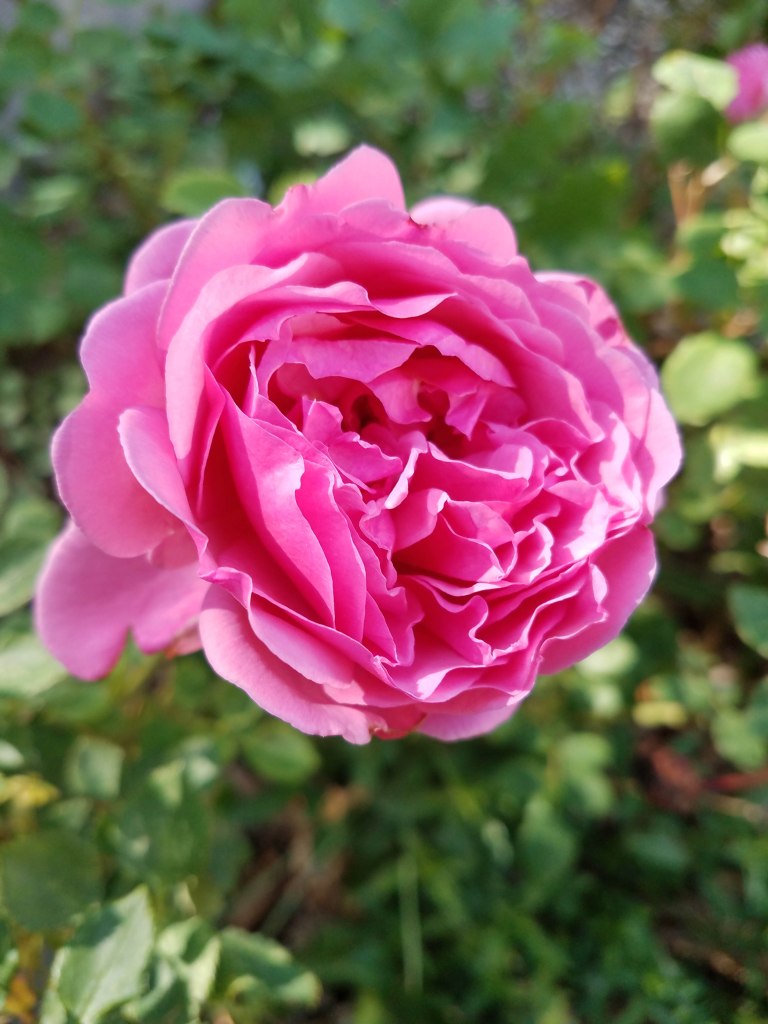
English Rose.
Time for a rose break! Look at what I found in the garden this morning!

Where do I go for information? I could have gotten info from sites linked to the company that markets tart cherry extracts, but that information is somewhat tainted by the simple fact that they want me to buy their product. I look for information from major publications and research funded by the public domain. Some of the best places that I’ve found to go are:

  • The National Center for Biotechnical Information (NCBI) has links to lots of places you can access for information. I used this site a lot as a teacher as students could look at genes and run DNA comparisons. Now I can use it to research tart cherry!
  • Linked to the NCBI home page is a great resource: PubMed. Everything in the medical and biological universe is searchable at this site; you can see the synopsis with a general outline of the research and results,  and there are links to the journals and books along with information on how to access the full text. Some full text articles are free, and there is advice on how to get others.
  • A subset of PubMed that is extremely useful, both for the search engine and information on how to evaluate information you find, is PubMed Health. For me, this is the mother lode.
  • I live in Aurora, Colorado. I am lucky in that the CU School of Medicine is located here, and there is a great library there. I went into the library, talked to them, and got an account that allows me to access articles through their licenses. So far I’ve only had to resort to this option a couple of times, but it is good to have it.

Next to keeping my journal, the info I find using these resources has been extremely helpful and empowering in my battle with these ill-behaved autoimmune conditions.

Knowledge is power!

Science and the Scleroderma Girl: A Series of Serendipitous Events


Serendipity: the faculty or phenomenon of finding valuable or agreeable things not sought for.

Pincushion Flower.
This morning, while weeding the back wilderness, I found this transplant. Serendipity in the garden.

I can clearly remember the first event of historical significance that invaded my simple world of early childhood. I had been snuck into the big kids playground at our school by my rule-breaking older sister. Swinging on a high bar way too high for my little First Grade body, I listened to my sister and her friends talk about Sputnik; a scary object launched by the Russians orbiting the earth above me. I couldn’t see it, but evidently it could be followed because it was talking to the ground with radio signals.

Just like that I was gone. The world was round, there were things that happened in the world that I couldn’t see, but evidence could be collected that betrayed their presence. I was a science geek in that instant, and it never ever stopped for me.

Sputnik, and the ensuing space race, made money available for science education in the public schools. I was exactly the right age to benefit from this new emphasis on understanding the world around us through scientific thought. I was a curious child: I questioned everything, collected bugs, nursed baby birds back to health, begged for a microscope for Christmas (which I got), and read endless books.

Years later, married to a young serviceman in the navy, I ended up applying to the university near where he was stationed to study biology. That is how I ended up working towards a degree in molecular biology at UCSD. My professors were famous scientists and I was so lucky to learn from them. Stanley Miller taught me physical chemistry, and I learned immunology from Seymour Jonathan Singer. Ok, I took that immunology class from Dr. Singer because he was my advisor, and I was kind of scared of him. I couldn’t say no when he pressed me to enroll.

Because I had immunology under my belt I was hired at the Scripps Clinic and Research Foundation to work in the lab of Dr. Eng Tan, who conducted research that focused on the molecules in a cell’s nucleus that were the targets of the antibodies found in patients with rheumatic conditions such as lupus and, wait for it, SCLERODERMA. Yep. My first job in that lab was doing the ANA tests. Later on I was part of the research team that identified SCL-70, one of the molecules involved in the diffuse form of systemic sclerosis. Here’s the paper if you want to torture yourself. 🙂

I have to say, I loved working in research, but it wasn’t as creative and social as I needed my work day to be. I went back to school, got a teaching certification, and began to teach biology and AP Biology. Whew. I had to take lots of classes to stay up on things, and along the way I learned lots about human anatomy and physiology. Just as I was working into my comfort zone education transformed and educational standards were instituted. Good grief. Why do I have to keep on stretching my wings like this?

I had to teach students how to think and plan experiments just as scientists did in my classroom.  I created lots of open-ended research problems that they could investigate, collect data on, and then draw conclusions that I could use to link to biological concepts that they were learning about. Wailing internally at the extra work, I began using science notebooks in my classrooms.

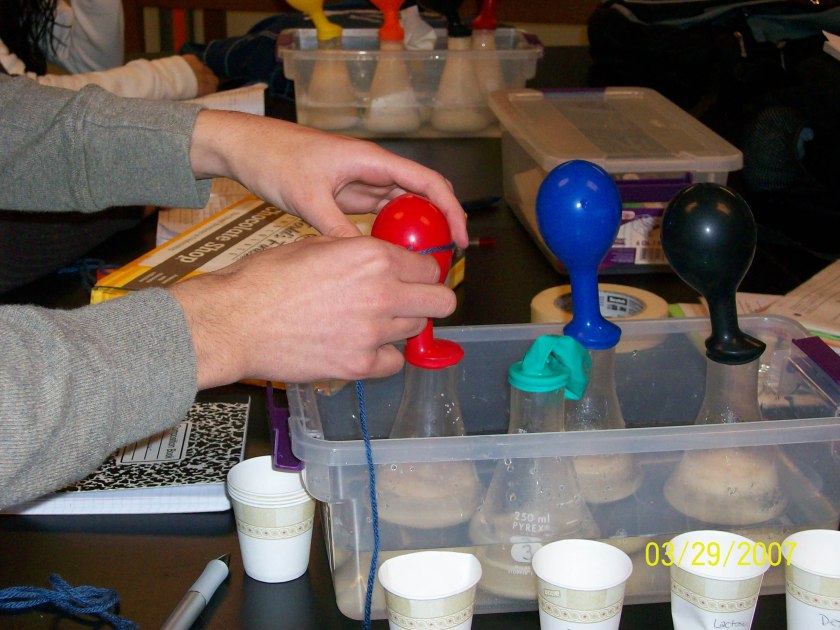
Students doing experiment.
In this lab the students grew yeast in different conditions and then collected the amount of CO2 gas that they produced as a measure of growth in the attached balloons. These students were varying the amount of sugar the yeast had.

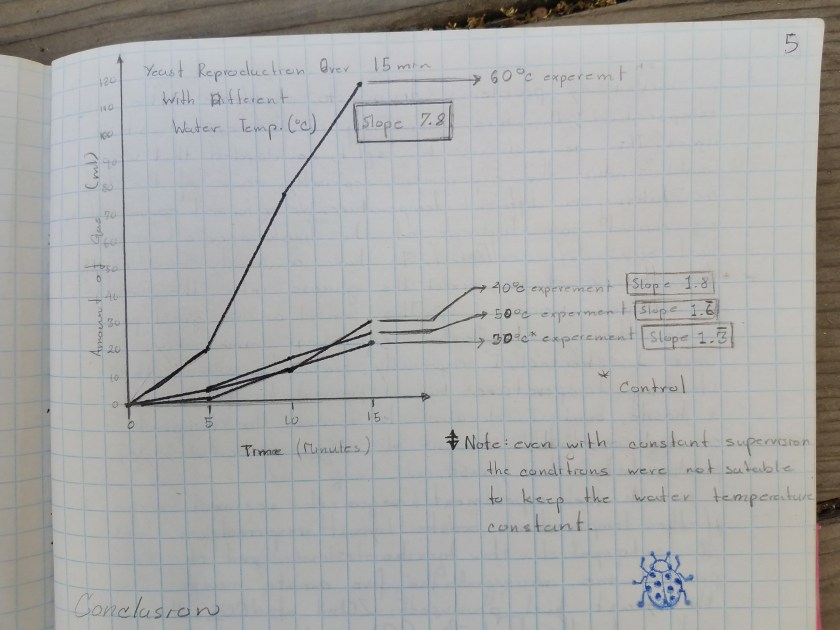
Graph of experiment.
Here’s the graph from a student team that varied the growth temperature. Those yeast sure liked water that was 60 degrees Centigrade! 

The kids liked the experiments, their ability to think scientifically grew by leaps and bounds, and along the way I really learned a lot of things myself. I ended up training other teachers on how to do science notebooking in their own classrooms, and eventually I helped write the inquiry science standards for my state.

Four years ago symptoms that I had been dealing with for years (and decades) overwhelmed me and I was diagnosed with a couple of the autoimmune diseases that I had learned about early in my professional life. Unbelievably, through no real choices of my own, I had been prepared with the background knowledge, resources, and experience that I needed for the fight.

Serendipity.

This is Science and the Scleroderma Girl, the mini-series project of blog posts about the adventures of a science geek in the world of chronic illness. June is Scleroderma Awareness Month, so I hope to put up a new post each day. I hope you’ll join me.

It’s June! Introducing Science and the Scleroderma Girl.

Okay, this is it. I’ve been fussing for over a year about writing a series about science, biology, medical decisions, and navigating safely through a world of alternative medicine and treatments. I’ve come close to launching into a block of mini-rants before, but never went there because it would just take too much energy…

June is Scleroderma Awareness Month. As luck would have it, June has also arrived as I sail back into calm waters following a 6 week storm set off by worsening symptoms, medical testing, and finally a collaborative consensus between my doctors and myself based on data that informs a new course of treatment. In other words, science, biology, and data-driven medical decisions have saved the day. I have lived a life of science in my educational and professional life and this training and way of thinking continues to save the day for me. I do have other skills, of course, but the foundation is always based in science.

I guess I think that it is time for me to share in case it helps anyone else.

Hot Cocoa Rose.
June has brought me the first rose of summer, too. Look at this cutie!

This month I am better. This month my energy is coming back, ideas for topics are swirling in my head, and I think that the time has come. I’ve started a planning grid with all of my topics and resources, and things are starting to come together. Since June is Scleroderma Awareness Month, this is the month that I should do this. If I can put this all together, there will be a post each day this month. With Star Trek quotes, of course!

I did tell you I was a science geek, didn’t I?