The Scleroderma Chronicles: Updates from the Sclero Front

It’s spring here in Colorado. The first baby bunny appeared this week, and the plants in the yard are starting to burst out in green buds. The roses are looking like they are going to do really well this year (except for that one that the bunnies ate…) and there was a huge outbreak of my little bulb flowers in the front garden. I have new cushions for my patio swing, and I sit in the sunshine, reading and drinking my morning latte, every warm morning. On chilly mornings I wrap in a favorite shawl and stay out with the cats as long as I can. The first grasshoppers of the year have arrived for the cats to chase, and the air is filled with birdsong. There are even blue jays!! Good days.

The phlox in the front is looking great!

A couple of day have been so warm I couldn’t stay in the sunshine long and I’ve had to deploy the umbrella shade. Then, the next day, there may be snow. This is spring in Colorado: rapid changes and big temperature swings. The same is true for the barometric pressure; look at what happened this week.
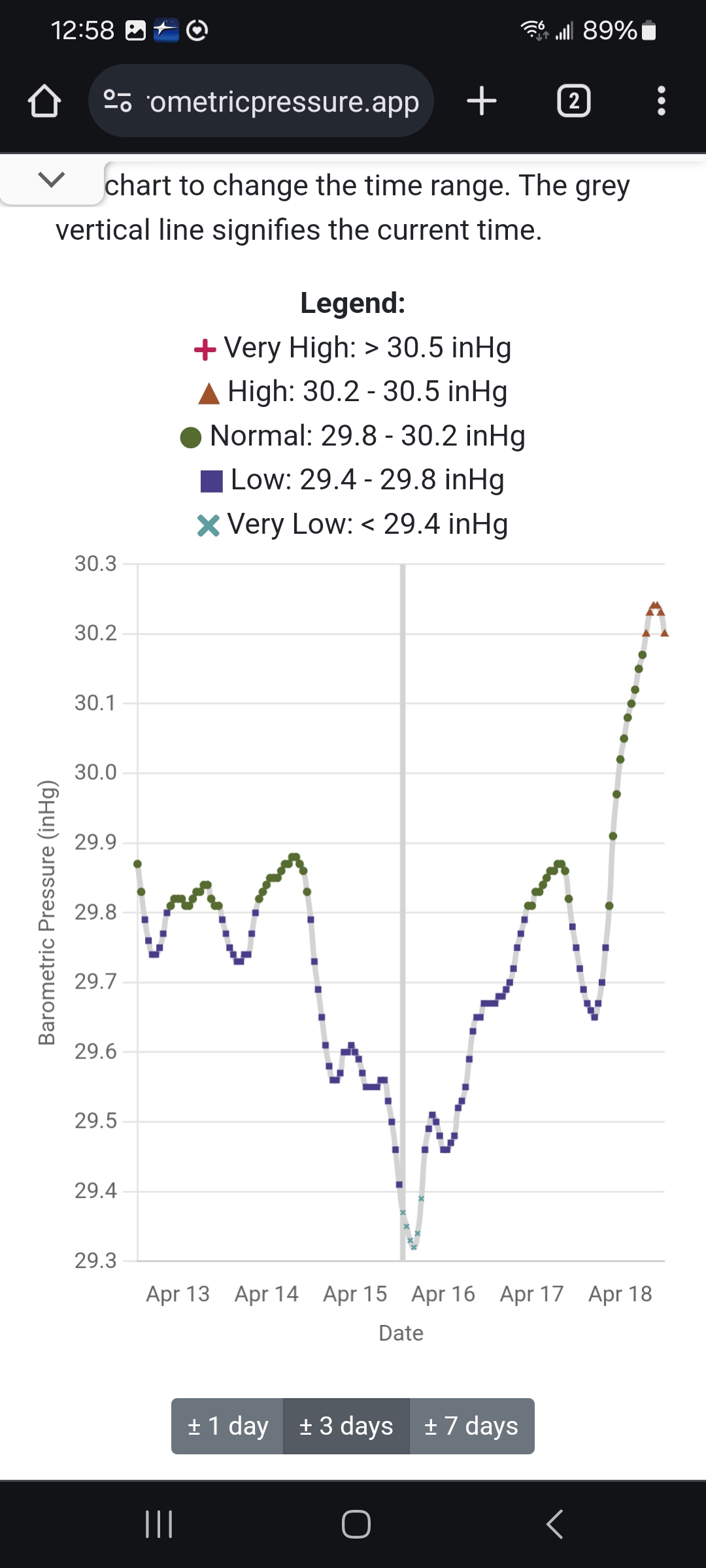
My emotional stability has been a little like the air pressure the last couple of weeks as I’ve gone through a round of testing and doctor’s appointments. I was very upbeat when I went in to get my blood draw to check my iron levels, and the bone density scan last month was just routine. I mean, I’ve been feeling soooo much better: more energy, sleeping better, more mentally alert and even my appetite has improved. Suddenly my gut doesn’t hate me, and I am getting out of the house more. I went to my knitting group for the first time in months! I was positive that my test results would reflect the improvement.

Not so much. After weeks of eating iron-rich foods and downing my iron supplement there was absolutely no change in my test results, and in fact, the test that measures the concentration of hemoglobin in individual red blood cells (MCHC) got worse. Seriously? The only gain was one value of 25.5 that went up to 25.6; still too low. After all that red meat, salmon, iron pills, avocado, and spinach all I got was 0.1 improvement? Kind of disheartening as this means that I have to have some invasive testing to see if I’m bleeding in my stomach (it’s a scleroderma thing), and I don’t think my doctor will put it off much longer. (It’s called watermelon stomach) (fabulous) (of course this is rare) (my zebra self is not happy).

Then the bone density scan results arrived. I have somehow developed a fairly serious case of osteoporosis in a short time span; the report says to start immediate treatment. Then I did some googling and found out that the diuretic that I take can cause osteoporosis, and I absolutely shouldn’t have been taking it because I have a strong family history and I’m kind of high risk. (Of course I am) (I stopped the diuretic) (now my feet are swollen) (my zebra self is crying).

I have to be honest. I was kind of crushed by the bad news that I absolutely did not expect. Then I mentally slapped myself around, did my exercises, potted some lavender plants, and went shopping on Amazon for some cheer-me-up jewelry. Just what I needed to pull myself together. One day at a time, right? I already have more than my share of challenges, so I shouldn’t waste any energy on things that haven’t happened yet. Next week I have an appointment with my internist, and we’ll work out a treatment plan for the osteoporosis and next steps for the anemia. (I took another iron supplement) (my inner zebra has pulled itself together again) (the zebra wants to point out that its lips aren’t as blue as they used to be).
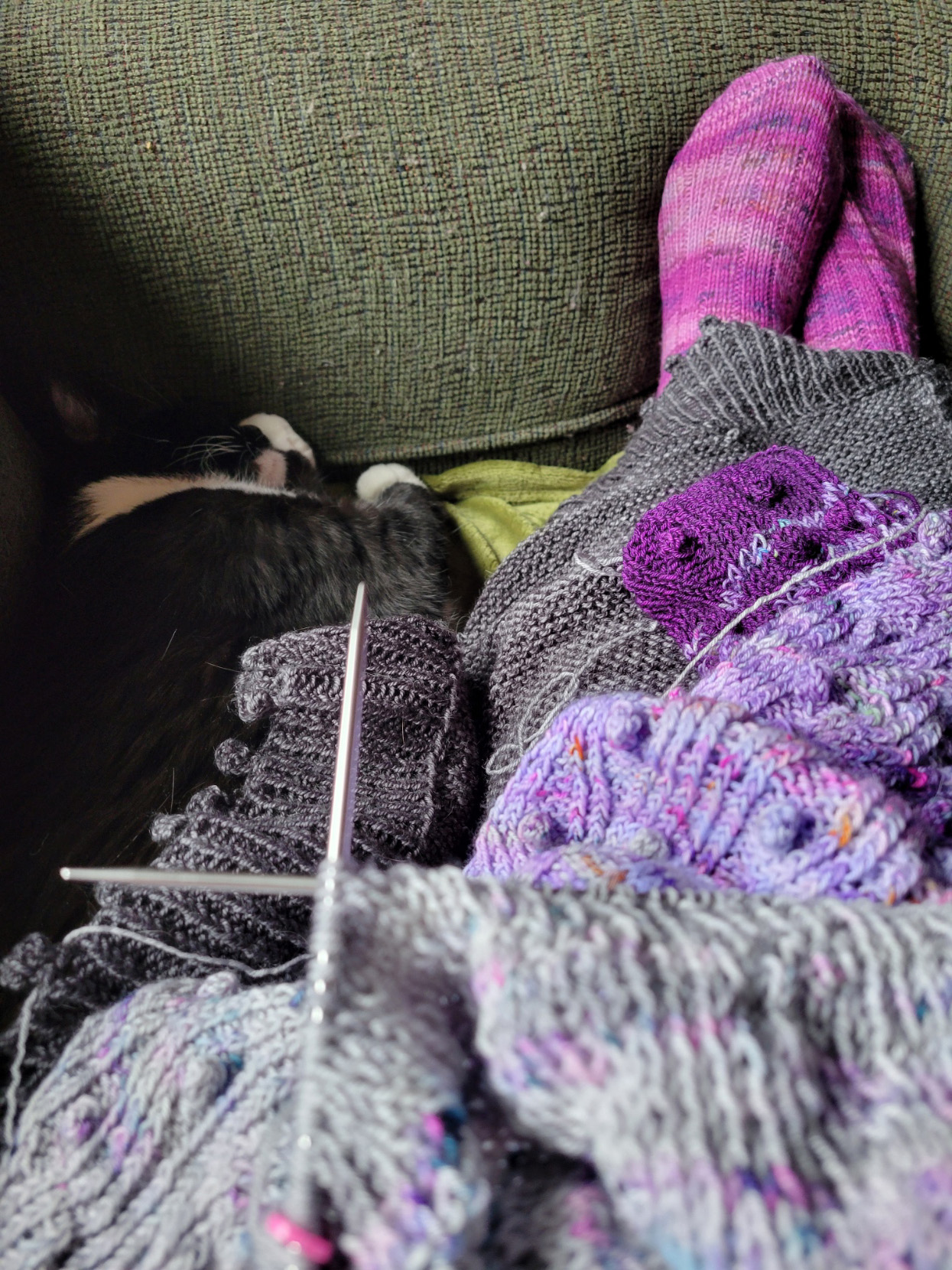
I also pulled out the La Prairie sweater and knit steadily through the sadness until the body came off the needles. Gosh. It looks really nice so far. Something has gone right this week…

Today I woke up to a snow/drizzle mixture that was too unwelcoming for even Mateo to go out on the catio. All my joints hurt, and my muscles weren’t sure if they were going to play nice either. Of course, I had to drive across town to get lung testing and a sit-down appointment with my pulmonologist to go over all my results. I put on my cute Weekender Crew sweater, wore my new “in your face, scleroderma!” jewelry, and headed off for the testing. It hurt to breath as I walked into the building. I convinced myself that it was just the cold air; after all, I feel pretty good, and I was overdue for some good news.

The lung testing specialist is now my friend. We laughed and talked and caught up as she got me ready for testing, and then I breezed through all the parts of the pulmonary function testing and the 6-minute walk test. Every single result was cause for celebration as Stephanie (my technician) became more and more excited with the little graphs and data appearing on the computer screen. “This is better!” she kept saying. By the last test she was practically jumping up and down with excitement. “This is great! This is great! she crowed as she walked me to the exam room to see my pulmonologist. “I’ll let him know that you are here.”

I love this pulmonologist. He is the doctor who first listened to me and picked up on the fact that I had a hole in my heart and pulmonary hypertension. He held my hand and told me I could cry when my interstitial lung disease was first diagnosed. He has always been the doctor who was most honest with me; he told me last year after the tide had turned that they hadn’t been sure I would make it a year. He supported me when I halted the anti-fibrotic drug due to quality-of-life concerns. Today he was all smiles as we went over the results and my exam. My lungs have maintained on the scans. I have regained some lung function. The decision to halt the drug was the right one; there is no obvious sign of fibrosis right now. This is the best possible outcome right now; everything that he hoped for. I was the last patient he saw today, and he was pleased to have such a good one. “Best appointment of the day!” he declared as he walked me out. We were both enclosed in a bubble of joyous happiness as we walked.

I took this picture outside the building.

Outside the clinic the parking lot was almost empty. The cold drizzle was steady, the sky was full of sad lumpy grey clouds, and the gloom of early evening was creeping in. Around the building some ornamental trees were just beginning to open their flower buds, but in the shelter of the courtyard on the south side, the sunniest location, one tree was covered in blooms. Kind of a metaphor for the last couple of weeks. Sit in the sunshine and bloom, no matter what is going on in the world around you.

On the drive home, in my mind, my zebra self was dancing for joy.

The Scleroderma Chronicles: Rare Disease Day, 2022

Well, this is a hard topic to write about. Quite frankly, I have been getting my butt kicked lately by my (wait for it) rare diseases. Still, I am trying to respond to the calls for publicity about rare diseases along with other members of the scleroderma and pulmonary hypertension communities.

You know, I feel like I should represent.

People with rare diseases are referred to as “zebras” in the medical community.

So, what’s a rare disease? A rare disease is classified as one that impacts a small percentage of the total population. Here in the United States that means fewer than 200,000 people diagnosed with the condition/disease. Perversely, there are a lot of people with rare diseases as there are almost 7,000 different rare diseases!  Some of these diseases are common enough that you may be familiar with them: albinism, achondroplasia (a type of dwarfism), and autoimmune hepatitis are examples. Others are very rare. Most are genetic in origin, and half of them impact children. More than 90% of rare conditions have no drug treatment.

The type of scleroderma that I have, limited systemic sclerosis, is considered rare as there are about 100,000 people in the US with this diagnosis. The latest diagnosis added to my medical history is of pulmonary arterial hypertension, another rare disease, and one that is a consequence of my scleroderma. Well, I am really rare now! I have struggled to explain my scleroderma to people when they ask; how can I explain in just a few sentences something that is just frankly causing horrific damage to my body and generating an ever-growing list of diagnosed conditions. Here’s my best answer at the moment:

Scleroderma is a chronic, progressive, uncurable, and often fatal autoimmune disease that causes scaring and damage to blood vessels, skin, internal organs, and muscles/joints. It is controlled and treated through the use of immunosuppressants and drugs that address symptoms. It is a life-altering diagnosis. It is my life.

So, I have blogged about Rare Disease Day several times in the past. Here’s what I wrote a couple of years ago, and what I wrote in 2018. In the past I have written about my symptoms and the struggle of living with a rare disease. It is pretty isolating. It is hard to get diagnosed and treated. I have also written about the difficulties to get funding for research for rare diseases and conditions, and the lack of treatments and cures because the patient population is so small.

This year I thought I would share some of the things that doctors have said to me since my scleroderma diagnosis. I’ve tried to organize these into chronological order to better reflect my journey.

  • My internist: It’s good to have a diagnosis, even if it is a shame.
  • My rheumatologist when I asked him what my life would be like in 5 years: Let me run some more tests, and then we can talk.
  • My ophthalmologist: Do you have a will?
  • The physician at the regional acute diagnostic center: This is a diagnosis like cancer. Of course, some cancers can be cured.
  • A physician speaker at a scleroderma support group presentation: this drug [the immunosuppressant that I take] can really give you a chance, as long as you don’t contract an infection.
  • My old rheumatologist: All you do is complain. Maybe I should order a sleep apnea test or prescribe antidepressants.
  • My internist, as I begged for an anti-inflammatory drug: I’m sorry. There isn’t anything that I can give you that won’t hurt your kidneys.
  • My dermatologist, as she prescribed an anti-inflammatory topical gel: This is unacceptable, and I am putting a stop to it now.
  • My new rheumatologist as she orders more testing on my painful joints: Why has no one followed up on this?
  • My rheumatologist two days later: You need to get a steroid injection in your hip joint as soon as possible.
  • The hip specialist: There is nothing more that I can do for you because your scleroderma is attacking all of your tendons and ligaments. You need a hip replacement, but it will fail.
  • The physician at urgent care: I don’t think they understood how complicated your medical status is when you were referred here. You need to be hospitalized because we can’t do the testing that you need here.
  • My pulmonologist as he walked me back to the waiting room: I really admire your attitude.
  • My cardiologist as I was being sedated for a right heart cath: Don’t worry. I’ll take good care of you.
  • My cardiologist as he started me on medication for pulmonary arterial hypertension: This is challenging, and we will need to be comfortable with “out of the box” thinking.
  • My rheumatologist last week, referring to herself, the cardiologist and the pulmonologist: We are your team!
  • My rheumatologist, also last week: We need to add a gastroenterologist to the team.

You can see how rocky the start was. There is a lesson here, I think. To be rare, to be a zebra in a medical community that is designed to identify the most likely cause of symptoms in a herd of horses, is hard. It is really challenging to secure the care that you need when, no matter how hard doctors try, you do not respond to the usual treatments, and you never fit the usual profile. It is easy to be seen as a problem. It is hard to keep insisting that there is something wrong when all the test results say you are okay.

Even when you are blue-lipped and panting it can be hard to convince doctors that there is a problem.

And yet, it is possible to get there. Over time, with great determination and persistence, I have A TEAM of doctors who view themselves as active collaborators in my care. They message each other to discuss test results and possible drug interactions, and they loop me into their discussions. It is only now, newly diagnosed with a terminal condition, that I feel confident and hopeful about my care.

Today I went in for a blood draw and a little jaunt through the local bookstore. The sun was shining, I bought a Starbucks coffee, and it was a good day.

****************************************

My scleroderma-related diagnoses:

  • GI tract: difficulty swallowing, hiatal hernia, GERD, gastroparesis, chronic gastritis.
  • Kidney: stage 3 chronic kidney disease.
  • Lungs: pulmonary arterial hypertension, interstitial lung disease, asthma, partial lung collapse.
  • Heart and circulatory system: grade 2 diastolic dysfunction (a type of heart failure), Raynaud’s phenomenon, telangiectasia.
  • Muscle/Skeletal: fibromyalgia and severe joint damage.

This is scleroderma. I’m a zebra, and these are my stripes.

Happy Rare Disease Day, everyone!

The colors associated with my diseases are teal (scleroderma), purple (Sjogren’s), and periwinkle (PAH). It sounds like the start of a great sweater, huh. 🙂