The Scleroderma Chronicles: The FDA, the Supreme Court and Unintended Consequences.

The United States Food & Drug Administration has really been on my mind this last week. Let me set the background: I have a rare, progressive autoimmune disease that at this date has NOT ONE SINGLE DRUG that can directly treat it. Not one. There are drugs that target symptoms and the complications of my disease, systemic sclerosis, but none that can shut the disease down.

Over the last few days two alerts about new treatment developments for systemic sclerosis hit my newsfeed. One of the drugs, Certa Therapeutics’ FT011, is designed to treat chronic fibrosis and was just granted FDA Fast Track status. After a 12-week trial 60% of the systemic sclerosis patients had clinically significant improvement: I suspect that they are talking about lung function here. This is huge! This is the drug that I have been waiting for ever since I quit the anti-fibrotic drug OFEV last summer due to intolerable side effects. Fast track status means I may get this drug in another year or so. THIS IS HUGE, PEOPLE!!!! HUGE!!!

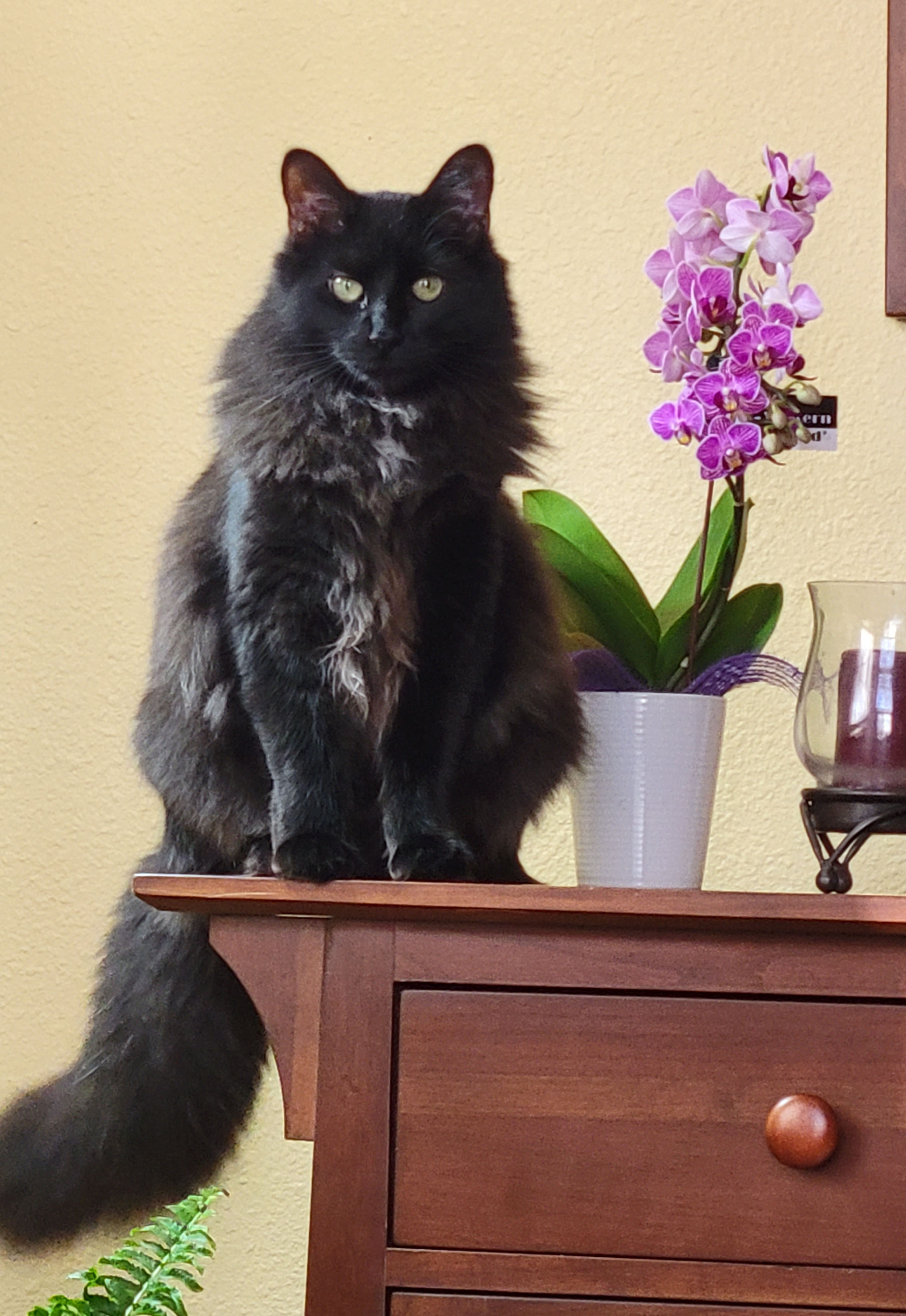
How about a break? Here is my monster orchid 4 years ago today.

Just a couple days after the news about FT011 another news alert, even bigger news, came that Cabaletta Bio’s CABA-201 drug had been granted Orphan Drug status by the FDA. I’m not completely sure, but this seems to be a type of CAR T-cell therapy that would provide an immune system reset: a cure. Did you catch that? A CURE!!!!! The disease that I live with, systemic sclerosis, could be stopped dead in its track if this works. Orphan Drug status provides some financial incentives and helps in bringing the drug to market, but it doesn’t speed up the process like the Fast Track status will for FT011. Still, this is good news arriving all at once. I have a sense that momentum is building as these new, very sophisticated drug treatment strategies come to market based on specific molecular interventions in the patient.

Anyway, none of this going to happen overnight because the FDA approval process is very slow and painstaking. This is the way it needs to be to develop drugs safely. Drugs are first visualized based on knowledge of the regulation and complexities of biological systems. “Oh, that’s a good idea for a drug,” some scientist tells themself, thinking about a regulatory pathway in humans. They follow through on their idea and then see if it works in a specific science-based process that tests the drug in lab, animals and then finally humans to see if it will treat the disease/condition.

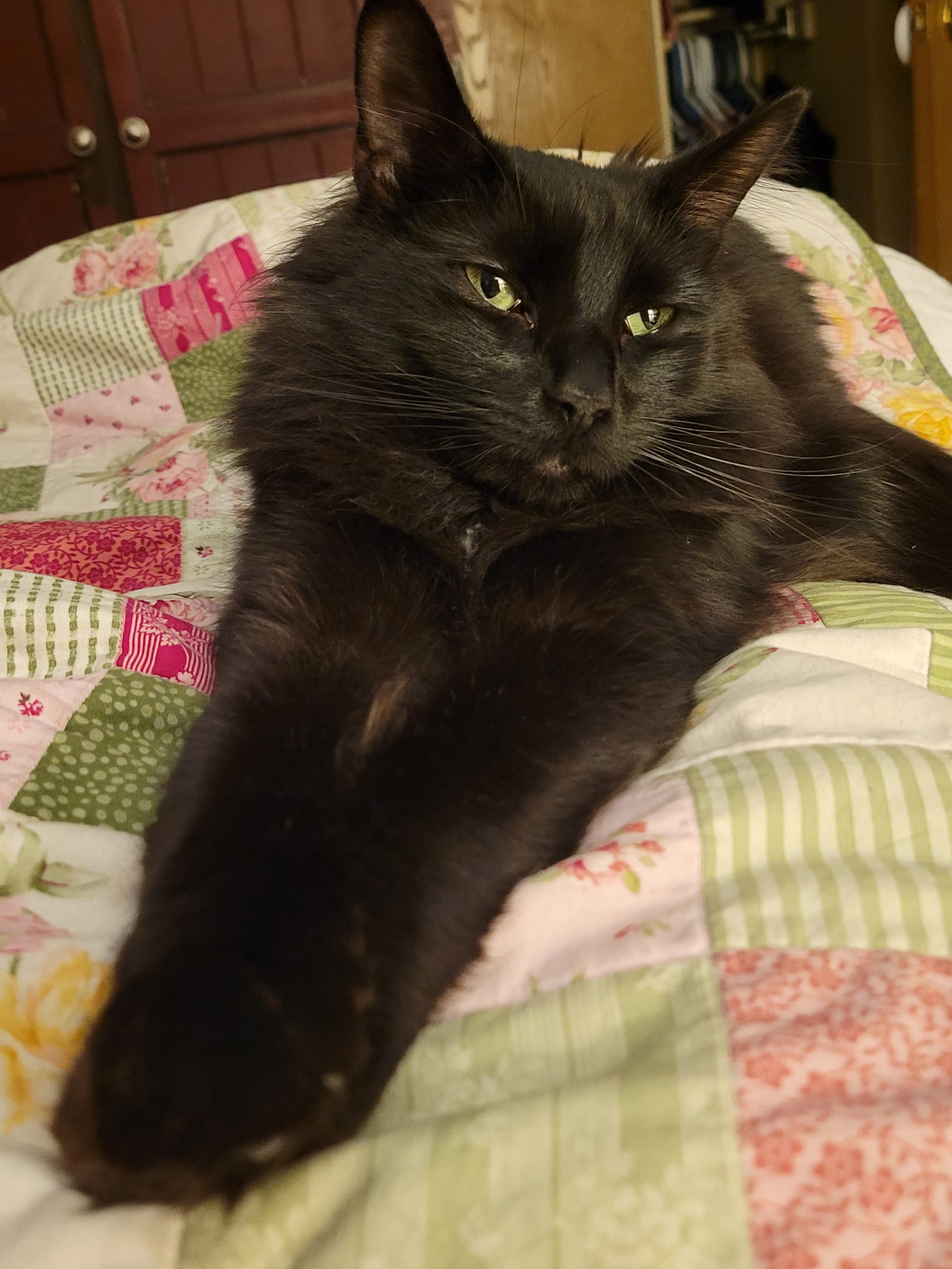
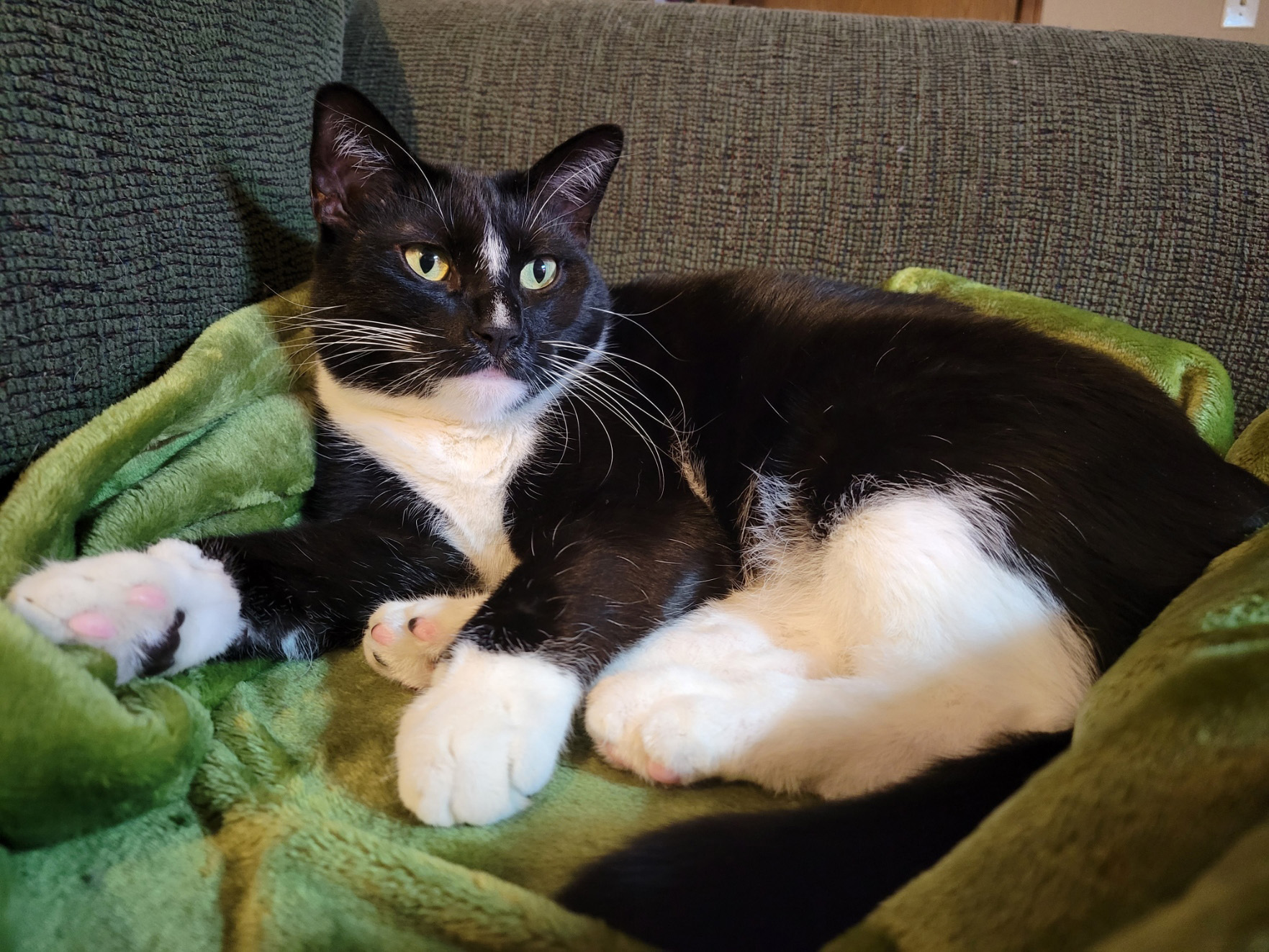
Mateo: Hang on, everyone. The Mother of Cats is going to go all science geek now…

For example, one of my drugs is called Letairis. It is designed to treat pulmonary arterial hypertension, and it is an endothelin receptor antagonist. What the heck is that, you ask? As you might, because who in their everyday life would need to know about this stuff, right? Maybe you should skip this part if you are feeling sleepy… You’re still reading? Wow! I’m so impressed and grateful for your trust… Well, anyway, here is the very short version at the Midnight Knitter level of understanding: endothelin is a small protein produced by the cells lining the inside of my blood vessels that causes blood vessels to constrict. The drug that I take, Letairis, is a sneaky molecule that mimics endothelin; it binds to the receptor on the target site and blocks endothelin, keeping it from attaching to the receptor. The drug prevents my blood vessels from constricting and keeps my blood pressure in my lungs low. Yay!

Anyway, some scientist long ago had an idea that maybe blocking the action of endothelin would be a good way to control pulmonary hypertension. This idea was tested in the lab, then on animals, and then if all seemed okay it was tested on a very small group of humans, and then larger groups of humans. Data is collected and analyzed to look for the efficacy of the drug while also identifying all the possible side effects. There is a lot of risk/benefit analysis before the drug is released to market. After that more data is collected to hunt for bad side effects once the drug is being used in this much larger market.

I guess my point is, this is a long, long process with lots of safeguards along the way. The FDA is the agency that provides the scientific guard rails that protect me and every other drug consumer in the US from bad information, harmful drugs, and unscrupulous people who push pseudoscience treatments in order to make a buck. Thank you, FDA, for providing this essential service for me and every other American whether they appreciate it or not. I’m glad that you do this, even if it means I have to wait for my new drug that is slowly working its way through the process to come help me.

Mateo: Now the Mother of Cats is getting political. Watch out everyone!!

Today the United States Supreme Court heard arguments about the abortion drug mifepristone that centered around its approval by the FDA and the decision by that agency to allow it to be delivered by mail. I’m convinced that the issue has been raised solely because this drug is used for abortions, but the arguments brought before the court are suddenly extremely pertinent to me and my own situation.

I’m pretty sure that not one of the justices on the supreme court is qualified to make a judgement about the scientific process used to develop this drug and the analysis that was made about its safety. Just as I wouldn’t allow one of the large pharmaceutical companies to rule on a matter of law, I am alarmed that the courts are now going to second-guess a science-based agency.

I am also extremely concerned about the court deciding whether drugs can be sent to patients through the mail. It has to do with the ancient, mostly forgotten until now, laws on the books about drugs that can be used for abortions or contraception being delivered by mail.

Remember my drug Letairis? I need it to control my life-threatening pulmonary arterial hypertension that was gifted to me by my systemic sclerosis. This drug has a rigorous enrollment process and requires female patients to use two forms of birth control and to take a pregnancy test every month before they can get the next 30-day supply. Each month this drug is delivered to me by overnight express from a pharmacy in another state. This drug can harm an unborn child and may create the need for an abortion. Suddenly the arguments that were made today before the US Supreme Court threaten me and my access to medical care.

I sure hope that Certa’s FT011’s progress on the Fast Track isn’t affected by all of this. An upended FDA approval process could be disastrous for me and a lot of other people waiting for a new drug to arrive to save their butt.

Unintended consequences are a bitch.

Update 3/27/2024: While I was writing this post yesterday, the FDA approved a new drug for pulmonary arterial hypertension (WHO Group 1). The relief and celebration in the online support communities this morning was pretty amazing. This is good news for me, too, as my PAH is in Group 1. Yay science!!

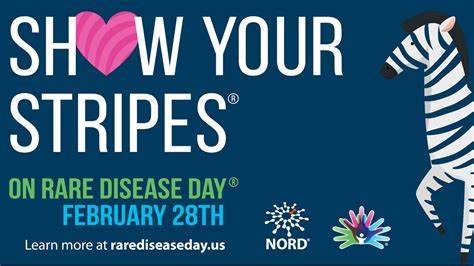
The Scleroderma Chronicles: Rare Disease Day 2024

Rare Disease Day is tomorrow, but since I’m going in for a lung scan on the 29th, I thought I would post this now.

Well, here it is again. Rare Disease Day. This is my 9th year posting about rare diseases: on August 28, 2014, I was diagnosed with a form of scleroderma called limited systemic sclerosis. This condition, autoimmune in nature, is progressive as multiple organs, blood vessels, and the skin of the patient (that would be me) stiffen and harden due to scarring (fibrosis). It is also considered rare, since fewer than 200,000 people in the US are currently diagnosed with it.

So, what’s up with the zebra? Well… in the medical community doctors and other health professionals are trained to focus on the most common cause for the symptoms that they are seeing in their patient. The saying goes: when you hear hoofbeats, think of horses, not zebras. Certainly, that makes a lot of sense in terms of patient care and cost control. It works most of the time.

Unless, of course, you are a zebra.

Life is challenging if you are a zebra in a herd of horses. Doctors screen for the most likely cause of reported symptoms, and then when those tests are negative, you usually get told that you are fine, and then you are pawned off with some pablum like… do these exercises… try to reduce stress…would you like anti-depressants?… Seriously, it is pretty crushing as you start to wonder if you are just an attention-seeking hypochondriac since for the most part you look great. In my case, I didn’t even appear to be aging…

This can go on for years. And years. Autoimmune conditions like mine tend to send patients with vague complaints (I hurt all over…) to the doctor’s office looking for help. Some of the symptoms can be so subtle that you just don’t think to mention them to the doctor because you already feel pretty defensive about complaining after a few borderline disparaging interactions in the past. Why mention that you have trouble swallowing sometimes? Or that your arm is starting to look like Flipper the dolphin in appearance and texture? Some new red freckles have shown up on your face, but why mention them when you really want to get to the bottom of why you hurt all over and what is up with this fatigue????? Sure, there were those carpal tunnel surgeries 10 years ago, and the hospitalization for gastritis last year, but why would you mention them… When I was finally diagnosed, I discovered that I was absolutely classic and presented with all five of the CREST features of limited systemic sclerosis. Oh, one more thing: lack of wrinkles is a red flag for scleroderma…

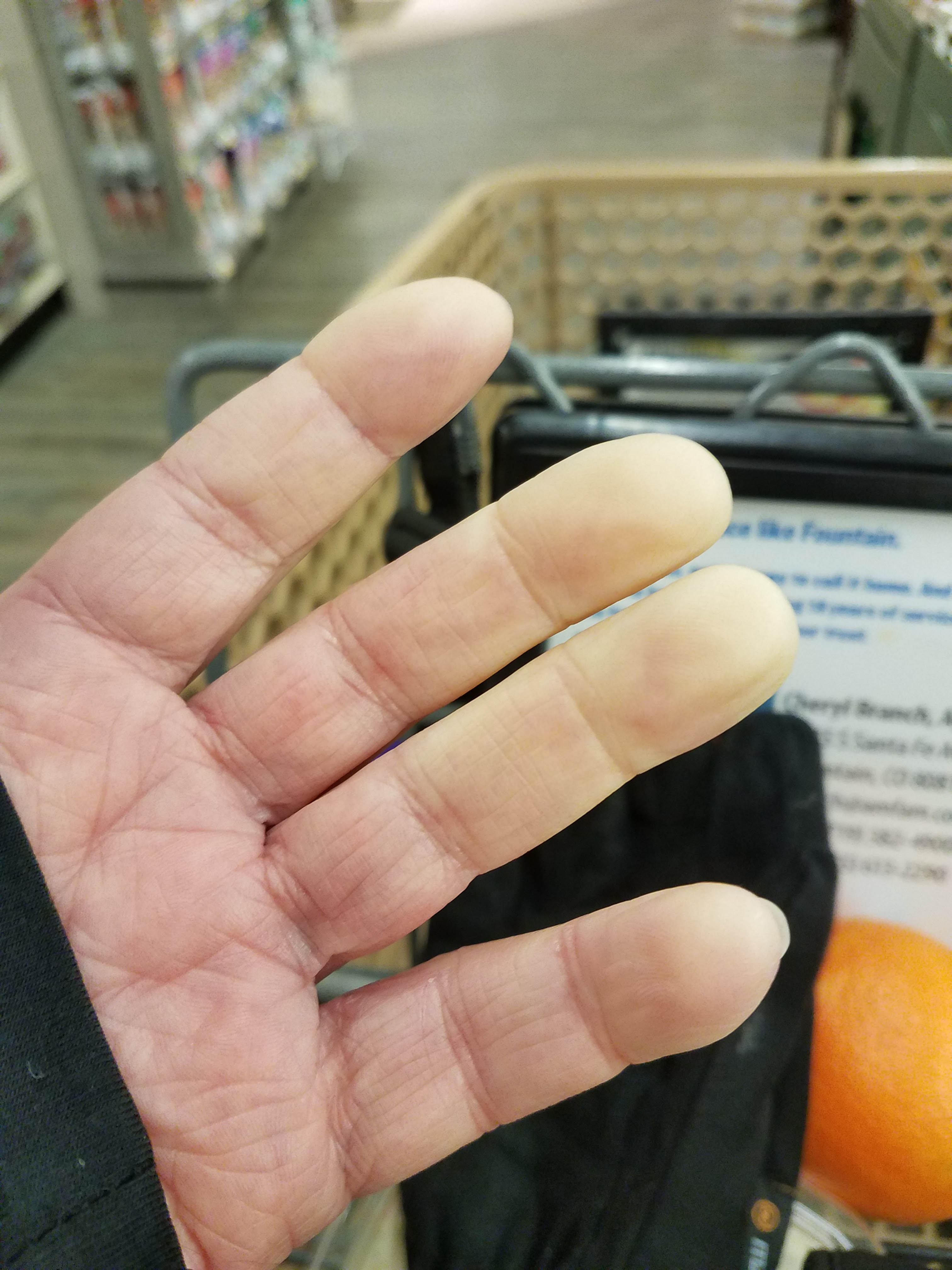
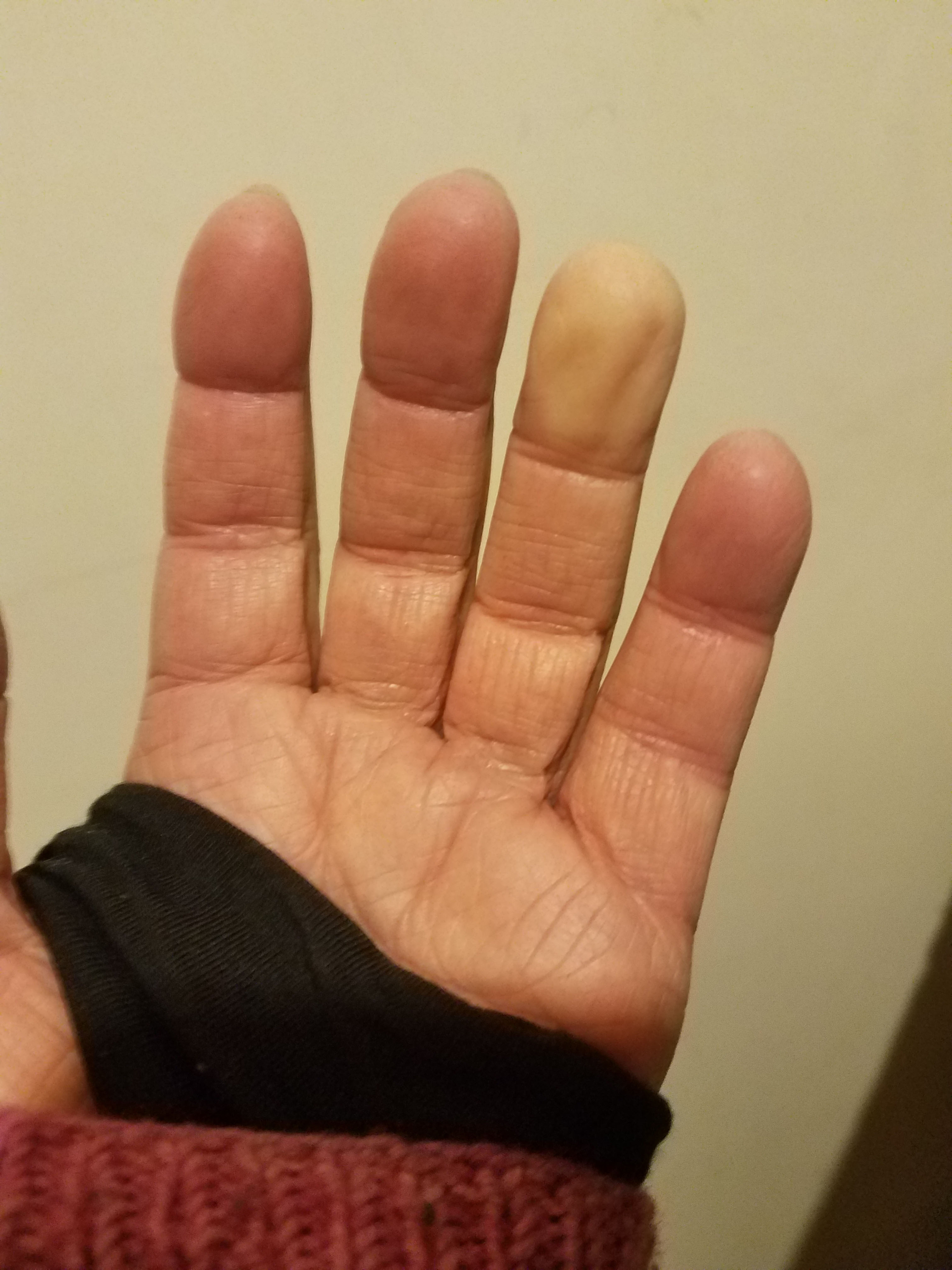
You can see two of the CREST characteristics here. I’ve lost circulation in my ring finger as a result of Raynaud’s, and the thick (sausage-like) fingers that are trying to contract are examples of sclerodactyly. The other distinguishing symptoms are trouble swallowing, lumps of calcium deposits on some of my bones, and those pesky red freckles that are now appearing everywhere. It was official: I was a zebra. There are a lot of us.

Rare diseases are also known as orphan diseases. They are poorly supported and most of the time there is no treatment. After failing a chemotherapy drug, I was moved to an off-label treatment using an immunosuppressant drug developed for kidney transplant patients. It was hard to get the drug as it was declined by my insurance, then the appeal failed, my doctor filed another appeal, and I went to see the pharmacist with a pathology report showing extreme gastritis. It was a fight, but I got the drug. This drug, Myfortic (mycophenolic acid), has proven to be so effective in slowing disease progression that it is now approved for systemic sclerosis and is a drug of choice along with its close relative CellCept. It has been doing a pretty good job at slowing things down; at the time of my diagnosis the 10-year survival rate was about 50%. Now that there are some better treatment options the survival numbers have improved: 10-year survival is up to 70%.

Two years ago, I developed two of the more serious complications of systemic sclerosis (SSc): pulmonary hypertension and interstitial lung disease: two more rare diseases. Not good news at all; my pulmonologist told me it would be okay to cry as he showed me my lung scans and gave me the bad news. Remember that little word “progressive” that I used to describe SSc? This is disease progression; the inflammation and formation of scar tissue (fibrosis) had hit my lungs and heart, and my have doctors responded with big time drugs. Yes. Big time and pretty expensive drugs. Over the last few years, literally in the time since I was first diagnosed, drugs have appeared that can greatly improve treatment and life expectancy in patients like me, and there are more drugs in the pipeline.

The first drug that can be used to directly treat SSc just moved from orphan drug status to the fast track. This is serious, serious good news. I looked into entering a clinical trial for this drug, but my doctors thought that I wasn’t a good candidate because I have too many complications right now. Seriously, I have been slotted into a diagnosis called SSc-ILD with PH which means that I am a SSc patient with interstitial lung disease and pulmonary hypertension. Good grief, I’m now a walking bundle of acronyms. That’s okay. I can hang on, help is on the way!! FT011, I am waiting for you!!!

So, what is up with all the colored stripes?

Serious medical conditions usually have an awareness ribbon color. It is a little cheesy, but if you are dealing with scary stuff, why not have some fun? Be a zebra, color your stripes in your awareness colors, and get yourself some fun t-shirts while you are at it. Eat Zebra Food (that would be black and white striped caramel popcorn to you non-zebras), get colored medical bracelets, and collect the stuffed animals. Zebras, of course!! My zebra has teal stripes (scleroderma), periwinkle stripes (PH) and purple for the ILD. Lung disease in general is green and blue. I also get purple for my Sjogren’s and fibromyalgia, and don’t forget the red for my heart failure. I’m a rainbow zebra!! Yay!

Okay, time to get serious. What is Rare Disease Day about? Raising awareness in the public about the challenges of living with a rare disease. There are a lot of people who have rare diseases, so by sharing our faces and voices the hope is that it will help make us more visible. We hope that a more educated public will aid in the diagnosis of others with rare conditions. (See above; diagnosis can take years. It would be wonderful if that could be sped up a little…) We hope it will help with funding for drugs, treatments, and maybe even cures. We hope that for those with invisible conditions, they will become more visible and supported. We hope.

MacKenzie and me from 2018.

To learn more about my rare conditions and others you can go to:

To everyone who battles on against scleroderma or any other serious medical condition, rare or not, I see you. Hugs! Shine on, my friends, shine on!

The Scleroderma Chronicles: Thoughts on the Night of the Blue Supermoon…

Did you look at the moon tonight? It is just huge, shining in the night like it knows that it is something special. Well, it is. This is the Blue Supermoon of 2023, my friends. Not to be seen again for 14 years. Just the sight of it makes me feel happy.

This is also the anniversary of the day that I was told that I had systemic sclerosis and Sjogren’s Disease. Actually, it is 9 years and one day since I drove to my first rheumatologist appointment; I was a little emotional that morning as I passed fields of beautiful sunflowers, their faces glowing in the light of the morning sun rising behind me. You’d think that the date would be kind of a bummer, but nope. As it turns out, there are lots of things that are making me feel happy at the moment.

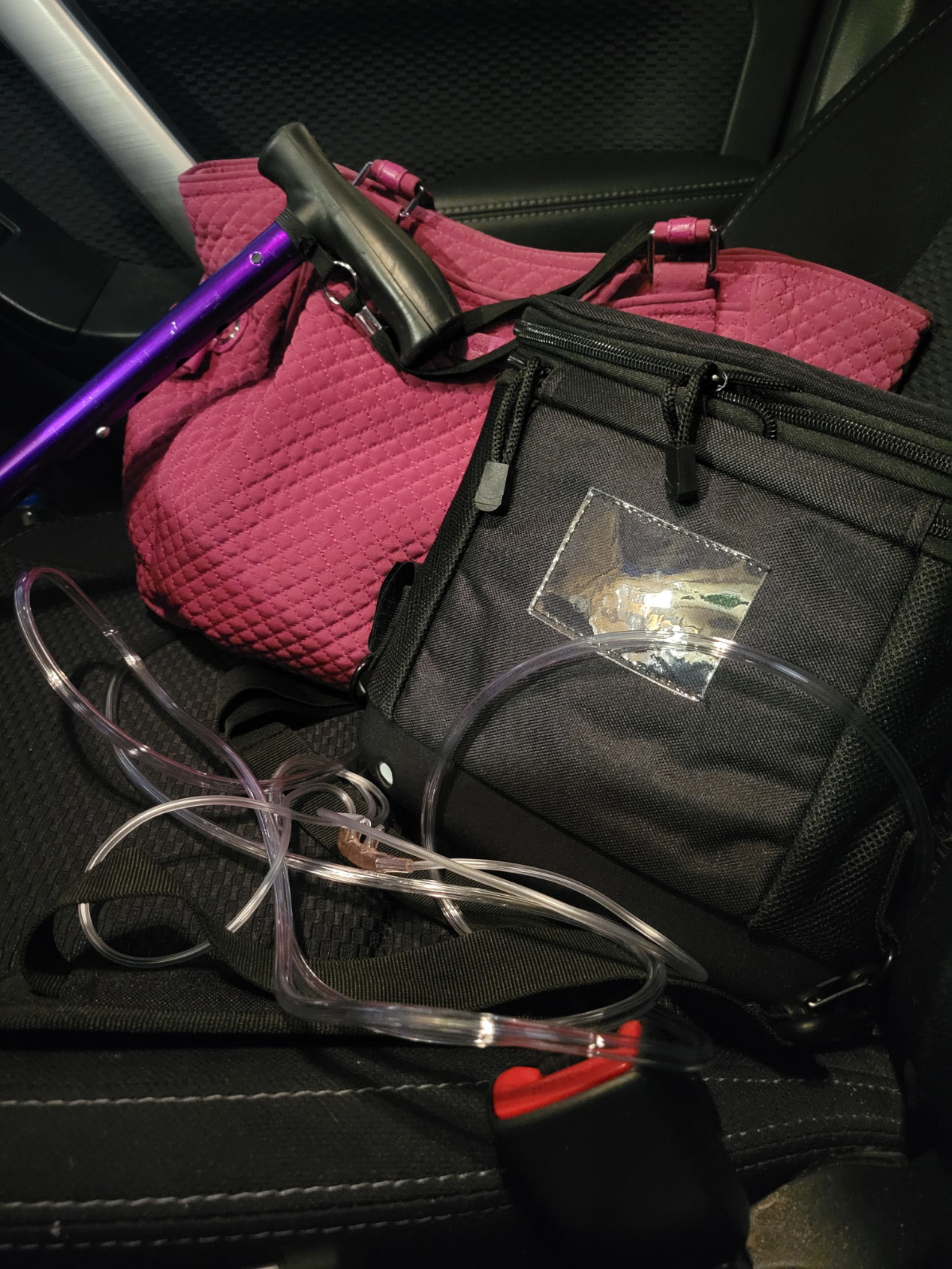
Do you see that black bag with my purse and cane? That is my portable oxygen concentrator!

That’s right, after languishing for 18 months on the waiting list, my name came up for the portable oxygen concentrator that I have been desperately needing. Look at that baby!!! It only weighs 5 pounds, it works great, I can adjust the level of flow on the fly, it can charge in the car, and it is exactly what I need. Yay!!! I got it yesterday on the exact 9-year anniversary of my diagnosis.

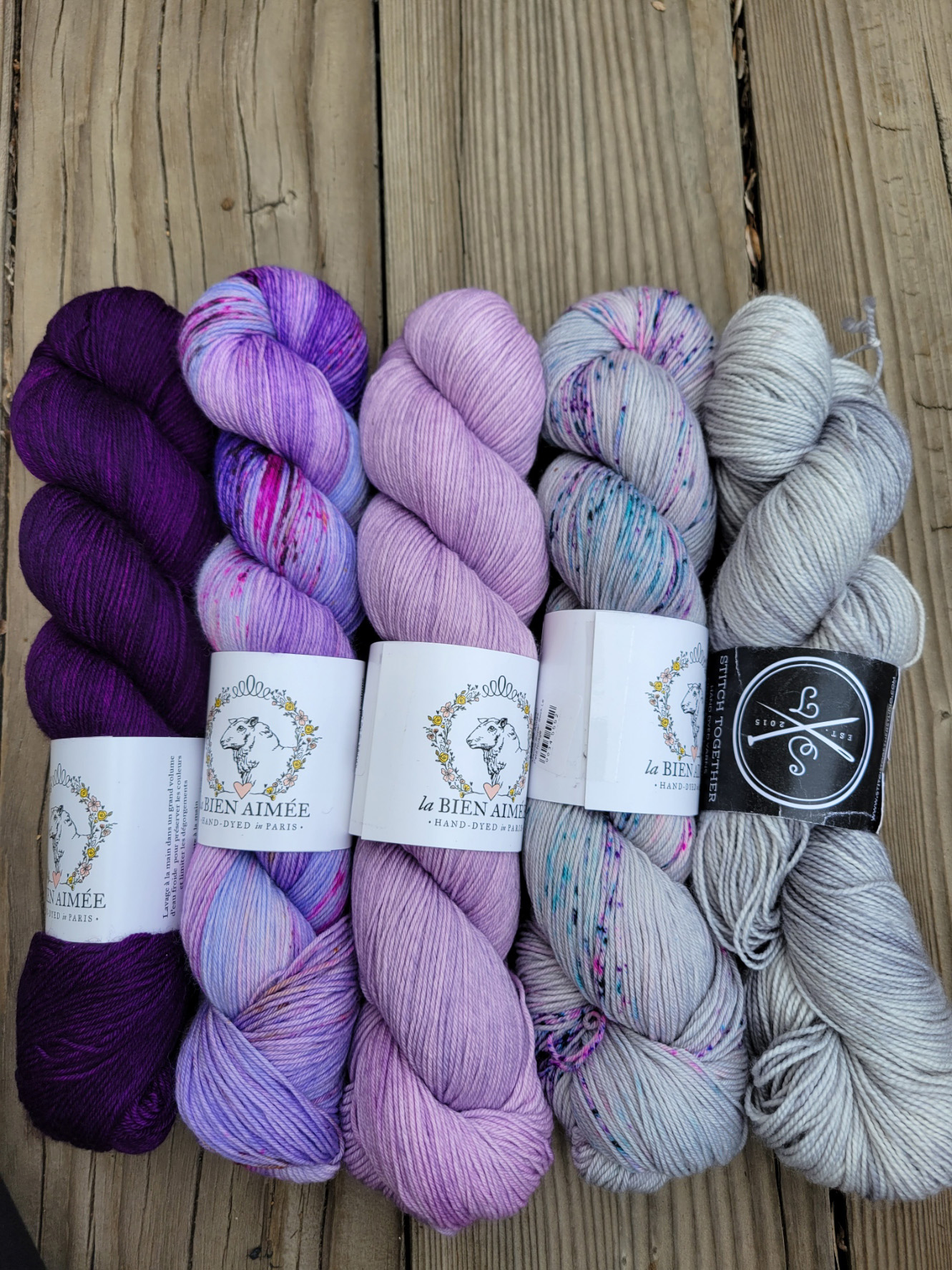
So happy, feeling absolutely empowered, I headed to the yarn store after picking up the concentrator. Time to take this baby for a spin, right? I have been struggling for months to make a decision about the yarn for the La Prairie cardigan that I want to knit next. I bought a kit of yarn to make the cardigan, but I’m not happy with it. I needed a new skein to go into the mix…

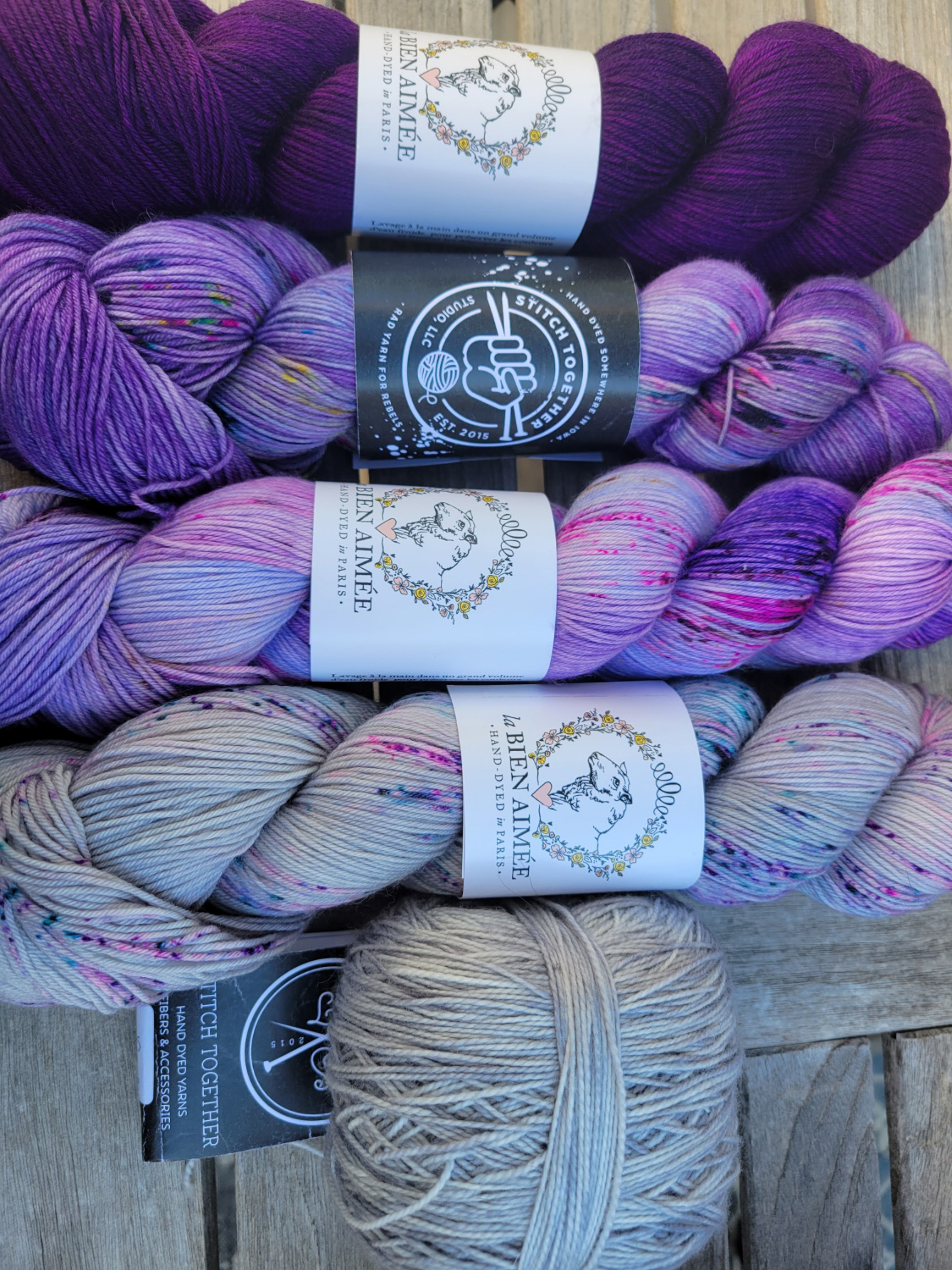
The yarn picture on the left is the original kit. The one on the right is the new variation that I’m not completely happy with. Feeling hopeful and more than a little determined, I sat on the floor in front of the most likely candidate yarns and, rocking my new O2 concentrator, holding up my phone with the yarns on the screen, I kept looking at different ideas for the fade…

Bingo! I found my yarn!

Winner, winner, chicken dinner! I suddenly realized that the Stitch Together yarn (second from the top) was exactly what I was looking for. There it is. I asked others in the store what they thought, and the consensus was that I had nailed down my fade. Yay!!! Finding that yarn made me happy.

So, I also bought the special edition Babe set from Spun Right Round.

I’m going to make that Barbie pink yarn into hats for the community knitting group that I knit for because… wait for it… the color makes me happy!! I had one of the original Barbie dolls, and just the thought of Barbie makes me… happy!

On the way home from the yarn store, still sucking down oxygen in the car and feeling pretty good, I stopped at the grocery store to buy some tiramisu because I was absolutely having a tiramisu kind of day, and there at the front of the store were sunflowers. You know, it is the end of August, and it is sunflower time. Shine like a sunflower!!

Pretty good looking, huh. Sunflowers are used as a symbol of scleroderma hope in some parts of the world (Hello, Australia! Talking to you!), and you know I bought these too.

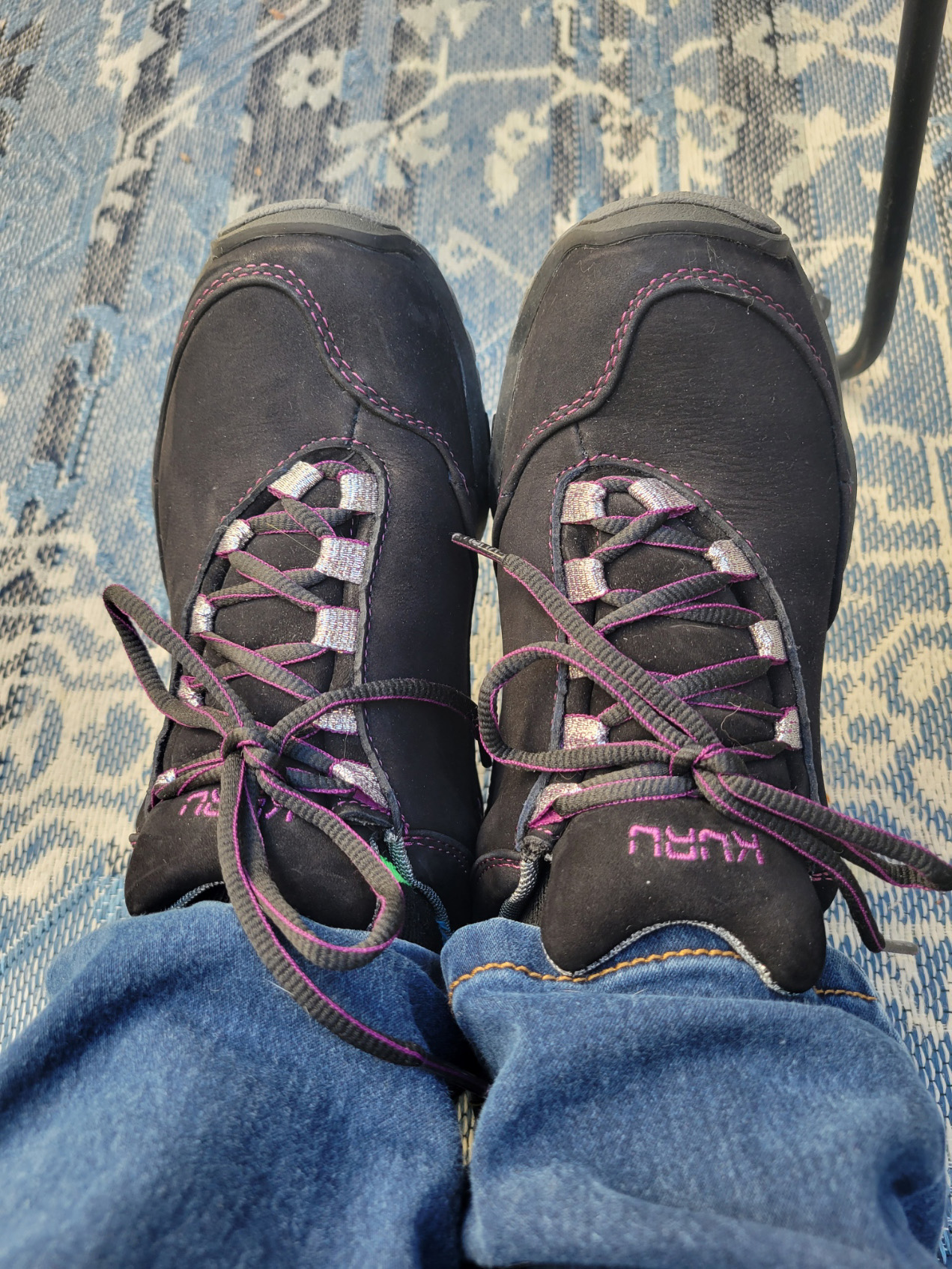
By the time I got home I was tallying up all of the things that made me happy. The leaves are starting to change on the trees in town, and the ornamental grasses are covered with rich golden plumes atop bright green stems. That makes me happy. Pumpkin spice is back at Starbucks. The kittens loved the new toys that I bought them. I ordered new clothes this week that fit great even though they are a smaller size than usual. I found new shoes to wear that are really helping a lot. Happy. I am happy.

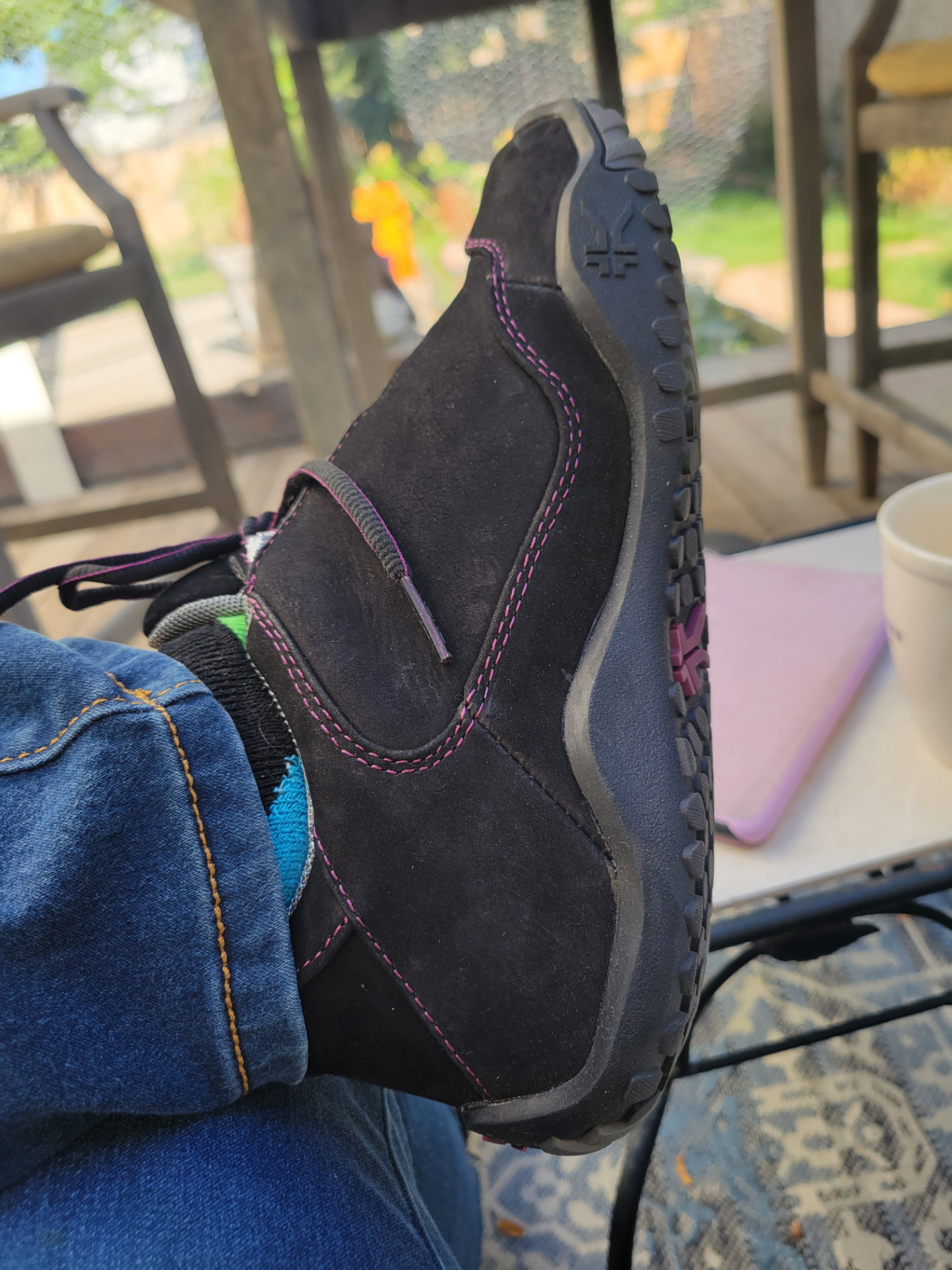
The shoes are shaped like walking boots on the bottom, but inside there is great arch support and a cushy insole. I am walking now with much less pain. Did you notice the purple detailing and the silver loops for the laces? Happy. These are happy shoes.

Once home, I headed outside to the catio with my yarn, the tiramisu, and a cup of coffee from my new Keurig machine (yep… happy), and as I set the plate and coffee cup on the table, a pair of adult cottontail rabbits raced around the corner of the deck and zoomed under my side gate. Looks like I will be having baby bunnies again. I am happy.

Nine years ago, I asked that first rheumatologist what my life would be like in five years time. He refused to answer, and it was my first clue that I might be in some trouble here. 18 months ago, my pulmonologist told me it was okay to cry when the first lung scans showed serious interstitial lung disease. One year ago, my pulmonologist told me that they were very worried about me after my lung biopsy… nothing was working, and he wasn’t sure I’d make it. Last month, the technician who did my latest pulmonary function test told me that I was too bad to walk any longer without portable oxygen. I came home, looked at the bottles that are too heavy for me to carry, and cried.

Tonight, under the blue supermoon, with sunflowers on my table, I am happy. One month later, I have my portable oxygen. 18 months later, my lung disease appears to be stable. 9 years later, I’m still here, rolling with the punches of new complications, facing down the monster, and finding ways to shine.

I am happy.

Shine on supermoon, shine on.

The Scleroderma Chronicles: Bioethical Dilemmas and Unintended Consequences

I was a biology teacher in the time of the Human Genome Project. This week, with the coming release of the newest movie about Oppenheimer and the development of the atomic bomb, I’ve been thinking about the DNA and genes again (I know, it is a biogeek thing…), because one of the candidates running for the Republican nomination in the US wants to cut the Department of Energy if elected.

Kind of a loose chain of threads, you’re probably thinking. Am I right? Well… the Department of Energy is the agency that is responsible for the regulation of the nuclear energy industry in the US. There’s a lot of waste coming out of those nuclear reactors, and there was some concern about how much mutational damage was being done to DNA through exposure to radiation. Well, to figure that out, you need to know what undamaged DNA looks like. The initial drive to figure out what the human genome looks like came from that agency and once the results came in early this century the world completely changed. Like a big change. Like an atomic bomb level change. Like, there are now sites that have huge depositories of biotechnical data and tools to aid in research.

Hannah’s World: no big changes here!

In the classroom we biology teachers began to teach about the Human Genome Project and also did a week-long unit around the ethical problems associated with this new knowledge (bioethics, if you will). The kids grappled with dilemmas like… if you had the gene for a fatal, untreatable illness, would you want to know? If you were a child at risk for this gene, would it be okay for your parents to have you tested for it before you are 18? If your unborn child tested positive for this condition, what would you do? Would it be okay for human organs to be grown for transplantation? Who should get the transplant… a single father of 4, or a 16-year-old student in your high school? Should your employer allow you to continue in your airline pilot job if a genetic test shows you are high risk for a sudden cardiac event. Should genetic test results be private? Whew. Lots to grapple with in this unit.

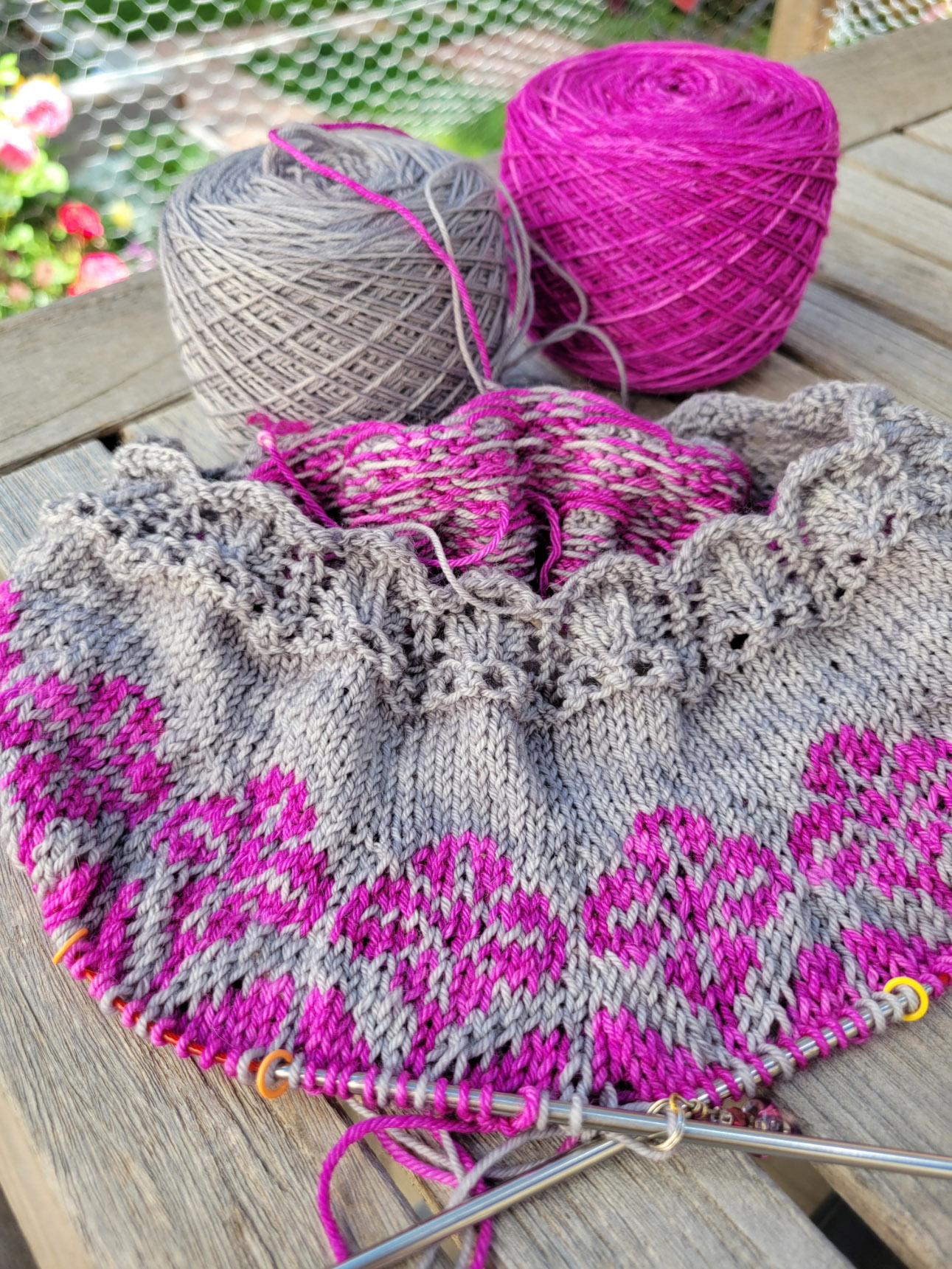
Makes your head hurt, doesn’t it. Check out my knitting progress this week!

So, shit kind of got real this week. One of the members of an online support group for pulmonary arterial hypertension (a progressive and fatal heart/lung condition that I have thanks to systemic sclerosis) has just been identified with a gene (bpmr2) that causes the condition; her PAH is caused by this gene and can be inherited; she has a different type from me, but it is still PAH. Oh, boy. This is not good at all. The life expectancy right now is up to about 7 years, but you only need one copy of the gene to be at risk for PAH… there is a 50% chance for each of her children that they inherited the gene. Only 20% of people with the gene will develop PAH, but that is still a big risk.

Should she tell her two children? she is asking in the forum. They are in their late 20s. If she does, and they get tested, should they have their own children if they have the gene? Her heart is broken, literally.

Life expectancy has greatly improved over the last few years with new medications being generated in the modern climate of expanding cellular and molecular biological information. Untreated PAH (and PH kind of gets lumped together with it according to my pulmonologist…) has a life expectancy of about 2.8 years… not good.

Rose break! By the end of the discussion thread, she was leaning towards telling the kids.

Which brings me to the next shitty bioethical item that occurred this week. One of the members of another support group caught Covid and had to go off her drugs while fighting the virus. She has been slow to recover, and still feels pretty bad, but she took a pregnancy test and restarted her medications again a few weeks ago, only to discover this week that she is actually 12 weeks pregnant. Why did she have to take a pregnancy test before restarting her drugs? Because some of the drugs used to treat PAH can cause extreme damage to a human fetus. The enrollment process is very strict, and every effort is made to keep patients from this situation.

I am in grief for this woman. The doctors think that the baby has been spared the worst of the drug toxicity, but now she is working her way through whether to abort or not, to restart her drugs, or not. To risk death to save the baby, or to abort and restart treatment. If the baby is born in good health, will she live long enough to see it enter kindergarten. If the baby is born with health problems, her medical burden is increased. She is young. This is a horrible mess, and she is already too far along to get an abortion in many states in the US. I don’t know if she has other children, or what her support structure is…

This week I heard that some states are demanding private health records to identify any out-of-state abortions or transgender care that has happened in another state. I hope that this woman lives in another country…

Then I heard that a popular hamburger joint near my home is now going to fire employees who wear a mask. Say, WHAT?! Let me tell you, any person who has a serious lung/heart condition like mine wants to wear a mask, and they are so grateful if the person at the service window is also wearing a mask. Sometimes people offer to put on a mask when they see that I am wearing one. Now that person can be fired for putting on a mask… remember the young PAH patient whose nightmare began with catching Covid? Truthfully, any random virus can cause serious damage to patients with PAH, especially if they are also immunosuppressed.

So, there are a lot of bioethical dilemmas here, and the unintended consequences of people who want to make sweeping decisions without understanding all the interlocking systems involved and the potential ramifications are staggering. NO, you can’t just disband the Department of Energy, and sweeping, inflexible decisions about reproductive issues (that seem to be smugly self-righteous to me) can be disastrous. It is easy to order up genetic tests, but what happens once you have the information can be life-altering.

And don’t get me started on this animosity towards mask wearing…

I can’t help but think that no one should attempt to enact legislation without suffering through experiencing something like the bioethics unit that was taught at the high school where I used to work. I keep wondering, do these legislators actually understand nuclear power and weapons? Have they heard of the Human Genome Project? About gene testing? About rare diseases? They absolutely need to go see the Oppenheimer movie, maybe, and then write me a report about the Human Genome Project. I’m pretty sure that they would struggle with epigenetics, but it would do them good if they looked into it. They can get extra credit for a summary of pulmonary arterial hypertension. I would like to give them a book list of summer reading to get through on their breaks, because only the well-informed and educated should attempt to make decisions about these issues in the seven levels of bioethical hell that is the life of patients like me.

Because this week was a really hard one; for too many people this shit is real.

PS: Have you seen the show House? I kind of think that he could use a little bioethics sensitivity training, too.

You all be safe out there!!

The Scleroderma Chronicles: Be a Rose.

So, I got a little testy in one of my Facebook support groups for systemic sclerosis this morning. A member of the group kind of disparaged me and another person for not being positive enough. It was “you need to refuse to let scleroderma define you” in response to the first person sadly saying that she missed her old life, and me giving her an online hug with the comment that if only a positive attitude was enough…

In my defense I had just experienced a Kaiser employee visibly reacting to my lack of wrinkles. As in, wow, that’s great! Like not having wrinkles makes this all worth it.

I lost another 4 pounds at my last check-in, which is concerning, but the nurse was thrilled for me. Me, I was a little teary at the continued loss.

Um, people… do you think that you might be a little shallow here?

I was out on the deck/catio with the cats drinking my morning latte when I hit this emotional wall, and after I had fired off the somewhat testy response, I spent some time in the garden. There were my roses, blooming like the utter champs that they are.

This is my Princess Alexandra of Kent rose.

This rose is looking great this year. Never before has the plant been able to hold up the blooms without the weight pulling the stems over. The problem is our semi-arid climate with hard winters; the plant grows back from the roots every year and it doesn’t have time to put in enough supportive tissue to hold up the blooms. This year, with all the rain and cool weather that we have had, the plant was able to put in enough of this tissue to do the job. The tissue that I’m talking about, a type of ground tissue, is called sclerenchyma. If you’re ever snapped a celery stalk in half and pulled out the strings, you were pulling out sclerenchyma tissue. This tissue is made of dry, hardened cells in the stem of the rose and I suspect that the “scler” part of the word is of the same origin as scleroderma. Look at that. The hardened cells are doing something good for this rose!

In me, not so much. Things have been a little difficult as my poor heart and lungs are not benefiting from the hardening and thickening going on in the cells and tissues of those organs. All of my tendons are seriously pissed off at the moment. Edema has become a problem, and it is becoming increasing clear that I need to stay on oxygen 24/7.

That’s my arm with the imprint of a quilt in it, in case you didn’t immediately recognize it… Edema is kind of a tip off that my heart is struggling and that’s new. The weight loss is also related to my heart/lungs because if oxygen isn’t getting down to my cells like it should, they can’t use energy efficiently, and then, you know, weight loss occurs. The tendon issue is scleroderma actively attacking them and gradually hardening them to bone. Bad scleroderma, bad!!

But look at how great these roses look!

So, what did I say in my testy response? Reality bites. Some of us have progressed to the point where we have to admit that no amount of positive thinking will allow us to attend that family function that we were invited to, or to visit the annual Wool Market in the mountains, or to even walk to the mailbox. To suggest that we could do things if we just had a more positive attitude is hurtful and not supportive. No matter how much you want to believe otherwise, scleroderma does define me and everyone else who is dealing with it. Courage requires us to face down the monster and to accept the reality of our disease. How we choose to function within that framework is up to us.

I may no longer be as mobile as I once was, and the life that I used to have is now mostly gone, but I choose to continue to bloom in place.

Like a rose.

Updates/Notes from the ScleroFront:

  • Do you like to wear linen? Those fibers are from the water tubes (xylem) in the flax plant, and made of sclerenchyma.
  • The bunny-murdering neighbor put her house up for sale!!
  • My Alpine Bloom sweater is coming right along!

The Scleroderma Chronicles: Carrying Light

You know, I think that synchronicity is a real thing; you just have to pay attention to what is going on around you. Sometimes, if you take notice, the world hands you just what you need at that moment.

Scleroderma has been kicking my butt lately. Having improved dramatically over the summer and sailing through my heart/lung testing last fall, my doctors were pretty upbeat when I reported worsening symptoms while visiting them in late winter. They ordered some testing, but they were also very reassuring.

A week ago I arrived at a Kaiser facility bright and early for a routine echocardiogram and 6-minute walk test. The echocardiogram did not go well (usually they don’t hurt, and what was up with having to pause so I could pant a little to catch my breath…) and I was in the red zone (the pulse oximeter starts glowing red if your oxygen drops below 90%) after a minute of walking. The test was halted after 3 minutes, and the concerned nurse walked me out to the elevator.

Ugh. Not good, little BLZ, not good. Refusing to overreact, I went to my favorite yarn store on my way home, bought some great yarn, and then hit Starbucks by my house. It was a bright, blue day and I headed out to the deck to knit.

I took this picture of Hannah. Look at that bright, blue sky!

Do you know the quote by Elizabeth Zimmerman that goes “Knit on, with confidence and hope, through all crises.”? Yep. That is a quote to live by! I cast on a new hexagon for my blanket and started knitting. I felt myself settle inside, my breathing steadied, I began to process what had happened, and my anxiety faded away. Scleroderma is a monster, and by the time I was casting off the hexagon, I was ready to once again face it down.

This post had appeared in my knitting group on Facebook from Michelle Obama a few days before:

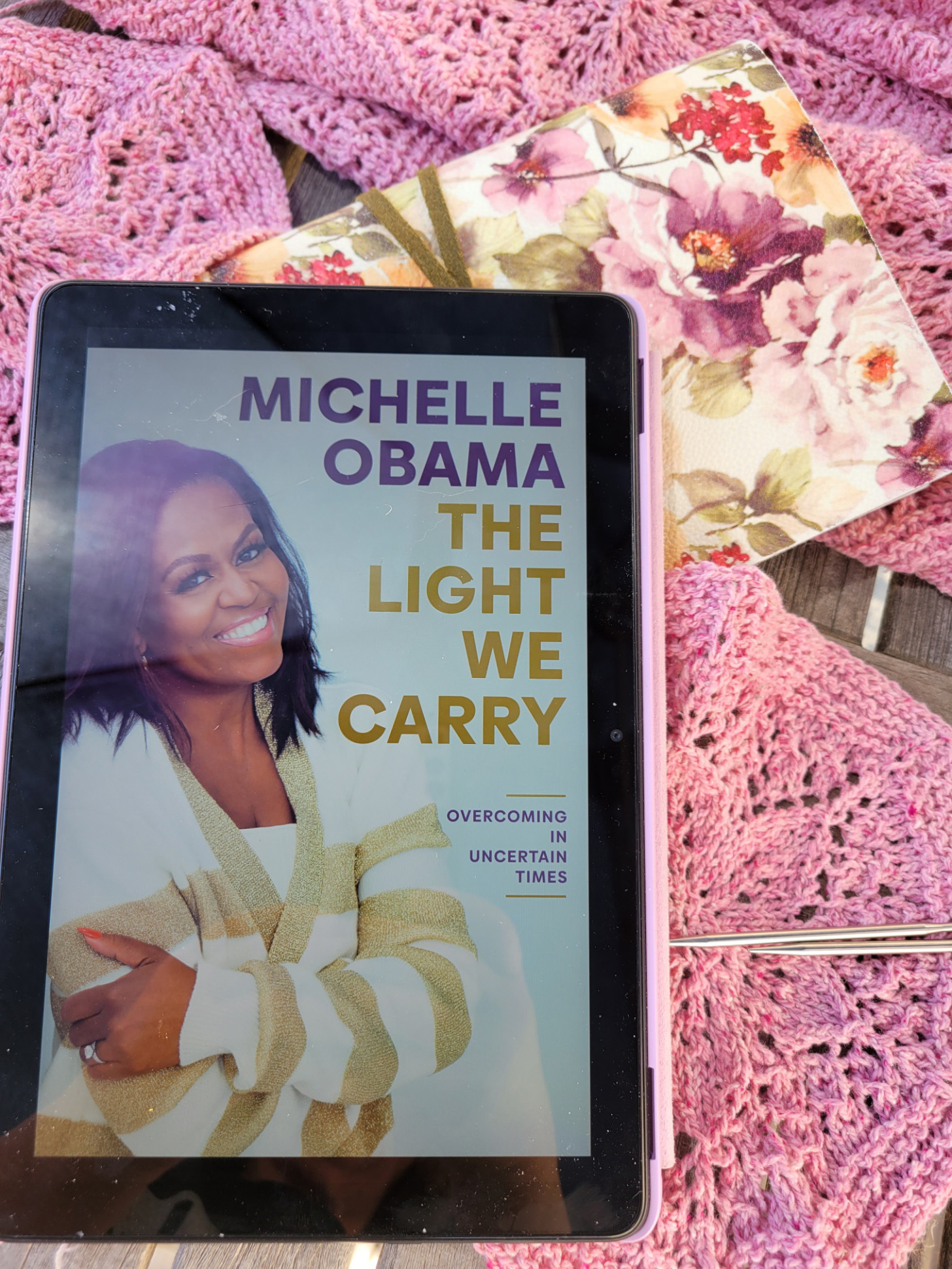
Well, look at that: Michelle Obama is a knitter! Yay! It looks like she also knows about the Zen of knitting and the ability it has to bring calm and purpose to a simple activity while you reflect upon and process problems large and small. I knitted every night to finish my teaching days. I knit in hospitals. I knit in meetings. I knit just about everywhere I can, and I especially knit to deal with the rolling shitshow that is my chronic illness. I went and bought Michelle’s book.

Thursday morning the results from the echocardiogram were posted and a couple of hours later my cardiologist called me. I was knitting and ready for the call.

For the first time the words stage 3 heart failure were used in the discussion with my doctor. My pulmonary pressure is higher than ever before and there is more fluid around my heart. It is not clear if my symptoms are caused by worsening pulmonary hypertension or pericarditis, but the only way to sort this out is to go back into the cath lab and directly measure the pressures with a right heart catherization. It may be both. I will need a different treatment regimen. An emergency referral was put in and tomorrow I’m heading back to the hospital for the procedure. This is what happened the last time I did this.

My pulmonologist, who works closely with my cardiologist and rheumatologist, saw me on Friday for a lung function test and office visit. My lungs are hanging in there, but my ability to diffuse oxygen into my bloodstream has dropped significantly. I told him about the upcoming trip to the cath lab, and he started checking those test results. I’m not going to lie, it is a little alarming when your doctor says, “No, no, this is not good. I am not happy with this at all.” More testing has been ordered. He emailed the other doctors on the team to start the discussion about what changes should be made with my meds.

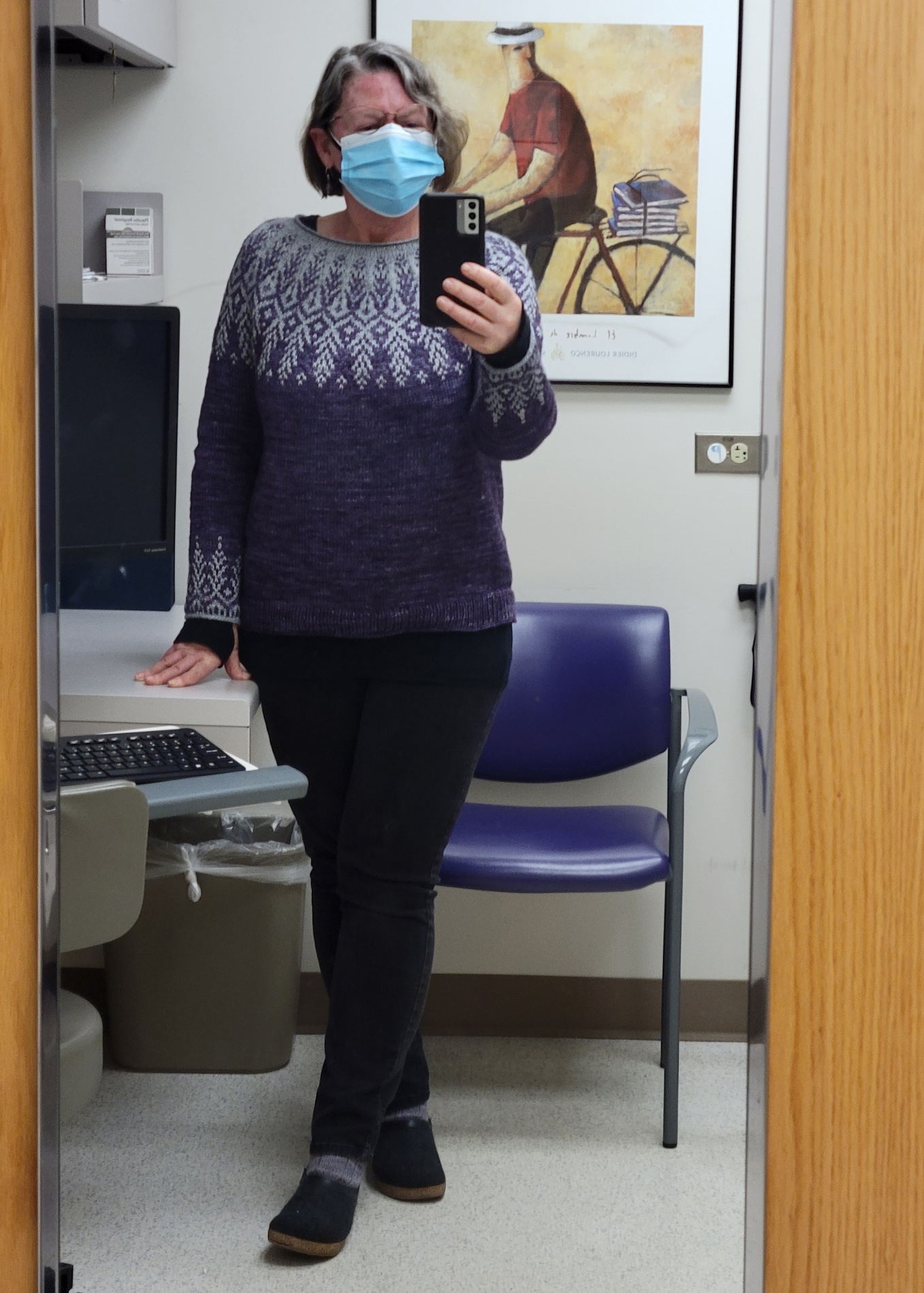
I took this picture of my new Goldwing sweater in his office the day that I met him. If you are going to scary appointments, armor yourself in your favorite knits!

This weekend I started reading The Light We Carry and was amazed that it starts with… knitting. Serendipity strikes!! Michelle Obama began knitting at the start of the pandemic as she struggled with the lockdown: grief, isolation, loss, and everything else that happened in that time. It became an important vehicle for processing, recovery, and perspective for her. The daughter of a father with MS, she is very aware of disability and how it absolutely impacts how someone like me can view myself and the rest of the world. She talked about using tools such as the cane that her father needed to empower ourselves to deal with what comes our way. Her book appears to be a toolbox of different strategies to cope with the challenges in life.

For the first time since all this started happening last week, I cried. This book is absolutely, positively, what I needed to read right now as I pack my bag for the hospital and prepare for what is coming my way in the upcoming days and weeks. It’s like someone could see right into my heart and lit a light for me. I will carry that light along with its warmth and glow tomorrow as I join my doctor and the pit crew in the cath lab. Whatever happens, I am positive, I will glow, and my light will shine.

So, Michelle, whatever can I show off as a favorite knit? Every single item that I cast off my needles has left me with a sense of purpose, accomplishment, and fed my creative needs. Knitting helps me cope with adversity, plan my day, and work through problems. Knitting delivers calm in a time of crisis. Knitting allows me to deal with an unpredictable autoimmune disease that delivers an uncertain future. Knitting connects me to all the knitters in the past and provides gifts for others as I pay forward. It is essential for my being and a vehicle to connect with others.

Here are some things I’m really pleased with: Goldenfern, a knitted copy of a beloved (and lost) cat, baby booties gifted to a neighbor knitted from a pattern handed down through 4 generations of my family, the hats and PICC line covers that are donated to Kaiser infusion centers in my area, and Mando (and Grogu) mitts for a knitworthy niece.

Tomorrow I’m wearing arm warmers and knitted socks into the cath lab. Take that, scleroderma.

Behold, I carry my (knitted) light with me!

Did you wonder what a BLZ is? That’s me, the Blue-Lipped Zebra!

The Scleroderma Chronicles: Rare Disease Day, 2023

Well, here it is again. Rare Disease Day. I kind of was going to ignore it this year because I’m quite frankly worn out by my… wait for it… rare diseases, but I also feel like I should pull myself together and represent for the community again.

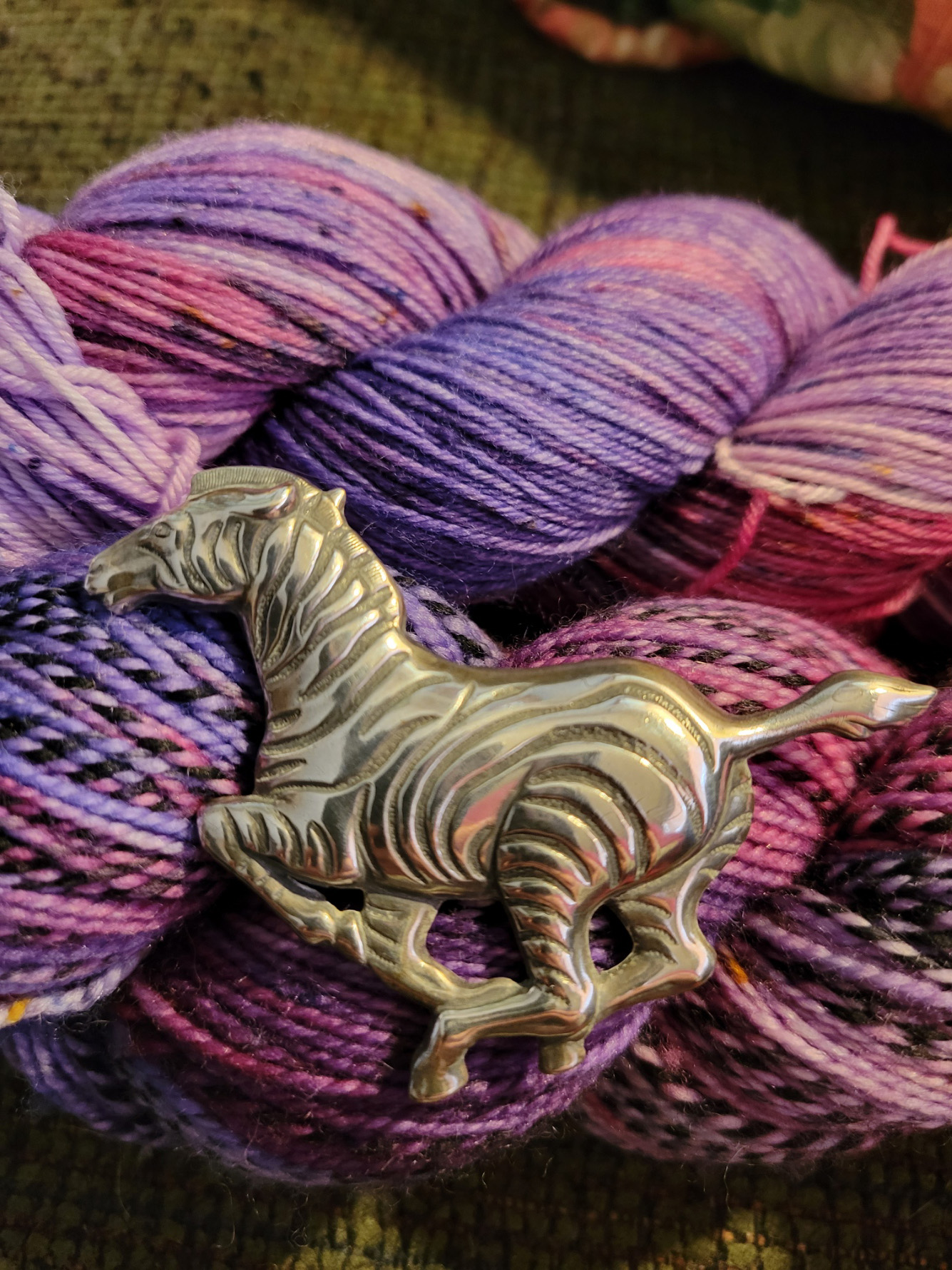
People with rare diseases are referred to as Zebras in the medical community. I obtained my zebra status when I was diagnosed with systemic sclerosis in 2014. This zebra was sent to me last week by my Most Knitworthy Niece Melissa.

I wrote a pretty darn good post last year about my journey with a rare disease which you can read here if you want. I talked about rare diseases in general, my specific conditions, and the many things that have been said to me by my doctors over the years. I thought about just reposting what I wrote last year, but I’ve been reflecting all morning on some recent events that kind of shine a light on my situation and that of other people who are coping with rare conditions.

  • I recently managed to go knit with my fellow members of Frayed Knots. This was a big social outing for me because it’s hard to get out of the house, and I have to be having a really good day to go to something like this. Knitting with friends is just “normal” for most people, and it would just be a little part of their day, but for me this was something that I had to prepare for a couple of days in advance, and then recover from in bed the next day. Many rare conditions are chronic, and chronic illnesses can be very isolating by their very nature.
  • A woman at the knitting group questioned my decision to wear a mask. I started to explain, but she cut me off to say that I was doing it so I could feel comfortable. It was a little condescending and suggested that I was being paranoid. Truthfully, my immune system, crushed by the drugs that I am taking right now, is compromised in its ability to make antibodies. If I catch a viral disease like the flu or Covid, there is a good chance that I won’t survive. My vaccinations have a low chance of protecting me for the same reason. For people with rare diseases, life is fraught and full of difficult decisions. For me, and for many other immunocompromised individuals, simple decisions involve life/death level risk analysis.
  • Another woman at the knitting table was struggling with long Covid and shared her difficulties with returning to work. She especially felt crushed by the attitudes of her coworkers who seemed to feel that she was “fine” and just trying to get attention. Yep. Been there, done that. Many rare diseases are genetic or largely invisible to others. Invisible illnesses are especially hard to cope with because others tend to question their validity.
  • I’m in several online support groups, and there are always discussions about what drugs to take, and whether the side effects are worth the risks. Yep. There are no specific drugs for systemic sclerosis, no cure, and treatment can involve a patchwork of risky off-label drugs. The drugs that are used are often non-specific carpet-bombing like approaches. Rare diseases have fewer treatment options because there are only a limited number of patients.

Over the last year my wonderful team of physicians have been suggesting that I am really unusual and have been extremely responsive to my emails. They clear an hour for appointments with me. I’m one of the very lucky zebras who has managed to get diagnoses, secured treatment, and am benefiting from a team of collaborative, interdisciplinary physicians who actively communicate with each other and with me; just last week my rheumatologist told me that for a patient with my status this is the only way to deliver care. I’m so grateful to have secured this level of medical attention, but I also feel a little nervous about it. I spent some time this morning trying to work out the probability of one person having the several medical diagnoses that I’ve racked up since 2014. Like, just how rare am I?

The National Organization for Rare Disorders estimates that there are 100,000 patients with systemic sclerosis in the United States. That’s rare, but still, a big club, right?

The 15% Rule is a general measurement of the risk of severe organ involvement in systemic sclerosis. As it turns out, quite a few of the major lung, heart, and kidney complications associated with systemic sclerosis happen about 15% of the time. I have Sjogren’s Disease overlap with my systemic sclerosis, which happens in about 13% of patients. Suddenly, I’m in a much smaller group of about 13,000 patients.

My most worrisome complicating conditions are diastolic dysfunction (a type of heart failure), pulmonary arterial hypertension (PAH) and interstitial lung disease (SSc-ILD). I looked up the risk of having each of these conditions using the 15% rule data, and it turns out the risks are 16% (diastolic dysfunction), 15% (PAH) and 35% for the SSc-ILD. Did you notice the the ILD doesn’t fit the 15% rule? Yep. It’s much more common and is the leading cause of death in systemic sclerosis patients. I found that risk factor here.

I brushed up on my probability math (you multiply the probabilities of independent events…), and after running the numbers:

100,000(13/100 x 16/100 x 15/100 x 35/100)

I came to a grand total of 116 other patients in the US who share my set of diagnosed conditions.

Oh.

See, I have lots and lots of stripes. Stripes in purple, teal, periwinkle, red, green, and blue: these are the awareness colors for my conditions.

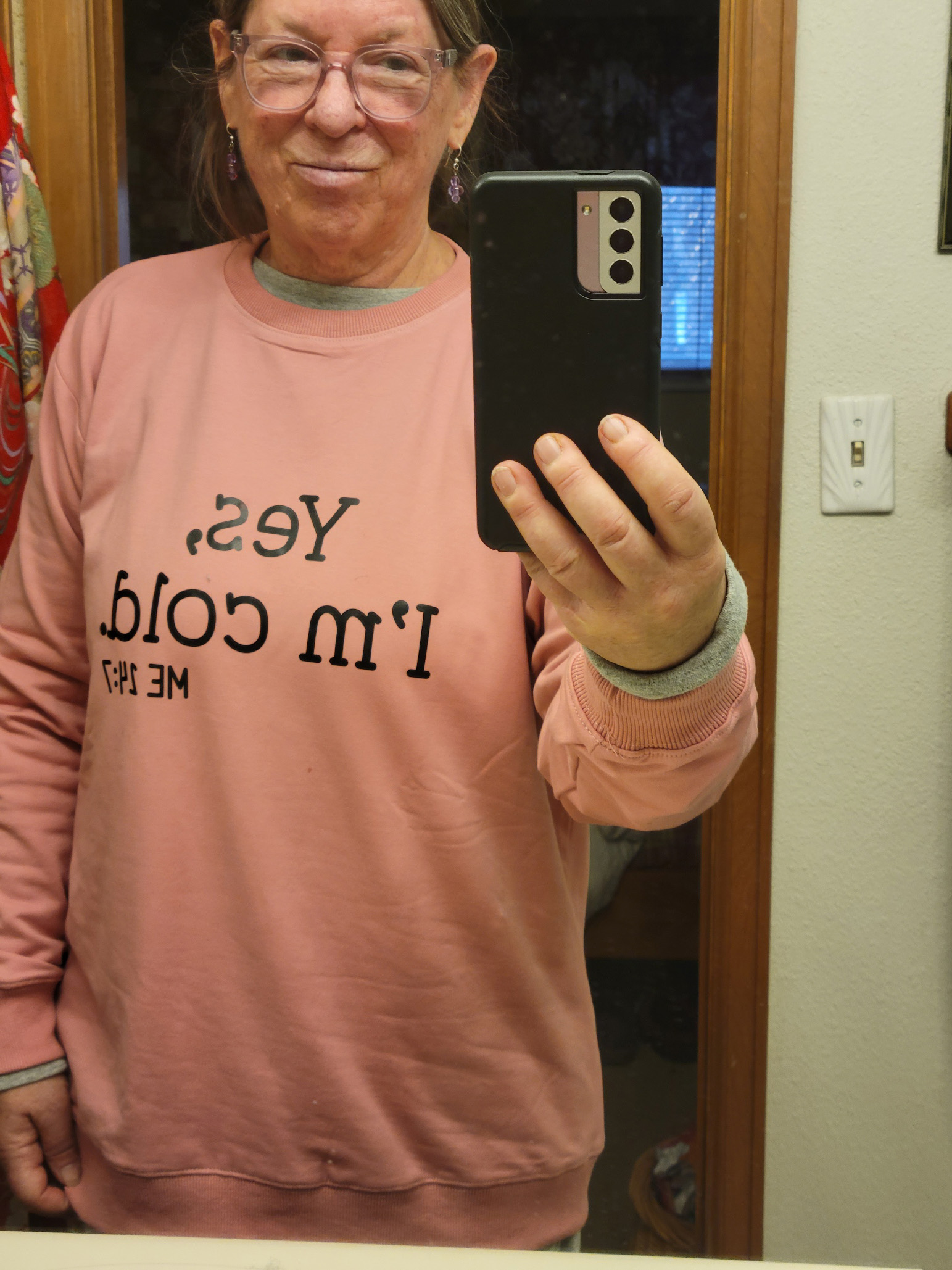
I just ordered that rainbow zebra unicorn shirt! I plan to wear it with my mask on my next social outing…

You can learn more about Rare Disease Day or my conditions at the links below.

The Scleroderma Chronicles: So, there was this flare…

Wow. It has been some time since I last posted. Ironically, the last post was about the Mother of Cats being broken. I felt really good, and I was casting on a plethora of projects and was all over the place with my knitting, reading, projects, you name it. Hannah was complaining in that post that I was broken, and that I wasn’t devoting myself to making her a blanket.

Then scleroderma lowered the boom on me. I went into a flare of epic proportions. I hurt all over, I struggled to do just simple tasks, I started sleeping 10-12 hours a day, and I had to go back onto daytime oxygen. I kept heat packs on my sore joints, but I really needed a total body heat pack to cope with what was going on: every single tendon in my body was under attack!! I couldn’t regulate my body temperature and took multiple naps a day because I was too cold to stay awake. I developed chest pain. My brain fog became so bad I wasn’t safe to drive anymore… Yep. Broken.

Okay, I also accidently drank some Miracle Gro fertilizer that I had stored in a Snapple bottle. That is some serious brain fog, people!! (Yes, I did have to call poison control, I did eat burnt toast and I did drink a lot of water, and I don’t want to talk about this anymore…) Yep. Broken.

I managed to get some knitting done in spite of my ill-behaved health. I got some wristers made as Christmas presents and sewed zippered pouches for my sister and cousin.

Wristers and a zippered project pouch.

Sewing was a riot as I had to get the sewing room organized so I didn’t have to stand up very much as I cut, sewed, and pressed fabric to make the bags, but with some creative thinking and furniture arrangements I pulled it off.

I also finished my Emma sweater. I made a hat. I made some socks. I made some slippers. Everything was on big needles and used heavy weight yarn as I got too tired to knit more than a few minutes at a time.

This sweater was knit using the CocoKnits method and I learned some new methods of shaping and finishing. The yarn was chunky weight and is warm and comfy. I got it done early in the flare and it was just perfect for the days to come. The yarn that was left over was used to make a hat and a pair of slippers.

I did read some nice books, but mostly I slept and waited this miserable thing out. In the weeks while I was mostly bedbound my orchids started to grew stems for future blossoms, the first snows arrived, and my son moved in with his cats.

This is handsome Jonesy. Hannah does not like Jonesy, so there is now a chicken wire barricade at the top of the stairs to keep the two groups of cats separated. My son also has a long-haired tuxedo cat who just doesn’t care about my cats. Hannah, however, has a complete meltdown if Jonesy comes near her, so… barricade.

Mateo: I love Jonesy and I go through the barricade every day to rough house with my new best bud while Hannah hangs out with the Mother of Cats. Jonesy is the wild playmate of my dreams!

So, I think that I am out of the flare now as the multiple naps a day have stopped, and my appetite is back. Yesterday we made lasagna for Christmas and here is the present that I got from my son:

Perfect, right?

Can you see my blue lips? The bad news is that the Blue-Lipped Zebra is back in full force. I finally emailed my cardiologist to let him know that I am once again panting for air and feeling light-headed from doing simple tasks like… lifting a pan out of the cupboard or grating cheese. Ugh. I’m pretty sure that I am heading back into the cath lab for another look at my pulmonary pressures, but right now I am glad to be back on my feet and out of the flare. My son is still here (he works from home, so he just moved his operation over to my house) and things are going well in the combined household.

Hannah: as long as Jonesy stays on his side of the barricade!! Also, maybe the Mother of Cats will now settle down and get my new blanket done!!

The Scleroderma Chronicles: Song of the Cell, Dance of the Cytokines

I’m reading a really wonderful book right now that is really speaking to me on so many levels.

This man is a BioGeek of the first order! He interweaves his experiences, patients, memories, and the history of cells together in a way that makes me green with envy. He unpacks the history of our understanding of cells by bringing those scientists to life in a way that makes me care about them; if only I could write that well. He is the teacher that I wish I had been as he reveals to us how cells work together to create complex human systems, and then ties all of that to the treatment of disease. I’m still in the first parts of the book, but I have already filled my kindle with highlights and notes.

This book was published at the exact right moment when I needed it. I have totally gone down the rabbit hole at PubMed over the last two weeks as I have read paper after paper while chasing down the major players in my chronic conditions (why am I sick, and what exactly are these new meds doing…) and how they link to inflammation. Why would anyone do something like this?

Well, it all comes down to this. I’m on high-risk drugs with some serious side effectss, and I want to make informed decisions about whether I continue taking them. I also had a run-in with elderberry juice, and was rescued by green chile; as a BioGeek I was sucked down the curiosity rabbit hole after that whole adventure. What? That doesn’t happen to you? Listen, it has been so bad I haven’t even been knitting!!!

These are the two drugs that I’m trying to understand. In his book Siddhartha Mukherjee argues that our understanding of cells, and how they work, has transformed medicine into the modern miracle that I am currently benefiting from. Drugs that directly interact with the molecular machinery of cells, the signals between them and the biochemical pathways that cells use to function, are the first of the major transformative directions modern medicine is taking in the treatment of so many pathologies such as cancer, diabetes, neurological, and autoimmune diseases such as mine.

Systemic sclerosis is really darn complicated, as it turns out, and the sequence of events that have been happening in my body are so convoluted it’s hard to track them all. It started in the cells lining my blood vessels. As those cells got injured, they sent out signals that activated parts of my immune system. Signals from the immune cells caused other cells to transform and they began to produce scar tissue… scleroderma means “hard skin”, the hallmark of my condition. Whew. Here’s a condensed version of all that if you want to torture yourself and/or fall asleep.

Let’s go back to my meds. Ambrisentan blocks a molecule that is involved in making blood vessels constrict and raises blood pressure when it is active. That molecule, endothelin, is getting turned off by the drug, and there is evidence that this will improve my exercise-induced pulmonary hypertension and will also keep it from progressing; it plays nice with my other pulmonary hypertension drug which shuts down an enzyme pathway involved in blood pressure. Ofev is my new (fairy dust) drug, and it disables some of the essential enzymes in the cells of my lungs that are involved in creating scar tissue. Interstitial lung disease is currently the leading cause of death for systemic sclerosis patients; mine is being treated by side railing the process in the cells that are essential players in the pathology.

Yay! Molecular trickery at the cellular level saves the day! I will be staying on these meds as long as I can.

Dancing to the tune of the song of immune system cells are cytokines, the messenger molecules that travel between immune system cells and other cells that they interact with. The dance is complex, with all the different messengers traveling through the blood to target cells in the body, latching on and causing the cells to take actions. Some cytokines increase inflammation, and other will shut it down. Your immune system can get dialed up or shut down, depending on what the messages are. In my travels through research papers at PubMed I focused first on what cytokines were involved in systemic sclerosis, and then I hunted for papers that had measured the levels of these cytokines when people ate different foods.

Foods that you consume can make a big difference, evidently. Elderberry made me much worse (I cried in two different doctor’s offices), and green chile saved the day. I was done doing google searches for “anti-inflammatory foods” and was going after hard data.

.What did you expect? I’m a BioGeek. OF COURSE I made a spreadsheet with the data!

Tumor Necrosis Factor alpha (TNFα) is a big driver in the whole systemic sclerosis story along with Interferon gamma (IFN-γ). They cause an increase in two more cytokines that promote inflammation, Interleukin-6 (IL-6) and Interleukin-1 beta (IL-1β). All four of these bad boys will make my inflammation worse and (probably… I’m guessing here) encourage my conditions to progress. A lot of these foods/supplements will lower the levels of these cytokines, which explains why I feel better when I eat them. ELDERBERRY increases three of these cytokines which is why I felt like death warmed over while drinking it. Google said it was anti-inflammatory… can you see why I switched to research papers and cytokines? Green chile stew has tomatoes and green chile in it (and some yummy pork and garlic!); no wonder it turned things around. I will try to eat as many of the “good” foods as I can, but I’m going to focus on ones that really shut down TNFα and IL-6. I’m ignoring the IL-10 and CRP info because it wasn’t really as well supported as the others, and I know that my CRP (C-Reactive Protein) levels are normal.

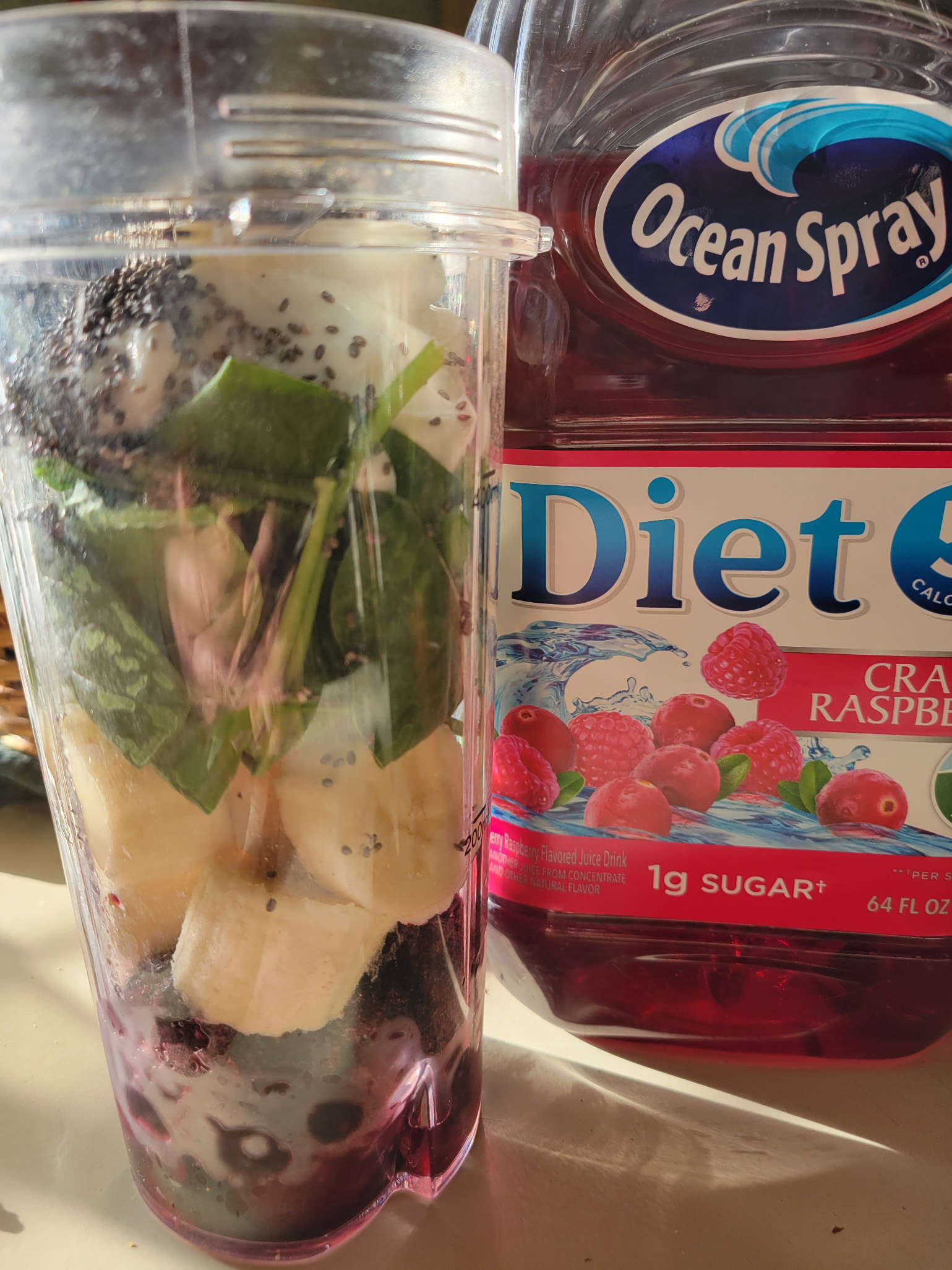
My lunch smoothie: tart cherries, raspberries, banana, spinach, yogurt, chia seed (gag) and cranberry juice. For dinner I’m having a green chile cheesy corn pudding thing that tastes pretty darn good.

Wow. Did you read all of that stuff above? You deserve a prize for perseverance.

Here’s your prize. It’s like a “Where’s Waldo” picture, but this one is Where’s Hannah!

So, there is all is. Inside my systemic sclerosis, pulmonary hypertension, interstitial lung disease self, there are all these dancing cytokines, following the song of cells. Scientists who were captured by all of this and who were entranced by the Song of the Cell have developed the drugs that are treating the two life-threatening complications of systemic sclerosis that have come my way. Inside me, the promise of the song goes on.

Time to get back to my book.

Notes:

  • Okay, I made a whole other spreadsheet with links to all of the research papers that I used to get some understanding about these cytokines, and which were important in my disease. You don’t want to see all of that, right? If you do, say so in a comment and I’ll send some links your way!
  • I became curious about what is happening with Covid patients and the cytokine storm that can cause severe symptoms. Yep. It’s happening because of TNFα, IFN-γ, and IL-6. If you catch Covid, I don’t recommend elderberry.
  • Clinical trials are currently underway to see if an IL-6 inhibitor will be an effective treatment for systemic sclerosis.
  • I’m a lucky, lucky girl. I have a degree in molecular biology, used to work in an immunology lab that focused on IL-1, was involved in a scleroderma research project, and finished up my lab days on a project looking at the impact of capsaicin on rheumatoid arthritis. I can almost understand what I’m reading on PubMed. Almost.

The Scleroderma Chronicles: This Drug isn’t Fairy Dust…

Oh, boy. I have been having adventures in my ongoing dice game with the Reaper. My (wonderful) pulmonologist started me on a high-risk drug towards the end of August to slow down the formation of scar tissue in my lungs due to my interstitial lung disease. Oh, boy. The side effects were not exactly great as I battled ongoing GI side effects and started to lose weight again.

My doctors get kind of worked up when I lose weight.

What?!!

I know, like this is a bad thing? Here’s their thought process: there is a correlation between weight loss and poor prognosis, so my docs tend to focus on the one factor that I can control. Ugh. I sadly moved onto a diet of chia seed puddings, rice, and bananas while gulping down fiber tablets. After a week the tide seemed to turn, and I was eating more.

This is the new drug, just recently approved for the direct treatment of scleroderma-associated interstitial lung disease. Yay Ofev!

Ofev entered the scene just recently. I first heard about it in the early years of my scleroderma journey, and it was approved for use about three years ago. It took a few weeks for me to get enrolled to receive this drug and I need to go for mandatory blood testing each month before I can get my next month’s supply.

There is a significant risk of blood clots, and the pharmacist really stressed that I should watch for bruising.

A few days after my appetite returned, I woke up with a sore and swollen leg; I was also bleeding from both nostrils. When I looked at my leg there was a large bruise that grew to be about 6 inches across… not good, little BLZ, not good!! Yep. There was an immediate full stop on the drug for a week, and then I was started at a half dose a week later. A week after I had restarted Ofev my pulmonologist called to check up on me. No bleeding, but I was dealing with stomach discomfort.

He gave me the Fairy Dust talk. “There is no magic cure, and this drug is not fairy dust.” he said, “Drug companies can manipulate data to make drugs look better than they really are; I can’t stand for you to be miserable on this drug. There is a case to be made for focusing on quality of life as opposed to quantity of life.” (Well, that’s not discouraging at all, right?!) As he and I talked I remembered my conversation with the pharmacist; she had stressed how important it was to take the pills exactly 12 hours apart to maintain a steady blood level… I was taking the high dose only once a day at that point, so I was probably experiencing a spike every day in my bloodstream. I asked for a script for the lower dose and convinced him that I should try that for a month even though the total amount each day would be more. Over the last few weeks, I’ve had a little bleeding and a couple of little bruises, but nothing like I saw on the higher dose.

I moved to the lower dose twice a day three weeks ago. While that was going on my roses started blooming again.

A week ago, I went for more lung and heart testing. I bought green chili cheese fries and a chocolate shake on my way home because… my GI tract has decided that it loves me and I’m hungry again! Besides… green chile cheese fries!!! The results came in last Friday. My oxygen is better, and I can walk farther than a year ago! My pulmonologist doesn’t need to see me for 6 months. My heart testing and bloodwork was used by my cardiologist in a predictive model that returned a result of… low risk of pulmonary hypertension progression at this time. My heart failure numbers did double, but he isn’t all that concerned; he doesn’t need to see me for another 6 months.

I hung up the phone after the last call and thought to myself… maybe Ofev is Fairy Dust after all, because… I. Am. Better. This has been 2 months of NOT FUN, but the proof is in the pudding.

By the way, chia seed pudding, highly recommended by my pulmonologist, is just plain nasty! Chia seeds, without any doubt, are not fairy dust!!!

To be fair, it probably isn’t all Ofev; after all, it has been pointed out to me that it is not a magic cure. I started other drugs to control my pulmonary hypertension over the last year. I have made a lot of adjustments on my end to handle my lung disease. All of my down products are out of the house. I bought a new humidifier that can be easily cleaned each week. I put a high-grade filter into the furnace and bought an air purifier. I take all my drugs right on schedule and I do gulp down fiber-rich foods that are keeping any symptoms under control (except chia pudding… see above).

Okay, Reaper. You won a couple of the tosses, but this one is totally mine.

Pass the Fairy Dust and roll the dice.

This BLZ is ready to play!