A few weeks ago I went to see my primary care physician for help with shortness of breath and joint pain. I totally scored! I walked out of there with a tetanus shot (fail), inhaled steroids to control my small airway disease (win) and an anti-inflammatory gel to put on my swollen, painful joints (huge win). What a difference to my life these new medications have made. I can breath! I can walk without pain! I can sleep through the night! This is huge, people. Take that Sjogren’s and scleroderma! Feeling so much better I began to spend more hours up and about, and there was a lot more knitting happening too.
I got some socks finished right up. Here are my project notes.I made a lot of progress on my Suburban wrap and was lured into knitting more than usual because I just had to get into the next section of the wrap. This is such a fun project with lots of color, texture and lace interest. So addictive. So hard to walk away from…
Oops. Then this happened.
Tendonitis!
One of the problems of getting better is that swelling is going down and the tissue is tightening up on some of my joints. My knees are really tight. My wrists are stiff. When I knit my joints loosen, so I thought I was helping them stay flexible. That is probably true to a certain point, but I guess I now need to be careful to not overdo things. Sigh. I am using the tendons in my left hand the most since I knit continental, and I push the yarn over the needle with my middle finger for each purl stitch. I’m really fast that way, but my tendons have totally rebelled in my left hand and wrist. To make things worse I can’t take NSAIDS or any other anti-inflammatory drug because of my scleroderma-battered kidneys and stomach. Sigh. My doctor ordered a knitting hiatus.
I want to be a compliant patient, really I do. I read a couple of books, managed to get through a couple of days without knitting, and then I snapped. I must knit!! Want knit now!! Knit, knit, knit. Why go on if I can’t knit? Sniff. Obviously this is totally unacceptable and I am going to figure out how to knit in spite of this bad boy wrist. Really, my left hand is the one having trouble, so maybe I can work around that. I tried to tension the yarn in lots of creative ways before I remembered that lots of people on the planet hold the yarn in their right hands. English knitting. I have never mastered purling English style, but now I’m really motivated!
I was in the last striped section of the wrap when disaster struck; stockinette means I have to purl back every other row. I managed to continental knit with the brace on (okay, it is a little loose) and am moving my left hand very little by working slowly and relying on my right hand.Working very slowly I am also managing to purl back English style. So slow. So awkward. So much safer for babying rebellious tentons.
Last night I finished the stripes and am ready to enter the last section of garter eyelet. Yay. Knit all the way! I can do this! Then it is into the last, ribbed section of the wrap.
Ribbing. That is going to be slow going. I think that I will check out Norwegian purling. Somehow I need to do this without moving my fingers too much. Yay. A new stitch to learn.
I’m on it!
Take that, scleroderma. You are messing with the wrong knitter!!
You know, I kind of view myself as a happy camper. I have more things (ahem… knitting projects) going then I can get finished on any given day or week, books lined up to read, and a “to-do” list that I’m slowly working my way through. Hey, people, I fixed the loose tiles on my kitchen floor last week!! My cat MacKenzie is my constant sidekick throughout the day as I knit, work in the garden, read in bed, and even with me (underfoot, demanding cookies) while I’m cooking. Even on the bad days when I’m pretty much down for the count, I manage small victories. There is just one problem with this picture.
Look at these beautiful coneflowers I just added to the garden. I’m hoping to lure some butterflies into the yard. Every garden should have butterflies, don’t you think?
I just don’t fit in the world all that well anymore. In my home, living the life that I’ve created for myself, it is really easy to forget how much I have adapted to accommodate the limitations of my scleroderma, Sjogren’s, and fibromyalgia. Once I go anywhere else reality hits me hard. Every trip out of my house is going to come at a cost. Here are the worst of the offenders that will lay me low.
Air Conditioning I know that almost everyone in the world is grateful for air conditioning in the summertime, but for me it is a royal nightmare. The shock of walking into a refrigerated building on a hot summer day will trigger an immediate Raynaud’s attack. I pull on long sleeves and fingerless mitts as soon as I get into the building, but my lungs know what’s up and I have trouble breathing. The airflow makes my eyes burn; I’ve been reduced to wearing my sunglasses indoors to protect my eyes. Don’t even get me started on the refrigerated cases churning out cold air; you haven’t lived until you’ve had to pull up the hood of your sweatshirt and the sleeves down over your hands so you can score some butter and eggs. If that wasn’t enough, there are also usually…
Scented Products Almost all buildings use scented cleaning products and sells additional items with scents. Candles. Lotions. Laundry soap. The scented bathrooms are a nightmare. If I’m not already in trouble with my breathing I will be if I have to walk down the laundry detergent aisle at the grocery store: I also start to itch and my face swells. Why do these chemicals even exist? They can’t be good for anyone!
Restaurants These are a special kind of hell for me. All the drinks come cold and with ice, and the entrees are served piping hot. There are other landmines that I need to avoid: salt, lactose, fiber. I have to carefully select something that is very soft and that will behave itself in my gastroparesis stomach. I can’t have spicy food. I can’t eat fresh veggies. Actually, to be safe, some of this food should go through a blender… I actually once soaked a cut up sandwich in soup so I could eat it…
Walking I am trying really hard to meet my walking goals every day, but I stretch those steps out over the day. A trip to run errands can be just exhausting if I’m on my feet for a couple of hours at a time. I need to always carry water, be aware of the location of bathrooms, and have places where I can sit down if I need to.
Sunshine It makes me sick! Enough said.
Ready for another picture? These paper wasps are building a nest right on the edge of my deck! MacKenzie and I are not amused. Still, it kind of shows how the outside world is full of dangers…
Recently I had a tough talk with myself about pruning down my outings and being more strategic about how I expend my energy. I need fewer outings, and my destinations need to be closer to home. I need to live online. I need to in a safe environment as much as I can to manage my diseases.
My home is my safe house. I have no air conditioning and I minimize air flow. I keep the temperature in the mid 70’s in the day so that my joints and lungs will be happy. I cook all of my own food, I don’t own any salt at all, and everything that I drink is room temperature. Fruits and veggies go through the blender to become smoothies. Every product that comes into the house is scent free. I’m always close to a bathroom or a soft surface to crash onto for a quick recovery if I get dizzy. My stairs have wrought iron rails that I use effectively on bad joint days. Flourishing in my safe house I sometimes forget how sick I am because, well, I have fewer problems.
I planted this yarrow last year in a flowerbed that has killed almost everything planted into it. Not this yarrow!! The secret of gardening, and living with serious chronic illness, is to keep on trying new things, and to match your needs to your environment. Or, in my case, make your environment match your needs.
Tomorrow I have a doctor’s appointment so I listed up some symptoms and issues that I need to ask her about. It is quite a list now that I look at it, and it kind of underscores how chronic illness can trick you into thinking that things that would normally send you screaming into urgent care are “just another day of scleroderma.” Shortness of breath is an almost daily thing. When I glance into the mirror these days I sometimes notice that my face is blue. One hip keeps failing me; okay, I actually have to lift that leg to get into the car. My joints swell so much that I can’t sleep at night.
But I am good, here in my little safe house with my gardens and cat.
Tomorrow my doctor and I will attack some of these scleroderma/Sjogren’s issues. I kind of think that lung testing and a MRI of my hip are in the future, and that there may be follow-up with my pulmonologist. I’ve been gathering up my energy in preparation for these outings into a world that is dangerous for me, knowing that after each outing my garden swing, knitting and latest book will be waiting for me. With a room temperature ice tea.
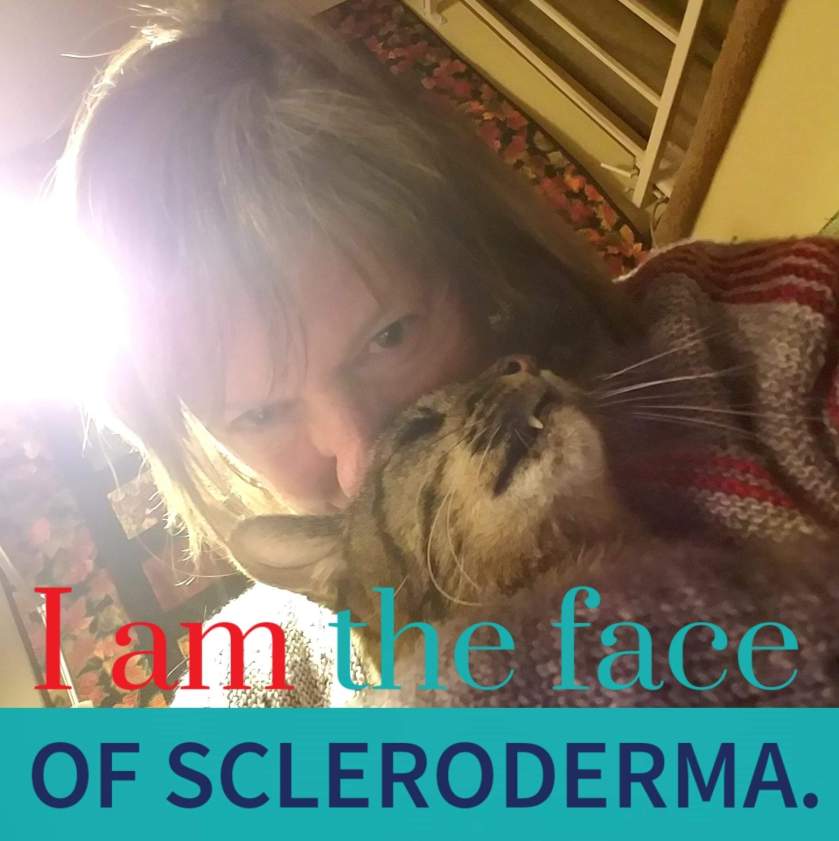
Today is World Scleroderma Day. Tonight the Niagara Falls will be illuminated blue and white in recognition of the day. All this month (June) there have been walks and outreach to raise awareness of this disease and to raise money for scleroderma research, and scleroderma patients all over the world have been urged to post pictures of their faces (and smiles) to made this disease more real and relatable.
Rather than flash my smile I have chosen to show this picture of me and MacKenzie, wrapped in handknits, fighting my way through a flare one frozen January. Good times! See the light in the background? It reminds me that every flare comes to an end.
The purpose of this day is to try to raise awareness of an illness that is mostly invisible and relatively unknown.
So what is scleroderma? It is a rare autoimmune disease that is a member of the rheumatic diseases family. The name “scleroderma” means hard (sclero) skin (derma), which is the most visible symptom. Scleroderma is the general name that is applied to a group of connective tissue diseases that may target only the skin, or the skin plus internal organs, or just the internal organs themselves. The words that are used to describe my type of scleroderma (limited systemic sclerosis) are rare, chronic, progressive, disabling, and possibly life threatening. This is a lot to wrap one’s head around, so I’ve decided to break it down.
Rare: Here in the United States the CDC has defined a disease with fewer than 200,000 patients as “rare”. Systemic sclerosis, with about 1-2 diagnosed people for every 100,000 citizens fits the bill. To be rare means your illness struggles for research and treatment funding as the patient population is small and almost no one is personally impacted by the disease in the general population. Hence, Scleroderma Awareness Month and World Scleroderma Day. Thank you, Niagara Falls!!
Auto-Immune Disease: The immune system, designed to protect us from foreign invaders like pathogens, is attacking some of the components of normal cells in scleroderma patients. The exact components can be identified using the antibodies of scleroderma patients and they are essential proteins found in the nucleus of the cell. My antibodies are attacking a protein found at the kinetochore of dividing chromosomes. I can’t help but wonder what the heck has happened here that I ended up with antibodies like these? I also eventually wondered if my cancer risk is increased since there is something off with this critical structure used in cell division (it is).
Connective Tissue: I used to try to explain this type of tissue to my AP Biology students. Connective tissue… well… it connects. It is what holds your bones together to form the skeleton. It gives support and stretchiness to your skin. It is involved in all the organs of your body, and holds the organs in systems together. It is essential to organize your muscles. In systemic sclerosis, all of this tissue can be involved in an inflammatory attack of the immune system and scarring occurs. Skin gets thick; hands curl, joints won’t bend, smiles twist and faces harden. Muscles and joints hurt. The smooth muscle in the digestive tract can be so damaged that organs don’t work right. Blood vessels are damaged and spasm, cutting off circulation to extremities and organs. The heart can get scarred. Scarred lungs prevent oxygen passage. Scleroderma, invisible to the outside viewer, can be devastating to the patient.
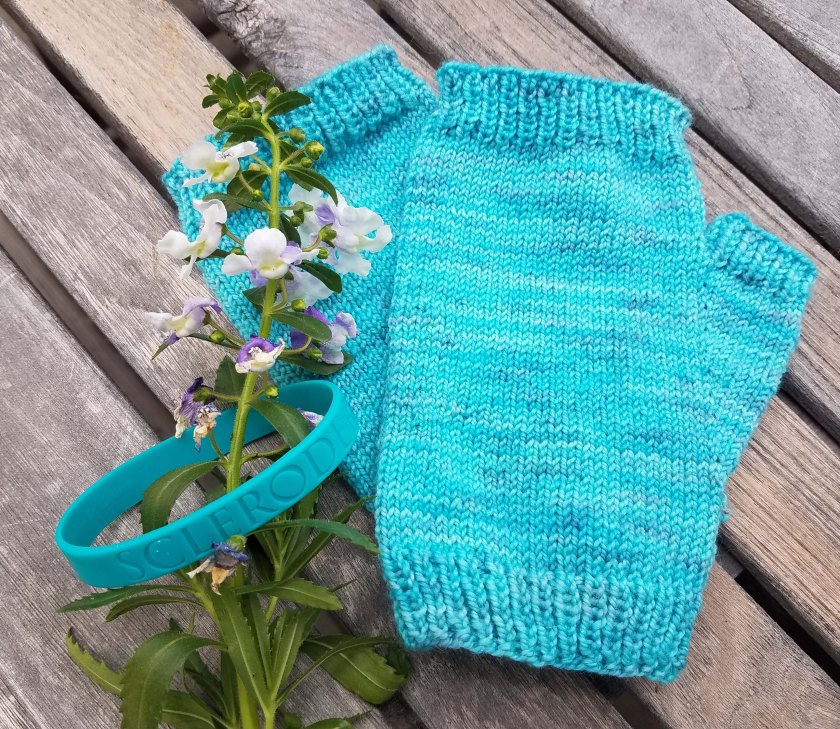
Vascular tissue damage causes circulation loss to my fingers and toes (Raynaud’s Phenomenon) which I fight by wearing fingerless mitts and wool socks. Works great and the Zen of knitting brings its own benefits.
Chronic: There is no cure, and it never ends. There are, however, treatments for individual impacted organs that are really helpful.
Progessive: Damage accumulates over time and conditions worsen. My doctors are monitoring my kidneys, heart, lungs and GI system. So far I am doing pretty well, but my GI tract is taking the most damage.
Disabling: Yep. It is getting really hard to walk, and I just don’t fit all that well into the world anymore since my diet is very restrictive, air conditioning isn’t my friend, and sunshine makes me go into a flare. Right now I don’t need supplemental oxygen, but if that comes back it will further restrict my independence.
Life-threatening: It took me months to think this one through, but eventually I did google “life expectancy of systemic sclerosis” and discovered that for me, with my treatment plan and risk factors, survival rate is about 75% for 10 years after diagnosis. Overall the death rate of scleroderma is 50%. Oh. Now I know. Who wants to live forever?
This week I wrote a letter to my congressman asking him to sponsor a bill that would fund research into fibrotic diseases like scleroderma and cystic fibrosis. I haven’t heard back, but maybe if he has heard of one of these diseases or knows someone impacted by scleroderma he will do it.
When I was a girl my grandmother had a little phrase to describe someone who was acting crabby (little me, of course) as having gotten up “on the wrong side of the bed.” You know what she was talking about. A person being constantly irritated by a never-ending series of triggers.
Today I woke up pretty sore, crawled down the stairs to make my morning latte, and once I had pulled myself up the stairs and back into bed I found a post from another blogger, NothingButKnit, on my phone called ThingsThat Are Bugging Me Right Now: A List. Oh. A list of all the things that are bugging me right now. Wow. Where do I start? There are so many things that bug me. Yippee, I can do this!!
NothingButKnit had only 4 things on the list. Gee. She is kind of a light weight, don’t you think? I mean, there are so many things that are bugging me at the moment it is impossible to prioritize them, but I can certainly try. Ignoring all the things happening in politics and current events, which are their own exhausting list that force me to call or write my congressmen EVERY STINKING DAY, and excluding my trifecta of autoimmune diseases, here is my own list:
Robocalls. Seriously. How many times do they think I need to be informed that this is their last attempt to contact me about my insurance. Especially since it is several times a day. This is why nice people can’t turn on their phone ringer.
Food packaging that I can’t open without dragging in the tool box from the garage. Don’t laugh. I have half of the toolbox in my kitchen drawer at this point. The big stars are the rose pruners and a pipe wrench.
Hailstorms! I bought a new car last summer and I’m pretty nervous about hail. A few weeks ago I got caught in a storm that dumped 4″ of hail; I was pumping gas when it started and was able to stay under shelter. Last week there was golf ball-sized hail. I don’t even want to think about baseball-sized hail…
I grabbed a picture early in the storm. Those stones are 1/2 inch across.
Bindweed. This plant grows at virtually the speed of light, swallows rose bushes overnight, and never dies no matter what I do. Stop bugging me, bindweed!!
Sigh. I’ve resigned myself to pulling weeds for 30″ a day. It’s best in situations like these to just keep chipping away at the problem without looking at the big picture.
Yowling cats. Cats that belong to my neighbors wander into my yard, roll in the cat mint, and sleep in the best cat sleeping spots in the yard. They also stop by the ground-level windows to chat with MacKenzie. How sweet. Especially at 4am. I love the sound of hissing, smacks on glass and yowling in the morning, don’t you?
MacKenzie also yowls every morning to let me know that he wants to go out into the garden for a nap. He loves his garden. I can’t let him out unless I can supervise him because of the stray cats and the dog next door, so he only gets to go out while I’m pulling weeds and watering. “Stop yowling!” I tell him every morning. “Let me out now!” MacKenzie yowls back. It’s like having a toddler again.
Barking dog. Ugh. The neighbor next to me got a sweet little puppy three summers ago that grew up into a territorial barking, growling, fence-charging Pitbull nightmare. After months of work she no longer goes berserk when I go into the yard, but if this dog sees a cat… it gets scary. The dog has chewed a hole in the fence that she can stick her face through. All the better to watch and bark at the cats that come visit my yard and MacKenzie. When she sees a cat she growls, body slams the fence and barks furiously while tearing at the hole in the fence.
This week I was outside pulling weeds with MacKenzie (between thunderstorms with the phone ringer off) when the dog suddenly saw him through the fence. Oh, oh. The dog got her face through the fence, the growling and barking commenced and I started running towards MacKenzie to see if I could shoo him away.
Nope. MacKenzie snapped, charged the fence from his side and went into total feline fury mode. In stunned amazement I watched my geriatric cat hiss, slash, and crash into the fence in a frenzy I’ve never witnessed before. I’m sure there was yowling, too. Every time the dog put her face through the hole, he let her have it again. Just as I was heading to get the hose the dog broke off the attack and it was over.
Mr. Victorious
The dog’s face was slashed in several places and she hurt herself trying to get more of her jaws through the hole. Luckily, she wasn’t able to get a good bite on the cat. MacKenzie, two claws ripped off and toe pads damaged by hitting the fence, stalked off to take a nap in a nearby (unweeded) garden patch. The dog’s owners now keep her inside to PROTECT HER FROM MY CAT and they repaired the hole in the fence that very night.
Be like MacKenzie, I tell myself. Don’t let things bug you too much. Defend yourself and smack down the things that you can, and spend the rest of your time sleeping in the garden.
Excuse me, I must head out to pull some more weeds, then it is knitting time. Maybe I will listen to an audiobook with my new sound-cancelling headphones while I knit. Outside, on my swinging garden seat, with my roses.
Robocalls, hailstorms, weeds, barking dog and yowling cat, begone!!
The last few weeks have been hard : rain, snow, an exceedingly badly behaved ankle, and all the fun of never-ending chronic complaints. Ugh! The weather fronts just kept rolling in, sending the air pressure swinging wildly and my breathing and joints into their own little crises. “Will it never end,” I asked my ankle and MacKenzie? “Nope!” said the ankle with a little sneer in its rotten little ankle voice. “Don’t count on it,” said MacKenzie as he squirmed deeper into the current knitting project with one paw extended, claw flashing, reaching for my yarn.
As you can guess, I’ve developed a nasty mood of my own.
There was a nice week with sunshine that made me and the ankle feel better: I got some yard work done and planted flowers. Then the weather turned on me and once again I was in bed, listening to audiobooks and knitting with my ankle propped up.
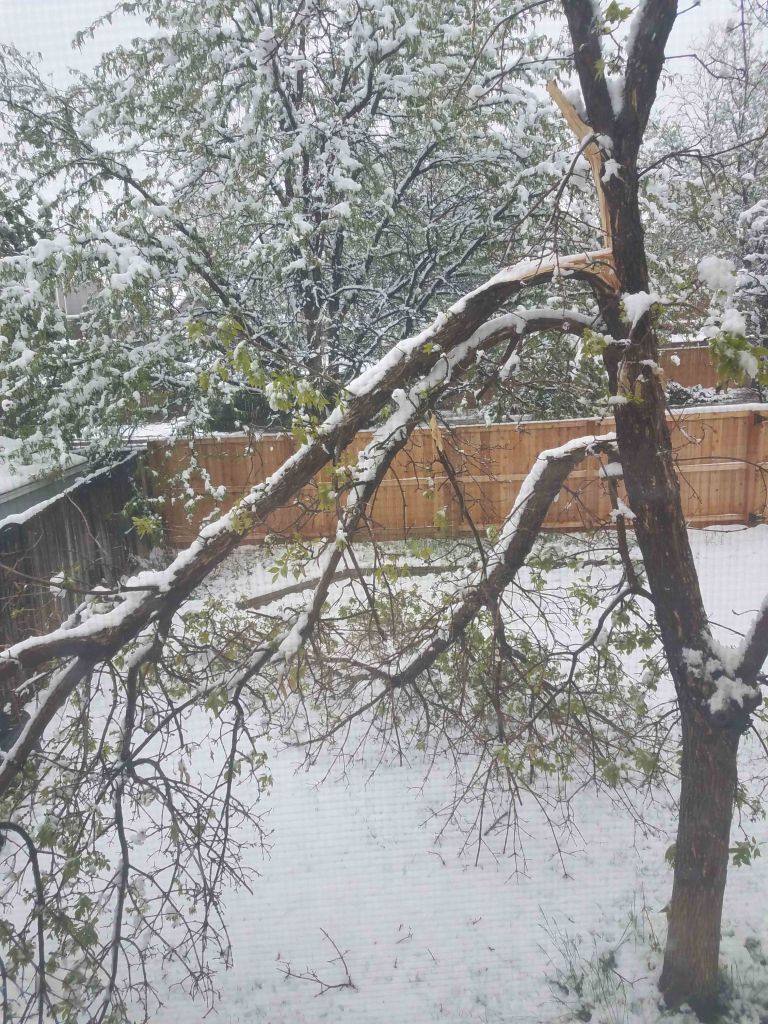
In the wee hours of Tuesday morning I woke up to the crack of breaking branches. Six inches of heavy spring snow (the latest storm this bad in 17 years in the Denver area) had done my tree in. No wonder my joints are cranky… even the tree gave up! I took this picture the next day after most of the snow had melted.
What is up with this ankle, you ask? Good question! Three weeks ago it suddenly developed a hard, red, and hot lump that radiated pain ruthlessly. The infection began spreading under my rhino-hide scleroderma skin. I was started on antibiotics, but the pain continued, the redness continued spreading around the outside of my ankle, and a dent in my leg appeared where the redness was. I chatted with a doctor online and she decided that I should be checked for cellulitis. Cellulitis?! Off to urgent care I went, and as soon as that doctor saw my ankle he ordered testing: another blood clot hunt and x-rays to see if the bone was damaged. Limping and in pain, I headed off to get the testing done. As I drove home from the ultrasound a call came in with the results of the testing: a benign tumor was found, and I was being referred to a dermatologist for treatment.
It’s like they forgot about the cellulitis! “Where are my new antibiotics?” I asked MacKenzie when I got home. MacKenzie just carried on for attention and cookies, so I made the appointment for the dermatologist to look at my ankle before returning to my knitting and propping the ankle back up. I made a little cage out of a box to put in my bed so I could sleep without the covers touching the ankle… “I have a tumor,” said the ankle in its nasty little voice.
The next day the redness and heat were a little better, but the pain and lump on my ankle remained. I resolved to head back to urgent care if I got worse, and carried on with my knitting. Tumor, whatever. I have scleroderma and I was betting that was what made the lump appear unusual in the ultrasound. I was pretty sure this was just another chapter in the scleroderma adventure.
Two days later I got in to see the dermatologist. Wow. Just wow. I am in love with this doctor. This is the doctor that I have been waiting for since my first diagnosis FIVE YEARS AGO!
Aside: I have been battling eczema for months. All of my doctors have seen my eczema face. Since I have noticed that a dose of ibuprofen (which I’m not supposed to take because of my iffy kidneys…) will give me 24-48 hours of happy joints with no fatigue or brain fog symptoms, and some eczema relief, I have literally begged for some type of anti-inflammatory drug to help me. Even though I am taking drugs that are crushing my immune system unto submission, there is something else that I need. I have cried in my internist’s office. Evidently there isn’t anything that can be given to me that won’t hurt my kidneys…
This dermatologist entered the office, took one look at my swollen, red and itchy face, and said that this was unacceptable and she was going to put a stop to it. Then she said that she had looked at the ultrasound and that there wasn’t anything that worried her there: scleroderma had caused fibrotic tissue to form. Then she wondered out loud why they had forgotten that I had cellulitis? Then she prescribed antibiotics that are also anti-inflammatory along with an anti-inflammatory cream to get my eczema whipped into shape. I was told to email her in a couple of days if there wasn’t a dramatic improvement to my ankle and face because she was going to make more referrals to get to the bottom of the eczema with an allergy specialist. And that the ankle should continue to be watched.
Look at how well my flowers came through the snow storm! I put a plastic garbage bag over them to keep them warm propped up over a tomato cage. You’d never know that they had 6″ of snow dumped on them! Just like my flowers, I came through the ankle adventure storm looking pretty good!
By the next morning it was obvious that I was better. Much better. Within a week my face was clear and the eczema was gone. My ankle is also much better, the lump is gone, but it continues to ache and carry on when I walk. My brain fog is gone. Fatigue? What fatigue? It’s like I needed an anti-inflammatory antibiotic or something…
My new, most wonderful in the whole world dermatologist is going to maintain me on the antibiotic. I’ve been on this drug before so I’m not worried about my kidneys at all.
I’m sorry I said all those nasty things to you, ankle. All in all, you were a blessing in disguise.
But anytime you want to stop with the achy hurt, that would be fine!
My last flare started sometime in the depths of December and dragged on for almost two months. It’s hard to begin to describe what is happening to me as my illnesses (systemic sclerosis and Sjogren’s Syndrome) intensify and the walls of my world gradually close in as I descend into the ever-deepening abyss of escalating illness. Always unpredictable, it starts before I am even aware that I am in trouble and before I know what’s up I’m a hot mess. Even now, as I write this, I can’t recall what the first true symptoms are, but I’m pretty sure that in the middle of my usual challenges with pain, fatigue and dryness the other problem children creep in the door and take me down before I even know they are there. As the flare builds momentum new symptoms erupt daily including:
Shortness of breath – I literally start panting every time I move
Gastritis that makes my stomach burn whenever it is empty, and
Gastroparesis that makes my stomach hurt whenever I eat
Intense itching and eruptions of eczema
Hair loss
Crushing fatigue
Sleep interruption
Swollen joints that won’t bend in the morning, and
Burning muscles that are too sore to touch
Brain fog and disorientation that makes me afraid to drive and unable to read
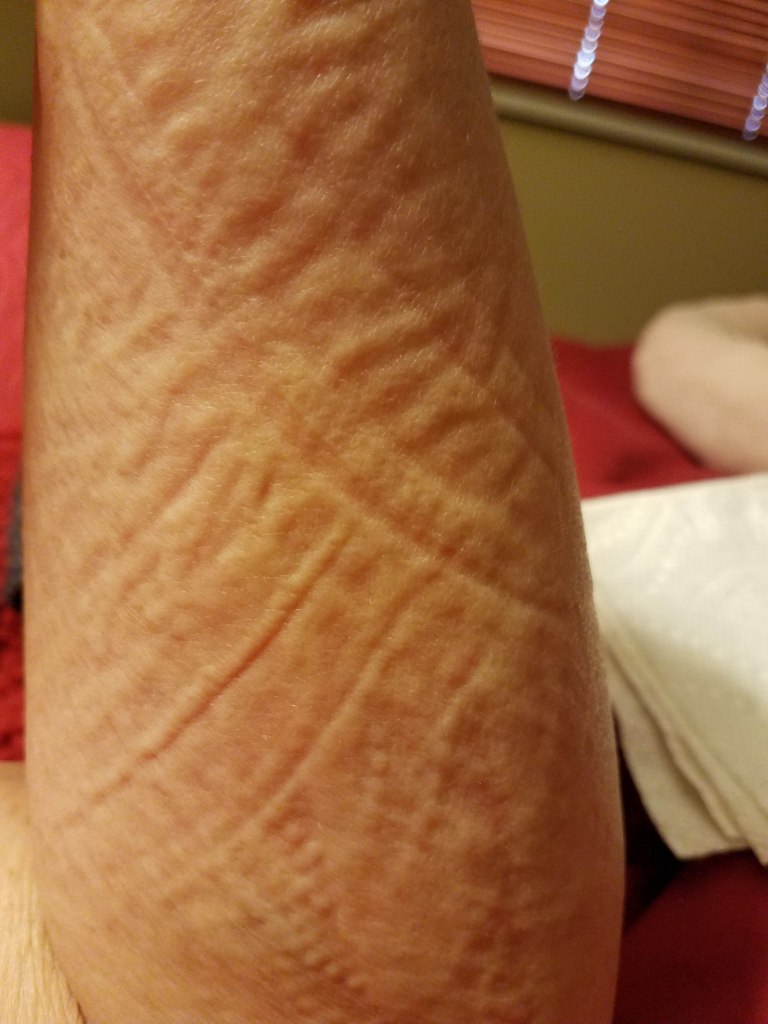
Oh yeah. There is edema, too. Check out this arm!
Flares are a test of patience, but they always do come to an end for me. Somewhere towards the middle of February, for no reason that I can put my finger on, I slept soundly through the night. Wow. That was great, I thought. A couple of days later I realized that my energy was coming back and that my stomach didn’t hurt any more. After a week I took a shower and there wasn’t a wad of hair deposited in the drain. My thinking became clear, my driving fearless, and my muscle pain and swollen joints receded to background levels. The itching stopped, the eczema disappeared, and I stopped using my inhaler. It was over; the storm had passed.
When I mentioned to my rheumatologist last month that I was having these flares things suddenly took a left turn and my whole appointment went off the rails. She first told me that there wasn’t any treatment that was more effective than what I was already receiving. (I know that, my systemic sclerosis is pretty stable, and I am grateful. I think that it is Sjogren’s causing all the trouble, but it has to ride in the treatment back seat since it probably won’t kill me.) Then she reminded me that I always mentioned my fatigue and muscle pain, and that maybe I should be tested for sleep apnea or given antidepressants. Suddenly, instead of talking about the conditions for which I was already diagnosed, we had to talk about depression and sleep apnea. I was defensive and almost in tears. It took days to process what had happened there.
The poor Mother of Cats needed extra attention for a few days…
It all boils down to two essential truths. I am a Zebra. I have been betrayed by a medical system designed to treat commonly occurring conditions when I suffered from a rare disease. I have had my symptoms dismissed, disparaged, or ignored for literally decades. For my rheumatologist, who I like and trust, to do this suddenly threw me back into a defensive, victim-like posture. I will not let this happen again.
The other essential truth is that it is insulting and counterproductive to cherry-pick out a couple of symptoms from the entire package that I call a flare, concentrate only on them, and then build a diagnostic hypothesis that addresses only those isolated symptoms. Yes, I do have muscle/joint pain, fatigue, and sleep disruption, but let’s not forget about the gastritis, itching, hair loss, edema and shortness of breath. Once I am out of the flare, my sleep is pretty good and my fatigue is much reduced. I know that my rheumatologist wants to help me, but I’m going to insist that we stick to the data and that logic and reason are employed as part of my treatment plan. Even if that plan includes a clause that says… you are currently receiving the best care available and there is nothing else we can do for you because scleroderma and Sjogren’s sucks. Well, all right then. Give it to me straight, because I can handle that, but don’t hunt for ANOTHER condition that you can medicate without better data.
Because I don’t have sleep apnea. I’ve been tested twice in the last three years. I wear a Fitbit that shows that I’m in deep sleep for 1-2 hours a night and that I’m almost motionless all night long. It is time to put that hypothesis to bed and to spend more time talking about things like this lupus-like rash that has appeared on my face…
I’ve also been checked for depression and I’m fine. Yes, I am aware that MOST chronically patients need help with depression, but that doesn’t mean ALL patients require additional drugs.
After all, I’m self-medicating every day with knitting!
I finally decided to write about this experience in my chronically ill life in case it could help someone else. Okay, I also needed to vent a little!
Should I perhaps knit a little something for my rheumatologist? It must be hard for her to treat patients every day who are dealing with painful, progressive and incurable diseases; no wonder she sometimes grasps at diagnostic straws hunting for a way to help.
But if she does it again this Zebra is ready to deal with that nonsense!
“When you hear hoofbeats, think of horses, not zebras.” ~medical school proverb
Zebra ~medical slang for an exotic medical diagnosis
16 years old: my last year illness-free.
As a teenager I struggled with eczema and was photosensitive; I was started on steroids, told to wear long sleeves, and to stay out of the sun. Without a clear cause for my eczema/rash I told that I was high strung and unable to handle stress; if I could control my emotions I would see my symptoms disappear. Eventually I did get better, the drugs stopped, and my life went on.
In my early 20s I had my first asthma attacks. I didn’t really understand what was happening, it was always in the night, and the doctor couldn’t find anything wrong. I was told to handle stress better. Most of the time I was okay, so I just learned to deal with it.
In my early 30s my knees began to swell and become painful. There were lumps below and behind my knees. I had an ultrasound to make sure the worst lump wasn’t cancer. I was told to do special exercises and to stick to low impact. My eyes hurt and I couldn’t go outside without sunglasses. Clouds of floaters swam across my vision. You have allergies, said the doctor. My finger was too fat for my wedding ring so I resized it.
In my 40s my hands became numb and swelled. I had a lot of pain and struggled to manage routine tasks. Carpal tunnel, said the doctors: it’s a repetitive motion injury and you did this to yourself. I had the surgery on both wrists and my hands did get better, but I still struggled with swelling and numbness, even in my feet. I developed a rash on my face. Rosacea, said the doctor. My knees still hurt. I started to develop high blood pressure. Control your diet and exercise, said the doctor. My fingers became too fat to wear any of my rings. I was tested for autoimmune antibodies associated with rheumatic diseases (anti-nuclear antibodies), but the result was only mildly positive so it was dismissed as not significant.
In my 50s my knees were so bad I had to take ibuprofen every day to function at work. It hurt to breathe in the mornings, and I had several cases of bronchitis that required an inhaler and steroids to recover from. I developed pleurisy. I was also told that there was nothing wrong with my lungs, and that I needed to get better shoes. My face and jaw hurt so much I couldn’t sleep. TMJ, said the doctor. You need to handle stress better. My kidney function dropped to 35%, alarming another doctor. You damaged your kidneys taking ibuprofen, I was told, and you can’t take any more. I changed my job so I wouldn’t have to stand so much at work. My blood pressure continued to rise in spite of changes in my diet and exercise; I was placed on a beta blocker to control it. I developed Raynaud’s phenomenon; don’t worry, I was told, it is a side effect of the beta blocker. I wondered why I wasn’t getting wrinkles like my friends. The rash on my face was getting worse.
In my early 60s I noticed that my arm was getting “thick” and that I sometimes couldn’t complete a swallow; food became “stuck” mid-gulp. I complained about dry mouth. My fingers turned blue in the cold. I was hospitalized with severe gastritis. I was stalked by fatigue and my knees hurt every single day. My fingers were too fat to make a tight fist. Unable to function at work, I retired early. I developed colitis and rarely left the house. Testing showed that I didn’t have an intestinal infection, and my doctor didn’t pursue things any further.
Struggling with life and my early retirement, I grew roses, read books, knitted, and launched this blog.
One night the light went off for me. I had joint pain, kidney damage, intestinal woes, Raynaud’s, a rash on my face, and a positive ANA. I walked in and demanded testing for lupus.
How is it possible, asked my doctor when confronted with the list of symptoms, that you haven’t already been diagnosed? Shocked that I had slipped through the cracks for years, my doctor immediately ordered the complete diagnostic battery for rheumatic diseases. It wasn’t lupus after all, but a couple of relatives: scleroderma and Sjogren’s syndrome, two rheumatic systemic diseases that unified all of my symptoms. The decades-long string of mystery complaints was over, and I was started on aggressive treatment for these two autoimmune diseases.
How was it possible that I hadn’t been diagnosed earlier? Isn’t that a wonderful question! How could I have slipped through the cracks year after year as I struggled with pain, respiratory infections, dysfunctional hands, eye problems, TMJ, and all the other medical woes that had parked themselves at my door? Why was there no diagnosis when, as I was to learn later, I was an absolute classic case of limited systemic sclerosis, a type of scleroderma, and that my Sjogren’s was obvious and well established.
In retrospect, the answer is glaringly obvious: I am not common. I have a rare disease (systemic sclerosis), and even though my doctors were well intentioned, they dismissed my symptoms when I didn’t fit the usual diagnostic profiles. I was a zebra in a herd of horses, ill-behaved and refusing to fall into line with their medical school training. Since I couldn’t be diagnosed with any of the normal causes for my symptoms, doctor after doctor concluded that they must be due to something else, like maybe stress… or lack of exercise… or my choices in pain medication. Time after time, I was assigned the blame for my own illness because of my inability to “handle stress”, repetitive motions, bad shoes, lack of exercise, taking ibuprofen, or any other excuse reasonable explanation that came to mind when my symptoms could not be ascribed to common causes. My doctors had been trained to ignore zebras, and these other causes were more plausible to them.
The other reason this happened was because my symptoms were always presented to my doctors in isolation: chest cold, painful eyes, knees that won’t bend, and so on. Symptoms that emerged over decades, and were presented to different doctors. No one saw the big picture until I finally pieced it together myself and then my doctor was shocked by the list: grouped together my symptoms screamed autoimmune rheumatic disease.
Why am I reflecting (and writing) about all of this? This month, March, is National Autoimmune Awareness Month. My story is one that is shared by many, many other people who deal with autoimmune illnesses. One of my diseases is rare (scleroderma), but the Sjogren’s and fibromyalgia are not. In a way, to have an autoimmune disease is to be a zebra because these conditions are elusive, can present themselves with a battery of symptoms that are seemingly unconnected, and don’t respond to the usual courses of treatments like antibiotics, diet and exercise. They can take, just as mine did, many years to diagnose. For many autoimmune patients, they are, just as I was, zebras crying for help in a herd of horses. Trained to treat horses, doctors don’t always hear the cries. One way to combat the problem is to educate the zebras so that they can, just as I did, recognize and group their symptoms together in a meaningful way to present to their doctors to help them make the diagnosis. Autoimmune Awareness Month is meant to educate everyone who might deal with an autoimmune disease: patients, families, caretakers, and doctors.
In my family we know these illnesses well. My grandfather died from complications of rheumatoid arthritis and my father had disabling allergies. I have scleroderma, Sjogren’s syndrome and fibromyalgia. My son has type-1 diabetes and my daughter-in-law has multiple sclerosis. In all of these illnesses there is an immune system that is attacking normal tissue in our bodies; for some of us the attack is moderated by drugs that are designed to disable parts of our immune systems, but it continues nevertheless. Unless there is a cure the damage will continue to accumulate in our organs and tissues. These are the words that are often used to describe autoimmune illnesses such as ours: disabling, progressive, incurable, potentially fatal.
We aren’t alone. There are around 50 million Americans who also have autoimmune diseases. There are over 100 different autoimmune diseases and the need for research, support and treatment is endless.
I started this year with a commitment to reduce the size of my stash and a fuzzy notion of attacking some knitting projects that I had never done before. I thought that I would like to learn how to do double knitting. Maybe some herringbone stitch. Definitely, thrummed mitts.
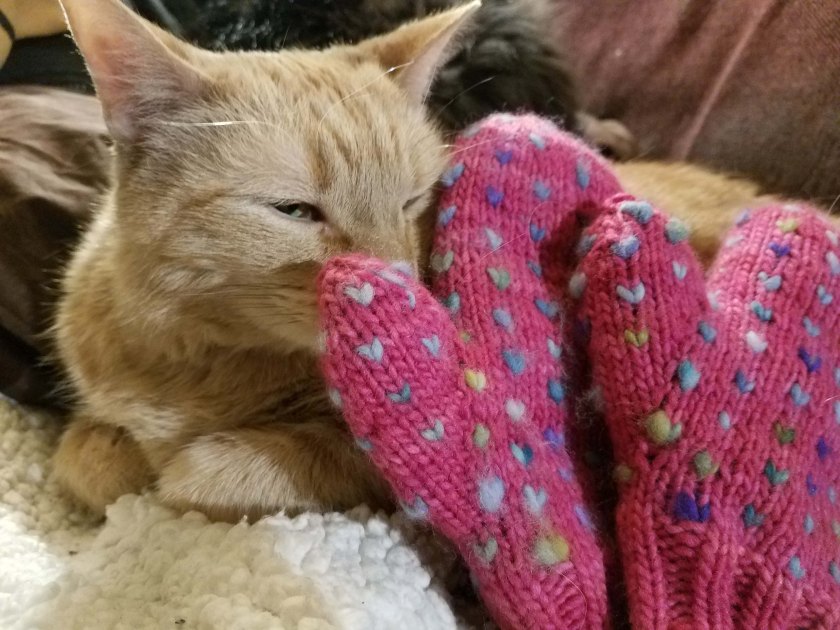
It was cold this weekend so I worked steadily all day Sunday on the thrummed mitts and got them done. This is my son’s cat Daxter checking them out.
I was really motivated to knit some warmer mittens, and I’ve heard that thrummed mittens provide serious warmth. They just look so cool, they can felt and mold themselves to fit hands well, and then there is the insulation factor. My Raynaud’s has gotten worse over the last year and I have some concerns about digital ulcers. Nope. I don’t want one of those!! I need to be able to function in the cold without taking risks with my fingers.
My BKB Deb gave me this merino roving from Malibrigo. Perfect for thrummed mitts!
I found a promising pattern online, Warm Paws by Carol Ullmann, dug out some worsted weight yarn from the stash, and watched videos on YouTube to learn about knitting in thrums. Pretty straightforward, and the pattern gave excellent instructions too.
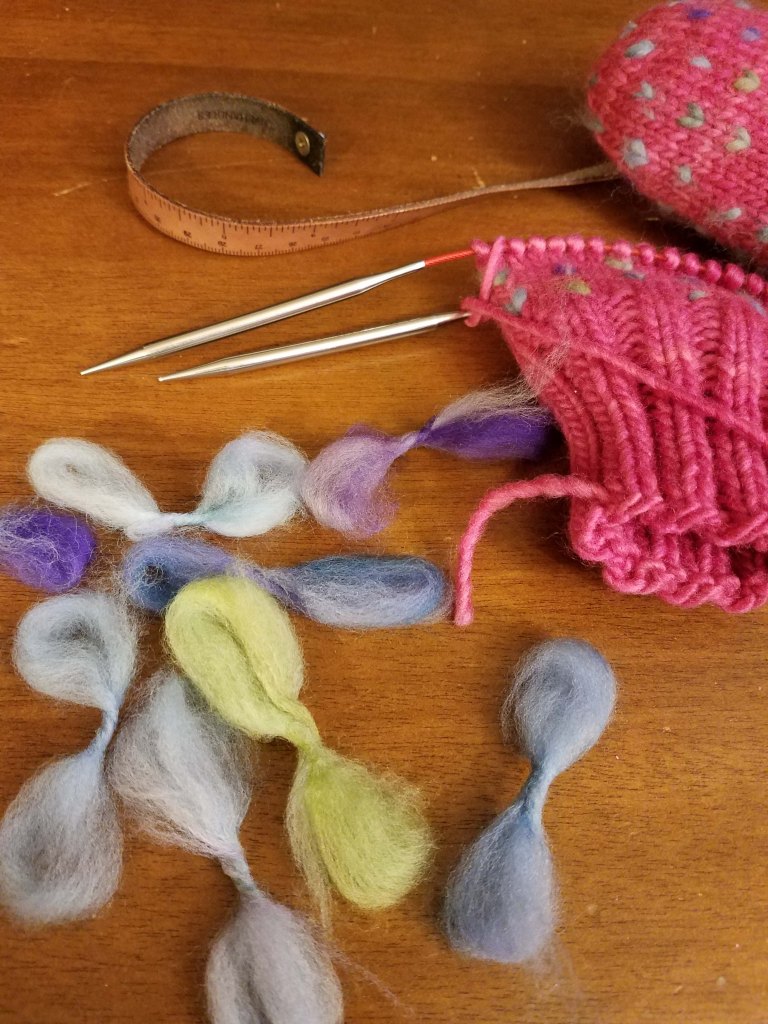
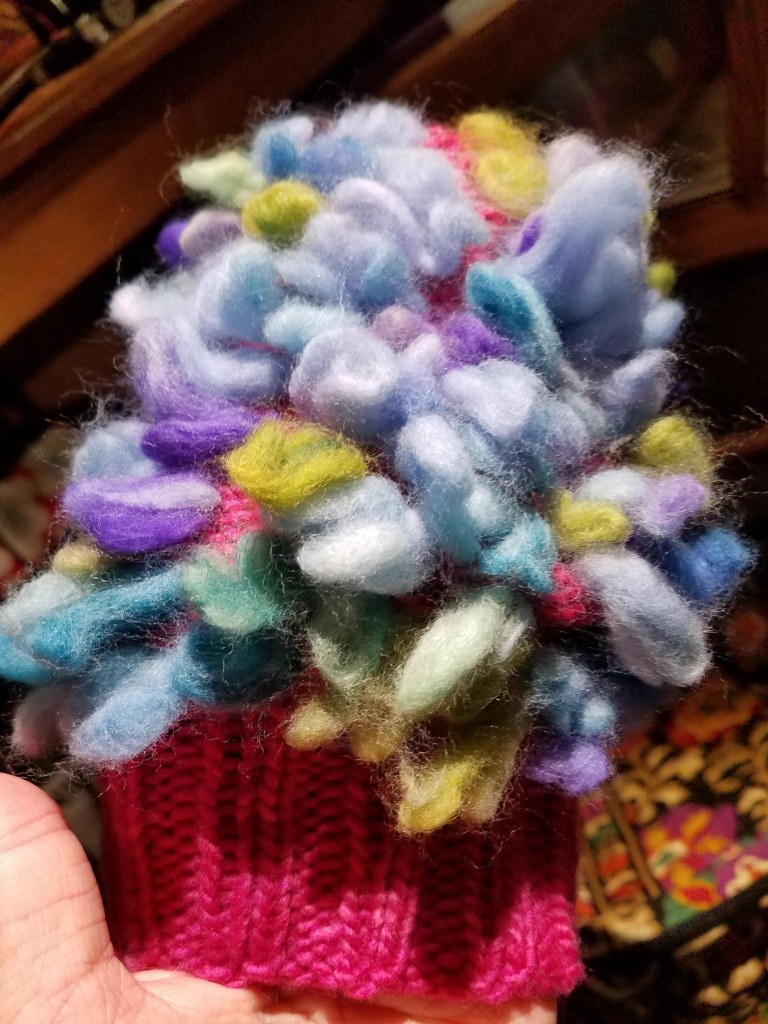
The staple length of the merino in the roving was pretty long: 3″-4″. It was also pretty darn soft and lofty. I pulled off little strips about 6″ long and then folded them into loops.Each loop was pinched in the middle to make a bow, and then twisted to hold it together. I quickly discovered that my thrums needed more handling to keep them from shedding on the mitten, so I added a little water to the center of the loop (where my fingers are gripping it) and then rubbed it briskly with a finger on the back of my hand or wrist to make the wool felt in the middle. Hey, I have scleroderma, and I can’t twist the loop between my fingers, but that would probably work for another person. 🙂The prepared thrums were pretty hardy once the middles were felted and I could make several ahead of time. In this shot you can see the felted middle in each thrum.Once knitted into the mitt the loopy thrums stayed in place and behaved themselves.
The finished mitts are just fantastic and fit like a dream. I wore them as I drove home from my son’s last night in the cold and snow; my hands stayed warm and for the first time in a long while I didn’t have a Raynaud’s attack during the drive. I’m still researching battery operated warm mittens, but in the meantime these thrummed mitts are going to be a game changer for me. The way that merino felted so quickly I figure that I can just stuff more loops in to increase the insulation as needed. Here are my project notes.
So, how am I doing on my New Year’s resolutions? I can check thrummed knitting off my list, and with this project I have now removed 14 skeins of yarn from the stash. I’m pretty sure I will make the goal of reducing the stash by 50 skeins this year. Of course, not every project is quick to complete. Check out how I’m doing on the fabulous, colorful mitts (that would make a unicorn cry with envy…) that I’m making for my knitworthy niece…
Those bobbles and braids are slowing me down, but look at how cool they are going to be!! Here are these project notes.
Happy knitting everyone, and I do hope that the weather is behaving for you.
I’m a big fan of the movie Star Wars. Seriously. I remember the first time that I saw this movie; we stood in line for hours, laughed at the droids, were amazed by the special effects, wished we had the Force, held our breath as the tension at the end of the movie mounted, and cheered wildly when the Death Star blew up. Over the next year we watched the movie 13 times in the theater, memorized the sound tract, and to this day I hear snippets of dialogue echoing in my mind…
Like this line said by the droid C-3PO to his buddy R2-D2 as they escaped from their badly damaged and captured ship to carry out a secret mission as directed by Princess Leia: “That’s funny, the damage doesn’t look that bad from out here.”
Bundled up in wool and staying warm. You can’t see my stage 3 kidney disease, interstitial lung disease, struggling gastric and intestinal organs, burning muscles, painful joints, brain fog, and my truly astonishing fatigue.
That’s me. Badly damaged on the inside, not that bad on the outside. The curse of all people who have an invisible illness. People often say, when they learn about my illness, something along the lines of… “Well, you look great!” It’s nice to hear, but it also suggests that I’m not really that sick. I can’t help but feel that they think that I am an attention-seeking hypochondriac. Sigh.
You have to admit, the visible symptoms are really subtle. It can be as little as lost circulation in a finger: Raynaud’s phenomenon. What can’t be seen is that I’m also experiencing circulation loss in my lungs, kidneys, brain and other organs.A poor dietary decision can hit me hard: dizziness, muscle pain and edema in my arms. I ate cheese enchiladas at my favorite restaurant this time.
It is amazing, really. How can the damage not look that bad from out here? I struggle for air. I often lack the energy to get through basic tasks. Pain stalks me waiting for a poor decision on my part that will give it an opening. An incoming weather front pushes me over a cliff. Holidays can be the worst as I struggle to manage my energy resources, diet and exposure to cold. I can get through the Christmas dinner okay, but the next two days are spent in bed sleeping myself back to functionality.
And yet, I’m starting the New Year feeling pretty darn chipper, well… as chipper as you can after a 12 hour nap and a strong latte to launch myself into motion. See, I can get back to functionality. I’m on great drugs and I have wonderful doctors. My latest round of medical testing shows that I am tolerating my drugs well, and my disease progression has virtually ground to a halt. I am making some gains. I spend a lot of time managing my symptoms and hoarding energy resources, but I am not getting worse. Some really scary words on my chart have gone away over the last year: chronic respiratory failure, pulmonary arterial hypertension, and severe kidney disease are no longer there. I have wonderful friends and supportive family members. I am still independent and can get out to social events.
I have the world’s bossiest cat to tend to me…and my indoor roses are blooming.
The rose bush is also struggling and covered with mildew. Sigh. It’s like a metaphor for my life. Bloom where you can, and pretend that all this other damage isn’t happening over there… Jedi mind tricks can be useful when dealing with implacable enemies like scleroderma and mildew.
Use the Force! I hear in my mind. If you know the movie Star Wars and the other movies in the series, it is a tale of heroic underdogs battling against great and evil foes, desperate times, hope and change.
I don’t have a light saber, but I have knitting needles.
I don’t have the Force (an invisible energy field created by all living things), but I have an online and real network of people and other living things that connect to me and support me. I have science and time on my side: new drugs are on the way and some of them are in new rounds of clinical trials. Remember the movie poster? A New Hope. Yep. Every year brings me a new edition of hope.
My illness is mostly invisible. The battle is real. Bring it on, 2019, I am ready for you!
Footnote: Perhaps you are wondering… whatever does she have? I was diagnosed with Limited Systemic Sclerosis and Sjogren’s Syndrome in 2014, and those two conditions carry with them a host of complicating conditions such as Raynaud’s, colitis, gastroparesis, interstitial lung disease, kidney disease, heart disease, oh my lord, and a partridge in a pear tree. In 2016 I was referred to palliative care and told to make final plans; Myfortic (CellCept) saved the day and I was discharged from palliative care a few months later. In 2018 my rheumatologist added fibromyalgia to the list and there is an ongoing discussion about dermatomyositis. Why do these autoimmune diseases throw parties and invite all of their friends? It’s like the bar at Mos Eisley Spaceport with all the strange aliens. As Obi-Wan tells Luke, “You will never find a more wretched hive of scum and villainy. We must be cautious.” I don’t have a blaster, but I think that in this case the drug Myfortic will do the job!
Wow. It is hard to believe it, but it has been more than 4 years since my diagnosis: Limited systemic sclerosis (scleroderma) and Sjogren’s disease. Time just flies when you are having fun, right? Seriously, I have been reflecting for a few weeks about what to write to mark the end of the fourth year. Should I write about how strange a dichotomy scleroderma is: people tell me that I look good, but what they can’t see is how my entire life is organized around accommodating my illnesses. Maybe I should write about how I have developed a Zen-like patience as I hit each roadblock; why worry about things you can’t change when in the course of time all will become more clear? Maybe I should talk about growth. Personal growth in the face of a heartless disease as I came to terms with my own ability to become an active member of my treatment team and to assert myself in the face of medical experts.
Done! Personal growth it is!
Even in the worst of times it is possible to create items of beauty that provide comfort and are therapeutic. I knit this shawl last spring while my doctors were determining if I had developed potentially fatal complications of systemic sclerosis: pulmonary hypertension or heart failure were the candidates. There was nothing to do but to knit on as I waited for test results.
When I was first diagnosed I really did go through a time of sadness and grief. It just came in waves for me as I began to figure out that systemic sclerosis and Sjogren’s are both incurable and difficult to manage. Then I realized that they might be disabling. Then it finally dawned on me that they might be fatal. To my horror I discovered that the 10-year survival rate was 60%. There would never, ever, be a “better”, I thought. The best I can hope for is becoming stable and maybe getting some softening of my skin.
The great unknowns of scleroderma really wore me down. Doctors kind of dodged my questions or referred me to another doctor on the team. I was afraid, and I didn’t want to make too much of a fuss because I was dependent on the medical specialists and I didn’t want to alienate them. I was struggling, weak, and truly a victim of my disease.
Flash forward 4 years. Things have changed. I began to keep a food log and journal and I worked out dietary changes that helped me. I participated in a self-management study, and I attended a couple of conferences. I remembered that I was trained to be a scientist, and I employed logic and reason in my scleroderma life. I spent a lot of time with Doctor Google and reading research papers at PubMed. I fired a rheumatologist, found another one, and convinced my primary care physician to meet with me regularly and to filter all the test results and doctors notes into a cohesive action plan. My care improved as I communicated better with my doctors and they developed a good sense of me and the other doctors on the team. My power over scleroderma grew as I faced down crisis after crisis. I may not conquer this disease, but by golly I will be brave and give it a good whacking!
Here’s an example of what I’m talking about. I have to get routine blood testing to make sure that I am tolerating the drugs that I’m on well. I went for the blood draw two weeks ago, and a couple of days later I got a phone call. There was a problem: a liver enzyme was suddenly elevated above normal ranges. I was told to head on over to urgent care to get checked out. I’m a compliant patient, so that is what I did. This is what happened when I met with the doctor in urgent care.
Doc: You’re fine. It’s just a bad test result.
Me: I have been experiencing worse (crushing) fatigue for the last two weeks as I’ve been fighting a cold and my muscle pain is pretty bad. I have been staying in bed two days recovering for every day up.
Doc: I think that we should put you on prednisone.
Me: I am very nervous about that. I’m already pretty immunosuppressed, and my pulmonologist has specifically told me to refuse steroids if I hit the ER.
Doc: Then we should start you on Cymbalta for the fibromyalgia pain.
Me: That is a drug that I’ve seen advertised that seems to have a lot of side effects. I just came through a rough patch because I was overmedicated this spring, and I’m nervous about adding another drug due to possible kidney or liver complications.
Doc: Can I at least offer you some antidepressants since you say you have trouble getting out of bed?
Me: I have fatigue not depression. It’s part of my illness.
Doc: Most chronically ill people have depression…
Me: Yep. I’ve dealt with anxiety and depression in the past. This isn’t depression.
Doc: But you will feel better.
Me: Hey, I’m not here seeking help with my illness this afternoon. I got sent here by rheumatology because of a high liver enzyme result, which you feel we should ignore, and I have chronic kidney disease. You want to prescribe a drug that will be cleared by one of those two organs? I’m not comfortable with any more medications without talking to my other doctors first. (I start edging towards the door to escape this frustrated pill pusher… maybe he just is excited to have a patient with a rare disease and wants to contribute, but I am out of here!)
Seriously, I do feel like I am living in a soap opera half the time that is being directed by my bossy cat. A soap opera staring yarn, of course!
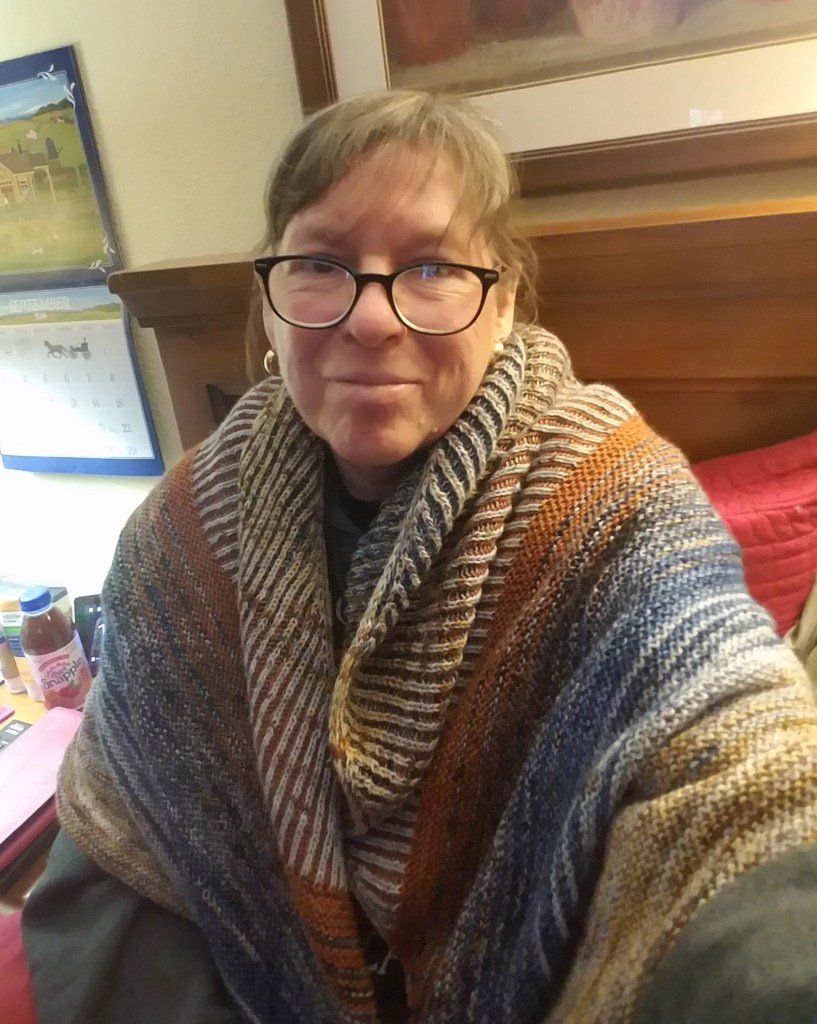
But he is also a great source of comfort. Here he is hanging out while I was knitting the shawl that I’m wearing in my picture.
That little episode put me back into bed for another day, but I was strong, I felt informed about my illnesses, and I didn’t allow a strange doctor who was dismissive of test results to prescribe me new medications. I have grown. My thinking about what is acceptable medical care has crystalized, and I feel empowered. I will talk about these drugs with my current team, and there will be a consensus decision before I start anything new.
Over the weekend I decided to double my dose of krill oil and to eat a banana every single day. 10 days later I am over the cold, I feel much better, my muscle pain is almost gone, and it seems I am through the flare. Yippee!
So, four years into this ugly disease where am I at? I am stable! The drugs that I am on have greatly increased survival rates for systemic sclerosis patients. My skin has softened some and I have pretty good function. My Raynaud’s is well controlled. My lungs, heart and kidneys have improved and my hypertension has vanished. My GI tract continues to rule my life, but I have gotten better control with a careful diet. Fatigue and pain stalk me continually, but I was thrilled to hear this week that my eyes have also improved since my ophthalmologist started me on krill oil. Hug a krill, everyone!
I have grown, and I am stronger for it. There will be many more adventures and bumps along the scleroderma road, but I am good. My priorities have shifted, and my values have clarified. I value the small things, have lost interest in making money, and budget my time ruthlessly. Scleroderma as a personal growth plan. Who knew?
Tomorrow I go in for the repeat blood tests to see if that enzyme is now back into normal ranges.














 Like this line said by the droid C-3PO to his buddy R2-D2 as they escaped from their badly damaged and captured ship to carry out a secret mission as directed by Princess Leia: “That’s funny, the damage doesn’t look that bad from out here.”



 Yarn, Books & Roses