Science and the Scleroderma Girl: Supplements and Me

Let’s be honest: everyone with scleroderma wants to feel better. We trade info constantly, and almost everyone has a supplement that they have found is really helpful. It’s tempting to load up on everything at Vitamin Cottage that might be helpful, but you should know me (geeky science girl here!) by now… if it doesn’t have promising research studies to back up the claims, I’m going to pass it up.

Supplements
The big three! These are the ones that I have found are most helpful for me. Yellow Boy is a terrible model… he kept head butting the bottles and this is the only shot I got.

Tumeric (and Curcumin)

So many people have advised me to try turmeric. Cruising the internet I found lots of information from sites that are devoted to nutrition, health, or supplements, but I wanted to see hard data. Yep. Pretty darn easy to find. This controlled experiment found curcumin worked better than a traditional pain med following a dental procedure. Another study looked at migraine pain and the levels of two inflammatory markers (IL-6 and C-reactive protein); the result was that curcumin and omega-3 fatty acids did reduce inflammation. Wow. That sounds pretty promising. Finally, since one article I read suggested that curcumin could help with renal disease I hunted for that…this research showed that curcumin is beneficial for kidney disease. I scored myself some curcumin and I think that it is helping, but I have to be careful with my gastritis-prone stomach lining.

Vitamin D

“Under no circumstances are you to let the sun hit your skin!” directed my dermatologist. “Are you getting enough sun?” asked my rheumatologist. “You need the vitamin D and the natural kind you make in your skin is best…” Ugh. How am I supposed to figure out stuff like this? Because I keep a symptom journal I have discovered that sunshine makes me sick: rash, fatigue, pain. Sorry rheumatologist, the dermatologist wins this round. I started taking the vitamin D supplement not long after I was diagnosed and noticed that it helped me with depression. Who knew? My internist monitors my vitamin D levels to make sure that my current supplement is enough.

Omega-3 Fatty Acids (Fish or Krill Oil)

I was really late to come to this party. Struggling with an out-of-control Sjogren’s flare last winter my ophthalmologist suggested that I take fish oil to improve my tear production. Okay, my tears are just horrible. Not only do I barely produce any tears, but what I have flash evaporates right off my eyeballs lickity-split. I didn’t even bother to check the internet before I gulped down some fish oil tablets from the grocery store. Wow!! The next morning I woke up to eyes that didn’t hurt. Then I noticed that my neuropathy was better.  Oh, yeah. There was that one study that said that omega-3 oils helped with migraines, and my ophthalmologist mentioned that he took it for tinnitus… It gets even better: it helps reduce blood clots too! Every time I end up in the ER they go on a blood clot hunt… this is probably a good supplement to add to my diet, huh. It also helps with Raynaud’s, but the effect was seen with people with primary Raynaud’s. Hey, it was a small study. I’m taking the krill oil anyway!
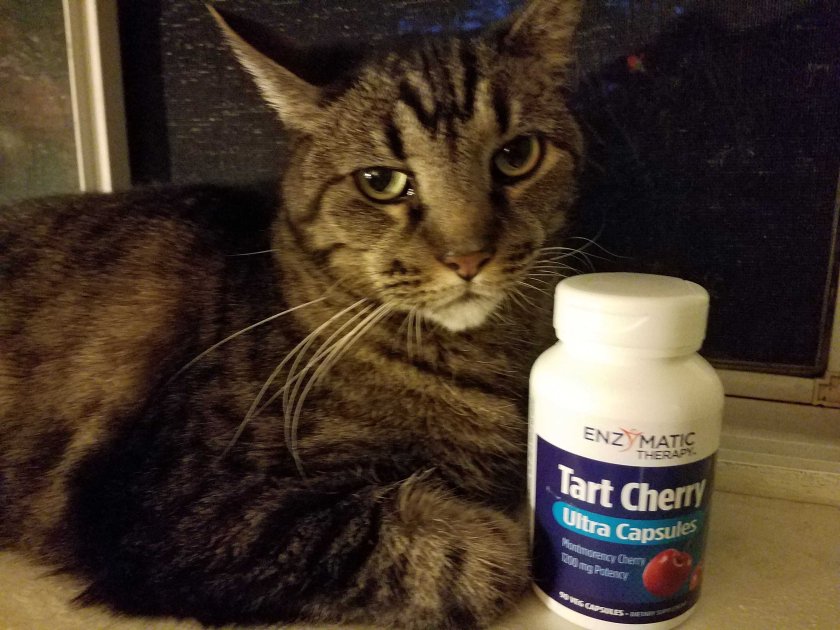
Tart Cherry
Another unhappy cat model… Okay, he is unhappy because he loves me and he knows that this tart cherry really did a number on me. Bad tart cherry, bad!!

Tart Cherry

Things were really bad for me last spring. I had brain fog and dizziness that left me afraid to drive. The fatigue was unreal and everything hurt. My BKB Deb advised me to try tart cherry. Off to the internet I went. Oh. It is a real thing. I found this article, and this one, and one showing memory improvement in rats. Since I was miserable and couldn’t remember what a memory was, I took tart cherry out for a spin. Woohoo! I woke up the next morning feeling *normal*. I had energy, and the brain fog was gone. In the days and weeks to come I continued to feel pretty darn good until… the kidney function tests came in. My kidney function dropped 15% in just 6 short weeks and the tart cherry fun came to a screeching halt. The notation “chronic kidney disease” was added to my chart and that was the end of that. I stopped the tart cherry, accepted feeling like road kill every morning, and my kidney function crawled back up to a higher score. Whew! Talk about dodging a bullet!

There is a lesson here. Take the supplements that your doctors suggest. Check out other supplements before you start taking them, and let your doctors know before you start. I talked over the tart cherry with my internist and rheumatologist before I started, and they caught the kidney function drop pretty quickly because I was going for bloodwork every month. Just because I ran into trouble doesn’t mean that you will. Keep a symptom/food log and monitor like crazy. If your doctors know what you’re up to they can order testing just like mine did. Saved by the blood test!

Knitting
Oh yeah. I also do a daily supplement of knitting. 🙂

If anyone has another great supplement I should check out, let me know!

Science and the Scleroderma Girl: What a Cell Wants… (AKA the Sugar Rant)

I’ve been pressured repeatedly to “give up sugar” to control my inflammation. Really, people have been pretty darn aggressive in this messaging both in person and online. To be fair, the people pressing this message must have felt they were improved when they cut back on sugar, but every time it happens I am torn between tears and frustration.

I’m sorry, but this is like telling me that I can’t put gasoline into my car anymore. The car simply can’t run on air alone, and neither can I.

Eukaryotic Cell
Cutest drawing of a cell ever!! This little guy, an idealized animal cell, needs many essential components to stay alive, including a constant supply of glucose and oxygen. That’s what a cell wants, what a cell needs… 

Okay, to be clear, we do need a component of air for energy: oxygen. I was running short of that commodity earlier in my scleroderma career and had to be placed on supplemental oxygen for about 6 months waiting for my drugs to kick in and save my ass. If you are short on oxygen, as I can attest, you are also short on energy and you can’t think very well. I was in trouble, as my pulmonologist put it, because my “engine” (my lungs) was too small for my body.

The other essential energy component is sugar, or specifically, glucose. Cells, and by extension, bodies, use an amazing system of biochemical pathways to convert biological materials to glucose, maintain a steady concentration of glucose in your blood, and then pack away the excess for storage in your muscles and liver. If blood glucose levels drop too low your body releases glucose from storage. If the stored glucose gets used up, your body begins to cannibalize other tissues. Why is glucose so important? Because it is used in the mitochondria located in body cells along with oxygen to produce the energy molecules (ATP for you geeks out there) that are used to run the whole biological show. If there is no ATP, the whole show stops. That’s why it is critical to keep people breathing and their blood pumping, but also why it is important to consume glucose.

My relationship with glucose is pretty darn complex. Too much sugar at a time isn’t a good thing: it can dehydrate and damage tissue, and high blood sugar can cause blood pressure spikes. Take home lesson for me: don’t binge on milkshakes, sugary pops, and French fries. Because I had hypertension and a family member with diabetes, I have spent years developing a diet that has a low glycemic index. I eat yellow potatoes instead of white ones, recipes with half the flour replaced with oatmeal, and little sugar. I also eat fresh fruit in my yogurt smoothies, and rice mixed with veggies. I am eating sugar every single day in my meals, and it really is essential for me to function properly; the trick is to try to consume it in a way that helps maintain good blood sugar levels. Frosting loaded cinnamon rolls… NO!! Banana and strawberry smoothie with yogurt… YES!!

So, every time someone insists that I have to “cut out sugar” I can feel my head getting ready to explode. I wonder if they understand that potatoes, bread and rice are also “sugar”. Have they given up fruits? If they are also cutting out gluten they may be actually spiking their blood sugar with rice-based alternatives. It is kind of crazy talk… It also is kind of “it’s your fault you are sick” talk. Not nice!!

Knitting
It makes me go sit in a corner somewhere to knit away the frustration…

The research is mixed on the link between sugar and inflammation. There are lots of articles on healthy eating sites that say it is bad, but I wanted to see actual controlled experiments looking at the link between sugar and inflammation. There are several ways to check for inflammation but most look for inflammatory markers in the blood and cell permeability. This controlled research study found that there was no link between excessive sugar intake and inflammation. It’s kind of a small study, though, so I went hunting for more. This study showed that sugars obtained from food were not inflammatory, but when people consumed free sugars (spooned sugar into coffee or cereal, or drank sugary fruit juice) they did increase inflammatory markers. Cool. That totally makes sense, and explains why other people are reporting that they feel better when they “cut out sugar”. My sugar canister goes months without being opened… I don’t add sugar to anything unless I’m baking. Still on the hunt for info, I found this meta-analysis of research studies that showed that high-fructose corn sugar wasn’t any worse than any other in terms of inflammatory marker increases.

Okay, I think that the rant is over. Sugar is your friend, but don’t get crazy people…

Back to the knitting!

Science and the Scleroderma Girl: The Dairy Rant

It happened again just last month; I was advised by another scleroderma patient in a most assertive and authoritative manner that I could not eat any dairy because it “was inflammatory”. She followed up with a lecture on how cow milk is not appropriate for humans, and that most people were lactose intolerant because it wasn’t good for us once we become adults. In her defense, there are numerous sources on the internet that argue that dairy is inflammatory (like this one, and this one), and many people accept this as common knowledge.

Sigh.

Cat face.
This was not a message that the Mother of Cats wanted to hear…

I get it. We are all in the grips of a chronic disease that refuses to behave itself, and we all want regain some control through our diets. I just have trouble accepting these blanket arguments without working the problem first. Hello, Science Girl! Here’s a little unpacking of the inflammatory dairy argument:

  • Inflammation: for me, the easiest way to think of this is the heat, redness, swelling and pain that is associated with trauma or irritation. It’s your body’s first level response to a possible invader; the local temperature is raised, fluid moves into tissue to allow defensive white blood cells to move around, and signals are sent out to activate other parts of the immune system. One of these signals is C-reactive protein, which can be measured in blood. Mine gets measured every month.
  • Cow milk: cow milk is inappropriate? What?! Does that mean I can’t eat chicken eggs, or even bananas for that matter?  Moving on…
  • Lactose: this is a disaccharide, a two-unit sugar made from the simple sugars glucose and galactose. In our digestive system we need to use the enzyme lactase (made in the lining of your small intestine) to break the two units of lactose apart so that the single sugar units (glucose and galactose) can be absorbed. Lactose itself is too big to be absorbed.
  • Lactose intolerance: if your body no longer produces the enzyme lactase  that lactose ends up in your large intestines where it is food for the bacteria that live there. Yep! Bacteria party time! The byproducts that they produce as they grow cause the unhappy inflammatory outcomes (gas, bloating, pain, diarrhea) that all lactose intolerant people know only too well.
  • Allergies: if you are allergic to casein, found in milks, then you need to avoid dairy as it will be an inflammatory agent for sure!
Dairy products.
Dairy that I eat… 

So, here is the take home lesson from my unpacking: if you are allergic to milk or have lactose intolerance, then consuming dairy products will make you sick… they are inflammatory. Cool. I get it. What if you are lactose intolerant though… can’t you just avoid the lactose and keep the dairy? Armed with my food log, more curiosity than is probably good for me, and a tendency to use myself as a one person experimental animal, I kept looking for safe food to eat.

I have to be frank here. My intestinal woes are so bad that I have developed a fraught relationship with the refrigerator. Seriously, I open the door, look inside, and view the contents with a jaded eye as I ask myself: what can I eat in here that won’t make me sick? I keep a food log, and anything that makes me sick more than once gets tossed. I throw out lots of food. I have also discovered that there are some foods that are the safest to fall back on when I’m struggling.

Dairy. No matter how bad things are, I can rely on yogurt and cheese, along with a few other mainstays, to get me through a rough patch and stable again.

Here’s the trick: I choose my dairy very carefully. My milk is the kind that has the lactose removed. I only eat yogurt that has live cultures in it; they already snacked on the lactose and it’s gone before I eat it!

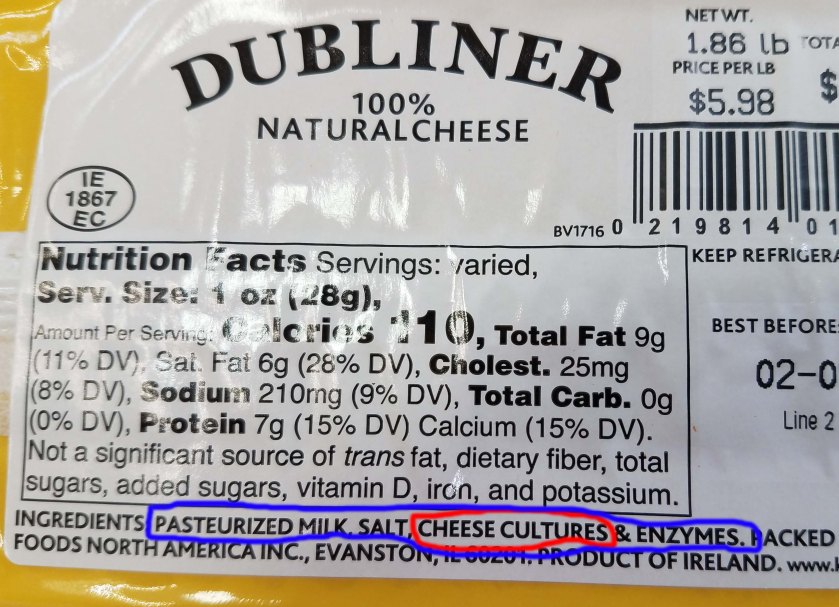
Cheese label.
I only buy natural cheese, and as you can see it is made with almost no additives. The enzymes were used to create curds in the milk, and that cheese culture took care of the lactose for me.

I read a lot of labels these days as I shop, and slowly I have discovered products that are safe and reliable. There is a sour cream with cultures that is safe. There is a safe cottage cheese. I haven’t found safe ice cream, but I’m still on the hunt. It’s best to stick to natural products, but even that isn’t good enough.

Cheese label.
This is natural cheese that says it has no sugars. I still won’t risk it because it was not made with cultured milk.

For me, always on the hunt for food that I can eat, dairy is my fall back safe zone. It will get me through a bad time, and if I eat yogurt every day I actually seem to improve. My C-reactive protein level drops. It’s almost like dairy is anti-inflammatory…

There are now numerous studies that show that dairy is anti-inflammatory. This review of clinical evidence showed that dairy reduced inflammation in individuals without a milk allergy, and here is another presentation arguing that dairy is anti-inflammatory. Check out the references!

So I told this woman that I had discovered that I needed to eat yogurt every day or I would run into trouble. Her response? You can’t eat that type of yogurt… it has sugar!!  Sugar is inflammatory!

Sigh.

Science and the Scleroderma Girl: Get Ready for the Rants!

Yep. This has all been about me needing to vent about all the alternative medicine and false information out there that is directed at people who are seeking to manage chronic conditions, lower their cancer risk, improve their lives, boost their immune systems, or just be more healthy.

There is so much coming at me that I would be a total victim if I didn’t have a way to sort through things. It is all presented as “scientific”, backed by “studies”, and supported by numerous testimonials. Often I am pressured by other people to adopt their products, treatment plans, or dietary guidelines, sometimes to an unacceptable degree.  The message “it’s your fault that you’re sick because you won’t do what I say” is out there, and I am surely not the only person to have been targeted by this.

Knitting.
Mostly I just ignore them and knit on. What do you think about my newest Close to You shawl? This yarn is from Western Sky Knits, and the colorway is called Nova.

Here’s the advice that comes my way:

  • Stop taking your drugs. The doctors don’t know what they are doing, and the side effects are unacceptable. (Really… this happens a lot!)
  • You can get well if you:
    • Follow the AP Protocol by going to an alternative medicine doctor
    • Never eat any processed or artificial foods
    • Only use natural products and eat organic
    • Only eat alkaline foods
  • You cannot consume any:
    • Salt
    • Sugar
    • Alcohol
    • Gluten
    • Dairy
    • Processed foods
    • Transfats
    • Seeds
  • You have to supplement your diet every day with :
    • Probiotics
    • Prebiotics
    • Turmeric
    • Cinnamon
    • Fish Oil
    • Vitamin D
    • Alkaline water
    • Tart cherry
    • Natural cider vinegar
  • You can treat your symptoms with:
    • Essential oils
    • Reflexology
    • Exercise
    • High fiber foods
    • Heat
    • Cold
    • Amber beads
    • Magnetic bracelets
    • Herbal tea
    • Aloe vera
  • Your disease was caused by:
    • A chemical exposure
    • Vaccines
    • That viral illness that you had sometime in the past
    • Leaky gut

Truly, if I wasn’t feeling overwhelmed by the fatigue, brain fog and all the other things that I deal with, having this all come my way is way over the top. Ugh. It is a lot of information, some reliable, some not so reliable, and some just plain false, for me to sort through.

Get ready!! The mini-rants are just ahead as I unpack as much of this as I can for you in the days ahead.

Science and the Scleroderma Girl: Hard Choices (Part 2)

Last week I wrote a post about trying to make a good decision about what drug I should be treated with for my systemic sclerosis. My rheumatologist had offered me methotrexate and CellCept; after trying to gather info about the drugs and their symptoms I unhappily picked methotrexate.

Cat
the Mother of Cats chose badly…

The first weeks of the drug seemed okay. I had a couple of hard days after taking my dose on Monday, but then I would feel much better for the rest of the week as the pain and brain fog receded for several days. The crazy thing was, my knees hurt REALLY badly during those two bad days. I checked online and other people had experience a similar phenomenon, so I soldiered on. Then one week the pain was pretty bad in my lower chest and right side and I was having trouble walking and breathing…

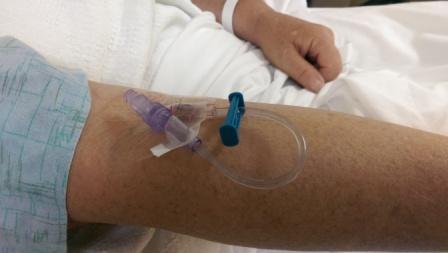
IV in arm.
Off to the ER I went where they hunted for lung damage and blood clots… 

It was an inflammation of the cartilage of my ribs, a condition called costochondritis. I called the rheumatologist’s office to see what I should do next, but didn’t hear back for a couple of days. I then emailed, and called again.

Finally the call came back; I was having a rare bone reaction and needed to stop the methotrexate. He was starting me on CellCept immediately.

Oh, that was an adventure. So much stomach pain… scratch that… stomach fire! Not just my stomach… my intestines were on fire too!! I gulped down spoonfuls of coconut oil trying to baby my stomach lining. I added food with the pills. I started vomiting in the middle of the night. It didn’t matter what I did, my stomach was going to be very upset. I stopped the drug and shot off an email to the rheumatologist again.

Hence began the two month battle to get me onto another form of drug in CellCept, which is mycophenolate mofetil. A stomach gentle version called Myfortic did exist, but it was not approved for systemic sclerosis, so the pharmacy refused to fill it. My rheumatologist filed an appeal. It was denied. My rheumatologist doubled down. Another rejection. Eventually I drove down to the Kaiser pharmacy and talked to the pharmacist as calmly as I could. I reminded him that Myfortic as just another salt of the approved drug, I had failed the approved form, my rheumatologist had appealed for this drug, and that I had a letter on file from another doctor in the Kaiser system stating that my gastritis prevented me from taking NSAIDS or anything else that would damage my stomach lining. I must have looked pathetic, because he gave me the pills.

Three years later I have greatly improved because of this drug that we had to fight for. In the meantime I have discovered (by hunting for info on PubMed Health) that while methotrexate helps with symptoms like inflammation and fatigue, the better choice in the long run is the drug that I am now receiving as it is associated with skin, lung, and heart improvements and better survival rates. I do have a higher lymphoma risk with this drug, and infections are a constant concern, but I think that I’m with the best drug available for me right now.

There is a take home lesson here. If you aren’t happy with your treatment, speak up! I should have contacted that doctor about those hurting knees long before I ended up in the ER. It’s easy to take a passive course when you are dealing with busy doctors and unhelpful pharmacists, especially when you aren’t sure if your symptoms are significant, but it is worth the time to shoot off a fast email anyway.

And let’s be honest. There are no easy choices, only hard ones. But even a bad choice can be corrected down the road with some luck,  persistence, and a dash of science.

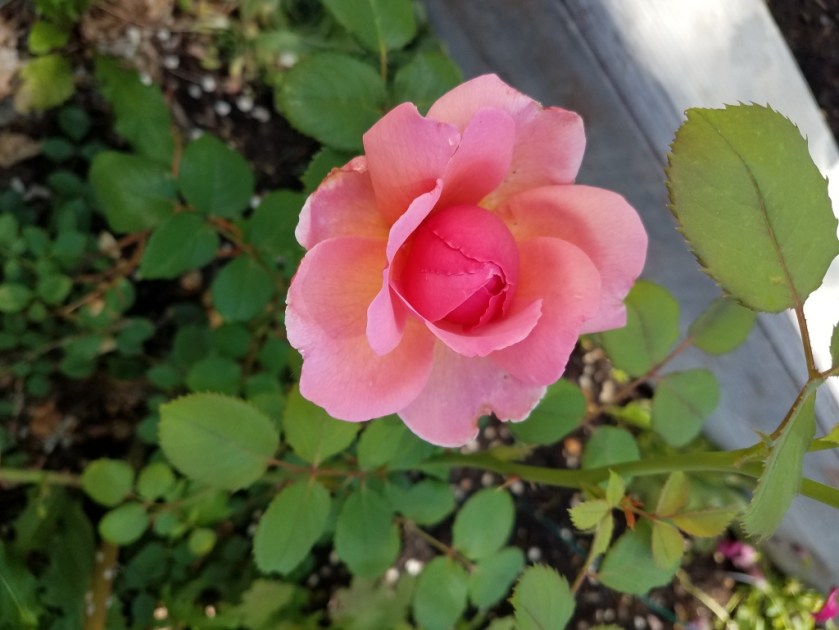
Rose
I bet you wondered where the rose was, didn’t you. Here it is, a little beat up by the hot weather, but still looking great!

Science and the Scleroderma Girl: Research Results

Yesterday was a good day for me. I ran to the library, went grocery shopping, and had my hair cut. The stylist who cut my hair, however, was having a poor day: she has fibromyalgia and was struggling with the pressure front moving through Colorado. I told her about bananas, and she told me about a new product that she was buying off the internet. As we swapped info she pulled out the bottle of her supplement and I snapped a picture of it with my camera. She gushed about her product: it is just great! It cleans toxins from your liver and pancreas too!

Okay, I just checked out this product  online, and it will need a blog post of its own. It has 19 different ingredients in it that I have to check out, but right now I think that I will need to stay away from it as it has aspirin in it from a willow bark ingredient. I already know that aspirin is something that can hurt my (already struggling) kidneys and put my stomach lining at risk (the gastroenterologist sent me a strongly worded letter on this topic… I’m complying!)  The other ingredients might be okay, however, and I should check them out to see if they are possibilities for me to add to my diet.

So, how do I do this? I do lots of searches with key words like “research”, “evidence”, “inflammation”, “mortality rates”, “efficacy” and the item that I’m searching for. When a friend recommended that I try tart cherry extract to help with inflammation I typed in “does tart cherry reduce inflammation” and discovered that there was an active ingredient in tart cherry that really did reduce inflammation and that it was more gentle on stomach linings than a NSAID. Clinical research projects had been done that showed positive effects by measuring inflammation markers in patient blood. I talked to both my internist and my rheumatologist about it, got their okay with some stipulations, started the supplement with medical monitoring (blood drawn every month), and had to stop 3 months later when my kidney function dropped dramatically. Oops.

There is an important lesson here. Just because something is “natural” doesn’t mean that it is safe. Think like a scientist. Keep a journal of your disease symptoms, diet and interventions. Ask questions and talk to your doctors. Educate yourself as much as you can.

English Rose.
Time for a rose break! Look at what I found in the garden this morning!

Where do I go for information? I could have gotten info from sites linked to the company that markets tart cherry extracts, but that information is somewhat tainted by the simple fact that they want me to buy their product. I look for information from major publications and research funded by the public domain. Some of the best places that I’ve found to go are:

  • The National Center for Biotechnical Information (NCBI) has links to lots of places you can access for information. I used this site a lot as a teacher as students could look at genes and run DNA comparisons. Now I can use it to research tart cherry!
  • Linked to the NCBI home page is a great resource: PubMed. Everything in the medical and biological universe is searchable at this site; you can see the synopsis with a general outline of the research and results,  and there are links to the journals and books along with information on how to access the full text. Some full text articles are free, and there is advice on how to get others.
  • A subset of PubMed that is extremely useful, both for the search engine and information on how to evaluate information you find, is PubMed Health. For me, this is the mother lode.
  • I live in Aurora, Colorado. I am lucky in that the CU School of Medicine is located here, and there is a great library there. I went into the library, talked to them, and got an account that allows me to access articles through their licenses. So far I’ve only had to resort to this option a couple of times, but it is good to have it.

Next to keeping my journal, the info I find using these resources has been extremely helpful and empowering in my battle with these ill-behaved autoimmune conditions.

Knowledge is power!

Science and the Scleroderma Girl: Hard Choices

Everything happened really fast when I was first diagnosed with scleroderma  and Sjogren’s Syndrome. I had been referred to the rheumatologist after the results of bloodwork that my PCP ordered up. The rheumatologist did an exam and some tests, told me that I had the form of scleroderma called limited systemic sclerosis, and was evasive when I asked him what this would mean for me in the long term. What would my life be like in five years, I asked. He said he needed to run some more tests and would get back to me. He also told me to stay off the internet.

Well, that was kind of ominous, don’t you think? My first clue that this might be rather serious…

I was given a prescription for a disease modifying drug (DMARD) called Plaquenil, a handful of pamphlets, and referrals for additional testing. Lots of testing. Waiting for my prescriptions to be filled I went to the lab to get blood drawn and then sat down to call to make appointment for the additional testing I needed. It was hard to not feel like the sky was crashing down on me.

Cinco de Mayo rose.
Hey, time for a rose break. Look at what is blooming in my garden this morning! 

After 6 months of the drug Plaquenil I was feeling better, so I was a little shocked when the rheumatologist told me that it was time to add additional drugs and that he was going to give me the choice of methotrexate or CellCept. He handed me information on the drugs, ordered more blood tests to determine the state of my liver, and told me to call back in a week to let him know which drug I was comfortable with.

Of course I went straight to the internet. Hello. Science girl here. How should I make a decision without more information? Time to put all that chemistry and molecular biology to work!!

Ugh. After researching both of these drugs it didn’t look too good to me. Methotrexate is actually a chemo drug, given in a lower dose to rheumatology patients to suppress the immune response.  I would need folic acid to try to minimize hair loss and other side effects, and it would knock me on my butt for a day or two each week. CellCept also suppressed the immune system by another pathway, had fewer side effects, more risk of cancer, and was really hard on the stomach. Both drugs had definite downsides. I would need to stay out of the sun to prevent DNA damage. My risk of serious infections, including  PML, a fatal brain infection, would go up. The side effects of methotrexate seemed to be worse to me, but the CellCept would be awful on my gastritis…

If I chose to remain untreated with either of these drugs my chance of developing a fatal complication from scleroderma went up. I was already in the early stages of interstitial lung disease and pulmonary arterial hypertension, both of which could be fatal, so I really did need to try to slow things down with a drug…

Ugh! I was feeling pretty helpless about making the decision. What should I do when the future was unknown? Everything was a gamble and I didn’t have any really good choices.

I called my rheumatologist and told him I wanted to try methotrexate because I was pretty sure that I wouldn’t be able to handle CellCept. It was done.

Jacob sheep
Science and the Scleroderma Girl will be taking the weekend off because tomorrow I am going to the Estes Park Wool Market with my BKB Deb. Any day in the mountains is a good day, but it will be even better with yarn, peeps, and cute sheep. Woohoo! Fiber festival time!!

This whole process was kind of awful. Just knowing how these drugs worked and their side effects wasn’t enough. I needed more info. I needed to hunt down research studies.

Science time!!

Science and the Scleroderma Girl: The Patient Scientist

It is really annoying to have an illness that just keeps going on and on and on… think of the energizer bunny here. A really annoying scleroderma energizer bunny. I am so over it already. I love my doctors, but they are really focused on slowing down the progression of my bad boy illness, systemic sclerosis, and are kind of dismissive of the pain and dizziness that is coming my way courtesy of the fibromyalgia and Sjogren’s Syndrome.

It isn’t that they don’t care. They just have clearly defined priorities in mind as they treat me. It is kind of like when my mom was going through chemo for her cancer. The doctors were very sympathetic about her struggles with nausea and fatigue, and helped her the best they could, but they did not let up on the chemo schedule. My doctors are also sympathetic, but they still took my immunosuppressant dose up as high as they could when I got into trouble with my lungs two years ago. Oh, you are having trouble sleeping? So sorry. Hang in there. It will get better…

Cat and computer.
Do you see how much help MacKenzie is giving me while writing this? He too is sympathetic. Oh, your legs are hurting today? Here, I’ll sleep on top of them for you…

I had a surge of rebellion about the same time that this was going on and decided that I would consider myself a walking experiment of one and would try to get a better handle of my symptoms; surely there must be correlations between what I was doing in my day and how I felt. If I understood my test results better perhaps I could have better conversations with my doctors. Stop being a victim, I told myself, and become a patient scientist!

Food log.
Today’s entry into my little symptom journal. I started out tracking my daily food intake, and then added in entries about other symptoms.

The food log was perhaps the most important thing that I did. I began to figure out lots of things by focusing on what I was eating and what my symptoms were. I ignored the “universal truths” that I was being told to me by other people and focused on what was happening with me. Bam! Some of the things that I figured out actually changed the diagnosis list on my chart, and I certainly improved the quality of my life. Here is the short list of what I discovered about myself: absolutely NO SALT or other forms of sodium, gluten is fine, fiber is a problem, lactose free dairy with live cultures is a daily must, bananas are boss, and I should eat foods with a low glycemic index. Oh yeah: vitamin D and krill oil supplements are good, but tart cherry supplements will damage my kidneys. Good to know.

What happened when I changed my diet? Muscles pain went way down, I got more energy, my gastritis and other GI symptoms improved greatly, I slept better, and the quality of my life improved. For each of those food choices I used myself as an experimental animal. Just one change was made in my diet, and then I tracked symptoms for a week or two to see what happened. My latest experiment has involved bananas; a banana a day keeps my muscle pain way down. Who knew? Have a headache? Eat raisins!

I began to gather other types of data. I took my blood pressure during times when I was feeling poorly to see what it was doing. That’s how I figured out that my inhaler was making my blood pressure drop. Now that I’m off my blood pressure medicine, my pressure is back up, and I’m using my inhaler safely every day. Today I noticed that I was a little short of breath while doing laundry…

Oxygen monitor
Oh. That blood oxygen level is a little two low. It was in the high 80s when I first checked, and was up to 91% by the time I snapped the picture.
Oxygen monitor
Well look at that! This is what happened a couple of minutes later after using the inhaler. My oxygen level is up to 95% and my heart rate has dropped back down. I really need to use this inhaler every day as it is helping keep my small airway disease under control.

Now that I’m using the inhaler daily my energy level is up in my little notebook. Hmm… I’m not sure if this is completely due to the inhaler as I also added bananas to my diet, but as I keep logging observations I may figure it out.

I also have started collecting all the data that I can get from my routine heart and lung testing. I usually get a phone call from the doctor that tells me how I’m doing, but with the data in hand I can have more meaningful conversations with my doctors.

PFT results.
This is some data from pulmonary function tests that were done 2 years apart.

The data that I have circled in the upper table of data shows that my lung volume didn’t change very much when administered a dose of albuterol during my first pulmonary function test, which was done right after I was diagnosed. Two years later, when I was really struggling with shortness of breath, the data in the lower table showed that I improved 16% in my lung volume after that same drug. The technician told me that this was a big response and that he was sure I would be prescribed a drug to help me; that didn’t happen until I made an appointment with my internist weeks later, told her about my response on the drug, and showed her the specific data that I had picked up from the hospital where the test was done. Bam!! I got the inhaler that day.

By collecting data at home and paying attention to my symptoms I’ve been able to give better information to my doctors who have responded with changes in my drug protocol and treatment focus. Today all of my doctors shoot me a full copy of all of my testing data as soon as they get it. I also can access data through the patient portal at Kaiser. I follow changes in data over time, and then I can have a meaningful discussion with my physicians when I see them.

I’m just one data point out of all of the patients that my doctors treat, but by using myself as a walking experiment of one I’ve been able to figure out management strategies to help myself and how to better communicate with my medical team to work with them as a collaborative partner.

This is good. I will never be in control of my illnesses, but I sure am poking them with the pitchfork.

Err… knitting needles. They have definitely been poked.

It is good to be a science geek.

Science and the Scleroderma Girl: A Series of Serendipitous Events


Serendipity: the faculty or phenomenon of finding valuable or agreeable things not sought for.

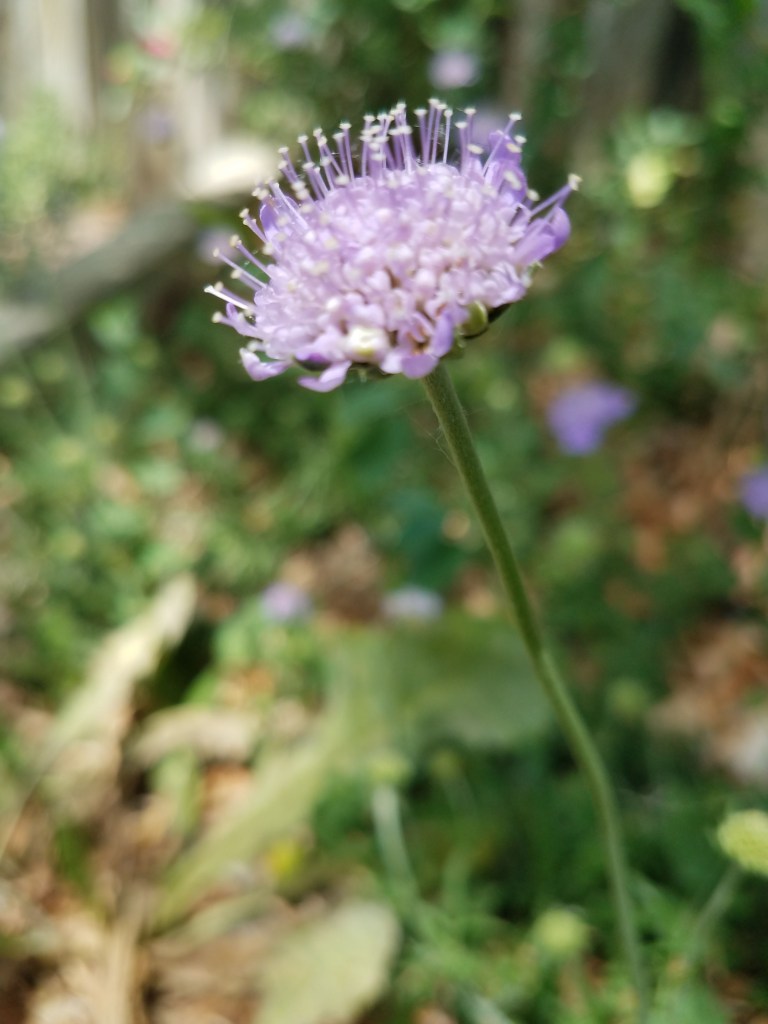
Pincushion Flower.
This morning, while weeding the back wilderness, I found this transplant. Serendipity in the garden.

I can clearly remember the first event of historical significance that invaded my simple world of early childhood. I had been snuck into the big kids playground at our school by my rule-breaking older sister. Swinging on a high bar way too high for my little First Grade body, I listened to my sister and her friends talk about Sputnik; a scary object launched by the Russians orbiting the earth above me. I couldn’t see it, but evidently it could be followed because it was talking to the ground with radio signals.

Just like that I was gone. The world was round, there were things that happened in the world that I couldn’t see, but evidence could be collected that betrayed their presence. I was a science geek in that instant, and it never ever stopped for me.

Sputnik, and the ensuing space race, made money available for science education in the public schools. I was exactly the right age to benefit from this new emphasis on understanding the world around us through scientific thought. I was a curious child: I questioned everything, collected bugs, nursed baby birds back to health, begged for a microscope for Christmas (which I got), and read endless books.

Years later, married to a young serviceman in the navy, I ended up applying to the university near where he was stationed to study biology. That is how I ended up working towards a degree in molecular biology at UCSD. My professors were famous scientists and I was so lucky to learn from them. Stanley Miller taught me physical chemistry, and I learned immunology from Seymour Jonathan Singer. Ok, I took that immunology class from Dr. Singer because he was my advisor, and I was kind of scared of him. I couldn’t say no when he pressed me to enroll.

Because I had immunology under my belt I was hired at the Scripps Clinic and Research Foundation to work in the lab of Dr. Eng Tan, who conducted research that focused on the molecules in a cell’s nucleus that were the targets of the antibodies found in patients with rheumatic conditions such as lupus and, wait for it, SCLERODERMA. Yep. My first job in that lab was doing the ANA tests. Later on I was part of the research team that identified SCL-70, one of the molecules involved in the diffuse form of systemic sclerosis. Here’s the paper if you want to torture yourself. 🙂

I have to say, I loved working in research, but it wasn’t as creative and social as I needed my work day to be. I went back to school, got a teaching certification, and began to teach biology and AP Biology. Whew. I had to take lots of classes to stay up on things, and along the way I learned lots about human anatomy and physiology. Just as I was working into my comfort zone education transformed and educational standards were instituted. Good grief. Why do I have to keep on stretching my wings like this?

I had to teach students how to think and plan experiments just as scientists did in my classroom.  I created lots of open-ended research problems that they could investigate, collect data on, and then draw conclusions that I could use to link to biological concepts that they were learning about. Wailing internally at the extra work, I began using science notebooks in my classrooms.

Students doing experiment.
In this lab the students grew yeast in different conditions and then collected the amount of CO2 gas that they produced as a measure of growth in the attached balloons. These students were varying the amount of sugar the yeast had.
Graph of experiment.
Here’s the graph from a student team that varied the growth temperature. Those yeast sure liked water that was 60 degrees Centigrade! 

The kids liked the experiments, their ability to think scientifically grew by leaps and bounds, and along the way I really learned a lot of things myself. I ended up training other teachers on how to do science notebooking in their own classrooms, and eventually I helped write the inquiry science standards for my state.

Four years ago symptoms that I had been dealing with for years (and decades) overwhelmed me and I was diagnosed with a couple of the autoimmune diseases that I had learned about early in my professional life. Unbelievably, through no real choices of my own, I had been prepared with the background knowledge, resources, and experience that I needed for the fight.

Serendipity.

This is Science and the Scleroderma Girl, the mini-series project of blog posts about the adventures of a science geek in the world of chronic illness. June is Scleroderma Awareness Month, so I hope to put up a new post each day. I hope you’ll join me.

The Scleroderma Chronicles: The lung results are in.

Spoiler Alert: More good news!!

Last week I drove across town to a hospital that is connected to my pulmonologist’s Kaiser office building for my pulmonary function test. If you’ve never had one of these, there is a machine that you breathe into, a computer that is calling the shots and a sealed glass booth that isolates you from the outer world. Into the booth I went. Time to get some answers!

As part of the test I used an inhaler to get a big slug of the drug albuterol. Wow. That really helped. I’ve been avoiding my inhaler for months as I would feel just HORRIBLE after using it due to dropping blood pressure.

But I just quit using my blood pressure medications two weeks ago and now it was really obvious that my breathing was much better after using the drug. “Here, you’d better take this diffuser”, said the technician giving me the tests. “You’re going to be using this!”

Wednesday my pulmonologist called me with the results. My lungs are better than they were two years ago! More to the point, my pulmonary arterial pressure is down into normal ranges and there is less leakage (okay, they call it regurgitation… what an ugly thing to say about my heart!) at that heart valve. Woohoo!! The fatal complication that we all thought I was going to have to face down is suddenly off the table. I’m not going onto oxygen. My doctor and I virtually hugged over the phone.

Here’s the deal. I have a second autoimmune disease called Sjogren’s Syndrome that can cause small airway disease in the lungs. My Sjogren’s has been pretty bad this year, and since I responded to the inhaler drug really well it looks like that is what is going on. My doctors focus on my bad boy systemic sclerosis so much that they tend to forget about this other life-altering, but not fatal, condition. This year Sjogren’s has been stabbing me in the back.

“Time to start giving your inhaler a workout!”, my pulmonologist told me. “Then try to get more exercise. Your lungs need to continue their recovery, and we are keeping you on the high dose of your immunosuppressant drug.”

Inhaler and fitbit.
I bought a fitbit yesterday and I plan to use the inhaler daily while I steadily increase my exercise. Next week I’m going gym shopping…

It’s the drug. It absolutely is the new drug that I’ve been taking for the last 2.5 years. It is a new drug for the systemic sclerosis community, one originally developed for organ transplant patients, that is now collecting a body of evidence that shows that it not only slows down the rate of disease, but also allows some reversal and healing to occur by impairing the immune system attack on the lungs.  My heart is better because my lungs are better. In a time when I have been experiencing chest pain and shortness of breath, it was because I was getting better and needed to come off some of my drugs, not because I was getting worse. I am completely blindsided and gob smacked by the unexpected turn of events.

Next week is the Estes Park Wool Market in Estes Park, Colorado. I’m off to the mountains and boy will I be running wild with my BKB Deb. I’m going to pet the alpacas, eat lamb kabobs, and then I am going to buy a boat load of yarn. My new fitbit will be getting a workout!

After that I’m going to see my internist so she can look at the big picture with me to see what else we’re missing. There’s another drug that I want to drop…

That will be another post.