

Well, here it is again. Rare Disease Day. This is my 9th year posting about rare diseases: on August 28, 2014, I was diagnosed with a form of scleroderma called limited systemic sclerosis. This condition, autoimmune in nature, is progressive as multiple organs, blood vessels, and the skin of the patient (that would be me) stiffen and harden due to scarring (fibrosis). It is also considered rare, since fewer than 200,000 people in the US are currently diagnosed with it.
So, what’s up with the zebra? Well… in the medical community doctors and other health professionals are trained to focus on the most common cause for the symptoms that they are seeing in their patient. The saying goes: when you hear hoofbeats, think of horses, not zebras. Certainly, that makes a lot of sense in terms of patient care and cost control. It works most of the time.
Unless, of course, you are a zebra.
Life is challenging if you are a zebra in a herd of horses. Doctors screen for the most likely cause of reported symptoms, and then when those tests are negative, you usually get told that you are fine, and then you are pawned off with some pablum like… do these exercises… try to reduce stress…would you like anti-depressants?… Seriously, it is pretty crushing as you start to wonder if you are just an attention-seeking hypochondriac since for the most part you look great. In my case, I didn’t even appear to be aging…
This can go on for years. And years. Autoimmune conditions like mine tend to send patients with vague complaints (I hurt all over…) to the doctor’s office looking for help. Some of the symptoms can be so subtle that you just don’t think to mention them to the doctor because you already feel pretty defensive about complaining after a few borderline disparaging interactions in the past. Why mention that you have trouble swallowing sometimes? Or that your arm is starting to look like Flipper the dolphin in appearance and texture? Some new red freckles have shown up on your face, but why mention them when you really want to get to the bottom of why you hurt all over and what is up with this fatigue????? Sure, there were those carpal tunnel surgeries 10 years ago, and the hospitalization for gastritis last year, but why would you mention them… When I was finally diagnosed, I discovered that I was absolutely classic and presented with all five of the CREST features of limited systemic sclerosis. Oh, one more thing: lack of wrinkles is a red flag for scleroderma…
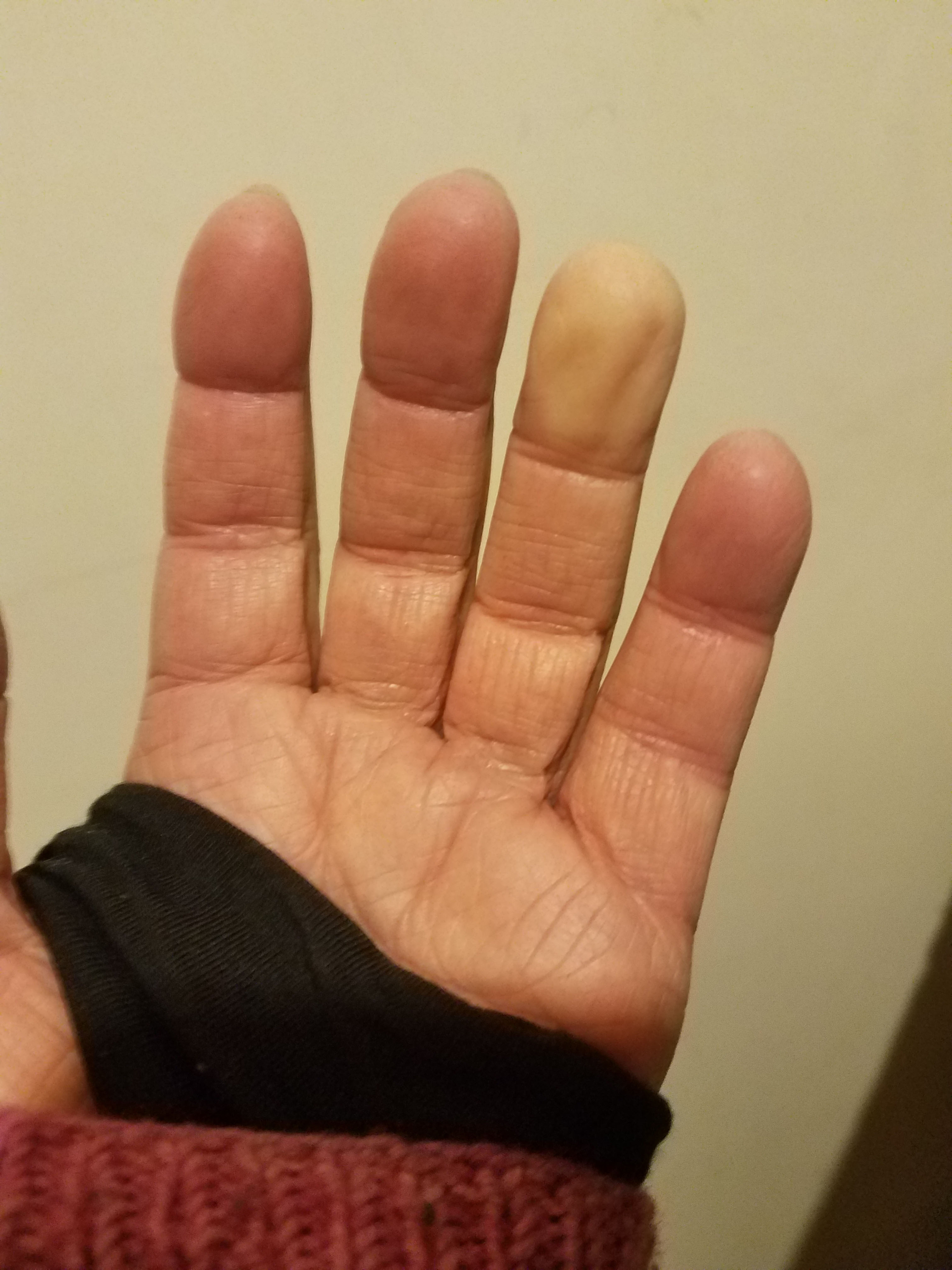

You can see two of the CREST characteristics here. I’ve lost circulation in my ring finger as a result of Raynaud’s, and the thick (sausage-like) fingers that are trying to contract are examples of sclerodactyly. The other distinguishing symptoms are trouble swallowing, lumps of calcium deposits on some of my bones, and those pesky red freckles that are now appearing everywhere. It was official: I was a zebra. There are a lot of us.

Rare diseases are also known as orphan diseases. They are poorly supported and most of the time there is no treatment. After failing a chemotherapy drug, I was moved to an off-label treatment using an immunosuppressant drug developed for kidney transplant patients. It was hard to get the drug as it was declined by my insurance, then the appeal failed, my doctor filed another appeal, and I went to see the pharmacist with a pathology report showing extreme gastritis. It was a fight, but I got the drug. This drug, Myfortic (mycophenolic acid), has proven to be so effective in slowing disease progression that it is now approved for systemic sclerosis and is a drug of choice along with its close relative CellCept. It has been doing a pretty good job at slowing things down; at the time of my diagnosis the 10-year survival rate was about 50%. Now that there are some better treatment options the survival numbers have improved: 10-year survival is up to 70%.
Two years ago, I developed two of the more serious complications of systemic sclerosis (SSc): pulmonary hypertension and interstitial lung disease: two more rare diseases. Not good news at all; my pulmonologist told me it would be okay to cry as he showed me my lung scans and gave me the bad news. Remember that little word “progressive” that I used to describe SSc? This is disease progression; the inflammation and formation of scar tissue (fibrosis) had hit my lungs and heart, and my have doctors responded with big time drugs. Yes. Big time and pretty expensive drugs. Over the last few years, literally in the time since I was first diagnosed, drugs have appeared that can greatly improve treatment and life expectancy in patients like me, and there are more drugs in the pipeline.
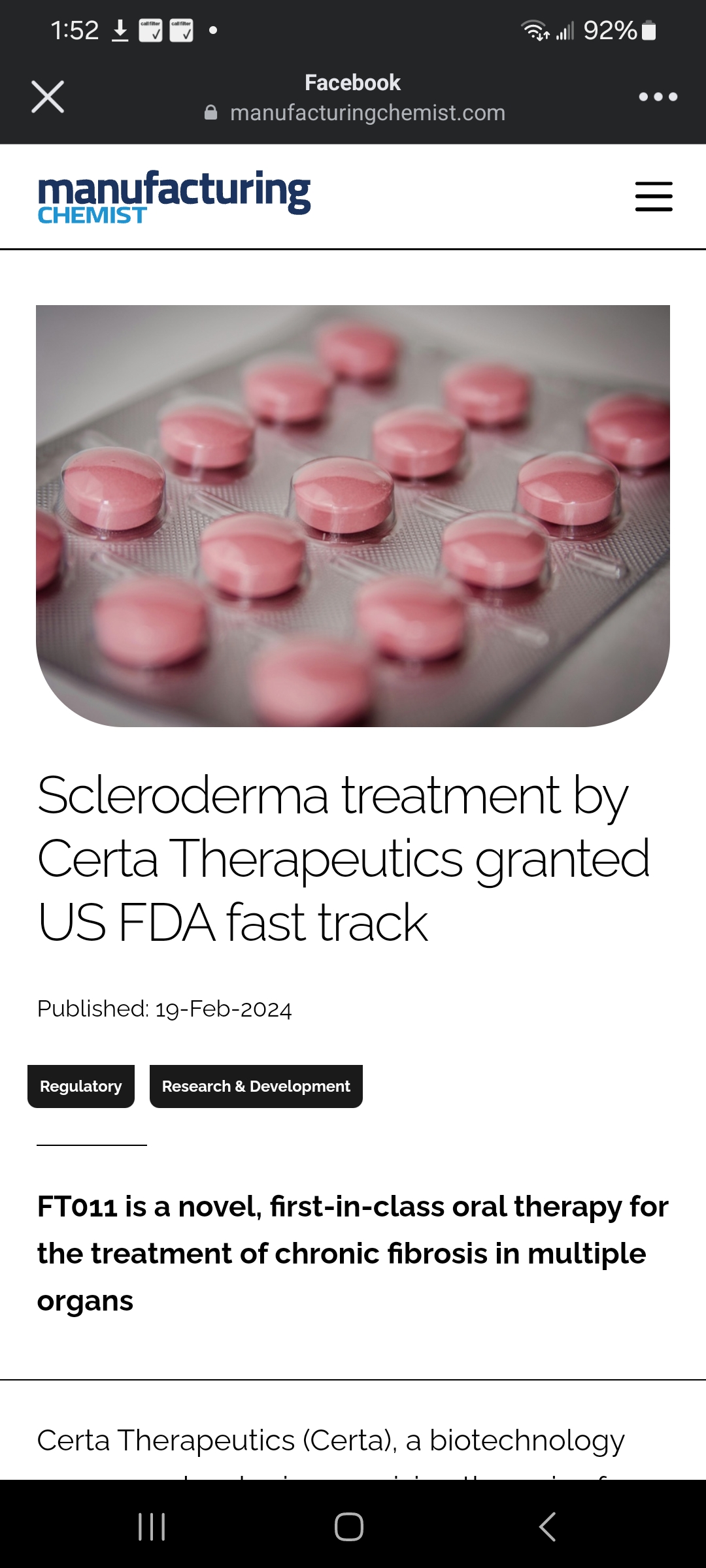
The first drug that can be used to directly treat SSc just moved from orphan drug status to the fast track. This is serious, serious good news. I looked into entering a clinical trial for this drug, but my doctors thought that I wasn’t a good candidate because I have too many complications right now. Seriously, I have been slotted into a diagnosis called SSc-ILD with PH which means that I am a SSc patient with interstitial lung disease and pulmonary hypertension. Good grief, I’m now a walking bundle of acronyms. That’s okay. I can hang on, help is on the way!! FT011, I am waiting for you!!!

Serious medical conditions usually have an awareness ribbon color. It is a little cheesy, but if you are dealing with scary stuff, why not have some fun? Be a zebra, color your stripes in your awareness colors, and get yourself some fun t-shirts while you are at it. Eat Zebra Food (that would be black and white striped caramel popcorn to you non-zebras), get colored medical bracelets, and collect the stuffed animals. Zebras, of course!! My zebra has teal stripes (scleroderma), periwinkle stripes (PH) and purple for the ILD. Lung disease in general is green and blue. I also get purple for my Sjogren’s and fibromyalgia, and don’t forget the red for my heart failure. I’m a rainbow zebra!! Yay!
Okay, time to get serious. What is Rare Disease Day about? Raising awareness in the public about the challenges of living with a rare disease. There are a lot of people who have rare diseases, so by sharing our faces and voices the hope is that it will help make us more visible. We hope that a more educated public will aid in the diagnosis of others with rare conditions. (See above; diagnosis can take years. It would be wonderful if that could be sped up a little…) We hope it will help with funding for drugs, treatments, and maybe even cures. We hope that for those with invisible conditions, they will become more visible and supported. We hope.

To learn more about my rare conditions and others you can go to:
- National Organization for Rare Disorders
- National Scleroderma Foundation
- Pulmonary Fibrosis Foundation
- Pulmonary Hypertension Association
- American Heart Association
- Sjogren’s Foundation
- National Fibromyalgia Association

To everyone who battles on against scleroderma or any other serious medical condition, rare or not, I see you. Hugs! Shine on, my friends, shine on!


 Yarn, Books & Roses