
One summer I spent a few weeks at the Laboratory for Atmospheric and Space Physics in Boulder, Colorado taking a course for teachers. We learned about light (the electromagnetic spectrum), stars, space exploration, and all things fun for geeks of the science teacher persuasion. We developed lessons and activities to teach these topics to our own students, and we even built simple AM radios.
Out in the courtyard between buildings at LASP my team and I spread out our antenna (yards and yards of wire hung in trees and across the ground), plugged in the earplug, and hunted up and down the radio-wave spectrum using our tuner looking for a signal. Suddenly, it was there. A voice and music from far away; a momentary connection to an invisible person that launched us into yelps and leaping high-fives in the afternoon heat. Even for people who can’t survive without computers and smart boards it was a magical moment.
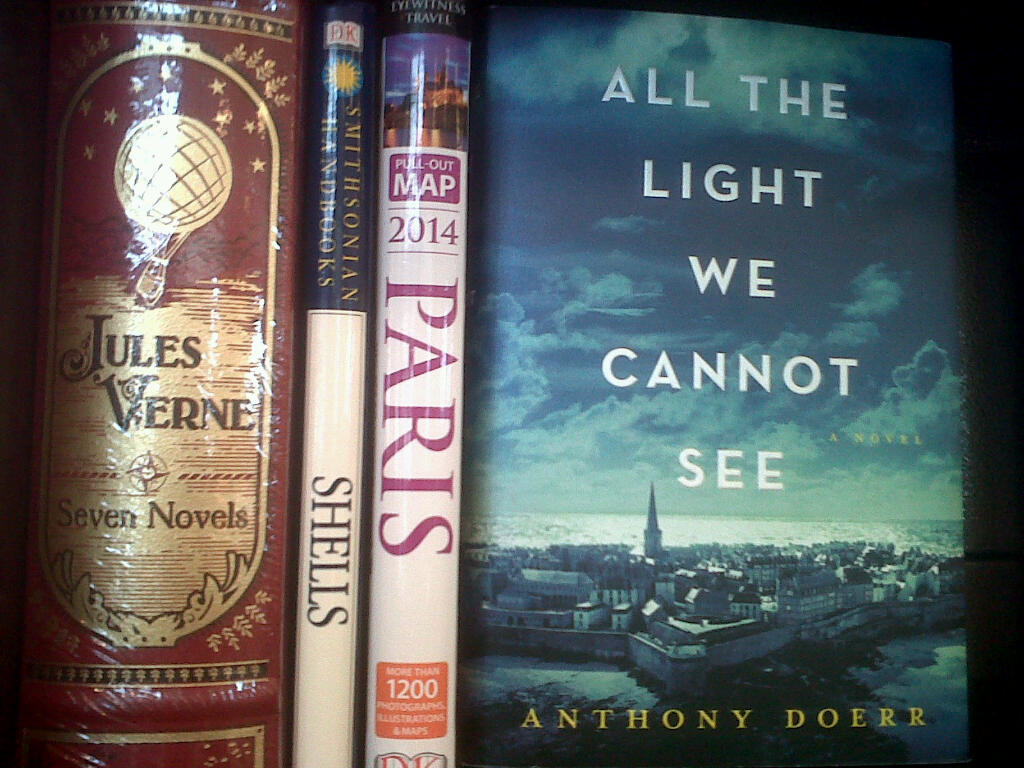
In the book All the Light We Cannot See the author Anthony Doerr tells a tale about connections such as these and so much more. On the surface it is a tale about a boy, a girl, and a fabulous diamond. Under the surface we discover that the “Sea of Flames” diamond is cursed with mystical powers, the boy is a genius whose talents will be consumed by the Third Reich, and that the girl is blind but sees better than many others around her. Their story is framed within the shocking human waste and chaos of war.
This should have been a grim story, and the likelihood that I would continue reading it was slim, but I was captured quickly by the humanity of the characters and the sense of wonder they brought to their worlds. Werner, our young boy in this book, keeps a book of “questions” of the kind only a budding scientist would collect. He builds a radio from scraps, and he and his sister Jutta listen to voices over the airwaves. They learn about the world outside their oppressive coal mining community, and they hear science lessons for children in a French voice that captivates them. “Open your eyes and see what you can with them before they close forever,” says the voice. Their eyes are opened.

Marie-Laure, our young girl, blind from a young age, is raised by her father in a museum in Paris, France. She is a clever young lady who observes, learns, and applies logic to the world around her. She collects pine cones, explores the inhabitants of oceans shores, learns how to classify mollusks by variations in their shells ,and reads Jules Verne novels in Braille. Her father loves her greatly.
The lives of Werner and Marie-Laure intersect through the radio. Werner becomes part of a unit that hunts for radio transmissions by freedom fighters in occupied Europe. Marie-Laure becomes involved in outlawed radio broadcasts. Through the radio these two are destined to meet each other. Because this is war, and there is an enchanted diamond of immense worth involved, nothing will be simple. Lives are lost, conditions become desperate, both Werner and Marie-Laure will be trapped in fire-bombed and burning Saint-Malo, and the sea reclaims its own. Human potential will be lost, a promising future obtained. What a book!
The book is much richer than the central characters and storyline. It is peopled with a host of other characters who are connected to Werner and Marie-Laure. It has themes within the central theme. Science lives in its pages, and books shine throughout. We become aware of the immense destructiveness of war; lives and cultures will be impacted for generations to come. We begin to understand our inability to control our own lives, and glimpse the amazing power of self-determination. As with the diamond in the book it is possible for great gifts and curses to exist at the same time. What is the light that we cannot see? I’m pretty sure that it is radio waves, microwaves, the heat from burning coal, and so many things that are obvious looking at an electromagnetic wave chart. “How does the brain, locked in darkness, build for us a world full of light?” Marie-Laure’s great-uncle asks in the book; the light we cannot see is also about souls, promises kept and lost, and the connections that bind us all together.
“Open your eyes and see what you can with them before they close forever.”


