Thoughts on the Night of the Beaver Supermoon

The supermoon just cleared the trees behind my house. It is really bright tonight, shining through my window, joy from the east. This moon is both special and hilarious at the same time: the Beaver Supermoon.

Oh, we have beaver here in Colorado! I used to go with my children at dusk to a local state park looking for them in a pond with a beaver lodge. The kids and I have seen adults and youngsters (kits) over the years. Sometimes they were in the shrubbery by the water, sometimes swimming across the pond, and I’ve even seen one chomping on a tree. I’ve accidently startled them (those tail slaps on the water will get your attention), and I’ve glimpsed them swimming across the water with a branch in their mouths. One summer we could see the drag marks in the wet earth as large sections of trees were dragged down to the water; these woody treasures provide both food and building material for the lodges and dams. Beavers are pretty special as their work in waterways create essential habitat for other species. This moon gets its name from the increased activity of beavers preparing for winter. It is also a larger moon this month, hence the name Beaver Supermoon.

This poster was on the wall in my classroom for years!

I’ve been simultaneously busy and stalled out lately. I have finally recovered from the absolutely horrible flare of never-ending tendonitis that forced me to abandon my knitting for almost a year. This is what my right wrist looked like last year at this time.
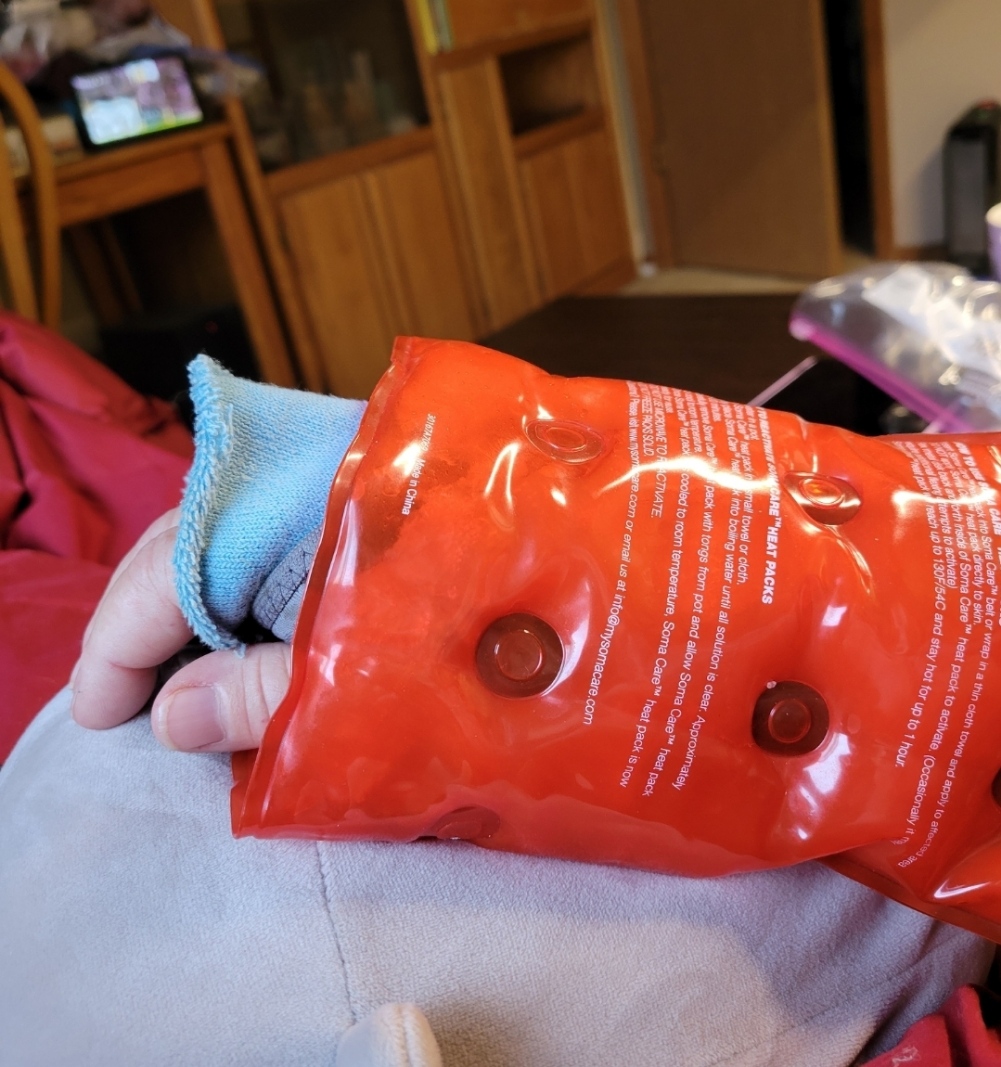
I tore the house apart as best as I could hunting for painkillers that I could take with this one!

The x-ray report after this adventure had the word “severe” sprinkled throughout it. My rheumatologist tested me for gout and pseudogout: both negative. She did write me a prescription for emergency prednisone and painkillers in case this happens again. Then the flare dragged on, and on. Then there was the car wreck and other adventures. I kept hopefully buying more yarn, and stockpiling new patterns, hoping that someday I could return to knitting.

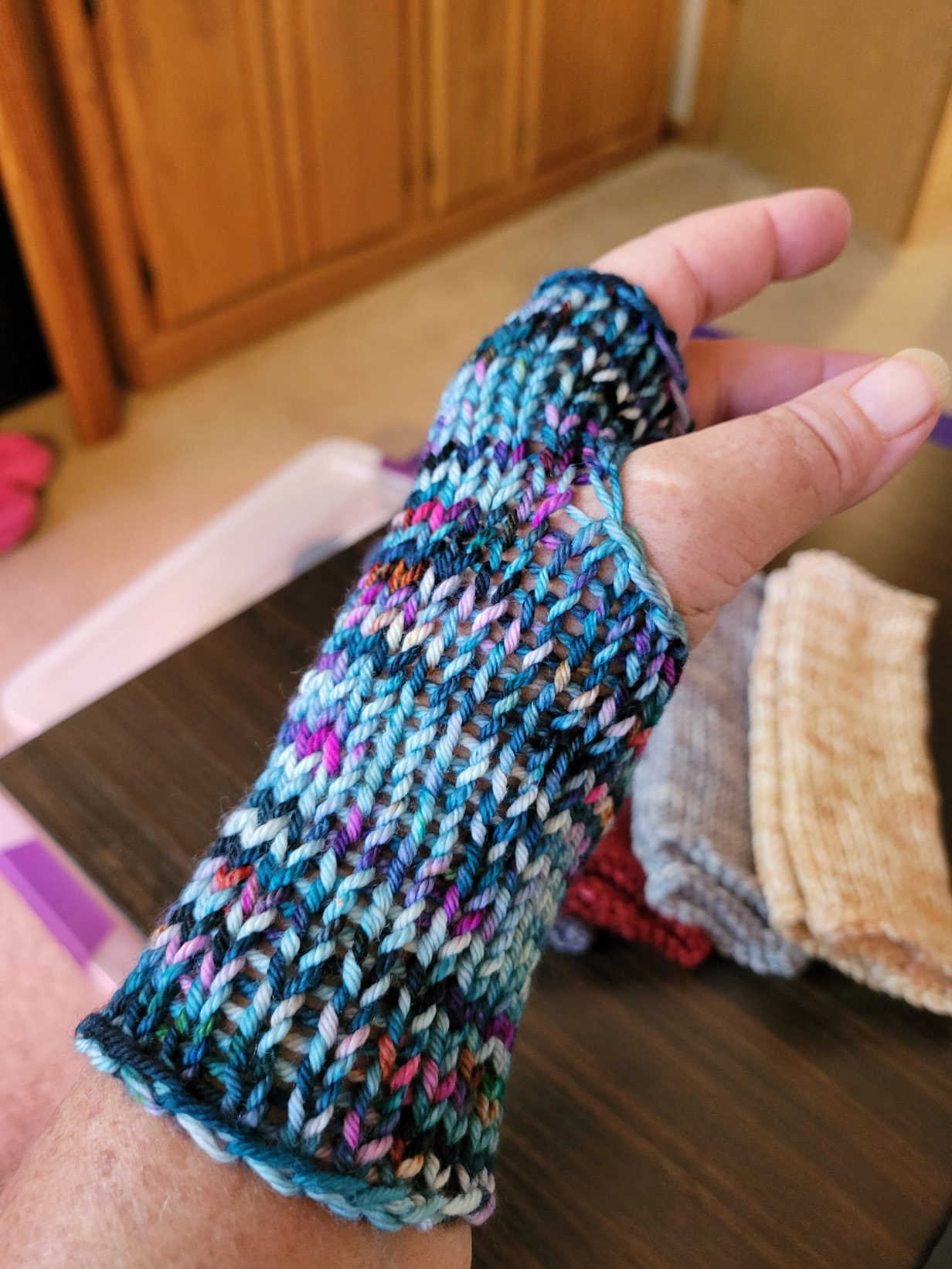
Two weeks ago the pain finally stopped and I started knitting in earnest again. Look at what I managed to accomplish!!

My Extra Lite Bright is off the needles, finished and blocked. This sweater will become a layering staple for me this fall.

And just like that, I stalled out, consumed by endless yarny possibilities. I have all of this yarn! I have all of these dreams of new sweaters dancing around in my head; so many possibilities. What should I knit?????

As fate would have it, I also finished a book on the same day that I took that sweater off the knitting needles. Help! Double indecision!!! So many books waiting for me on my Kindle. Help. I’m on fire to get going, and unable to make a decision. Help me Supermoon, help!!!!

That’s how I ended up spending the day as busy as a beaver, kitting up yarn with patterns to make new sweaters. Yarn was wound, and a sweater was cast on… but I have two more sweaters that I have located needles for and I’m going to cast them on too. Three sweaters at once? Sure. Why not?!

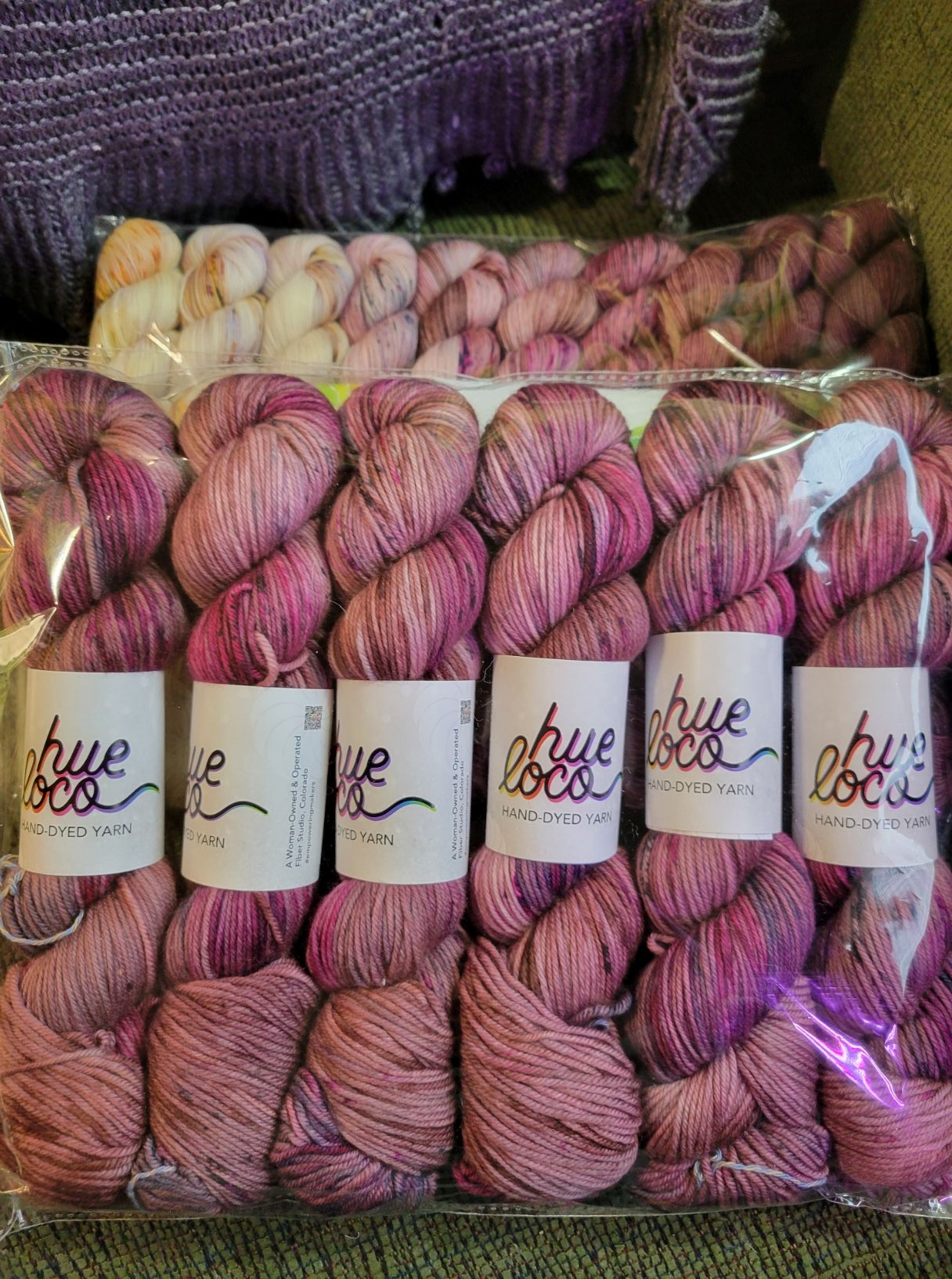
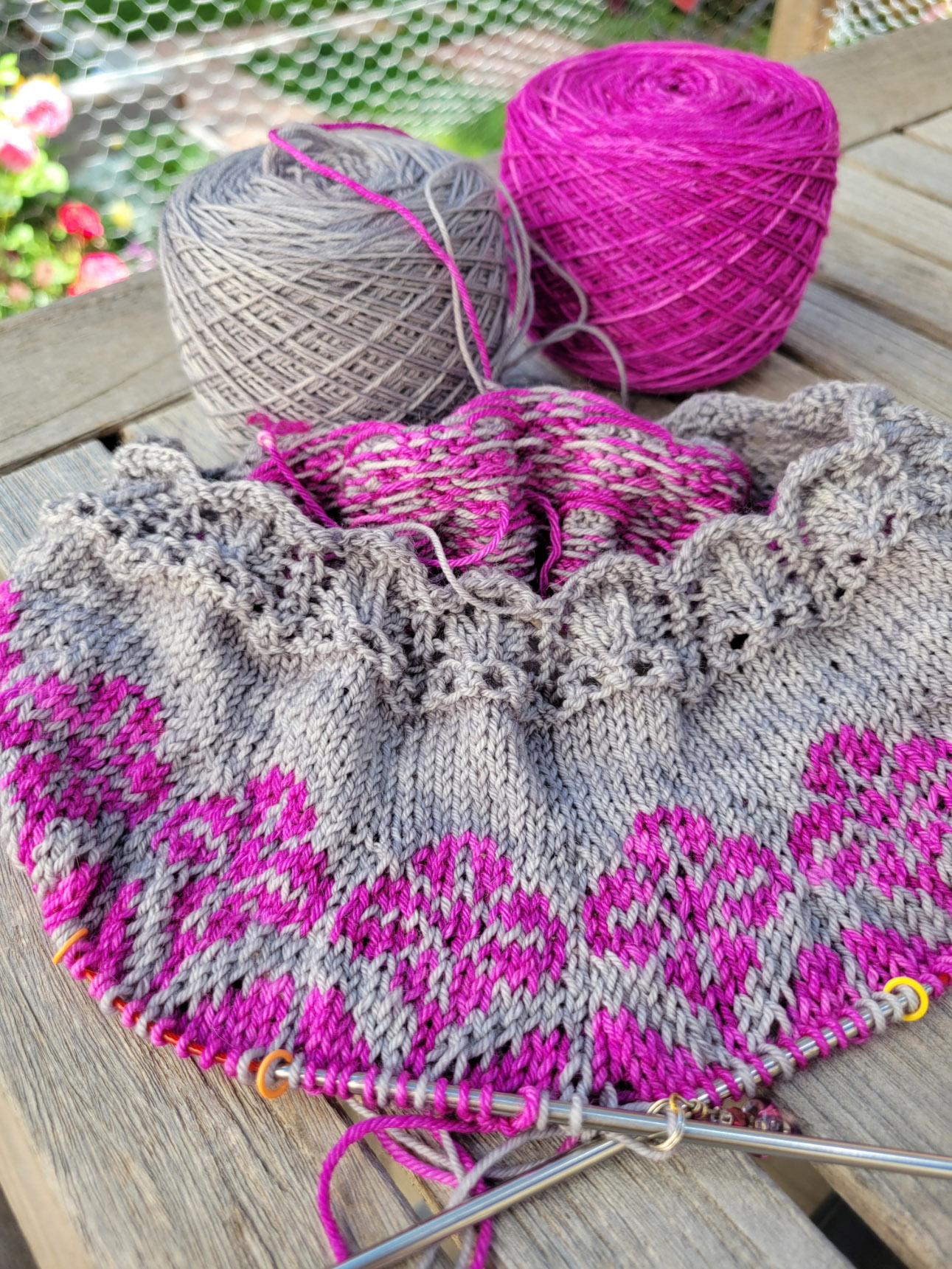
The grey/pink yarn combo will become a Renaissance Sweater. The yarn in the middle (there are 5 colors there) is destined to become a Colorica cardigan. The yarn on the right has already been cast on and is becoming an Alchemist Pullover. There are some kits for more sweaters, but those are the ones that are seeing action right away. Why these three? Well… one is colorwork, one is a cardigan that will involve some lace and purling, and the third is just too cute to not get made right away. My hope is that no matter what my hands and wrists are up to, I will be able to get some knitting done.

Then there are the books. So many books. If I’m knitting three sweaters at once, maybe I should have several books going at the same time too. In that spirit I am reading and listening to all of these.

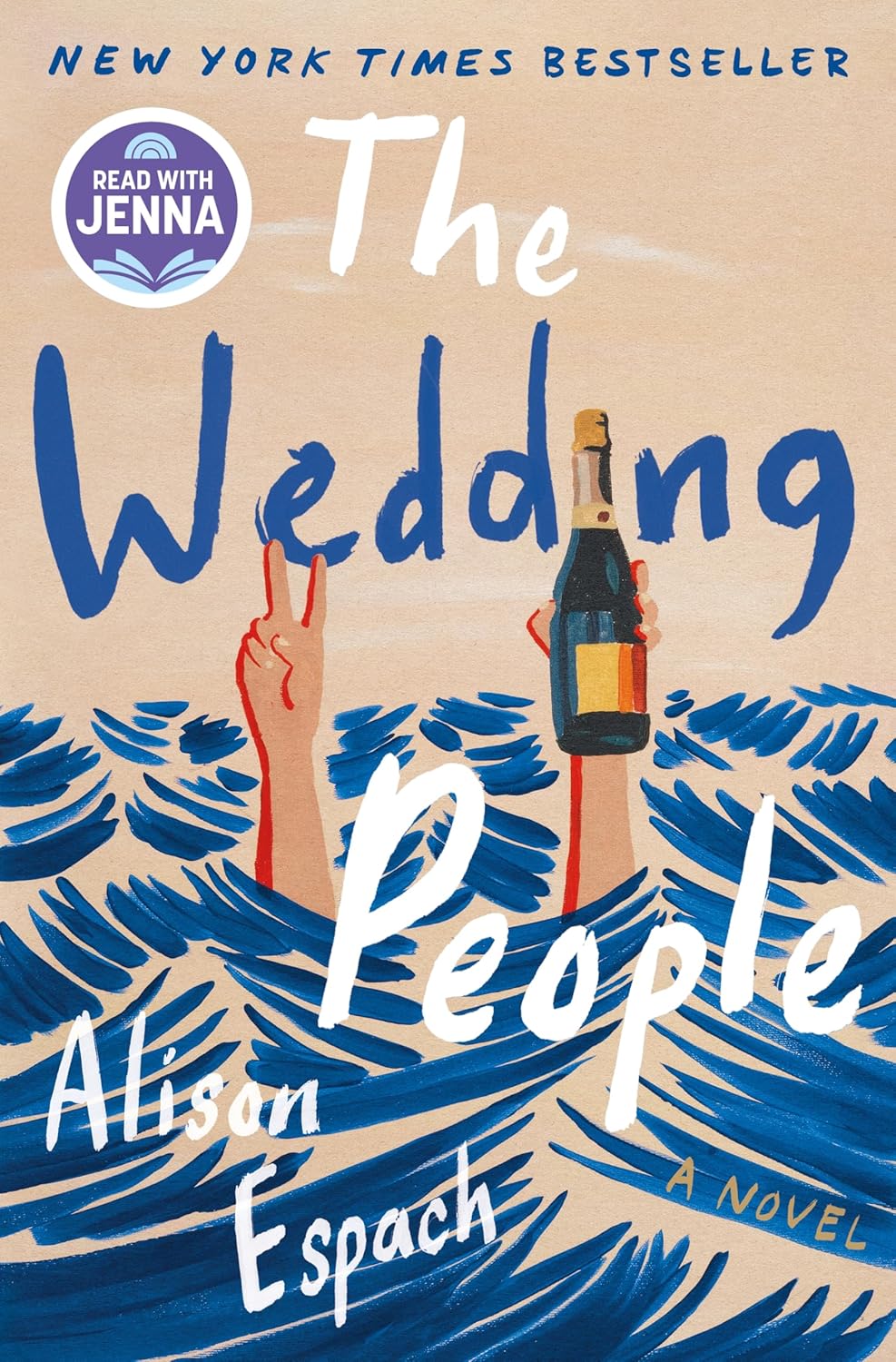
I’ve started reading Buckeye, listening to The Wedding People, and I’m pretty sure that I need a little Three Pines action right away, so it is going to be in action soon, too.

There are several other books nagging at me. I told them to go hang out with the yarn stash overflow. Still, they call to me. The yarn calls to me. I have fought my way through the indecision of making choices when surrounded by great possibilities. Is this what beavers feel when faced with a new stand of aspen? Whatever. I have made the decisions, I have made a start on the first sweater and the first books, and like the beavers that gave tonight’s moon its name, I am full of purpose and I have big plans.

There is a lesson here. A year ago, I was in a terrible flare, unable to knit or even read. The best I could manage was an audiobook, and even then, I had to play it over and over as I had trouble concentrating and following the story. I sought help, I tried new drugs, I stuck to my special diet, and I did my physical therapy. I came through that time, and now I am here, shining bright again. Just as the moon returns to full force at the end of each cycle, I have managed a comeback too.

In my excitement over the knitting and books I haven’t forgotten the chemo hats, port pillows, and zipper pouches that I also have to get done. Saturday, I get to meet up with all of my friends again for a sewing extravaganza to produce more zipper pouches, and one of my friends wants to take the three quilts that my sister started; they will go to a program for children getting their first bed. Who knew that this was a thing? Like the beaver, I hope that my work will ripple out and bring change in my community around me, supporting lots of new life.

Shine on Beaver Supermoon. Shine on.

The BioGeek Summer Reading List: Polio

Hannah hanging out with the summer books.

It’s been a kind of slow summer because… tendonitis… but I am getting a lot of reading done. I had moved some books into the craft room with the intention of reading them *someday soon*, and then just like that, this became the summer of nonfiction, disease book reading. Hey, I’m a BioGeek, and these books are actually pretty interesting. I had some idea of organizing the books into an order that made sense, but the topics kept overlapping so much I am just going to dive in and start talking about what I’ve been reading about and how it connects to me. Should I talk about the books from my days in the classroom? The book that made me start hoarding essentials in case of a pandemic? The book that made me aware of ebola? Hmmm… Let’s start out with the one that has a lot of personal connections to me and my family…

It’s August 14th, 1945. My mom had just arrived in New York City from Argentina, returning to the United States to visit her sister, a member of the Women’s Army Corps in Washington, D.C. I’m guessing that NYC was in an uproar that day, as it was the exact date of the end of World War Two here in the US, being Victory over Japan Day. For my mother, however, it was also the start of her involvement in another type of war.

Halfway across the nation, an epidemic of polio had broken out in the state of Illinois. There was a national call for nurses, and the American Red Cross contacted my mom, asking her if she could go. Here is the chart showing the dates of newly diagnosed cases in city of Rockford and Winnebago County, Illinois that year.

It was a big outbreak, and mom was one of many, many nurses and other health professionals who answered the call. Just like that, polio became part of the story of my family. My mother met my father when she was sent by the Red Cross to another potential polio outbreak in Albuquerque, New Mexico; he was a patient recovering from his service in North Africa when she met him there. The polio outbreak didn’t amount to much, but the romance did. 🙂 One of my first memories was getting a polio vaccine. I remember collecting dimes in a cardboard folder as a participant in the March of Dimes. I once was smuggled into the hospital by my mom, clutching an ornry yellow cat named Henry, to show him off to a woman in an iron lung; she had been in that iron lung for years and my mom had been sharing tales of Henry’s misadventures with her. Some of my classmates had had polio, and I knew people who wore leg braces. Much of my childhood was colored by polio. In my mind, polio was a terrifying, ever present disease that had gripped the USA.

I read Polio: An American Story a few weeks ago, thinking that it would enrich my understandings of the polio time that I had lived through. Boy, did it ever! There was so much that I didn’t understand about polio. It was an illness that emerged as outbreaks in communities with modern plumbing and higher levels of sanitation. The common understanding came to be that polio was a virus that was common in poor sanitary conditions, and most people exposed early developed immunity without significant illness. I did not see that coming! It was also not the most dangerous or significant disease in the US at that time, but it was one that felt terrifying. The president, Franklin D. Roosevelt, was a polio survivor. The fundraising campaign to find a cure for polio, a vaccine to prevent illness, was boosted by this president and the national spotlight that he brought to these efforts. A private organization, the National Foundation for Infantile Paralysis, provided for the care and rehab of polios and funded the development of the polio vaccines. The organization later became known as the March of Dimes: the very entity that I once collected dimes for. The vaccine trials used children, 2 million of them, as guinea pigs (!), and there was significant conflict between the two major researchers who used different approaches: Jonas Salk and Albert Sabin, and the battle became political. As vaccine production ramped up, lessons were learned about product control. In many ways, the national drive that existed during WWII was continued in the drive to conquer polio. The first vaccine, developed by Salk, was announced in March of 1953 to national celebration.

This book was really engaging, and I leaned so much. Imagine a private organization that takes over to provide for your care when you are diagnosed with a disabling disease! Who knew that the battle of the vaccines was so intense, and the process to verify efficacy so convoluted. Some of this applies to our situation today as people here in the US are questioning the efficacy of vaccines and the validity of the development process. Some of that is grounded in the long, checked history of polio vaccines. That first vaccine I remember was the Salk vaccine developed from inactivated viruses. Years later a live virus version of the vaccine, the Sabin vaccine, became more widely used, but today the Salk vaccine is once again used. Here in the USA, it is easy to think that polio is a disease of the past, but it lives on in other areas in the world.

So, what was next on my BioGeek reading list? Tuberculosis!!! Stay tuned…

Notes:

  • It was hugely ironic that my mom arrived back in the US on the very day the war with Japan ended. Years before, while her parents were attempting to enroll her in nursing school, her sister, waiting in the car, heard the first report of the bombing of Pearl Harbor on the radio; America’s entry into WWII was immediately afterwards.
  • The fundraising and research drives of many organizations connected to disease prevention, treatments, and cures are modeled on the success of the polio campaign. I hear the echos over the decades now with every email from the National Scleroderma Foundation.
  • Oh, how is my scleroderma doing these days? Tendonitis continues, but my latest visit with my cardiologist went well: my pulmonary arterial hypertension is stable, and my heart is doing okay. The EKG isn’t completely normal, but I’ll take it, right?!! He wants to add another drug or two, but we are delaying for now as I’m already taking a LOT of medications.
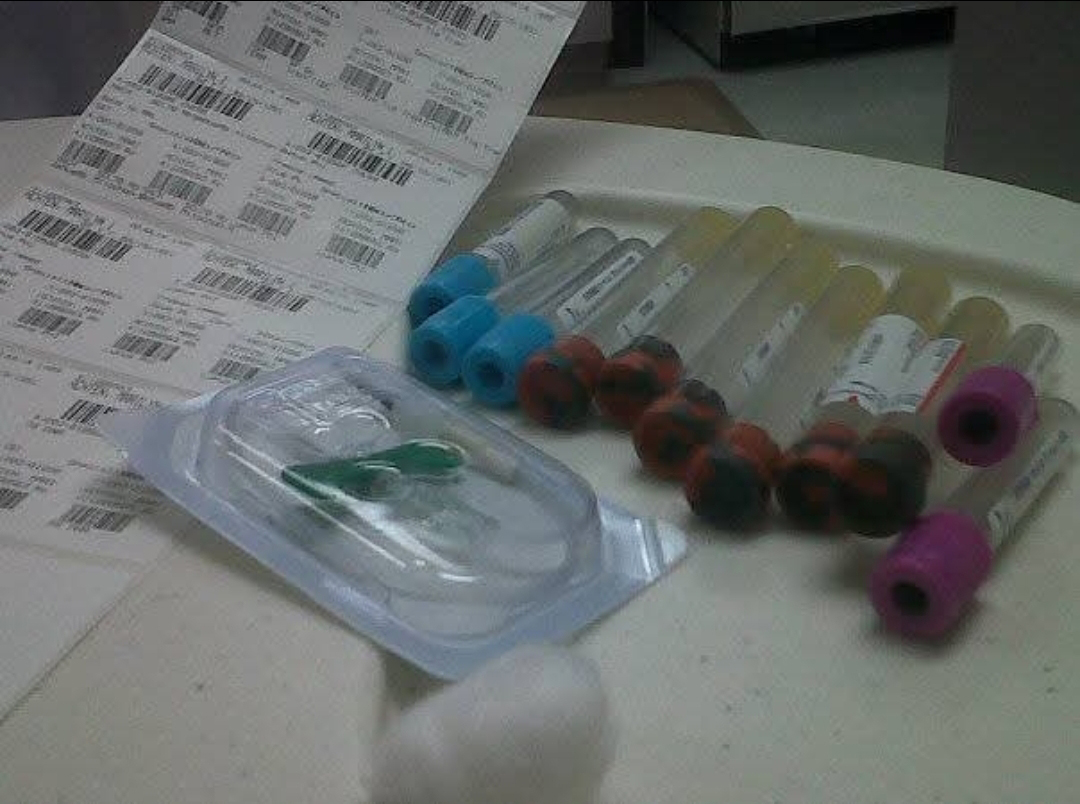
  • Last week was the anniversary of day my doctor ordered the blood tests that led to my diagnosis of Sjogren’s Disease and Limited Systemic Sclerosis.

That was 22 tests in 14 vials of blood. Today I take 22 pills a day. Kind of ironic, right? Do I consider yarn to be part of my essential treatment? Why yes, yes I do!

Hannah and the CoalBear: Days of Bugs and Yarn

Hi. I’m Mateo.

Did you miss me?

Life has been crazy here. The Mother of Cats spends all of her time playing with yarn while listening to audiobooks, which is…BORING!! So boring. It’s all fine for Hannah because she likes to hang out with the knitting machine while the Mother of Cats works on it, but I need action! I need excitement! I need BUGS!!!

See what I’m talking about? They can do this for hours at a time!

I like to go upstairs to bite on Hannah at least twice an hour to make sure they don’t forget about me, because… did I mention that I have needs? All of this out-of-control knitting is making me go crazy. I seriously need a trip out to the catio and a bug hunt EVERY SINGLE HOUR!!!

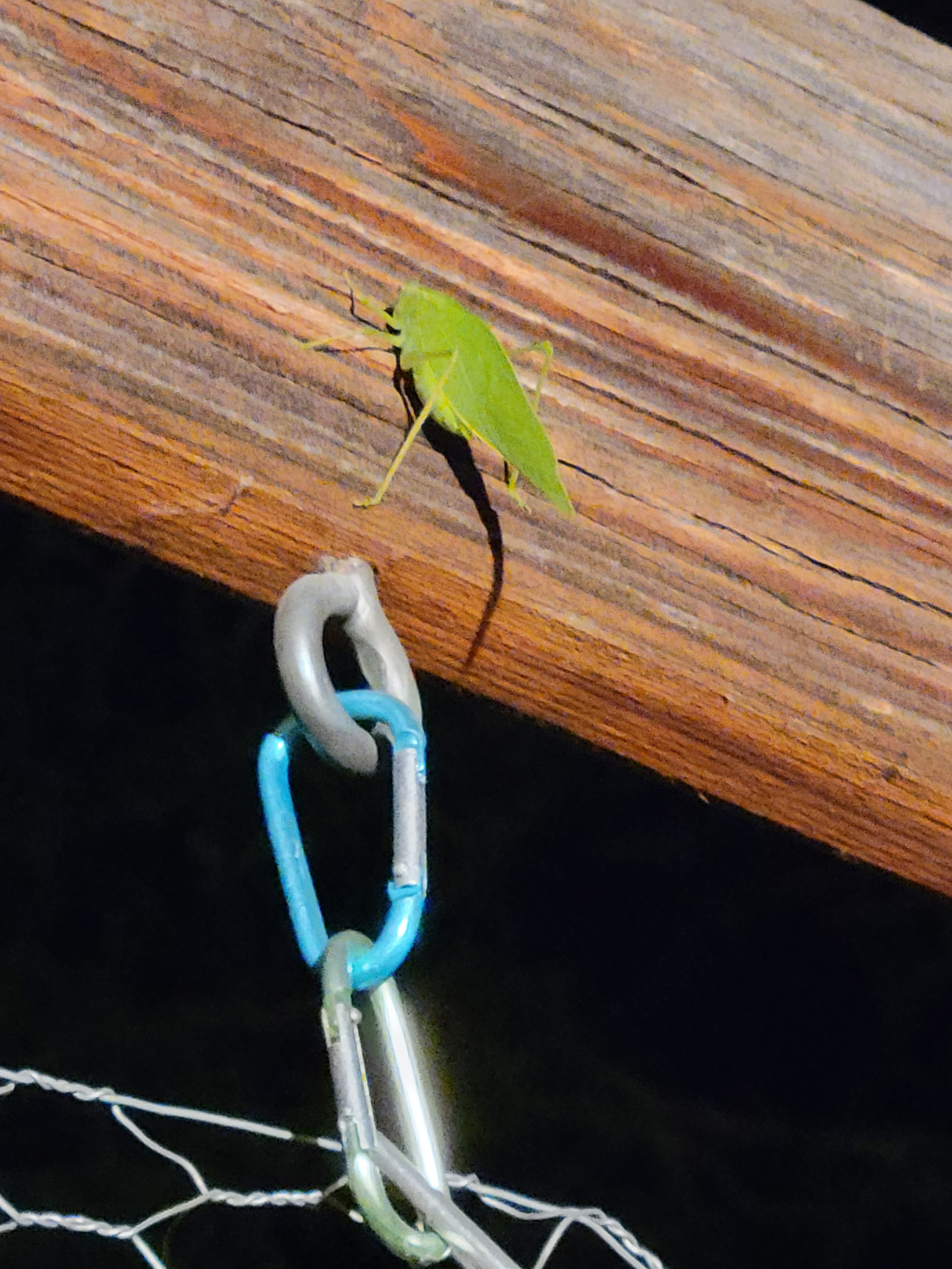
Especially after dark, because that’s when the really interesting bugs come out. I like to catch these guys and then I take them inside to play with them. So much fun… until the Mother of Cats catches me and takes my bug back outside. Why is she so mean to me? I worked hard to catch that bug, and then she just takes it away? Does that sound fair to you?

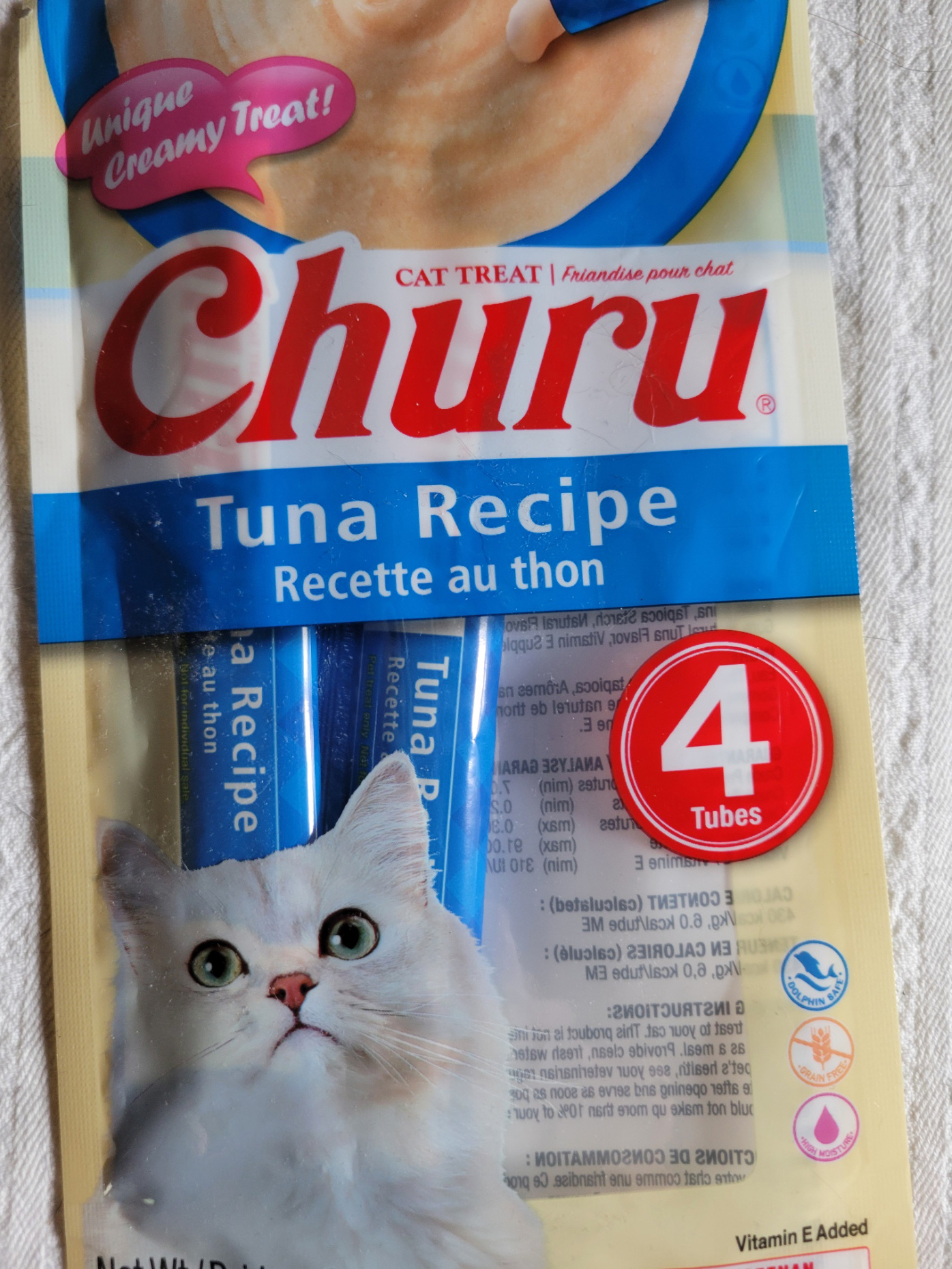
Luckily, she has discovered these treats that she gives us when we came back in at night. These treats are so good it is almost worth leaving all the bugs outside!!

Anyway, let’s talk about the yarn and the knitting. Seriously, I think that we need an intervention!! She has three of the cranking knitting machines now, and she has been steadily producing hats and fingerless mitts every single day.

Do you see this? She now has 34 pairs of fingerless mitts, and 41 hats. All of these knitted things go to her community knitting non-profit next week, and then she will be starting all over again. She is so excited about all the knits and keeps talking about reducing the stash, but this is just CRAZY, right? I think that maybe she should take the knitting machine outside. I need bugs. I need bunnies (don’t you think that the bunnies want to play with me? I’m a good boy. I would never eat hurt one of the bunnies…) There is always lots of fun things to see outside!

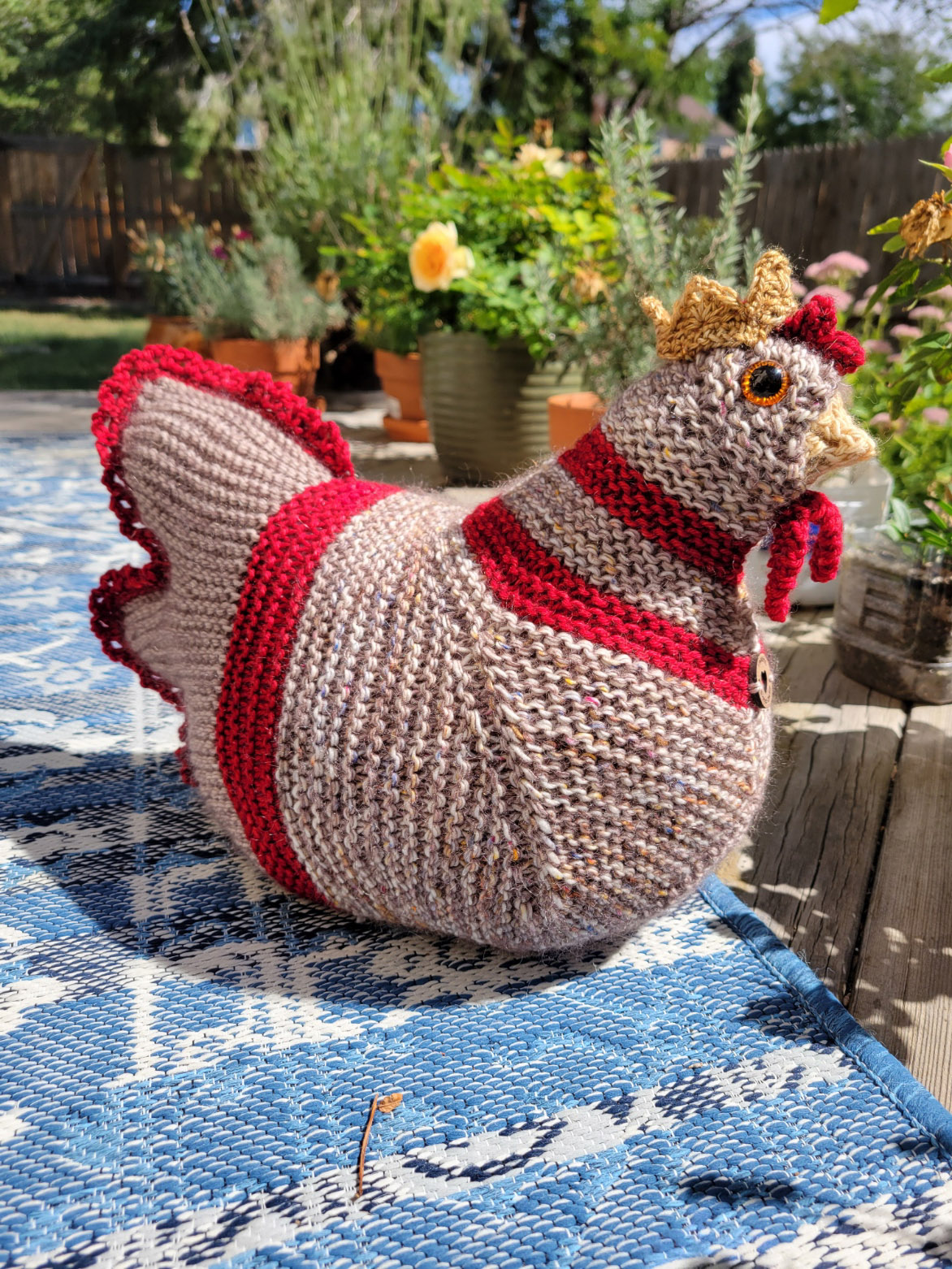
Then there are the chickens!! She knitted four more chickens this month (that haven’t been sewn up and stuffed yet), and she mailed away two.

This hen was mailed out Thursday. Why does it have a crown? WHERE IS MY CROWN???

Okay, I guess that is all for now. I feel a lot better for having gotten this off my chest. I’m going to go hunt down Hannah and see if I can get her to chase me around the house for a while.

Hannah: That would be a big NOPE, little guy.

This is Mateo, the CoalBear, signing off.

>^..^<

Notes from the Mother of Cats:

To be fair to Mateo, there has been a lot of interesting action out in the yard lately. The bird feeder is drawing lots of action with a constant parade of squirrels and birds stopping by. The bunnies travel right along the catio as they transit to the front yard, and you already heard about the bugs. This week Mateo was transmitting extreme concern about something in the back tree, and when I walked out to see what it was, a huge bird erupted out in a crazy swirling tumble of flapping wings and vanished from view as it crossed my yard. Like, maybe it was an eagle? A golden eagle? Did it grab one of the big fat doves at my feeder? I’ve seen them in the neighborhood, but how crazy to have one in my tree!

It was an eagle!!!
Definitely an eagle!!!

I’m suddenly unable to watch television but listening to audiobooks while cranking out hats and fingerless mitts on the knitting machines is working great. I’m totally reveling in the constantly growing pile of hats and the obvious dent in the yarn stash. By using the machines for the hats and mitts I’m able to get the chickens knitted without hurting my wrists and hands too much. That chicken pattern is the Emotional Support Chicken, and the chicken in the picture is my 24th one. I found the pattern for the little crown here.

I learned how to make fingerless mitts on the knitting machine, which involves making a thumb hole while the knitting is on the machine. That new skill set off a whole new stack of knitted goods. I’m thinking about another post showing how I do it.

Mateo: Maybe there is a bug in here…

The BioGeek Memoirs: Teasel

Last September my son drove me to a yarn store in Loveland, Colorado to buy the yarn for my Weekender Crew sweater. He took a route that cut through the countryside and small towns, and there along the road were some dried teasels. “I should get you to pull over,” I said in jest. I should have! I have been thinking of teasels ever since then.

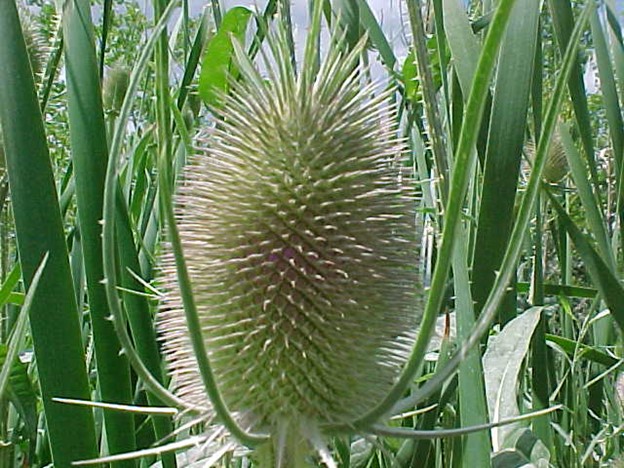
I took these pictures years ago because I just loved the way the plant bloomed. Pretty cool, right? Plus… purple! These blooms will eventually produce seeds contained in those in dried structures covered with barbed spikes that are just looking to hook onto something. As it turns out, the teasel heads with their hooked spikes can be useful and have an interesting history.

Years ago, I took a spinning class from Maggie Casey in Boulder, Colorado, and I learned how to card wool to prepare it for spinning.

Behold: my wool carders and a couple of rolags made of carded wool.

Before you can spin wool you need to pull the fibers apart, fluff them up, and get them pretty much aligned in one direction. The wire teeth on my carders do that for me. Maggie told us (I’m pretty sure that Maggie is the one who told me this…) that the word carding came from the Latin word (carduus) for teasels, and that the original carding was done with teasels. I can believe it! The locks of washed (scoured) wool can easily be picked open and fluffed using teasel pods. Every time I see a teasel plant, I hear the word “carduus” in my mind and think of my poor, neglected spinning wheel.

So, being the BioGeek that I am, I looked up the scientific names of teasels: not a carduus in sight. The genus of that teasel is Dipsacus, and the plant that I saw along the road and took pictures of is specifically Dipsacus fullonum. Oh. The crushing disappointment. I hunted for Carduus and discovered that it is a genus of thistle plants.

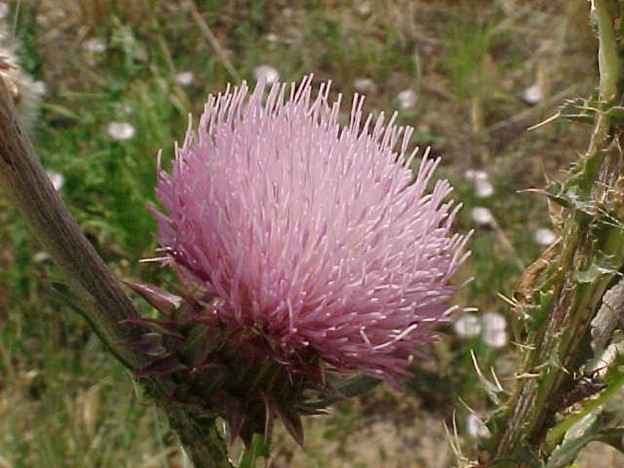
Okay, this is a bull thistle, but you can kind of see the potential for spikiness. Carduus thistles produce dried seed heads that are spikier, and the ancient Romans used the word carduus to refer to both teasels and thistles. Maggie was right! Centuries later, when scientific names were assigned to life on earth, carduus went to the thistle, and the teasel had to settle for dipsacus.

Still, teasels are pretty darn cool and have been involved in woolen fabric production to improve the warmth of the fabric. Teasels were brushed across the wool fabric to pull up fibers, making the fabric a little fluffy (or brushed) as part of the fulling process. Brushed fabric like this was warmer to wear, as the raised nap trapped air providing more insulation. Check out this teasel loaded cross that was used for this purpose. Imagine drum rollers loaded with teasel seed pods. Remember that my local wild teasel is called D. fullonum? I can’t help but wonder if the root word for “full” is included in the name. Yay, teasel!

While I’m on using teasels to pull up fibers, have you ever teased your hair to fluff it up? Did you wonder where that word came from? Yep. From teasels, of course.

Here in Colorado, these teasels and thistles are on the noxious weed list. Oh, dear. The plants originated in Europe, and that’s where they belong. Here in Colorado, they are invasive species that propagate like wild and choak out native species, interfering with agriculture, and there are management plans designed to control the spread of the plants. I was lucky to see one.

But I have to admit, it made me so happy to see a wild teasel along the side of the road that beautiful afternoon in September as my son drove me north to get me my yarn and to celebrate my birthday. Carduus, I heard in my mind.

My spinning wheel shivers in anticipation.

The BioGeek Memoirs: Milkweed

Last summer my son and I made several trips to our favorite cat rescue shelter hunting for the right kitten. His wonderful Maine Coon cat had died and his remaining cat, the MONSTER of Hannah’s nightmares, was sad. Obviously, he needed a kitten!

One Caturday in July, we pulled up to discover that the butterfly garden planted in front of the rescue shelter was in full bloom. The most stunning flowers on display were the milkweed.

Can you see the bee on one of the flowers?

Wow, I thought, milkweed! I almost never see it blooming like this; I’m always late to the party and come across it once it has gone to seed. This was pretty amazing, and there was a lot of it. I stayed outside to take pictures while my son went into the shelter to hunt for a kitten. No kitten this day, but I did get great pictures.

Over the years I’ve been steadily adding flowers to my yard that are good for butterflies.

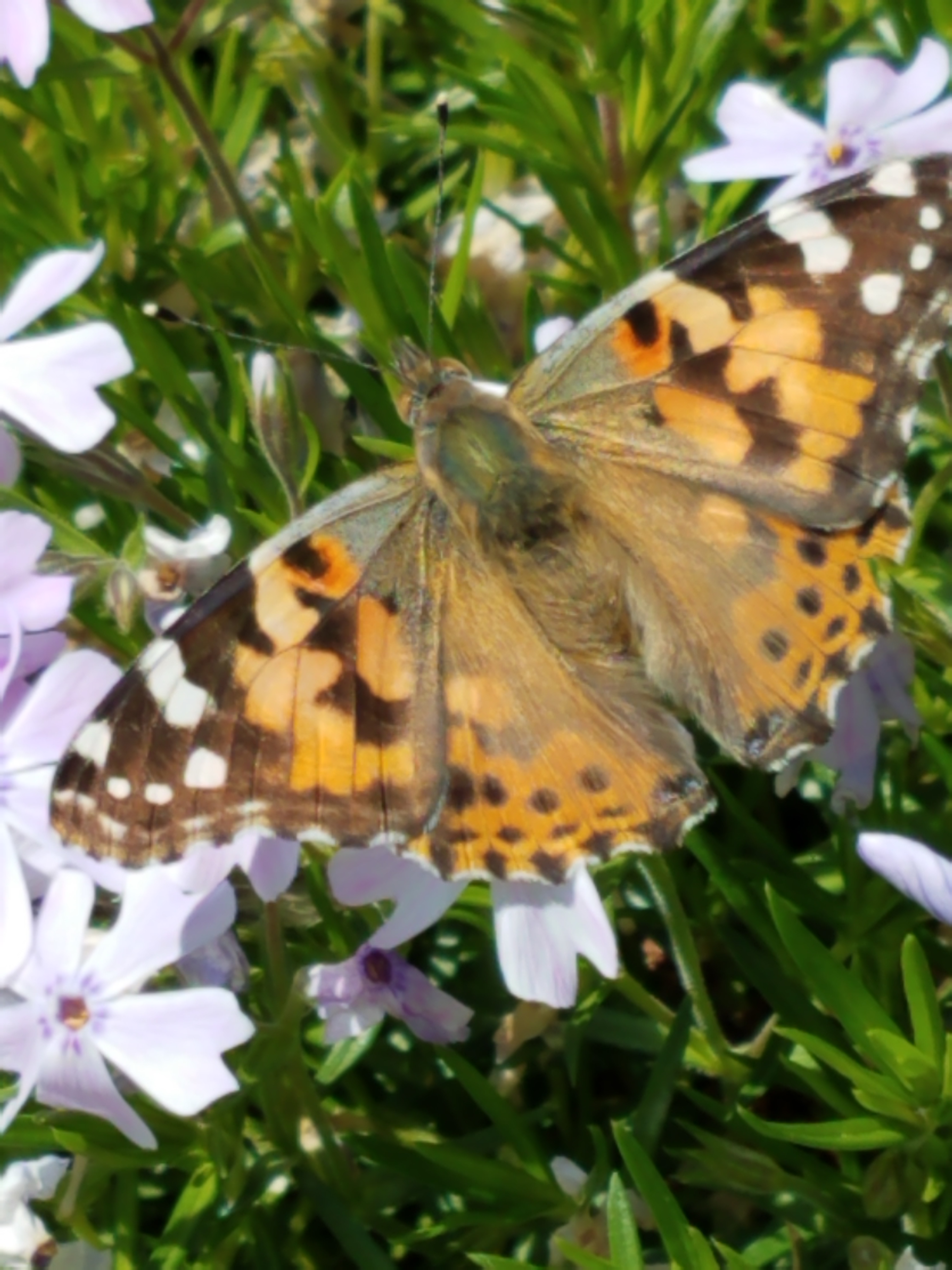
The butterflies in the pictures above are painted ladies and a swallowtail. Butterflies need flowers that are large enough to support their weight and have nectar conveniently available. Milkweed certainly fits that bill, and it is especially important since it is the major food source for the monarch butterfly. Monarchs are the butterflies of my childhood in Southern California, and they have recently been placed on the endangered list. Why are they struggling? Habitat loss, insecticides, a dwindling food supply…

Food supply! Milkweeds are food for monarch butterflies. I was pretty excited to see some more milkweed growing along the road in a field near my house. (Yes, I look for stuff like that. I am a BioGeek. I’m still on the lookout for some nice teasel, but that is another post…)

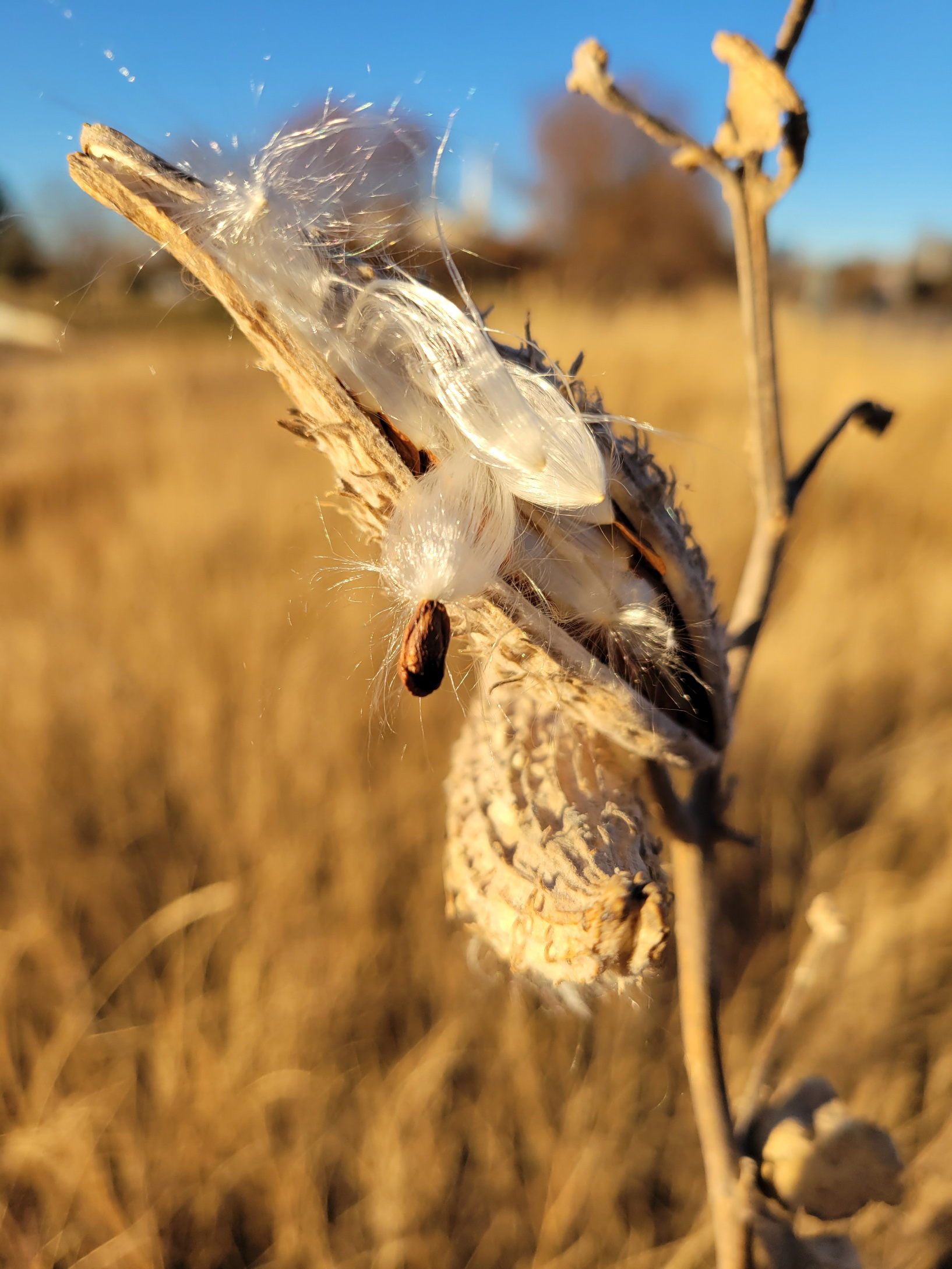
The picture on the left is of the remaining pods after the flowers were done blooming, and the one on the right is a few weeks later, the pods burst open and the seeds getting ready to fly on the wind like a dandelion to a new location. Cool, right. With luck some of these seeds will find a great place to live and more milkweed will appear in this field over the next few years.

Do monarch butterflies come through Colorado where I live? Why yes, yes they do!! They migrate right through the state in early fall and evidently you can see them in the Denver area. In my yard? Not so much right now. To the east of where I live, Monarch Watch tags and tracks monarch butterflies through their migration and has implemented programs to provide food for the monarchs along the way. Imagine thousands of plots of planted milkweed and other nectar plants put out just for these butterflies and you get the picture. Eventually this field near my house could be one of the stops along the way for these migrating butterflies.

Rosalynn Carter, the former first lady of the United States, died two weeks ago and her memorial service was last Wednesday. It was hard to keep the tears out of my eyes as the people who knew and loved her shared their memories. Recipes that featured mayonnaise. Twenty-dollar bills included in birthday cards. Her strawberry cake recipe. Her love for monarch butterflies. Monarch butterflies!

That’s right. Rosalynn Carter was a driving force for the establishment of butterfly gardens. She made saving the monarch butterfly her personal mission towards the end of her life. There is a Rosalynn Carter Butterfly Trail, and here is where you can register your own butterfly garden. You should have milkweed in that garden, by the way!

Someday I will perhaps find a monarch butterfly in my own yard, because you know some of those milkweed seeds found their way home with me this fall. I’m planting them in the sun where they can hang out with the yarrow, the coneflowers, and the butterfly bush.

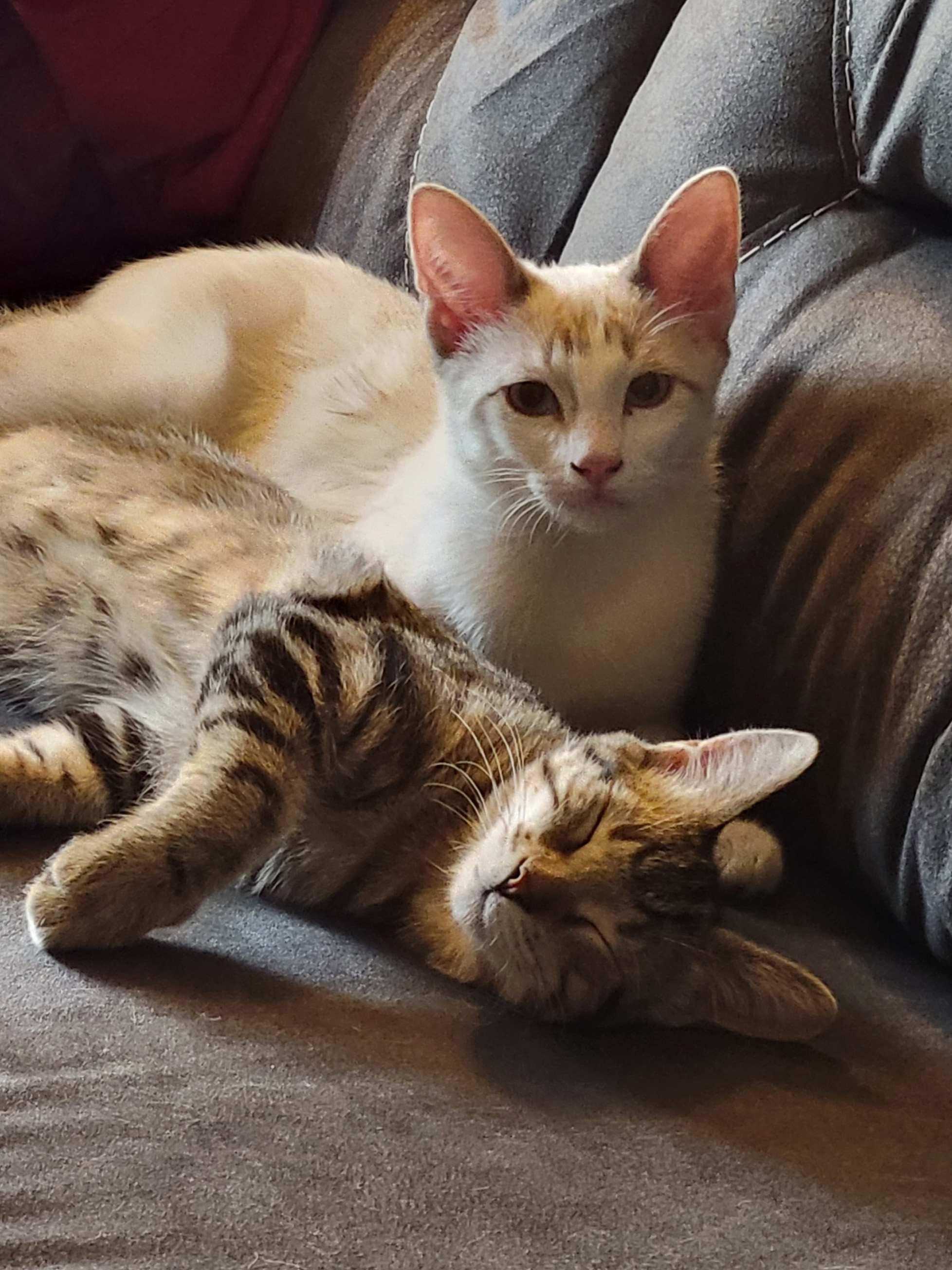
Oh, did you forget about the kittens? My son eventually found the two most perfect kittens in the world and his cat Jonesy MONSTER is a very happy boy again.

Update: Knit One, Spin Too just let me know about a new book about milkweed that came out in September called The Milkweed Lands. Who knew there was so much to milkweeds? I just ordered a copy. 🙂

The Scleroderma Chronicles: Bioethical Dilemmas and Unintended Consequences

I was a biology teacher in the time of the Human Genome Project. This week, with the coming release of the newest movie about Oppenheimer and the development of the atomic bomb, I’ve been thinking about the DNA and genes again (I know, it is a biogeek thing…), because one of the candidates running for the Republican nomination in the US wants to cut the Department of Energy if elected.

Kind of a loose chain of threads, you’re probably thinking. Am I right? Well… the Department of Energy is the agency that is responsible for the regulation of the nuclear energy industry in the US. There’s a lot of waste coming out of those nuclear reactors, and there was some concern about how much mutational damage was being done to DNA through exposure to radiation. Well, to figure that out, you need to know what undamaged DNA looks like. The initial drive to figure out what the human genome looks like came from that agency and once the results came in early this century the world completely changed. Like a big change. Like an atomic bomb level change. Like, there are now sites that have huge depositories of biotechnical data and tools to aid in research.

Hannah’s World: no big changes here!

In the classroom we biology teachers began to teach about the Human Genome Project and also did a week-long unit around the ethical problems associated with this new knowledge (bioethics, if you will). The kids grappled with dilemmas like… if you had the gene for a fatal, untreatable illness, would you want to know? If you were a child at risk for this gene, would it be okay for your parents to have you tested for it before you are 18? If your unborn child tested positive for this condition, what would you do? Would it be okay for human organs to be grown for transplantation? Who should get the transplant… a single father of 4, or a 16-year-old student in your high school? Should your employer allow you to continue in your airline pilot job if a genetic test shows you are high risk for a sudden cardiac event. Should genetic test results be private? Whew. Lots to grapple with in this unit.

Makes your head hurt, doesn’t it. Check out my knitting progress this week!

So, shit kind of got real this week. One of the members of an online support group for pulmonary arterial hypertension (a progressive and fatal heart/lung condition that I have thanks to systemic sclerosis) has just been identified with a gene (bpmr2) that causes the condition; her PAH is caused by this gene and can be inherited; she has a different type from me, but it is still PAH. Oh, boy. This is not good at all. The life expectancy right now is up to about 7 years, but you only need one copy of the gene to be at risk for PAH… there is a 50% chance for each of her children that they inherited the gene. Only 20% of people with the gene will develop PAH, but that is still a big risk.

Should she tell her two children? she is asking in the forum. They are in their late 20s. If she does, and they get tested, should they have their own children if they have the gene? Her heart is broken, literally.

Life expectancy has greatly improved over the last few years with new medications being generated in the modern climate of expanding cellular and molecular biological information. Untreated PAH (and PH kind of gets lumped together with it according to my pulmonologist…) has a life expectancy of about 2.8 years… not good.

Rose break! By the end of the discussion thread, she was leaning towards telling the kids.

Which brings me to the next shitty bioethical item that occurred this week. One of the members of another support group caught Covid and had to go off her drugs while fighting the virus. She has been slow to recover, and still feels pretty bad, but she took a pregnancy test and restarted her medications again a few weeks ago, only to discover this week that she is actually 12 weeks pregnant. Why did she have to take a pregnancy test before restarting her drugs? Because some of the drugs used to treat PAH can cause extreme damage to a human fetus. The enrollment process is very strict, and every effort is made to keep patients from this situation.

I am in grief for this woman. The doctors think that the baby has been spared the worst of the drug toxicity, but now she is working her way through whether to abort or not, to restart her drugs, or not. To risk death to save the baby, or to abort and restart treatment. If the baby is born in good health, will she live long enough to see it enter kindergarten. If the baby is born with health problems, her medical burden is increased. She is young. This is a horrible mess, and she is already too far along to get an abortion in many states in the US. I don’t know if she has other children, or what her support structure is…

This week I heard that some states are demanding private health records to identify any out-of-state abortions or transgender care that has happened in another state. I hope that this woman lives in another country…

Then I heard that a popular hamburger joint near my home is now going to fire employees who wear a mask. Say, WHAT?! Let me tell you, any person who has a serious lung/heart condition like mine wants to wear a mask, and they are so grateful if the person at the service window is also wearing a mask. Sometimes people offer to put on a mask when they see that I am wearing one. Now that person can be fired for putting on a mask… remember the young PAH patient whose nightmare began with catching Covid? Truthfully, any random virus can cause serious damage to patients with PAH, especially if they are also immunosuppressed.

So, there are a lot of bioethical dilemmas here, and the unintended consequences of people who want to make sweeping decisions without understanding all the interlocking systems involved and the potential ramifications are staggering. NO, you can’t just disband the Department of Energy, and sweeping, inflexible decisions about reproductive issues (that seem to be smugly self-righteous to me) can be disastrous. It is easy to order up genetic tests, but what happens once you have the information can be life-altering.

And don’t get me started on this animosity towards mask wearing…

I can’t help but think that no one should attempt to enact legislation without suffering through experiencing something like the bioethics unit that was taught at the high school where I used to work. I keep wondering, do these legislators actually understand nuclear power and weapons? Have they heard of the Human Genome Project? About gene testing? About rare diseases? They absolutely need to go see the Oppenheimer movie, maybe, and then write me a report about the Human Genome Project. I’m pretty sure that they would struggle with epigenetics, but it would do them good if they looked into it. They can get extra credit for a summary of pulmonary arterial hypertension. I would like to give them a book list of summer reading to get through on their breaks, because only the well-informed and educated should attempt to make decisions about these issues in the seven levels of bioethical hell that is the life of patients like me.

Because this week was a really hard one; for too many people this shit is real.

PS: Have you seen the show House? I kind of think that he could use a little bioethics sensitivity training, too.

You all be safe out there!!

The Scleroderma Chronicles: Be a Rose.

So, I got a little testy in one of my Facebook support groups for systemic sclerosis this morning. A member of the group kind of disparaged me and another person for not being positive enough. It was “you need to refuse to let scleroderma define you” in response to the first person sadly saying that she missed her old life, and me giving her an online hug with the comment that if only a positive attitude was enough…

In my defense I had just experienced a Kaiser employee visibly reacting to my lack of wrinkles. As in, wow, that’s great! Like not having wrinkles makes this all worth it.

I lost another 4 pounds at my last check-in, which is concerning, but the nurse was thrilled for me. Me, I was a little teary at the continued loss.

Um, people… do you think that you might be a little shallow here?

I was out on the deck/catio with the cats drinking my morning latte when I hit this emotional wall, and after I had fired off the somewhat testy response, I spent some time in the garden. There were my roses, blooming like the utter champs that they are.

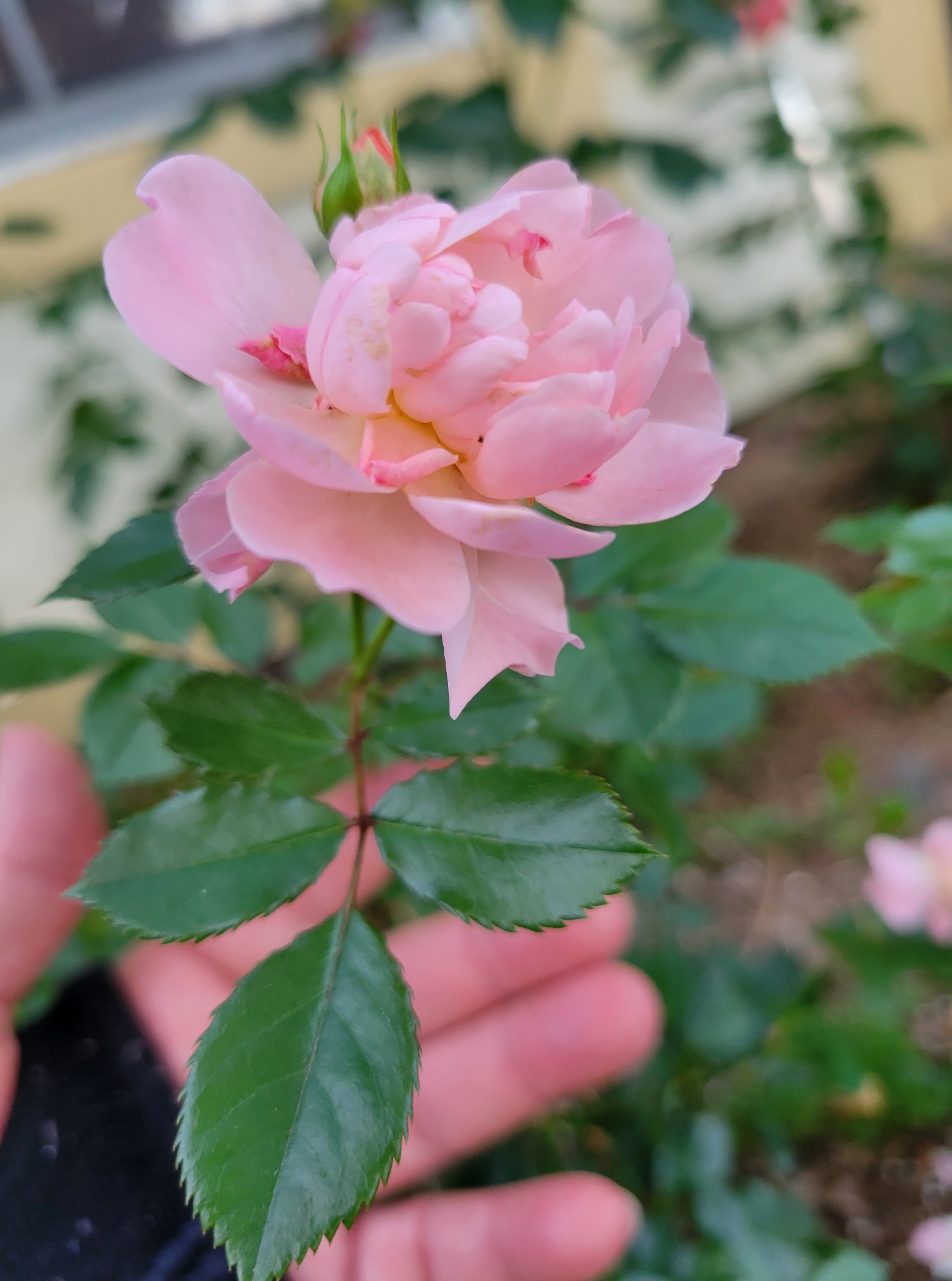
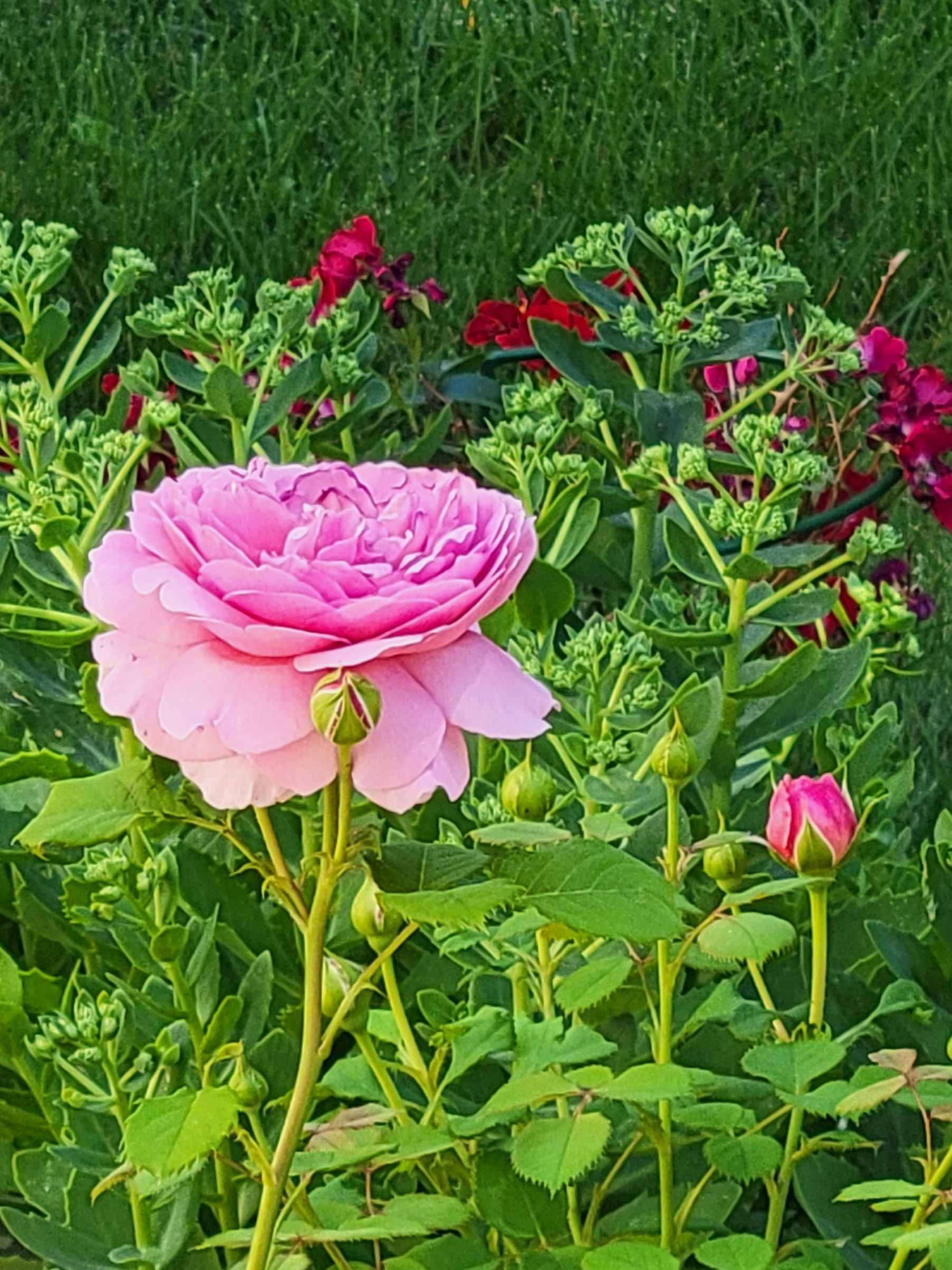
This is my Princess Alexandra of Kent rose.

This rose is looking great this year. Never before has the plant been able to hold up the blooms without the weight pulling the stems over. The problem is our semi-arid climate with hard winters; the plant grows back from the roots every year and it doesn’t have time to put in enough supportive tissue to hold up the blooms. This year, with all the rain and cool weather that we have had, the plant was able to put in enough of this tissue to do the job. The tissue that I’m talking about, a type of ground tissue, is called sclerenchyma. If you’re ever snapped a celery stalk in half and pulled out the strings, you were pulling out sclerenchyma tissue. This tissue is made of dry, hardened cells in the stem of the rose and I suspect that the “scler” part of the word is of the same origin as scleroderma. Look at that. The hardened cells are doing something good for this rose!

In me, not so much. Things have been a little difficult as my poor heart and lungs are not benefiting from the hardening and thickening going on in the cells and tissues of those organs. All of my tendons are seriously pissed off at the moment. Edema has become a problem, and it is becoming increasing clear that I need to stay on oxygen 24/7.

That’s my arm with the imprint of a quilt in it, in case you didn’t immediately recognize it… Edema is kind of a tip off that my heart is struggling and that’s new. The weight loss is also related to my heart/lungs because if oxygen isn’t getting down to my cells like it should, they can’t use energy efficiently, and then, you know, weight loss occurs. The tendon issue is scleroderma actively attacking them and gradually hardening them to bone. Bad scleroderma, bad!!

But look at how great these roses look!

So, what did I say in my testy response? Reality bites. Some of us have progressed to the point where we have to admit that no amount of positive thinking will allow us to attend that family function that we were invited to, or to visit the annual Wool Market in the mountains, or to even walk to the mailbox. To suggest that we could do things if we just had a more positive attitude is hurtful and not supportive. No matter how much you want to believe otherwise, scleroderma does define me and everyone else who is dealing with it. Courage requires us to face down the monster and to accept the reality of our disease. How we choose to function within that framework is up to us.

I may no longer be as mobile as I once was, and the life that I used to have is now mostly gone, but I choose to continue to bloom in place.

Like a rose.

Updates/Notes from the ScleroFront:

  • Do you like to wear linen? Those fibers are from the water tubes (xylem) in the flax plant, and made of sclerenchyma.
  • The bunny-murdering neighbor put her house up for sale!!
  • My Alpine Bloom sweater is coming right along!

Summer Solstice 2023: Back in the Garden

This has been quite the year so far. I have never seen so much spring rain; it has been cool with daily rain for weeks (along with a few scary thunderstorms that triggered hail and tornado sirens…). After years of drought, this has been a little disconcerting this year.

Do you see the little yellow star on the rainfall map? Yeah, that’s me. There has been so much water I have had to rescue potted plants that were overflowing (with the poor plants drowning inside the flooded pot) and the plants and trees are more lush than I’ve ever seen before. I had a little pond in the back yard, and I never took the winterization covers off the outdoor faucets until today. Finally, finally this week the weather turned, and it became warm outdoors over the weekend. I finally turned off the furnace for the summer last night.

Hannah: where are the moths?

Poor Hannah, the miller moths are now gone, but the butterflies are right around the corner. Maybe there will be dragonflies! Summer is finally here. I headed out to the yard to get some pictures.

My first rose has opened up!!
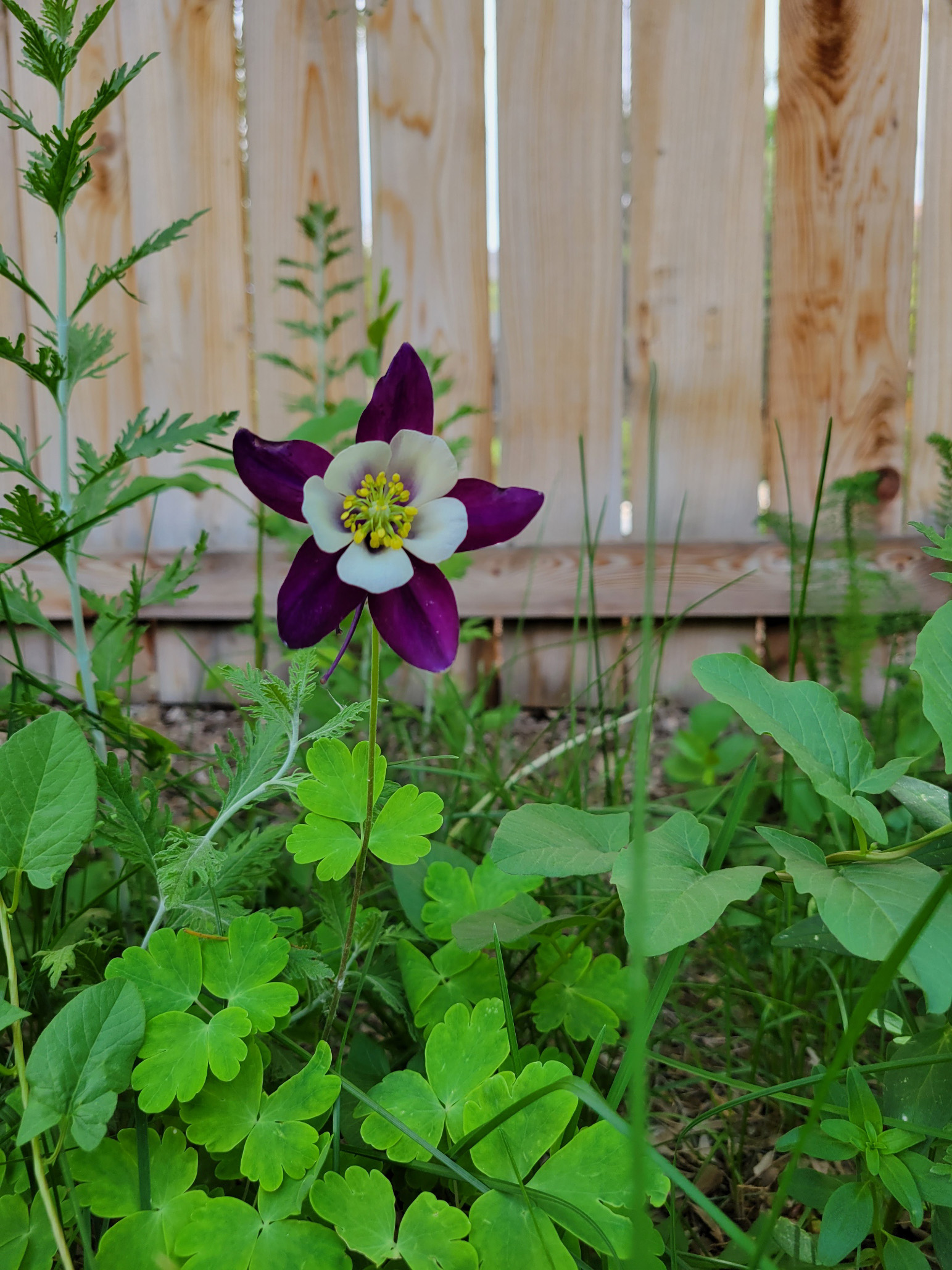
The columbine is blooming!
There are even more mushrooms appearing under my Douglas fir.
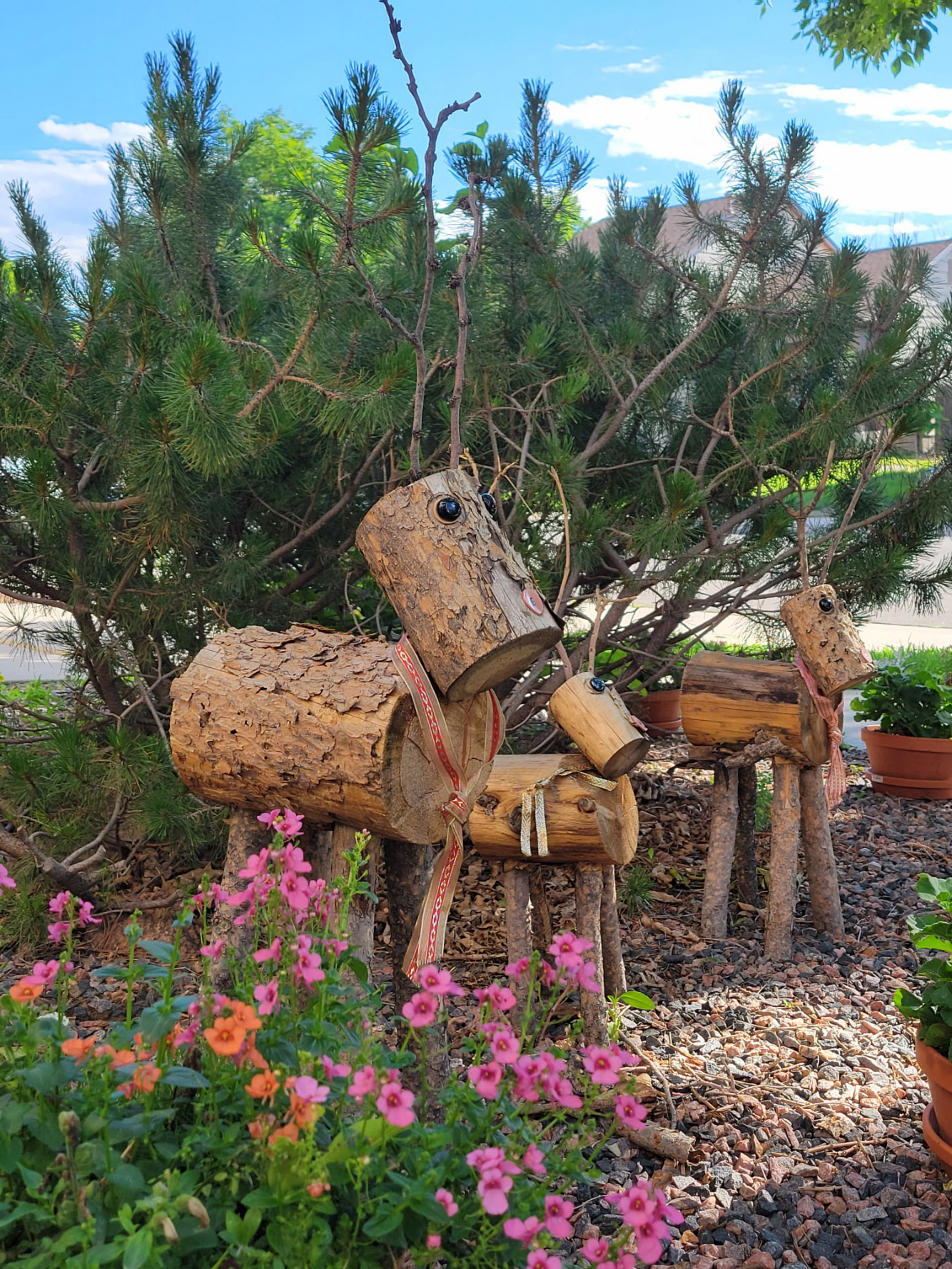
Things are looking pretty good at my front door. Okay, the deer are starting to look a little worn (bark has been falling off…), but that pinyon pine is covered in new growth!

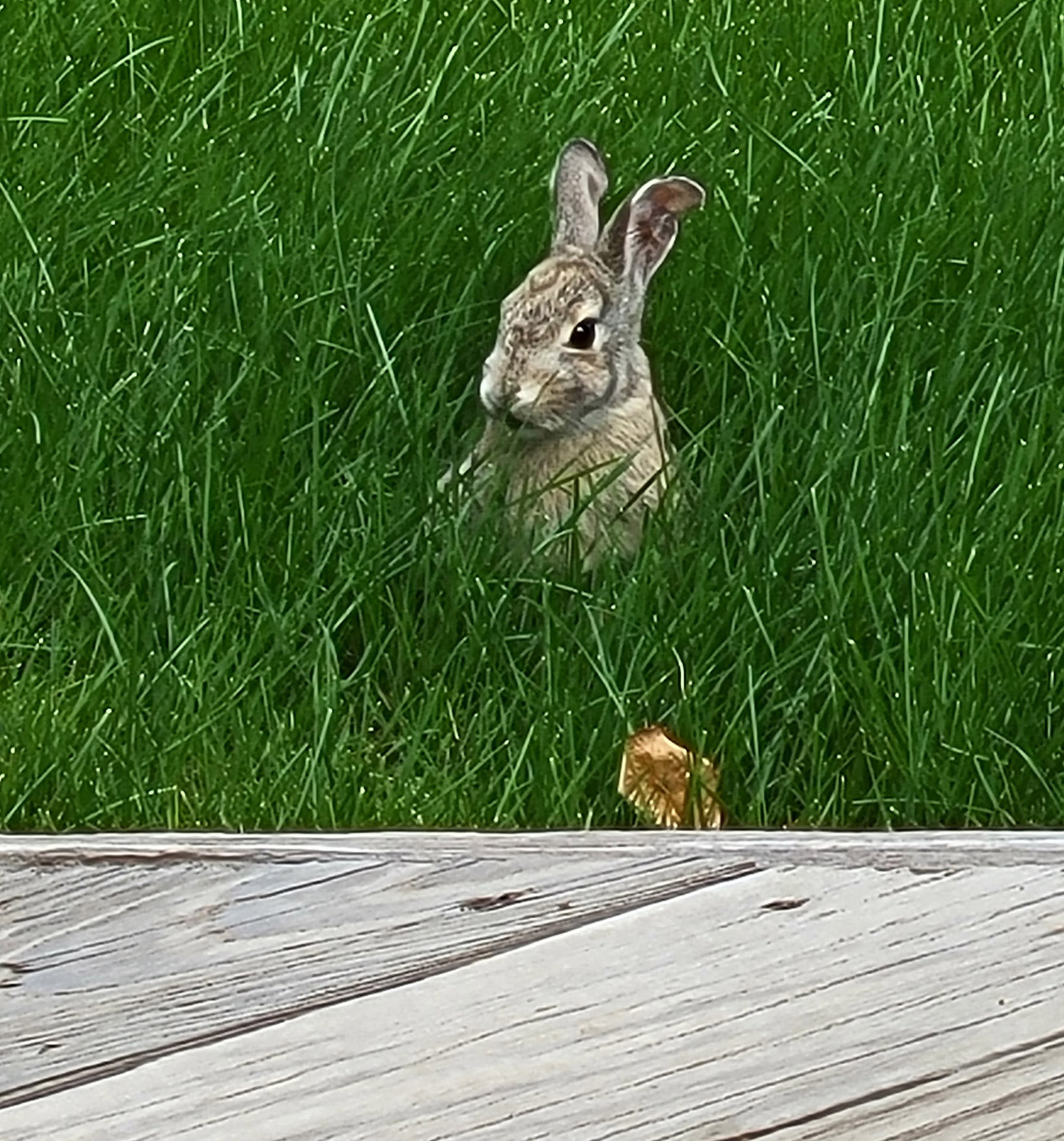
The older bunnies of the spring are now laughing at me from the (unusually lush) lawn, and there is a new fluffle of babies emerging from under the deck.

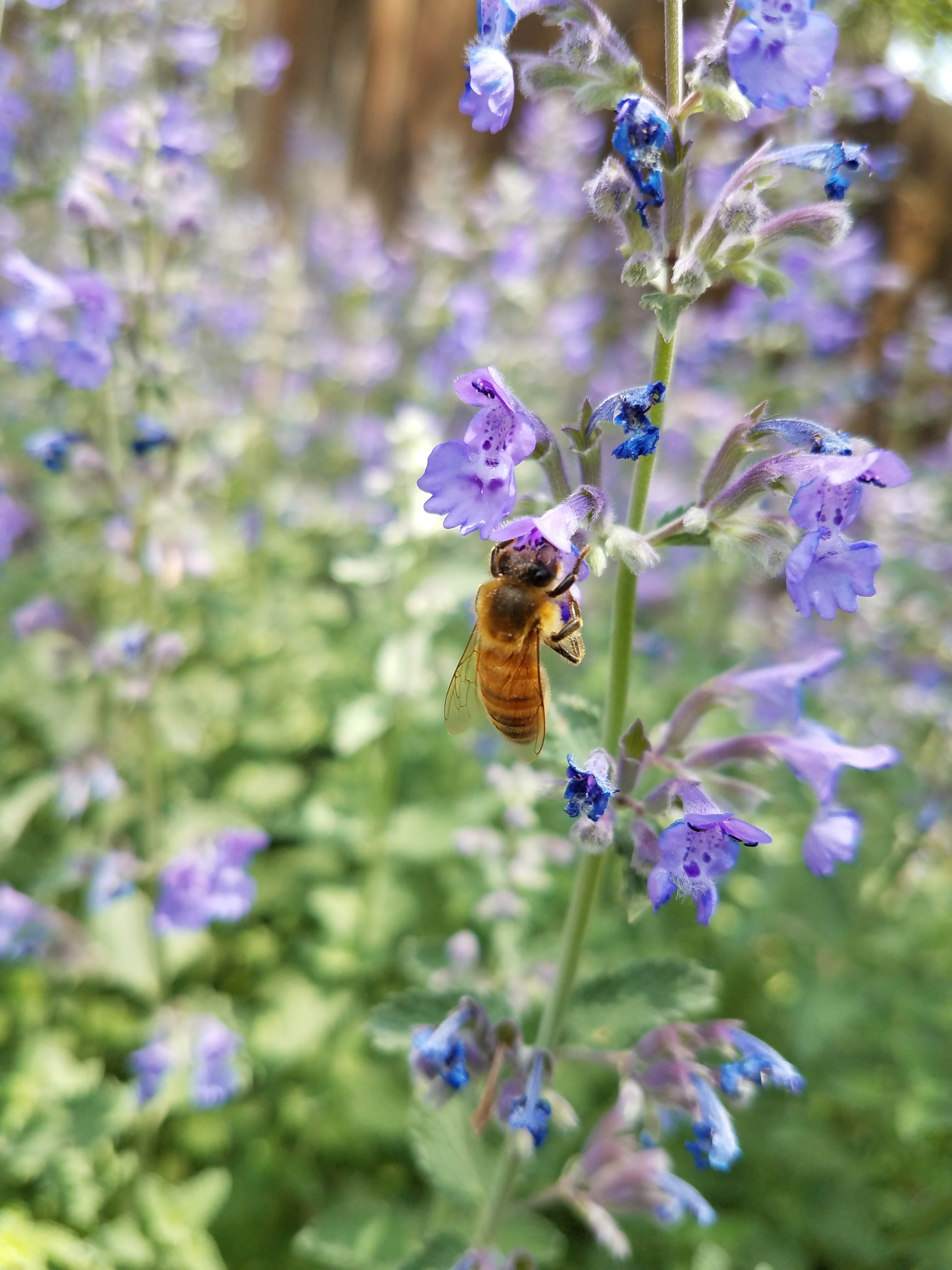
There are birds everywhere in the yard, but I had no luck snapping a shot. I did, however, capture a bee at the catmint.

Welcome to summer, everyone!

The BioGeek Memoirs: Miller Moth

Last night a miller moth got into the house. The cats staked it out and Hannah kept trilling for me to come help her get it. The poor moth, trapped in my house in an environment that was definitely not safe, clung to the wall up near the ceiling.

These moths are small: about an inch across and they will leave a dusty powder behind if you touch them. This powder, reminiscent of the powder on people working in flour mills, is the source of the moth’s common name.

Later in the evening, after I had turned out lights in the house and was reading in bed, the moth, attracted by my reading light, arrived upstairs to bat and fly around my light. Chaos erupted as cats launched themselves towards the moth, and I grabbed the lamp. Mateo dove down the wall behind the bedside table, chasing the moth while Hannah tried to cut it off from the other side. Sigh. It was another long night…

This year there are an awful lot of moths on the move. Look at what showed up on my Facebook feed!

That’s right. As the cats and I know well, these moths are creatures of the night. I see them snacking on flowers that attract moths (lilacs, I’m talking to you!!) and bopping around lights during the night hours. Why these moths, creatures that hide from light all day, are attracted to sources of light at night, is a mystery to me, but there you are. There are several theories about why this happens, which you can read about here if you’d like.

Miller moths are annual visitors to my part of Colorado as they migrate westward towards the cooler foothills of the Rocky Mountains for the summer. In their caterpillar stage of life these moths existed as army cutworms, wreaking havoc on crops and grasses in fields on the Great Plains to the east. Once they emerge from their cocoons, the adults take to wing and head west in a great migration that lasts for weeks every May-June. Why are they doing this? There is a lot of speculation, but mostly it is thought that they are looking for better food and cooler conditions to survive the hot summer.

I try to keep a good attitude about the moths at this time of year. These moths are nocturnal and hunt for hiding places during the day where they are safe; too often they crawl into the cracks at the edges of the doors and windows and if you open one, the moth will take flight, end up in the house, and begin frantically searching for another hiding spot. Opening the garage door sets off a flurry of moths. I’m not going to lie; it can be really spooky when an unawares homeowner opens the front door to an erupting cloud of moths suddenly taking flight and batting against their face and hair. In my case it is worse because I have a storm door outside of my front door, and when I open the door, the moths have no place to fly except into my house. <Cue the cat excitement!!> How do those moths squeeze past the storm door to get inside the gap? They are experts at squeezing through tiny openings! Seriously, it has been so bad this year that this also showed up in my Facebook feed:

You are supposed to gently trap them and return them to the outside world where they belong. Here is the link to the article.

Can you hear Mateo wailing why??? He thinks that these moths are the best cat toys ever, and this is what Hannah looked like the first time she saw a moth on the wall:

Hannah: what is that??!

Well, the reason why they should go back outside is because they are important to the ecosystem. They are significant pollinators of flowers like the lilacs I mentioned above and other plants with strongly scented (and lightly colored) flowers. They are also important sources of food for birds like swallows; right now, there are furballs of swallows dipping and darting through some intersections and dodging cars as they snatch moths from the air. It is so bad it can be concerning when you approach the intersection; a swallow hit a car next to me while I was waiting at a light yesterday. Clearly, there are miller moths at these intersections and the birds are dive-bombing the cars as they hunt the moths. The reasons aren’t clear why the feeding is so good at some intersections, but as with all things miller moth, there you are. It must have to do with the lights, the lines between the poles, the swirling air, nearby fields, whatever. Just another magical phenomenon associated with the migration.

There is one last thing that I think of when the miller moths arrive. It is time for the kids to graduate! Year after year, graduation after graduation, I shook the hiding miller moths from my robes, carefully arranged my masters hood around my shoulders, and marched with my students as they left me and moved on with their lives.

The best migration ever!

The Scleroderma Chronicles: Chasing down the Cytokines

There was more response than I expected from my last post about my efforts to obtain a better understanding about my chronic conditions, the new drugs I was taking, and how to lower my inflammation. I offered in that post to share the links that I used to figure out what foods impact the levels of cytokines that are important in my systemic sclerosis. I’ve gotten feedback/requests for the spreadsheet with my links that I used in my adventures at PubMed.

I’ve been thinking about this for a couple of days, and I think that the most useful thing to do would be to share my process as I hunted down information about cytokines involved in my systemic sclerosis (SSc), and the cytokines that I needed to pay attention to in my diet.

I started out asking: What are the cytokines involved in systemic sclerosis? I did searches using terms like cytokines and systemic sclerosis. Here are some of the links to papers that I found.

I kept a list of the cytokines that were being measured in these studies and I finally began to get a sense of the four big players that were being measured and considered as targets for therapy: Tumor Necrosis Factor alpha (TNFα), Interferon gamma (IFN-γ), Interleukin-6 (IL-6), and Interleukin-1beta (IL-1β). You can follow the same process to research any inflammatory disease that you are interested in; you may get different results. (For example, C-Reactive Protein, called CRP for short, features in many inflammatory conditions. For little SSc me, not so much… my levels are normal.) Anyway, once I had the cytokines of interest, I did searches on all 4 of them. Here’s my info on TNF-α.

InformationSource
TNF-α is also a potent inflammatory mediator and apoptosis inducerThe role of Tumor Necrosis Factor-alpha (TNF-α) in the pathogenesis of systemic lupus erythematosus
Produced by activated immune cells (macrophages, NK cells, T-cells) known to trigger a series of various inflammatory molecules, including other cytokines and chemokines The Role of Tumor Necrosis Factor Alpha (TNF-α) in Autoimmune Disease and Current TNF-α Inhibitors in Therapeutics
TNF-α causes other immune response cells to produce IL-1 and IL-6Tumor necrosis factor – Wikipedia
My question: What does TNF-α do?

I did the same for the other three cytokines and it turns out that for me, it is best to reduce all of them in my blood. At this point I made a little chart with the 4 cytokines at the top and began to do searches on different foods that I thought were anti-inflammatory.

FoodTNFαIFN-γIL-6IL-1β
Chile (Capsaicin)
Tart Cherry
Tomatoes (Lycopene)
Question: Which foods/supplements will decrease these cytokines levels

Now the searching gets easy. I just typed in the questions in the search bar like, “Does capsaicin reduce TNFα” or maybe “Does capsaicin reduce cytokines” and the answer would quickly pop up with some resources. Warning: the search engine will give you the pertinent text and then you are on your own as you search through these papers! If you just go with the fast answers, you will take some risks… I told my sister that tomatoes were bad because I didn’t read the whole text, and I’m not sure if she has forgiven me yet…

Anyway, here are some papers about the foods/supplements above:

If I found a source that said one of the cytokines was reduced by one of my targeted foods, I just put an “X” in that box and moved on. I was no longer recording all of the links in my excitement, and as I found info it sometimes confirmed previous finds, but not always. If I got contradictory information, I was forced to read whole papers. Ugh. Also, you might want to try a different search engine; I used Chrome on my phone and Explorer on the computer, which is another reason for incomplete links on the computer. For the three foods in the table above it ended looking like this.

FoodTNFαIFN-γIL-6IL-1β
Chile (Capsaicin)xx
Tart Cherryxx
Tomatoes (Lycopene)xxx
Question: Which foods/supplements will decrease these cytokines levels

I hope this unpacks the process that I used and helps with any searches that you decide to do that are specific to your own needs/interests.

Happy Caturday!!