
I’ve been thinking about resilience today after this graphic showed up on my Facebook feed.
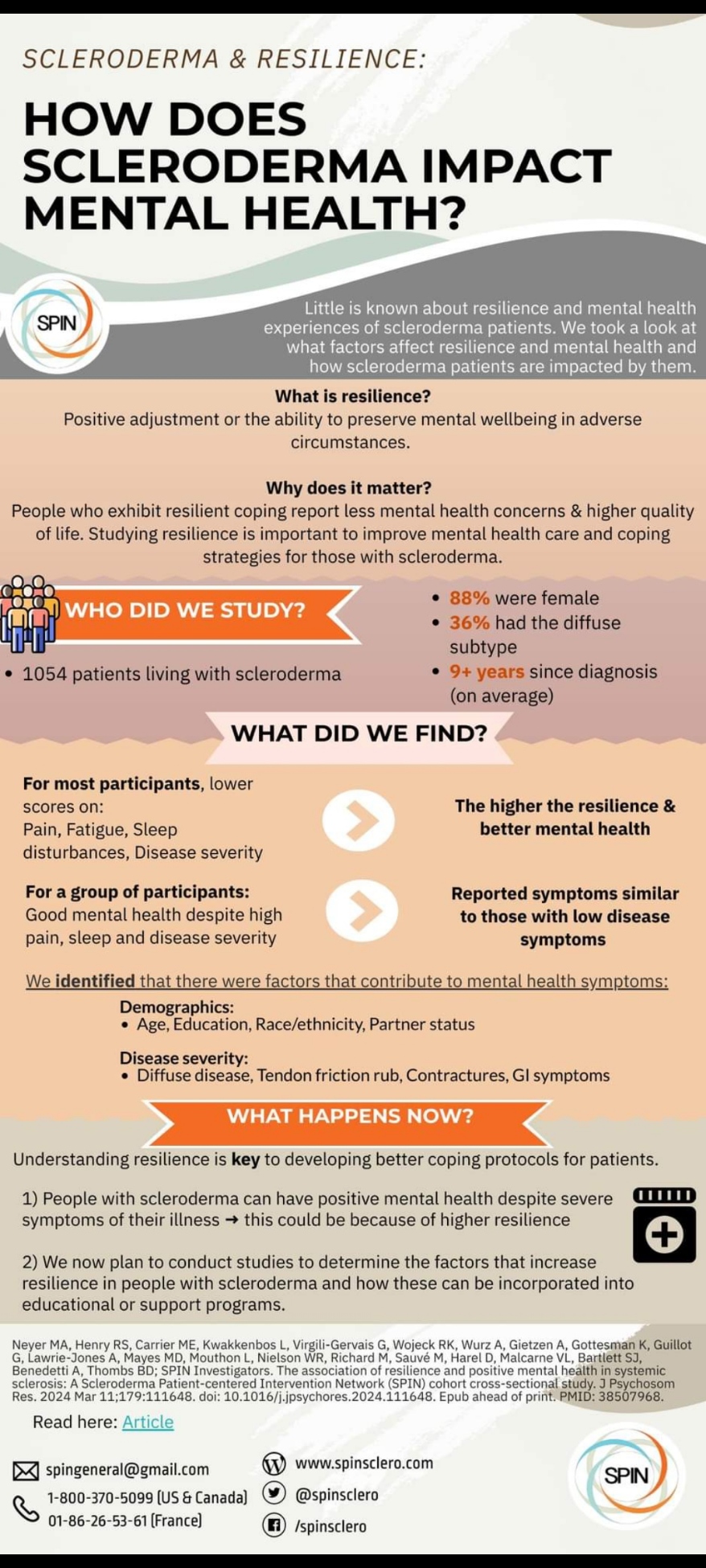
I’m pretty sure that I was one of the patients in this study. Certainly, I was a participant in a SPIN clinical research study during which I filled out lots of questionnaires about my illness. The focus of the project that I was enrolled in was to see if online educational videos about scleroderma, possible interventions to help with the progression of symptoms, and information about resources could help patients in how they coped. I was tracked for over a year to see how I was doing. How was my pain? How was my sleep? Was I depressed? How severe was my disease, and how did I feel about that? Did I have issues with anxiety? What were my scleroderma-associated complications?
Not surprisingly, the study referenced in the graphic found that they could break patients into 4 groups based on the severity of their disease (Low -> Very High). They found, for the most part, as patients dealt with an increasing disease burden, they coped less well and struggled with depression and anxiety more.
Except for one group of outliers. They had a pretty significant disease burden, but they were not depressed and didn’t struggle with anxiety. They kept rolling with the punches and finding ways to flourish even within the eye of the storm, securing for themselves a better quality of life than others facing the same challenges. I’m pretty sure that I am one of the people in this group of outliers. I remember that I reported that I was having lots of trouble with pain and sleep disruption, but no depression; my current battery of scleroderma-associated complications should put me into the High disease group. Here is a paper where the researchers further investigated the association between disease burden and mental health and resiliency.

So, the big question that the researchers are now pursuing is what determines resiliency, and how can these essential coping skills be conferred to other systemic sclerosis patients through training and support.
So, what is resiliency? That was the big question of the day for me as I worked out front weeding a garden. Working outside is now hard for me, but I dragged out a little chair to sit on, put my tools into a crate that was easy to push, and I slowly worked my way along the front walk cleaning up my garden and pulling out weeds. I had to take breaks to pant from time to time, but by the time I was done the gardens looked great! The weather was perfect, there were lots of birds, and one of my neighbors had music playing while he worked in his garage. After a little break on the catio with the cats (coffee and a lemon bar time!!), I strapped on my portable oxygen concentrator and mowed the front lawn. I’ve had a hard week, and I struggled to get myself outside to work in the yard, but by the end of all of this I felt much better. You might even say I felt happy.

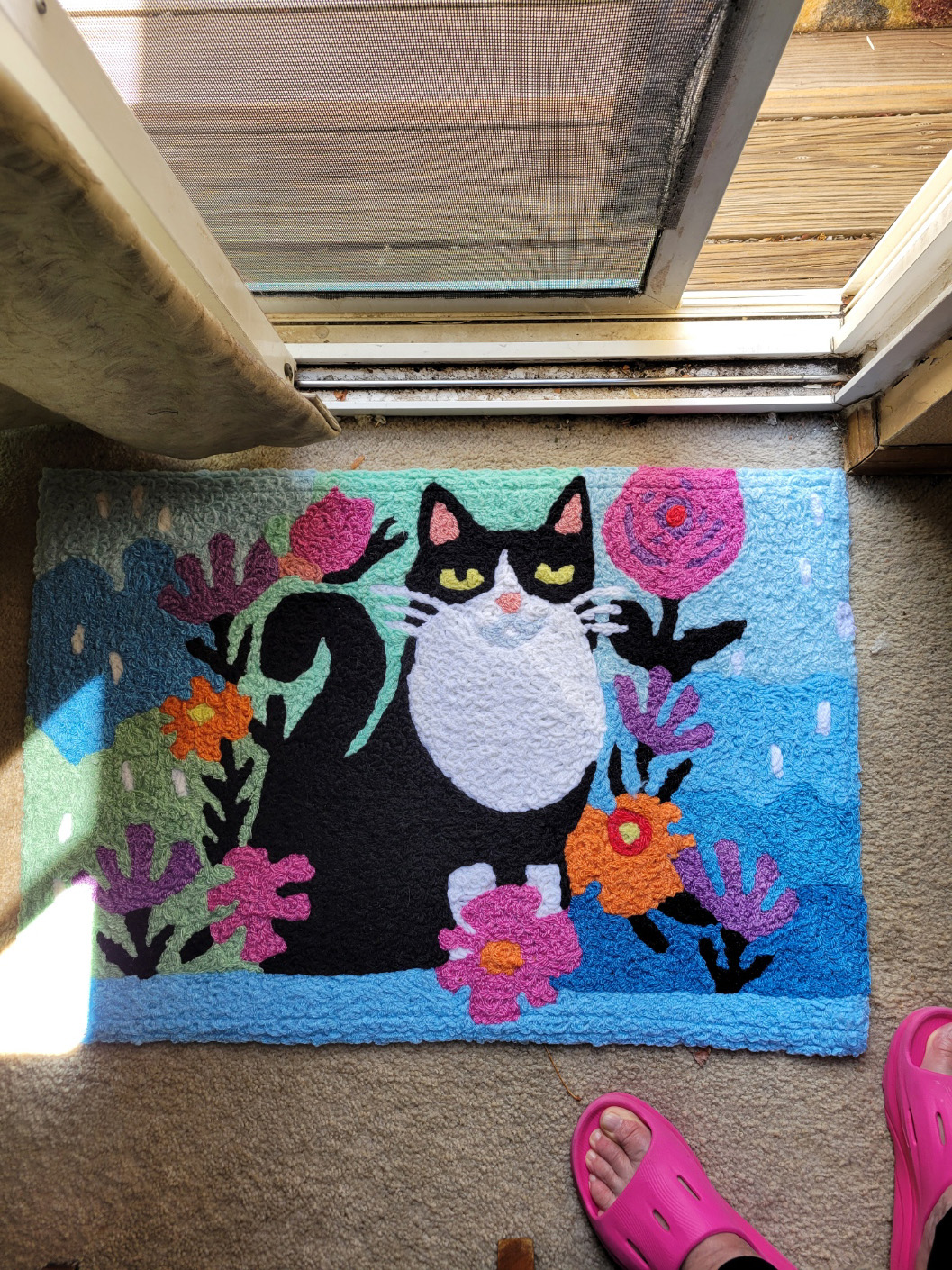
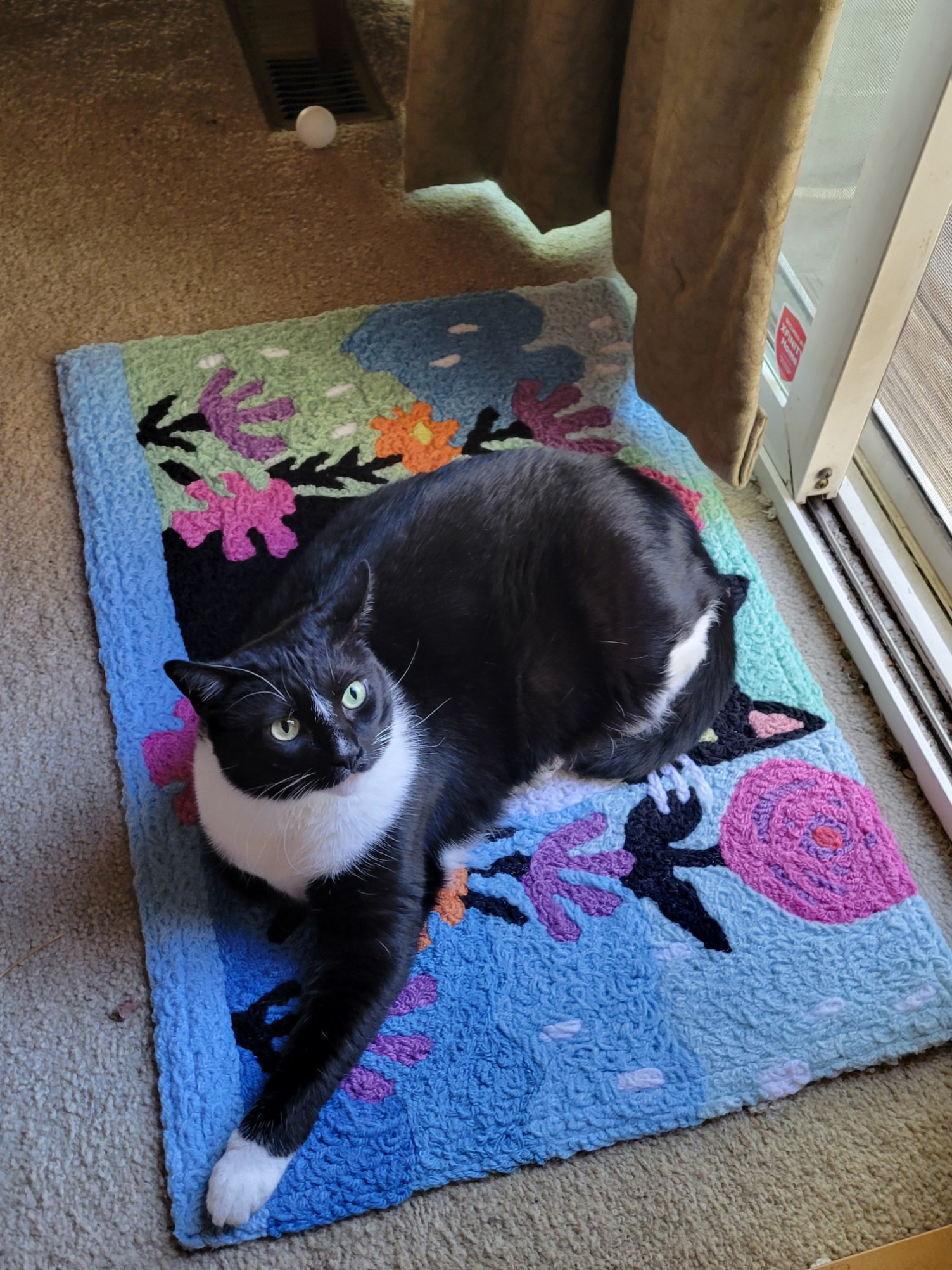
Look at how nice the front pot of flowers is looking! I bought a new rug to put by the door onto the catio, Amazon delivered it today, and Hannah moved right in. Yay! Take that scleroderma!! I win the day!! I am happy!!!!
So, what is resiliency? I’m still stuck on that question. I’m pretty sure that it is a state of mind that allows people to focus on what can be done instead of what has been lost. Resiliency allows people to embrace their changing circumstances and effortlessly employ life hacks to get things done while acknowledging that other things are now too much. It must have to do with an ability to name the monsters, stuff them into a box, and put them on a shelf (in the back of the yarn stash) while activating self-advocacy. It must require faith that you will be able to cope with scary things when they come, while still recognizing that you are in a difficult situation. It must require support and resources. I think it has to be an internalized quality: resiliency gives you the self-confidence and self-worth that’s necessary to face down medical authorities and to ask for demand help and answers.
I look forward to what these researchers find as they continue looking at the phenomenon of the outliers: patients dealing with a severely debilitating and isolating rare disease with grace.
I kind of think that they will discover that these people have engaging interests that allow them to have a sense of accomplishment and purpose. I bet that they find that they have pets and people that they love. I bet that they produce something of beauty in their lives. I am almost certain that they will find that the outliers have found ways to communicate in a positive manner with others about the challenges of life with a progressive, and often fatal disease.

Why am I resilient? I have cats. I have yarn. I have curiosity and lots of resources to chase it. I have purpose as I produce donated items for others in difficult situations. I have roses. I have people who love me, and I have people who read my little posts about coping with life on the down slope of systemic sclerosis.
Thank you for being part of my resiliency system.

 Yarn, Books & Roses
Ah, Marilyn, you cannot bring yourself to say it, so I shall. Resiliency, as named, takes a whole big shitload of …
INTELLIGENCE !!!
Enough to draw from your past learning|teaching experiences, apply them to your current researching and be able extrapolate what’s needed.
You have an excellent brain, and you use it.
What a nice thing to say, but I have met some really bright people in my time who didn’t seem to cope well when things changed on them. I do think that my experiences and education do help me, and my mother, who died of ovarian cancer almost 40 years ago, was the best role model for resilience ever! I do wonder what the researchers will be looking at as their hope is that their findings will help other patients facing difficult medical journeys.
To my mind, you’ve either got it or you ain’t got it; and I would, more than somewhat sceptically, suggest that the findings will not assist those who ain’t.
They might, however, be of help to those who have just been launched into this hellish disease and its effects, if the timing’s right …
I am kind of afraid that some of their findings will show that people have an intrinsic quality that we label resilience, or they don’t, but there still might be things that will help.
I was at a conference a couple of weeks ago and the presenter told us to not use the internet for medical advice: only get medical advice from your doctor and the Scleroderma Foundation site. I had to speak out and push back: if I had done that I still wouldn’t be diagnosed! It occurred to me that seeking my own information by using reputable sources is a type of resilience. I am very compliant and follow my doctors’ directives, but I am also able to have data-based discussions with them that allow me to collaborate in my treatment. Surely that can be passed on to others. 🙂
Being a part of your system, Marilyn, has been an inspirational pleasure. You live up to your own detailed analysis of resilience. I agree entirely with MR about your brain, and the qualities that you list transcend even that.
Thank you for being part of my system! After I posted the blog I remembered that I have read that knitting helps reduce stress and blood pressure. It isn’t the knitting per se, but the fact that it is kind of meditative and rewarding in the items that are produced. There must be lots of other things that will give the same benefits. I’m happy with my brain, but I’m pretty sure that other things are going on that also help me.
Quite so – the brain itself wouldn’t cut it
When life has thrown difficult things my way, my doctor has said, “Don’t stop knitting.”
It definitely does have meditative benefits.
My doctor told me the same thing. It is helping my hands, and it is definitely helping my state of mind.
Thank you for being part of our resiliency systems. We see that you have an overall positive mindset and that you are making it against a lot of odds, so that gives us hope for downturns in our lives. You set a pretty good example.
Thank you for giving me empowering feedback! I worry sometimes that I just have really low expectations, so it doesn’t take much to give me joy, but in my heart, I think that there is something to deliberately feeding resiliency.
Obstinate bloody-minded defiant flexibility. That is the definition that I’d use for resilience. At least, as it applies to me – one must always remember that I have a hole in my head.
About the internet searches: you are able to judge the reputable sources, and superb nonsense filters. There are too many folks who use the same internet and only find two headed lizard people cults running the government. They must be what the conference presenter was trying to discourage.
The little roses are adorable. You find the prettiest roses!
I’m trying to wrap my mind around “obstinate bloody-minded defiant flexibility”. Is that “think for myself, refuse to let medical professionals doctorsplain my symptoms to me (also known as medical gaslighting), and accepting their treatment plan after discussing my concerns with them?” I think that you did nail it.
I think that people go out onto the internet to look for what they want to find. If they are convinced that there is a conspiracy or cult involving the government, that is what they find. If they believe that there is a cure for cancer that is being withheld by big pharma to make a lot of money, that is what they find. If they are in blatant denial about their diagnosis (or the severity of a public health crisis) they find ivermectin or proof that the Covid vaccine is killing millions of people. That still isn’t a good reason to tell people that they should just accept the pronouncements of their doctors without thinking for themselves. It is a good reason, however, to educate people about how to evaluate information that they find and great ways to use the internet to become interactive partners with their health care team. My best example of that is googling some crazy terms in a cardiac imaging report, realizing that they meant I had a partially collapsed lung, and then sending the text from that report to my pulmonologist. I got a lung scan the next week and that’s how my interstitial lung disease was diagnosed.
I sound like a teacher, huh, but I am ready to put together a conference presentation on how to do that. So for, there have been no takers. Did I mention that I stopped going to the Scleroderma support group because it was too focused on alternative medicine and also controlled by men who seem to feel that women should just put them in the care of men and keep their mouths shut. NOT a good fit for me.
I found those roses at the grocery store! There are four of those guys in each pot, and I’m hoping that I can get them pulled apart and moved into a garden by the deck where they will be fabulous for years to come. Even if they don’t all survive, I will have some great blooms in the future.
I think you’re one of the most resilient people I know! Thank you for sharing your knowledge with us through your Blog. I also feel that resilient people possess a sense of humor and know how to make lemonade out of lemons! You are a wonderful example of both of these qualities.
You are welcome, but I think that the blog is helping me more. I did think about humor, and I think that you are right. I’m a little concerned that my humor is getting a little dark these days…
I agree 100% with all of this. The compartmentalization of things (shoving them into a drawer or box in one’s mind) is a huge help because I think otherwise, the tendency is to get overwhelmed – BUT that also assumes you have something to replace the monsters with and if you don’t, that is when depression starts creeping in IMHO. Having a great support system in place of things you enjoy doing when you can do them, staying engaged at the level of you can with the rest of the world, and (I’m not joking here), having a warm furry friend (or friends) to brighten up your day even if the day is focused around staying in bed and just waiting for a better one, is REALLY important. Glad to be a part of your system!
PS: I really love Hannah’s new rug!
I as searching for the right word for my boxes, but you nailed it. Compartmentalization is absolutely essential for managing anxiety. There are some important details, however, as it means that you do recognize the validity of the monster in the box, but you make a conscious decision to not let something that hasn’t happened yet control your life. The first video on pulmonary arterial hypertension I watched started with a doctor explaining that PAH is a fatal complication of systemic sclerosis. You know I went into a tailspin over that! That monster is in the box. I had to remind myself that knowing that doesn’t change anything; my symptoms are the same. I’m getting the best treatment out there, my doctor is fabulous, and it means I can have all the yarn I want. 🙂
You are so right about the cats! I am coming out of a bad week of needing to stay on oxygen 24/7 and without the cats it would have been much worse. I think that audiobooks are pretty great, too, as I couldn’t even sit up to knit. No wonder working out in the yard was such a mood lifter! This afternoon I’m going to the garden center. 🙂
Without reading all of your post, I’d have guessed, and said, that you personify resilience. In the face of what I know is an awful disease, you’ve always come across as optimistic, busy, knowledgeable, upbeat, etc. So many friends, so many hobbies and interests. It helps that you are both intelligent and well educated and know how to find reliable, legitimate information on the gift/curse that is the internet. And I firmly believe that pets are invaluable. They bring love, comfort, companionship. They entertain, they don’t talk back. Perfect roommates, IMHO. And plenty of studies confirm that stroking them relaxes you and lessens anxiety. But you know all this.
I love your roses! I saw some at the grocery store in pre-covid days and was absolutely enchanted.
(Glad you quit that “support” group. Exactly the kind of people and thinking I avoid.)
I think of you often. Behave yourself! 😉
I’m kind of blown away by the positive feedback from everyone who commented on this post. I’ve been thinking about this all day again, and I realize that after almost 10 years I’m in much worse shape physically but doing sooo much better emotionally. The person with resilience that blogs now is not who I was in the beginning. I’m so glad that I got here. I’m still picking it apart in my brain about what is the big difference.
Yes. The pets are the best!!! Always there for me, following me from room to room, interacting when I need it, and just my comfort animals when I go down.
I am so glad that I’m out of the group, and I also let some friends go that I realized were toxic. I absolutely do not have extra energy to spend with people who drain me!!
Behave myself? Where is the fun in that?
Marilyn, I would venture to guess that everyone who follows your blog believes, as I do, that you are tenacious, intelligent, empowered, persistent, AND resilient. I think that when we remain empowered, we’re more in control, and with control, you feel less like a victim. Sadly, it has been proven that doctors are less likely to take women seriously, to everyone’s detriment. I admire your strength, and I’m pleased to hear that you aren’t plagued by depression. I wish I could give you a hug.
Thank you so much for what feels like an online hug. I think that you are absolutely right, it is essential to feel empowered. When I was first diagnosed, I was pretty passive and completely dependent on what the doctors were telling me. I was hesitant to rock the boat because I was dependent on them, and they were being dismissive or evasive about the symptoms that I was reporting. It was only after I began to acquire and carefully read all of my test results that things started to get better. The trick is to move beyond victim mentality, even when you are being victimized by your situation.
I did struggle with depression while coming off steroids. That was not fun, but it gives me some perspective to measure against now.
I’m sorry about the steroid withdrawal depression, but I’m relieved to hear that it wasn’t long-lasting.
You are a wise woman.
Your resilience, your intelligence, and the support network that you have built for yourself shines through in all of your blog posts! The way you handle this very difficult situation – acknowledging it, working with it, and finding ways to cope is incredibly admirable. It can’t be easy, but you are an inspiration.
Thank you, this feedback means a lot. Actually, I’m struggling with imposter syndrome a little, as I’m just doing the best I can in zebra-land.
Aw! Hugs! I know we all struggle with imposter syndrome from time to time, but you are the real deal!