
Last September my son drove me to a yarn store in Loveland, Colorado to buy the yarn for my Weekender Crew sweater. He took a route that cut through the countryside and small towns, and there along the road were some dried teasels. “I should get you to pull over,” I said in jest. I should have! I have been thinking of teasels ever since then.
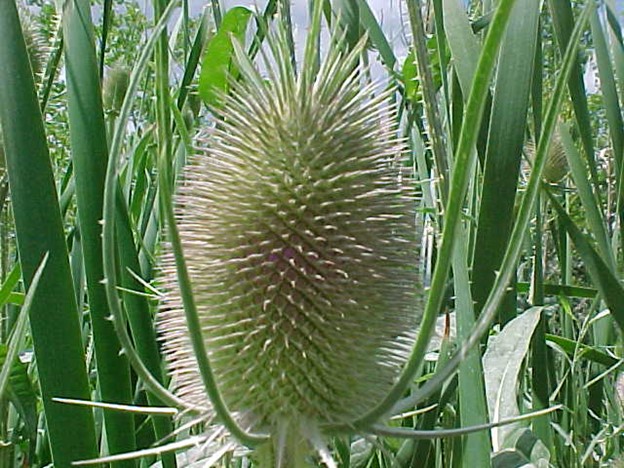


I took these pictures years ago because I just loved the way the plant bloomed. Pretty cool, right? Plus… purple! These blooms will eventually produce seeds contained in those in dried structures covered with barbed spikes that are just looking to hook onto something. As it turns out, the teasel heads with their hooked spikes can be useful and have an interesting history.
Years ago, I took a spinning class from Maggie Casey in Boulder, Colorado, and I learned how to card wool to prepare it for spinning.

Before you can spin wool you need to pull the fibers apart, fluff them up, and get them pretty much aligned in one direction. The wire teeth on my carders do that for me. Maggie told us (I’m pretty sure that Maggie is the one who told me this…) that the word carding came from the Latin word (carduus) for teasels, and that the original carding was done with teasels. I can believe it! The locks of washed (scoured) wool can easily be picked open and fluffed using teasel pods. Every time I see a teasel plant, I hear the word “carduus” in my mind and think of my poor, neglected spinning wheel.
So, being the BioGeek that I am, I looked up the scientific names of teasels: not a carduus in sight. The genus of that teasel is Dipsacus, and the plant that I saw along the road and took pictures of is specifically Dipsacus fullonum. Oh. The crushing disappointment. I hunted for Carduus and discovered that it is a genus of thistle plants.

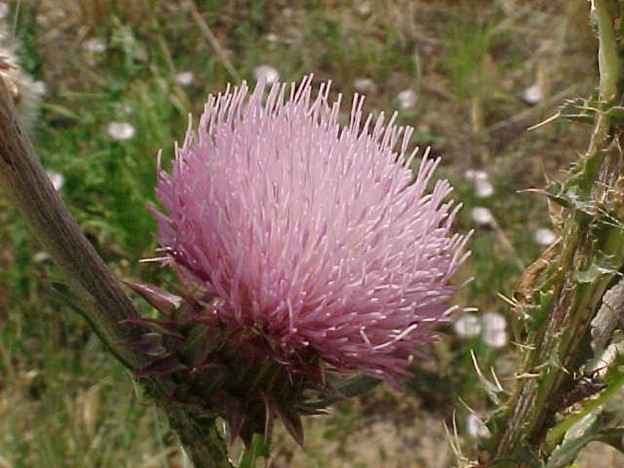
Okay, this is a bull thistle, but you can kind of see the potential for spikiness. Carduus thistles produce dried seed heads that are spikier, and the ancient Romans used the word carduus to refer to both teasels and thistles. Maggie was right! Centuries later, when scientific names were assigned to life on earth, carduus went to the thistle, and the teasel had to settle for dipsacus.
Still, teasels are pretty darn cool and have been involved in woolen fabric production to improve the warmth of the fabric. Teasels were brushed across the wool fabric to pull up fibers, making the fabric a little fluffy (or brushed) as part of the fulling process. Brushed fabric like this was warmer to wear, as the raised nap trapped air providing more insulation. Check out this teasel loaded cross that was used for this purpose. Imagine drum rollers loaded with teasel seed pods. Remember that my local wild teasel is called D. fullonum? I can’t help but wonder if the root word for “full” is included in the name. Yay, teasel!
While I’m on using teasels to pull up fibers, have you ever teased your hair to fluff it up? Did you wonder where that word came from? Yep. From teasels, of course.
Here in Colorado, these teasels and thistles are on the noxious weed list. Oh, dear. The plants originated in Europe, and that’s where they belong. Here in Colorado, they are invasive species that propagate like wild and choak out native species, interfering with agriculture, and there are management plans designed to control the spread of the plants. I was lucky to see one.
But I have to admit, it made me so happy to see a wild teasel along the side of the road that beautiful afternoon in September as my son drove me north to get me my yarn and to celebrate my birthday. Carduus, I heard in my mind.
My spinning wheel shivers in anticipation.

 Yarn, Books & Roses
Very interesting! I have never seen a teasel. I do know the thistle, tho. If they are related, it is easy to see how the teasel became useful in the processing of wool. What a nice memory of a lovely day out with your son.
It is a plant that is being eradicated where they can, so that makes sense. I never saw one until the 90s. I wonder if they are more common in places where there are sheep and wool mills.
Most informative, Marilyn – thanks ! 🙂
Fascinating. I’d have just dismissed the things as some kind of thistle and moved on.
I wouldn’t have given it another thought if it wasn’t for the spinning and weaving classes.
At the Johnstons of Elgin Cashmere makers (about 60 miles from where I live) they still use teasels in the finishing process. We did a tour about 10 years ago. The birds love teasels here, looks sore to land on the heads to me, but they manage fine.
How cool that they are still being used! I wonder if the birds here don’t handle teasels, and that is why they are so invasive. It seems to me that you have to be a tough customer with long beaks to pull it off because of those spines.
Do you get goldfinches there? That’s who we usually see on the ones that grow here.
I’ve never seen a goldfinch, so I looked it up. There are goldfinches on the east coast of the US, but none where I live.
Fascinating. Both teasels and thistles volunteer in our garden. We generally let them run their course, because we like their sculptural quality and there flowers – but we do eventually pull them up
I really like both of them too, and the thistles are much more common and a bigger problem here. I pull them right up because they’ll take over the garden (and yard) if given a chance.
What an interesting post today and I learned something new. They are beautiful plants, and I think Thistles are too.
They are beautiful plants, aren’t they. Also… purple!
They really are! Got to love purple ☺️
Wow – very interesting!