
This is a story of slavery, starships, books, rainbows, genealogy, and freedom. It all started while I was working in a research lab at Scripps Clinic and Research Foundation in La Jolla, California. This was my first job after graduating from UCSD with a bright shiny degree in molecular biology, and while it was an entry level position, it was a great job for me.
I should tell you about this lab. The head of the lab was a leader in his field, and the lab was filled with interesting people from around the world. I got to experience great new foods and cultural ideas; this lab was full of immigrants and foreign nationals doing fellowships. I learned Ukrainian curse words, inappropriate Brazilian gestures, ate Mexican and German food, and played pranks on a Canadian MD/PhD because… well, you had to know him. This man deserved to be pranked on a regular basis!

I was a California girl, raised just above the border with Mexico, and I had attended public schools with classmates of all backgrounds and ethnicities. I had also lived in Japan for two years. My friends from high school spoke Spanish. I was so focused on myself, a young wife and mother, battling for first a degree, and then a career in a world where women were openly discriminated against, that I wasn’t very racially aware. For me, it was like everyone was different, but it was everywhere, and it wasn’t a big deal, right? I was making my way by refusing to acknowledge the barriers and doing what I wanted despite them. It was 1977.
Then this show called Roots, adapted from the book of the same name, was on television. I knew about slavery, but I never really understood. It was devastating. I was devastated. It was hard to face a Black-American coworker in the lab after an episode that showed a main character, Kunta Kinte, getting mutilated to prevent him from attempting to escape slavery. We talked the next morning, fighting tears, about that episode. I’ve never forgotten that show, the talk with my co-worker, or the actor who portrayed Kunta Kinte, LeVar Burton.
Time goes by, and LeVar Burton became Geordi La Forge of the Starship Enterprise in the television series Star Trek: The Next Generation. I’m a big science fiction fan, and of course I’ve watched everything Star Trek. I absolutely loved the show, and the characters that I liked the best were Geordi and Worf. I was miffed that Geordi had to wear his stupid visor and was happy when we finally got to see his face again. The franchise has been robust, and I’ve seen a lot of Geordi over the years. Yay, Star Trek.

Like many other young parents of my generation, I let my kids watch Sesame Street and Reading Rainbow on television. There was LeVar Burton again, making books fun. That was great, since I was a big reader myself, and even though I read to my boys and took them to the library regularly, it was wonderful to get reinforcement from a television show too.
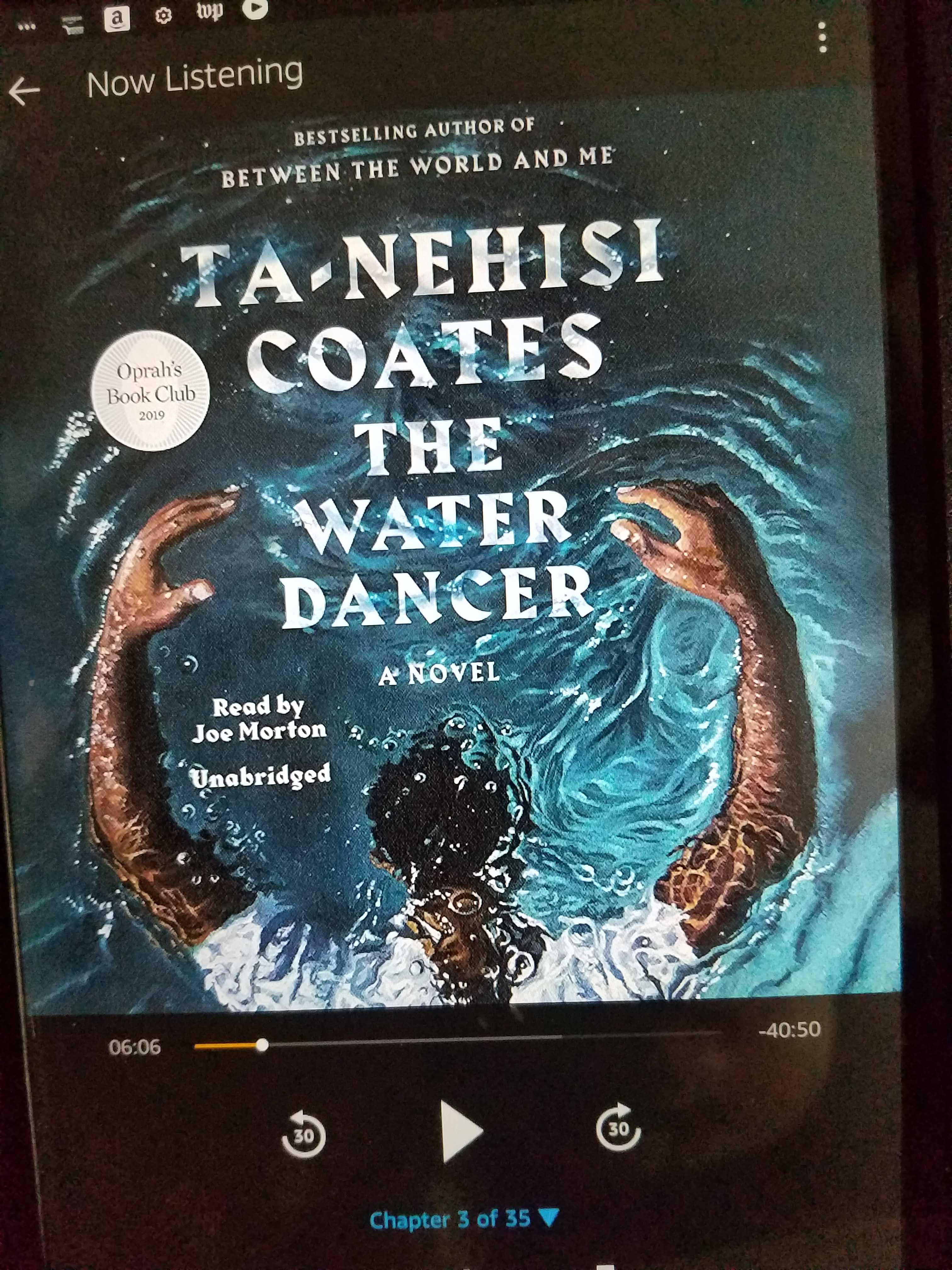
Time goes by, the boys grow up, and the husband and I go our separate ways. I keep reading books and watching Star Trek. I joined a book club, and mentioned a book that I would like to read called The Water Dancer by Ta-Nehisi Coates; another member of the group said that we should only read books by authors whose names we could pronounce. Oh, it was on! I bought that book and read it on my own. I thought about the book. I blogged about the book. As a small part of the plot, it described landowners of large plantations moving from Virginia to Tennessee as the land failed. I remembered that some of my family had started in North Carolina and then moved to Tennessee, so I googled to see if there was a plantation with the last name of those people. There was, and they were slave owners. I had been told that my dad grew up on a farm. I was thinking “Little House on the Prairie”, but maybe that was all wrong. Of course it was. How unbelievably naïve I was. I was told that the farm failed because of mismanagement; was it because the slave labor was gone? I had a huge Water Dancer moment, and it was crushing.
I got a subscription to MyHeritage through my local library a few weeks ago and began to chase down the ancestral links on my father’s side of the family. Generation after generation I chased them back through time from Tennessee, to North Carolina, to New Jersey, to New York, to New Amsterdam, to the Netherlands, and finally to France. Huguenots. The name is in the Huguenot registry. They left France for religious freedom. My ancestors who came to the New World landed in New Amsterdam in 1663; the last name of my immigrant ancestor was Cossart. That one family gave rise to the entire line in the United States, and over time different spellings of the name emerged. The spelling that is used in my family is Cozart.
I did an image search for the name Cozart. So many faces and names. Several are notable individuals, and many are black. All of these people are somehow connected to me either by our genes or the institution of slavery.
And there she was: Stephanie Cozart Burton. The wife of LeVar Burton.
Once again, I was in tears, facing my coworker the morning after seeing that episode of Roots, crushed that I hadn’t understood the existential evil in America’s past. My ancestors came to America for opportunity and freedom, and then engaged in an appalling abuse of other people.
This is a pivotal time in the US. We are in the election of my lifetime, deciding if America is for all Americans, with liberty and justice for all, or if something else happens. Some people want to control lots and lots of things, including access to healthcare, the right for all Americans to vote, what people are allowed to read, and what they can learn about in school. People whose ancestors came from other lands demonizing new immigrants seeking the same promise of America that led Jacques Cossart here in 1663. I suspect that The Water Dancer is a book that some people would like to ban. I wouldn’t have started to piece all of this together without that book. I wouldn’t have started to understand who I am, and where I came from on my father’s side, and the burden of my past. For all of us, our freedoms are fragile, and the loss of them is possible in the turn of an election, a court ruling, a change in policy, in a loss of funding…
Standing in the gap is a woman of Jamaican and South Asian descent. An American who believes in Freedom.
Vote, my good people, vote.
And read. Learn about the past, explore new ideas, expand your horizons, and think for yourself.
Make it so.
Notes and Additional Thoughts
- If you are reading this early in the day on September 17th, you might be able to catch the harvest supermoon with its partial eclipse. Here’s some info.
- Scripps Clinic and Research Foundation divided the research and clinical portions years ago. The entity that I worked at is now Scripps Research.
- That first job was doing the antinuclear antibody (ANA) tests in Dr. Eng Tan’s lab: he was a pioneer in the field. Now I have been diagnosed with two of the autoimmune conditions that I did ANA tests for as a new college graduate.
- I didn’t “catch” those conditions in the lab, as I already had symptoms as a teenager and while I lived in Japan.
- About Japan: I lived in the city of my mother’s birth, Yokohama. The US Navy sent us there; later on, they sent us right back to the place where we had gone to high school.
- Are you hearing the theme music to “The Twilight Zone” yet?
- This what that music sounds like!
- Why are you still reading?
- Go outside and look at that harvest supermoon!!!






 Yarn, Books & Roses