The Scleroderma Chronicles: This is World Scleroderma Day!

A couple of weeks ago I went in for a routine blood draw at my local Kaiser clinic. I gave the phlebotomist my ID card and told her my name and birthdate: for some reason they like to verify these things, right? Anyway, what happened this time was… she exclaimed that didn’t look my age. (Well, yeah. That may be one of the bigger red flags for scleroderma… no wrinkles.) “It’s just my disease doing that,” I assured her. “I really am that old.”

This lady wanted to know what I had done to get rid of the wrinkles. She wanted this magic wrinkle remover too! I carefully told her about scleroderma. “I never heard of that!” she said. Still thinking that I was a lucky person, she drew my blood and I got out of there. I would be happy to have every single wrinkle that I have earned over the years, but no… I have scleroderma. The systemic form with limited skin involvement. Lucky me.
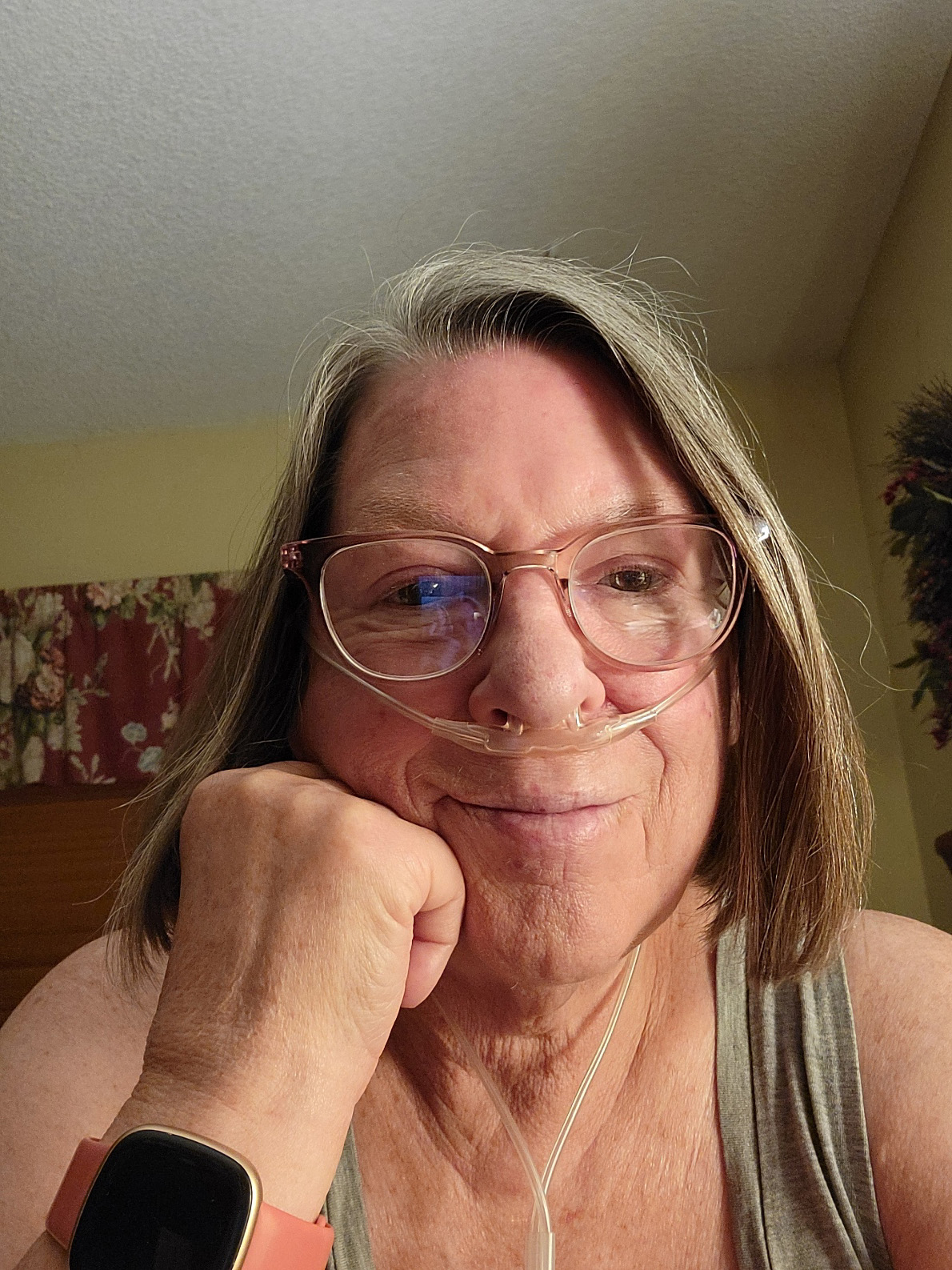
I do have wrinkles around my chin and mouth, but I was wearing a mask during the interaction with the lady at Kaiser. I had to go on oxygen this day (I have lung and heart involvement) and you can see the swollen tendons in my hand and the tight skin over my knuckles.

That’s why there is this thing called World Scleroderma Day. This is a complex autoimmune disease with illusive symptoms (brain fog… trouble swallowing…GERD…swollen fingers…trouble breathing sometimes…fingers that suddenly lose circulation and turn white or blue…) that make the disease difficult to diagnose without specialized testing and evaluation by a scleroderma specialist.

Systemic sclerosis (the form of scleroderma that I have) is thought to start with some event (still unclear) that triggers the formation of antibodies that target specific molecules the nucleus of cells. These antibodies lead to damage in blood vessels and their linings; the damaged blood vessels release chemical signals that trigger a cascade of events that impact other cells of the body. Some cells are related to inflammation. Other cells are tipped over into forming uncontrolled scar tissue (fibrosis). Here is the problem: the tissue engaged in fibrosis is all of the connective tissue. What is connective tissue, you ask? Think of all the ways a person is held together. Tissue that makes your skin stretchy. Tissue that holds your muscle fibers together. Tissue that makes up your tendons, ligaments, and the structure in your joints. Tissue that holds your intestines, heart, kidney, and lungs together. The cartilage in your ribs. All inflamed, under attack, and forming thicker and thicker layers of scar tissue. Some of this damage causes calcium deposition. Unobservable from the outside, the patient is slowly hardening inside. The most obvious symptoms is the skin thickening and then pulling tight over time.

Scleroderma, and especially systemic sclerosis, has the highest fatality rate of all rheumatic diseases. Did I mention that there is no cure? There are treatments for complications that develop like pulmonary arterial hypertension (PAH) and interstitial lung disease (ILD), but they, like the immunosuppressant drugs that many of us take, mostly stabilize and slow progression. (Dear Kaiser lady… that’s why I was getting a blood draw. The drugs that I take are risky, and my doctors need to make sure my kidneys and liver are tolerating the meds okay.)

So, what is the purpose of World Scleroderma Day? It’s to highlight this condition that impacts more people than it should even though it is rare. It’s to raise awareness of the symptoms and hopefully aid in other people getting an appropriate diagnosis. Maybe shining a spotlight on scleroderma will help in getting funding for research, treatments, and even a cure.

Sunflowers are the international symbol for scleroderma.

Here is where you can learn more about scleroderma, it’s symptoms, and treatment.

PS How was my blood work? Yay, doing okay!! Kidney function is up into normal ranges again!!! How old am I? I was born in 1951. 🙂

The Scleroderma Chronicles: Bioethical Dilemmas and Unintended Consequences

I was a biology teacher in the time of the Human Genome Project. This week, with the coming release of the newest movie about Oppenheimer and the development of the atomic bomb, I’ve been thinking about the DNA and genes again (I know, it is a biogeek thing…), because one of the candidates running for the Republican nomination in the US wants to cut the Department of Energy if elected.

Kind of a loose chain of threads, you’re probably thinking. Am I right? Well… the Department of Energy is the agency that is responsible for the regulation of the nuclear energy industry in the US. There’s a lot of waste coming out of those nuclear reactors, and there was some concern about how much mutational damage was being done to DNA through exposure to radiation. Well, to figure that out, you need to know what undamaged DNA looks like. The initial drive to figure out what the human genome looks like came from that agency and once the results came in early this century the world completely changed. Like a big change. Like an atomic bomb level change. Like, there are now sites that have huge depositories of biotechnical data and tools to aid in research.

Hannah’s World: no big changes here!

In the classroom we biology teachers began to teach about the Human Genome Project and also did a week-long unit around the ethical problems associated with this new knowledge (bioethics, if you will). The kids grappled with dilemmas like… if you had the gene for a fatal, untreatable illness, would you want to know? If you were a child at risk for this gene, would it be okay for your parents to have you tested for it before you are 18? If your unborn child tested positive for this condition, what would you do? Would it be okay for human organs to be grown for transplantation? Who should get the transplant… a single father of 4, or a 16-year-old student in your high school? Should your employer allow you to continue in your airline pilot job if a genetic test shows you are high risk for a sudden cardiac event. Should genetic test results be private? Whew. Lots to grapple with in this unit.

Makes your head hurt, doesn’t it. Check out my knitting progress this week!

So, shit kind of got real this week. One of the members of an online support group for pulmonary arterial hypertension (a progressive and fatal heart/lung condition that I have thanks to systemic sclerosis) has just been identified with a gene (bpmr2) that causes the condition; her PAH is caused by this gene and can be inherited; she has a different type from me, but it is still PAH. Oh, boy. This is not good at all. The life expectancy right now is up to about 7 years, but you only need one copy of the gene to be at risk for PAH… there is a 50% chance for each of her children that they inherited the gene. Only 20% of people with the gene will develop PAH, but that is still a big risk.

Should she tell her two children? she is asking in the forum. They are in their late 20s. If she does, and they get tested, should they have their own children if they have the gene? Her heart is broken, literally.

Life expectancy has greatly improved over the last few years with new medications being generated in the modern climate of expanding cellular and molecular biological information. Untreated PAH (and PH kind of gets lumped together with it according to my pulmonologist…) has a life expectancy of about 2.8 years… not good.

Rose break! By the end of the discussion thread, she was leaning towards telling the kids.

Which brings me to the next shitty bioethical item that occurred this week. One of the members of another support group caught Covid and had to go off her drugs while fighting the virus. She has been slow to recover, and still feels pretty bad, but she took a pregnancy test and restarted her medications again a few weeks ago, only to discover this week that she is actually 12 weeks pregnant. Why did she have to take a pregnancy test before restarting her drugs? Because some of the drugs used to treat PAH can cause extreme damage to a human fetus. The enrollment process is very strict, and every effort is made to keep patients from this situation.

I am in grief for this woman. The doctors think that the baby has been spared the worst of the drug toxicity, but now she is working her way through whether to abort or not, to restart her drugs, or not. To risk death to save the baby, or to abort and restart treatment. If the baby is born in good health, will she live long enough to see it enter kindergarten. If the baby is born with health problems, her medical burden is increased. She is young. This is a horrible mess, and she is already too far along to get an abortion in many states in the US. I don’t know if she has other children, or what her support structure is…

This week I heard that some states are demanding private health records to identify any out-of-state abortions or transgender care that has happened in another state. I hope that this woman lives in another country…

Then I heard that a popular hamburger joint near my home is now going to fire employees who wear a mask. Say, WHAT?! Let me tell you, any person who has a serious lung/heart condition like mine wants to wear a mask, and they are so grateful if the person at the service window is also wearing a mask. Sometimes people offer to put on a mask when they see that I am wearing one. Now that person can be fired for putting on a mask… remember the young PAH patient whose nightmare began with catching Covid? Truthfully, any random virus can cause serious damage to patients with PAH, especially if they are also immunosuppressed.

So, there are a lot of bioethical dilemmas here, and the unintended consequences of people who want to make sweeping decisions without understanding all the interlocking systems involved and the potential ramifications are staggering. NO, you can’t just disband the Department of Energy, and sweeping, inflexible decisions about reproductive issues (that seem to be smugly self-righteous to me) can be disastrous. It is easy to order up genetic tests, but what happens once you have the information can be life-altering.

And don’t get me started on this animosity towards mask wearing…

I can’t help but think that no one should attempt to enact legislation without suffering through experiencing something like the bioethics unit that was taught at the high school where I used to work. I keep wondering, do these legislators actually understand nuclear power and weapons? Have they heard of the Human Genome Project? About gene testing? About rare diseases? They absolutely need to go see the Oppenheimer movie, maybe, and then write me a report about the Human Genome Project. I’m pretty sure that they would struggle with epigenetics, but it would do them good if they looked into it. They can get extra credit for a summary of pulmonary arterial hypertension. I would like to give them a book list of summer reading to get through on their breaks, because only the well-informed and educated should attempt to make decisions about these issues in the seven levels of bioethical hell that is the life of patients like me.

Because this week was a really hard one; for too many people this shit is real.

PS: Have you seen the show House? I kind of think that he could use a little bioethics sensitivity training, too.

You all be safe out there!!