
Okay, you know this little guy well. I think that I first called him a roly poly when I was a child because… if you mess with them or pick them up they roll up into a little ball. Those little rolled up bugs look a little like pills, hence the alternative name: pill bugs. I suspect that we were kind of mean to roly polies when we were kids. Poor guys.

I have quite a few of these critters hanging out in my garden. They appear in the loose dirt as I pull out weeds, move stones, and dig around in my gardens. They build extensive tunnels under my bricks in the side garden and are feasting away on the leaf and mulch debris and landscape timber around my gardens. They are, essentially, decomposers and really excel at that niche in the garden ecosystem. Can they also eat leaves, roots, and other things that I want to grow in the garden? Well… yeah. They can be a problem, but I think that since I mulch pretty aggressively due to our dry climate that hasn’t been an issue for me.
Did you think that they were insects? I mean, we call them pill BUGS. Nope. They are actually a type of crustacean. As in, they are land dwelling cousins of lobsters and crayfish. They rely on gills to obtain oxygen, and they have other characteristics common to crustaceans like the hard exoskeleton, jointed appendages and two sets of antennae on their heads. (One set is not visible to the curious gardener. Bummer. I have looked.)
These isopods (that’s the name of the crustacean group that they belong to) are also called potato bugs. That is kind of my favorite because you can catch them by cutting a potato in half, scooping out most of the inside, and then putting the potato back into the garden where it will attract pill bugs for you. Easy peasy, right? Here’s a little video that shows how to catch them with a potato.
That explains why I used to take some potatoes to school with me, make a couple of potato traps in my AP Biology class, and then assigned the class the homework of catching 10 potato bugs each over the next week.
Say what?
I used the pill bugs in class to do a lab with them that helped them identify animal behaviors and to also learn some things about experimental design with live animals. Poor little guys. They became the star performers in an open-ended inquiry lab where students had to generate an hypothesis, create the test chamber, collect data, and then draw conclusions from their results.
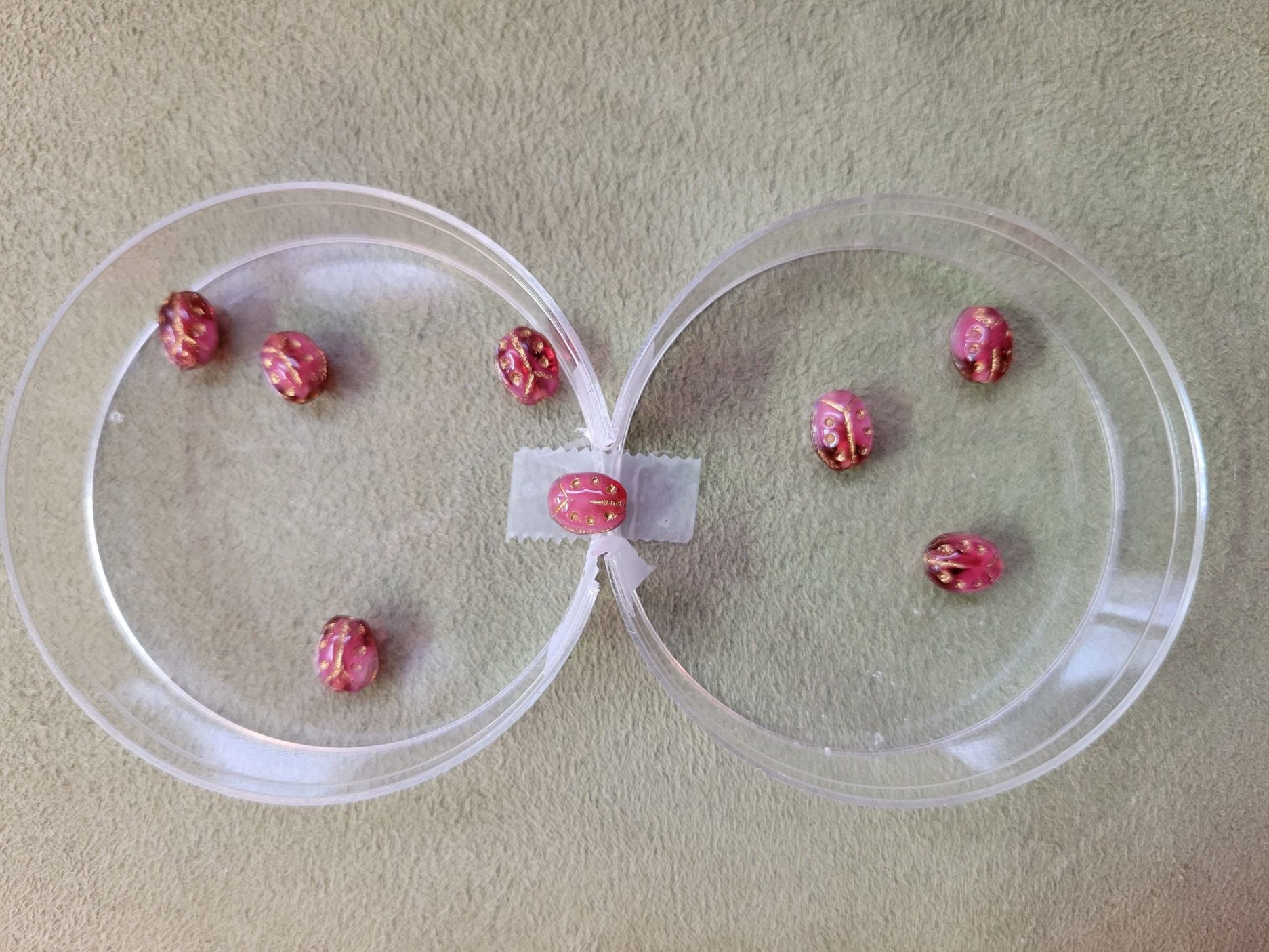
I know, I know… those aren’t pill bugs! I dug around in my bead collection and found these to stand in for the real things. (Um… it is winter and snowing outside…) Still, you can get the idea of how this worked. The students would set up the chambers to offer the pill bugs a choice between the two sides; the pill bugs would run around like crazy and the students would collect data that would (hopefully) reveal a clear preference in their environment. Try to imagine student teams trying to set up the chambers and then getting in 10 pill bugs, putting the lids onto the dishes without harming one of their experimental animals, and all the chaos that ensued. Shrieking. Escaped pill bugs. Ice cubes melting on lab notebooks…
The trick was to offer the isopods a clear choice: wet/dry, warm/cold, sweet/salty, or maybe covered/open conditions.
The second trick was to make sure that the isopods were being offered only one choice.
The final (and most important trick) was to figure out how to collect data and then process it. Teams struggled to come up with a data table. Once you have the data, how do you make meaning from it? Most teams decided to count the number of critters in each dish every 30 seconds and then graphed the results to show the preferences.
At the end of the lab cycle the pill bugs were all released in the landscaping right outside my classroom where they went back to their best little pill bug lives in the bark mulch and plantings along the front of the building. My principal never caught on to what my class was up to, but he did once ask me why kids from my class were frantically digging through the mulch out front. “Oh. Those kids forgot to do their homework on time,” I said as I beat a path out his office door. Poor man. He had been an English teacher before he became a principal.
So, what do pill bugs like? They like to be under cover. They also prefer damp to dry, cool is much better than warm (they will all stand on an ice cube to try to get away from the warmer dish), they avoid salt, and they prefer rotting potato to fresh potato.
I loved this lab. I always used it towards the start of the year as it was extremely helpful in establishing good practices in hypotheses, experimental designs, data presentation, dependent and independent variables, and, of course, lots of details about pill bugs and animal behavior. It was helpful in establishing norms and lab expectations in my classroom in a lower risk environment (unless you were one of the pill bugs) as other labs involved more chemicals, sharp instruments, and stressful time constraints.
All that comes back to me every time I weed the garden and the roly polies emerge, potential experimental animals, each one of them.
Pill bugs and the advancement of scientific knowledge.
I bet that you will never look at pill bugs the same again.




 Yarn, Books & Roses