The BioGeek Memoirs: Teasel

Last September my son drove me to a yarn store in Loveland, Colorado to buy the yarn for my Weekender Crew sweater. He took a route that cut through the countryside and small towns, and there along the road were some dried teasels. “I should get you to pull over,” I said in jest. I should have! I have been thinking of teasels ever since then.
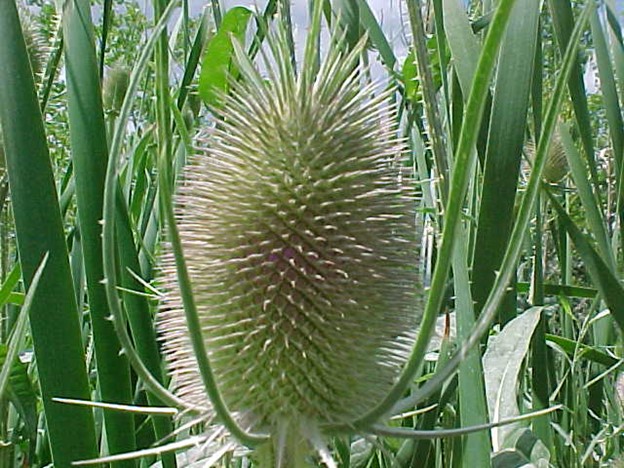
I took these pictures years ago because I just loved the way the plant bloomed. Pretty cool, right? Plus… purple! These blooms will eventually produce seeds contained in those in dried structures covered with barbed spikes that are just looking to hook onto something. As it turns out, the teasel heads with their hooked spikes can be useful and have an interesting history.

Years ago, I took a spinning class from Maggie Casey in Boulder, Colorado, and I learned how to card wool to prepare it for spinning.

Behold: my wool carders and a couple of rolags made of carded wool.

Before you can spin wool you need to pull the fibers apart, fluff them up, and get them pretty much aligned in one direction. The wire teeth on my carders do that for me. Maggie told us (I’m pretty sure that Maggie is the one who told me this…) that the word carding came from the Latin word (carduus) for teasels, and that the original carding was done with teasels. I can believe it! The locks of washed (scoured) wool can easily be picked open and fluffed using teasel pods. Every time I see a teasel plant, I hear the word “carduus” in my mind and think of my poor, neglected spinning wheel.

So, being the BioGeek that I am, I looked up the scientific names of teasels: not a carduus in sight. The genus of that teasel is Dipsacus, and the plant that I saw along the road and took pictures of is specifically Dipsacus fullonum. Oh. The crushing disappointment. I hunted for Carduus and discovered that it is a genus of thistle plants.

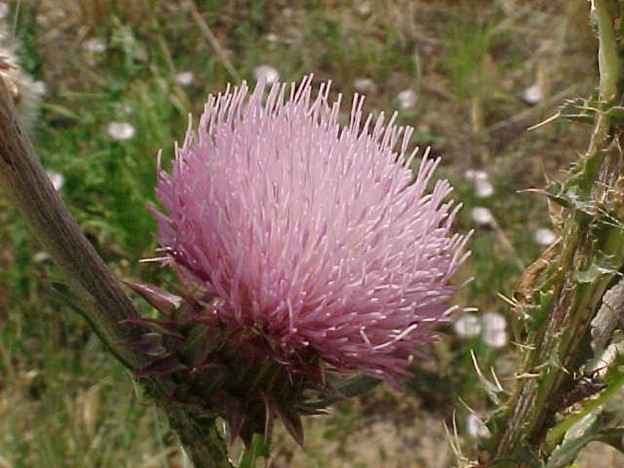
Okay, this is a bull thistle, but you can kind of see the potential for spikiness. Carduus thistles produce dried seed heads that are spikier, and the ancient Romans used the word carduus to refer to both teasels and thistles. Maggie was right! Centuries later, when scientific names were assigned to life on earth, carduus went to the thistle, and the teasel had to settle for dipsacus.

Still, teasels are pretty darn cool and have been involved in woolen fabric production to improve the warmth of the fabric. Teasels were brushed across the wool fabric to pull up fibers, making the fabric a little fluffy (or brushed) as part of the fulling process. Brushed fabric like this was warmer to wear, as the raised nap trapped air providing more insulation. Check out this teasel loaded cross that was used for this purpose. Imagine drum rollers loaded with teasel seed pods. Remember that my local wild teasel is called D. fullonum? I can’t help but wonder if the root word for “full” is included in the name. Yay, teasel!

While I’m on using teasels to pull up fibers, have you ever teased your hair to fluff it up? Did you wonder where that word came from? Yep. From teasels, of course.

Here in Colorado, these teasels and thistles are on the noxious weed list. Oh, dear. The plants originated in Europe, and that’s where they belong. Here in Colorado, they are invasive species that propagate like wild and choak out native species, interfering with agriculture, and there are management plans designed to control the spread of the plants. I was lucky to see one.

But I have to admit, it made me so happy to see a wild teasel along the side of the road that beautiful afternoon in September as my son drove me north to get me my yarn and to celebrate my birthday. Carduus, I heard in my mind.

My spinning wheel shivers in anticipation.

The BioGeek Memoirs: Yarrow

Hi. I bet you were looking for another animal, weren’t you? Plants need some love too, you know.

Yarrow from my garden.

Yarrow is a plant that does really well in the climate where I live; actually, it is a plant that is native to Colorado and can be found in many other biomes. It has kind of lacy leaves and produces large flat blooming clusters filled with tiny white (or colored) flowers. The plants that I have in my garden have been produced for the popular market and are nice and showy. The flowers are large, last most of the summer, and draw a lot of pollinators like bees, moths and butterflies. They mostly play nice with the other plants (okay, they have a habit over overgrowing the smaller perennials, so I have to ruthlessly weed out the plants that are out of bounds), and I like the lacy green plant as much as the flowers.

The first yarrow I ever noticed was a bunch that was planted along the curb in a busy intersection. This plant received no care, didn’t seem to get additional water beyond precipitation and splashes from the street, and looks fantastic. It was covered in huge yellow blooms that kept their color for most of the summer. Every single summer the plant put out more blooms and got bigger over the years: a perennial for sure. Hmm… what a great plant, I thought. Of course, I put some yellow yarrow in the garden.

Then I bought a spinning wheel. Then I found someone who had a flock of sheep and beautiful fleeces for sale. In just a few months I had spun my way through that first white fleece (a sheep named Bob) and had all of that yarn to dye. I took a natural dye workshop from Maggie Casey at Shuttles, Spindles & Skeins in Boulder, Colorado. What a fun (but smelly) day that was!

We made several dyes and learned how to get them to “bite” onto the yarn with mordants (think of mordants as linking chemicals that attach the dye molecule to the protein of the wool) like alum and iron. I loved the indigo dye vat that I made that day and got lots of blue yarns from it. There was a nice golden yellow from onion skins, a raspberry from brazilwood, and a sage green dye extracted from yarrow using iron nails for the mordant.

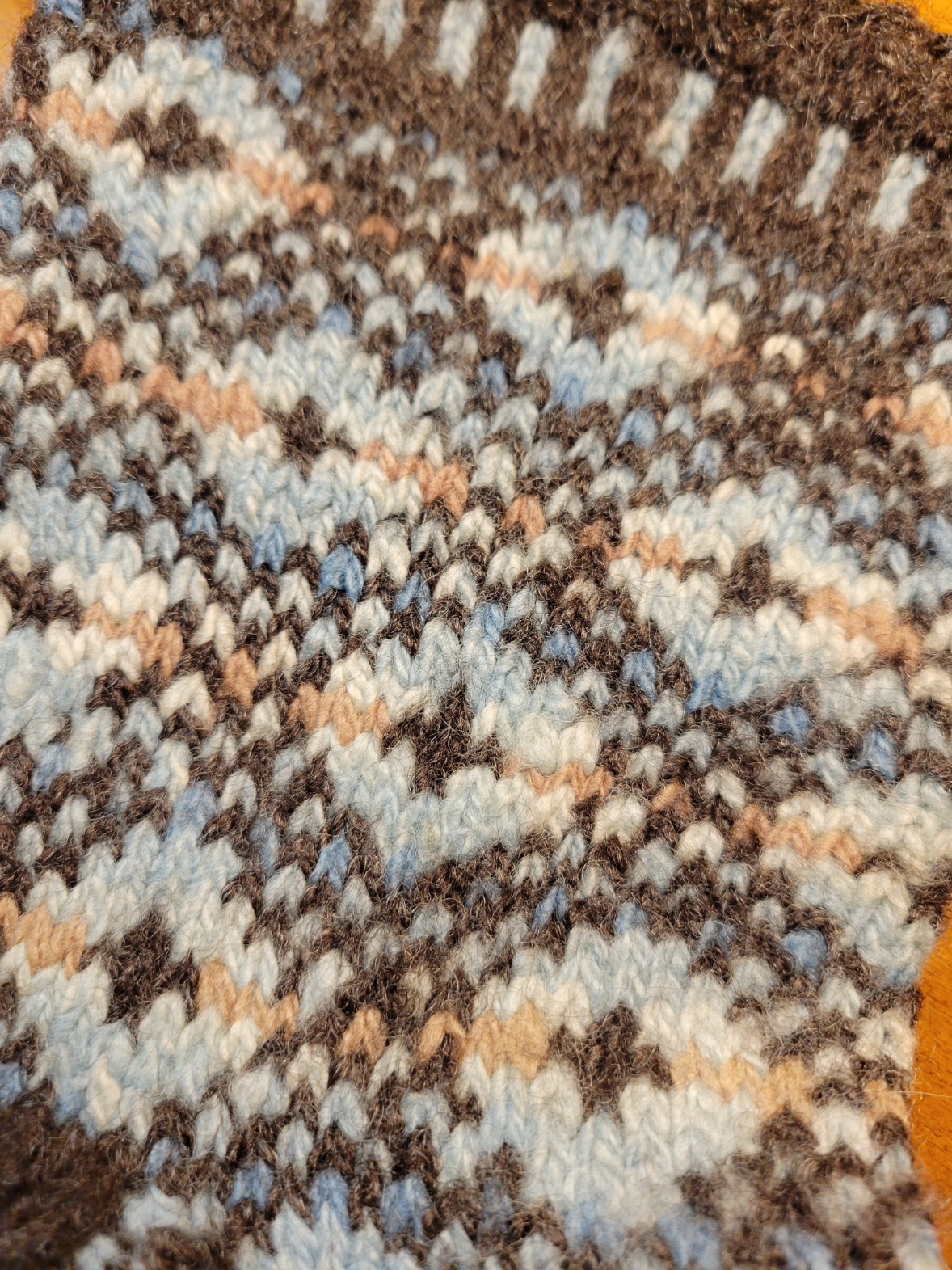
Close-up of the sock I knitted from the indigo and brazilwood dyed yarn. This sock, now more than 20 years old, was made using three shades of indigo, the raspberry (now kind of clay colored) contrast stripe is the brazilwood, and the dark grey is the natural color of another sheep named Silverheels, because of course he was. Everything is now faded, but you get the idea.

That sock, a genuine homespun, naturally dyed, hand knit item, has been my go-to boot sock for a couple of decades and was for a time my “interview” sock when asked to show a sample of my work to clients that I knitted for. Faded, but still going, it has been living in my car as part of the winter travel kit.

Back to the dyeing! Oh, boy. That yarrow was a smelly mess as we boiled the stems, leaves and flowers on the stove out on the porch. Seriously, this stuff could be medicine. Oh, wait. It can be medicine! Yarrow was known by early healers as a plant that could be used to stop bleeding and has lots of different names, some of which refer to this ability to staunch blood like nosebleed plant or woundwort. Luckily none of us were bleeding that day; we strained the vegetable matter (and nails) out of the boiled yarrow mess pot, added back in our skeins of yarn, and simmered gently until we had a nice sage green color.

That yarn became socks that I gave away to a coworker. The love for yarrow remained and I added white yarrow to my garden years later, and a couple of summers after that a wonderful purplish-pink yarrow joined the party.

This plant hangs out with my lavender.

The pink is my favorite. The plant is spreading out and taking over the whole garden that I planted it in (hang in there, lavender, you can stand up for yourself!). It blooms like crazy all summer and I keep thinking that I should cut the flowers to preserve them. I never have used the plants for dye, but I still have a lot of white yarn that would love to get some color going.

Lavender holding its own with the yarrow.

Beautiful yarrow, evoking forever the memory of that great Saturday dyeing yarn from a sheep named Bob in Maggie’s driveway. What could be better?