The Scleroderma Chronicles: Chasing down the Cytokines

There was more response than I expected from my last post about my efforts to obtain a better understanding about my chronic conditions, the new drugs I was taking, and how to lower my inflammation. I offered in that post to share the links that I used to figure out what foods impact the levels of cytokines that are important in my systemic sclerosis. I’ve gotten feedback/requests for the spreadsheet with my links that I used in my adventures at PubMed.

I’ve been thinking about this for a couple of days, and I think that the most useful thing to do would be to share my process as I hunted down information about cytokines involved in my systemic sclerosis (SSc), and the cytokines that I needed to pay attention to in my diet.

I started out asking: What are the cytokines involved in systemic sclerosis? I did searches using terms like cytokines and systemic sclerosis. Here are some of the links to papers that I found.

I kept a list of the cytokines that were being measured in these studies and I finally began to get a sense of the four big players that were being measured and considered as targets for therapy: Tumor Necrosis Factor alpha (TNFα), Interferon gamma (IFN-γ), Interleukin-6 (IL-6), and Interleukin-1beta (IL-1β). You can follow the same process to research any inflammatory disease that you are interested in; you may get different results. (For example, C-Reactive Protein, called CRP for short, features in many inflammatory conditions. For little SSc me, not so much… my levels are normal.) Anyway, once I had the cytokines of interest, I did searches on all 4 of them. Here’s my info on TNF-α.

InformationSource
TNF-α is also a potent inflammatory mediator and apoptosis inducerThe role of Tumor Necrosis Factor-alpha (TNF-α) in the pathogenesis of systemic lupus erythematosus
Produced by activated immune cells (macrophages, NK cells, T-cells) known to trigger a series of various inflammatory molecules, including other cytokines and chemokines The Role of Tumor Necrosis Factor Alpha (TNF-α) in Autoimmune Disease and Current TNF-α Inhibitors in Therapeutics
TNF-α causes other immune response cells to produce IL-1 and IL-6Tumor necrosis factor – Wikipedia
My question: What does TNF-α do?

I did the same for the other three cytokines and it turns out that for me, it is best to reduce all of them in my blood. At this point I made a little chart with the 4 cytokines at the top and began to do searches on different foods that I thought were anti-inflammatory.

FoodTNFαIFN-γIL-6IL-1β
Chile (Capsaicin)
Tart Cherry
Tomatoes (Lycopene)
Question: Which foods/supplements will decrease these cytokines levels

Now the searching gets easy. I just typed in the questions in the search bar like, “Does capsaicin reduce TNFα” or maybe “Does capsaicin reduce cytokines” and the answer would quickly pop up with some resources. Warning: the search engine will give you the pertinent text and then you are on your own as you search through these papers! If you just go with the fast answers, you will take some risks… I told my sister that tomatoes were bad because I didn’t read the whole text, and I’m not sure if she has forgiven me yet…

Anyway, here are some papers about the foods/supplements above:

If I found a source that said one of the cytokines was reduced by one of my targeted foods, I just put an “X” in that box and moved on. I was no longer recording all of the links in my excitement, and as I found info it sometimes confirmed previous finds, but not always. If I got contradictory information, I was forced to read whole papers. Ugh. Also, you might want to try a different search engine; I used Chrome on my phone and Explorer on the computer, which is another reason for incomplete links on the computer. For the three foods in the table above it ended looking like this.

FoodTNFαIFN-γIL-6IL-1β
Chile (Capsaicin)xx
Tart Cherryxx
Tomatoes (Lycopene)xxx
Question: Which foods/supplements will decrease these cytokines levels

I hope this unpacks the process that I used and helps with any searches that you decide to do that are specific to your own needs/interests.
Happy Caturday!!

The Scleroderma Chronicles: Song of the Cell, Dance of the Cytokines

I’m reading a really wonderful book right now that is really speaking to me on so many levels.

This man is a BioGeek of the first order! He interweaves his experiences, patients, memories, and the history of cells together in a way that makes me green with envy. He unpacks the history of our understanding of cells by bringing those scientists to life in a way that makes me care about them; if only I could write that well. He is the teacher that I wish I had been as he reveals to us how cells work together to create complex human systems, and then ties all of that to the treatment of disease. I’m still in the first parts of the book, but I have already filled my kindle with highlights and notes.

This book was published at the exact right moment when I needed it. I have totally gone down the rabbit hole at PubMed over the last two weeks as I have read paper after paper while chasing down the major players in my chronic conditions (why am I sick, and what exactly are these new meds doing…) and how they link to inflammation. Why would anyone do something like this?

Well, it all comes down to this. I’m on high-risk drugs with some serious side effectss, and I want to make informed decisions about whether I continue taking them. I also had a run-in with elderberry juice, and was rescued by green chile; as a BioGeek I was sucked down the curiosity rabbit hole after that whole adventure. What? That doesn’t happen to you? Listen, it has been so bad I haven’t even been knitting!!!

These are the two drugs that I’m trying to understand. In his book Siddhartha Mukherjee argues that our understanding of cells, and how they work, has transformed medicine into the modern miracle that I am currently benefiting from. Drugs that directly interact with the molecular machinery of cells, the signals between them and the biochemical pathways that cells use to function, are the first of the major transformative directions modern medicine is taking in the treatment of so many pathologies such as cancer, diabetes, neurological, and autoimmune diseases such as mine.

Systemic sclerosis is really darn complicated, as it turns out, and the sequence of events that have been happening in my body are so convoluted it’s hard to track them all. It started in the cells lining my blood vessels. As those cells got injured, they sent out signals that activated parts of my immune system. Signals from the immune cells caused other cells to transform and they began to produce scar tissue… scleroderma means “hard skin”, the hallmark of my condition. Whew. Here’s a condensed version of all that if you want to torture yourself and/or fall asleep.

Let’s go back to my meds. Ambrisentan blocks a molecule that is involved in making blood vessels constrict and raises blood pressure when it is active. That molecule, endothelin, is getting turned off by the drug, and there is evidence that this will improve my exercise-induced pulmonary hypertension and will also keep it from progressing; it plays nice with my other pulmonary hypertension drug which shuts down an enzyme pathway involved in blood pressure. Ofev is my new (fairy dust) drug, and it disables some of the essential enzymes in the cells of my lungs that are involved in creating scar tissue. Interstitial lung disease is currently the leading cause of death for systemic sclerosis patients; mine is being treated by side railing the process in the cells that are essential players in the pathology.

Yay! Molecular trickery at the cellular level saves the day! I will be staying on these meds as long as I can.

Dancing to the tune of the song of immune system cells are cytokines, the messenger molecules that travel between immune system cells and other cells that they interact with. The dance is complex, with all the different messengers traveling through the blood to target cells in the body, latching on and causing the cells to take actions. Some cytokines increase inflammation, and other will shut it down. Your immune system can get dialed up or shut down, depending on what the messages are. In my travels through research papers at PubMed I focused first on what cytokines were involved in systemic sclerosis, and then I hunted for papers that had measured the levels of these cytokines when people ate different foods.

Foods that you consume can make a big difference, evidently. Elderberry made me much worse (I cried in two different doctor’s offices), and green chile saved the day. I was done doing google searches for “anti-inflammatory foods” and was going after hard data.

.What did you expect? I’m a BioGeek. OF COURSE I made a spreadsheet with the data!

Tumor Necrosis Factor alpha (TNFα) is a big driver in the whole systemic sclerosis story along with Interferon gamma (IFN-γ). They cause an increase in two more cytokines that promote inflammation, Interleukin-6 (IL-6) and Interleukin-1 beta (IL-1β). All four of these bad boys will make my inflammation worse and (probably… I’m guessing here) encourage my conditions to progress. A lot of these foods/supplements will lower the levels of these cytokines, which explains why I feel better when I eat them. ELDERBERRY increases three of these cytokines which is why I felt like death warmed over while drinking it. Google said it was anti-inflammatory… can you see why I switched to research papers and cytokines? Green chile stew has tomatoes and green chile in it (and some yummy pork and garlic!); no wonder it turned things around. I will try to eat as many of the “good” foods as I can, but I’m going to focus on ones that really shut down TNFα and IL-6. I’m ignoring the IL-10 and CRP info because it wasn’t really as well supported as the others, and I know that my CRP (C-Reactive Protein) levels are normal.

My lunch smoothie: tart cherries, raspberries, banana, spinach, yogurt, chia seed (gag) and cranberry juice. For dinner I’m having a green chile cheesy corn pudding thing that tastes pretty darn good.

Wow. Did you read all of that stuff above? You deserve a prize for perseverance.

Here’s your prize. It’s like a “Where’s Waldo” picture, but this one is Where’s Hannah!

So, there is all is. Inside my systemic sclerosis, pulmonary hypertension, interstitial lung disease self, there are all these dancing cytokines, following the song of cells. Scientists who were captured by all of this and who were entranced by the Song of the Cell have developed the drugs that are treating the two life-threatening complications of systemic sclerosis that have come my way. Inside me, the promise of the song goes on.

Time to get back to my book.

Notes:

  • Okay, I made a whole other spreadsheet with links to all of the research papers that I used to get some understanding about these cytokines, and which were important in my disease. You don’t want to see all of that, right? If you do, say so in a comment and I’ll send some links your way!
  • I became curious about what is happening with Covid patients and the cytokine storm that can cause severe symptoms. Yep. It’s happening because of TNFα, IFN-γ, and IL-6. If you catch Covid, I don’t recommend elderberry.
  • Clinical trials are currently underway to see if an IL-6 inhibitor will be an effective treatment for systemic sclerosis.
  • I’m a lucky, lucky girl. I have a degree in molecular biology, used to work in an immunology lab that focused on IL-1, was involved in a scleroderma research project, and finished up my lab days on a project looking at the impact of capsaicin on rheumatoid arthritis. I can almost understand what I’m reading on PubMed. Almost.

The BioGeek Memoirs: Ladybug and Aphid

It has suddenly gotten cold here, and I had to bring in plants from outside when we had a hard frost Sunday night. This morning there was a ladybug on the kitchen wall near the ceiling. It was early, I hadn’t had my morning latte yet, and my knees weren’t all that interested in climbing up on the counter to catch the ladybug.

That big jade plant used to be on my front porch.

I’m pretty sure that the ladybug caught a ride into the house on one of the two jade plants that I brought in for the winter. Poor thing. I looked for it later when I was fully caffeinated, and my knees were warmed up, but it was gone. Poor thing. I’ll keep looking for it, but chances are the cats are on the job and its days are numbered.

This is a ladybug. You may know them as ladybird beetles or ladybirds.

They are all over the yard at the moment. I found several while getting the leaves raked up last week and I’m hoping that I didn’t put any of them in the trash bags with the leaves. They are cute, right? I bet you used to catch them and did the “Ladybug, ladybug, fly away home…” thing with them too. I just loved ladybugs as a kid and loved to watch them lift their bright spotted elytra (wing covers) as they took to flight from off my pudgy little kid finger.

You’d never know that they were relentless predators, right?

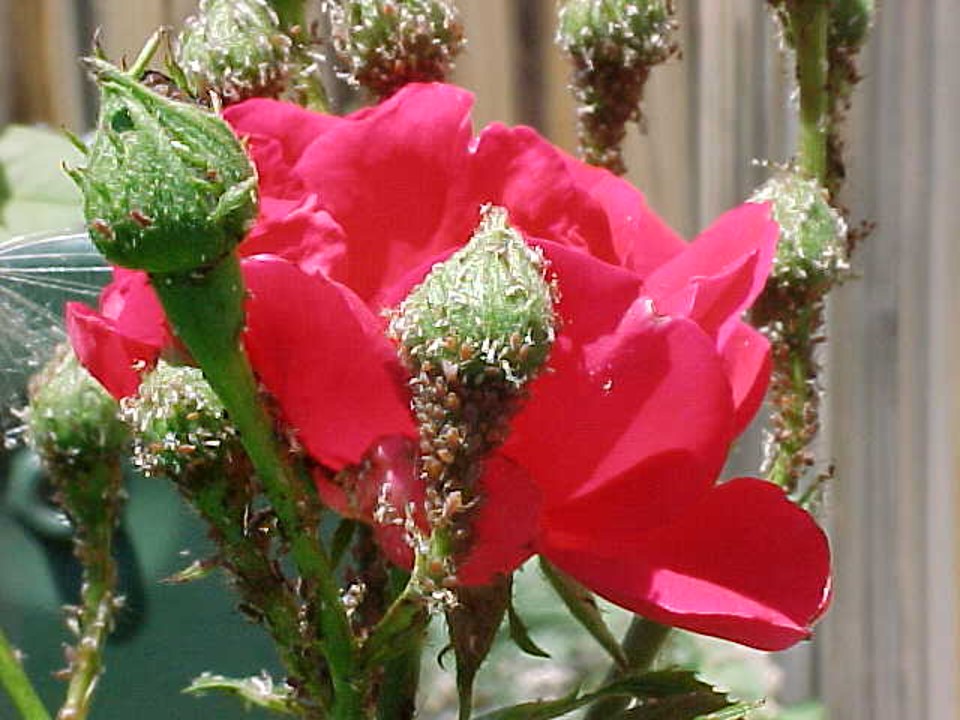
See all of those aphids on my rose? I needed some ladybugs to come take care of this for me!!!

That’s right, ladybugs prey on aphids. Yay, ladybugs! You may not recognize them on the bushes while they are on the hunt because a lot of the munching happens in the nymph form, and they look kind of like alien spiders of some type. You remember learning about the butterfly life cycle, right? Ladybugs are somewhat the same with the nymphs being the hungry caterpillar equivalent.

I used to use ladybugs and aphids in my teaching because they are good examples of sexual and asexual reproduction. Ladybugs mate between males and females to combine DNA from both parents in the offspring, and aphids do that too, but the reason they can take over the garden so quickly is because they mostly are reproducing without any mating and can produce ridiculous numbers of offspring within weeks as the new females (yep, they are all females) lay even more eggs and you can get a rose like mine above before you even know you have a problem. This is why I wanted to return that kitchen ladybug back to the garden outside.

(Are you wondering if I showed pictures of ladybugs mating to my biology students? Of course, I did! If you had to teach meiosis to 16 year-old teenagers who were becoming bored out of their minds, you would have too!!)

Every once in a while, the ladybugs get out of control and swarm here in Colorado. I mean, there can be a lot of ladybugs all at once!! Check out this picture! It tends to happen when we have really wet springs, so the ladybugs seem to manage okay as they clear the local ecosystem of aphids and then move on to other pests, and my roses certainly do great those years. We haven’t had a swarm in about a decade now because of drought, but the ladybugs in my yard certainly have been handling all of the aphids.

I guess I should go look for that ladybug again…

The Sweater Hack

I’ve been knitting away on my Lace & Fade Boxy sweater in the evenings and debating my choices and decisions. I had 4 skeins of a special edition yarn that was a collaboration between Madelinetosh and Shibui in the colorway Ironwood. I really liked this yarn because it was a great neutral that would go with everything… kind of a smoky brownish/black with tiny hints of violet. I fell in love with the Lace & Fade Boxy pattern by Joji Locatelli and debated different strategies to knit it. Should I use another color for the lace insets? Should I buy the matching Shibui lace yarn for the lace insets? Um… I’m in a destash and I want to get rid of yarn! Besides, how rugged will this sweater be with that thin lace yarn? Knit the whole sweater in the neutral yarn and use some snazzy color in a I-cord bind off on the edges? So many possibilities…

In the end I knitted the whole sweater in the one yarn and color.

Here it is, late at night in my bathroom, just off the needles. The sleeves still need to be done, and there is also the neckline finishing to do.

I was pretty sure that the sweater would grow significantly after blocking, but it is also pretty darn saggy up there around the neck. I decided to block this puppy and finish up the neckline before making any more decisions.

Okay, here it is a few nights later.

The neckline is now finished, and the sweater is blocked; it is absolutely too short. I need to do something to add length.

I knit Swoon a few years ago from this book. I love the lace. This lace is knit on size 5 (3.75 mm) needles and the yarn is laceweight.

That lace was knitted and then sewn to the bottom of the knitted piece. The picot hemmed edge was a pain to knit, and I kind of felt that the edging would be too much to carry off at the bottom of this boxy sweater. I wanted functional and hard-wearing, not cute frippery, for this sweater. Obviously, this lace wasn’t quite right, but it would add the length that I wanted. I did like the garter in the lace and felt that it could be a nice flat panel for the bottom of the sweater. Knit from the bottom up, this original lace has peaks along the bottom. I decided that if I knitted it from the top down, which would reverse the decreases, it would create a straight bottom and the puffiness would block out. I worked out the stitch count that I would need, picked up stitches, and the sweater hack was on!

Look! A flat bottom edge.

This lace isn’t as open as the one knitted on the larger needles with laceweight yarn, but it works in this application. I fussed around with different bind offs until I found one that created the smooth edge and fit the lace: 2 stitch I-cord bind off. There was puffiness at the top of the lace, but after the steam blocking it settled right down and is playing nice.

Finished sweater!

I debated about how to handle the sleeves and finally decided to just duplicate the bottom of the sweater. I picked up the sleeve stitches, knit 7 rounds and then 8 rounds of the ribbing, did a slight decrease to get my stitch count, and I loosely bound off. (I know… I didn’t want the ribbing to stretch, and I had that puffiness of the lace to control, so I did it.) I picked up the stitches for the lace panel and knit it exactly like I did the bottom of the sweater. Look… I have 3/4 sleeves that work with my sweater.

So, there it is. My hacked sweater, made by modifying the Lace & Fade Boxy design and incorporating a lace idea from Swoon. I made the decisions late at night, gazing at what I had so far in the bathroom mirror, based on what I had on hand and what I envisioned for the final sweater. I wanted a sweater that would be warm, comfy, easy to layer, and hard wearing with some lace.

Nailed it!

I have just enough yarn left over to make wristers for cold days.

The Scleroderma Chronicles: This Drug isn’t Fairy Dust…

Oh, boy. I have been having adventures in my ongoing dice game with the Reaper. My (wonderful) pulmonologist started me on a high-risk drug towards the end of August to slow down the formation of scar tissue in my lungs due to my interstitial lung disease. Oh, boy. The side effects were not exactly great as I battled ongoing GI side effects and started to lose weight again.

My doctors get kind of worked up when I lose weight.

What?!!

I know, like this is a bad thing? Here’s their thought process: there is a correlation between weight loss and poor prognosis, so my docs tend to focus on the one factor that I can control. Ugh. I sadly moved onto a diet of chia seed puddings, rice, and bananas while gulping down fiber tablets. After a week the tide seemed to turn, and I was eating more.

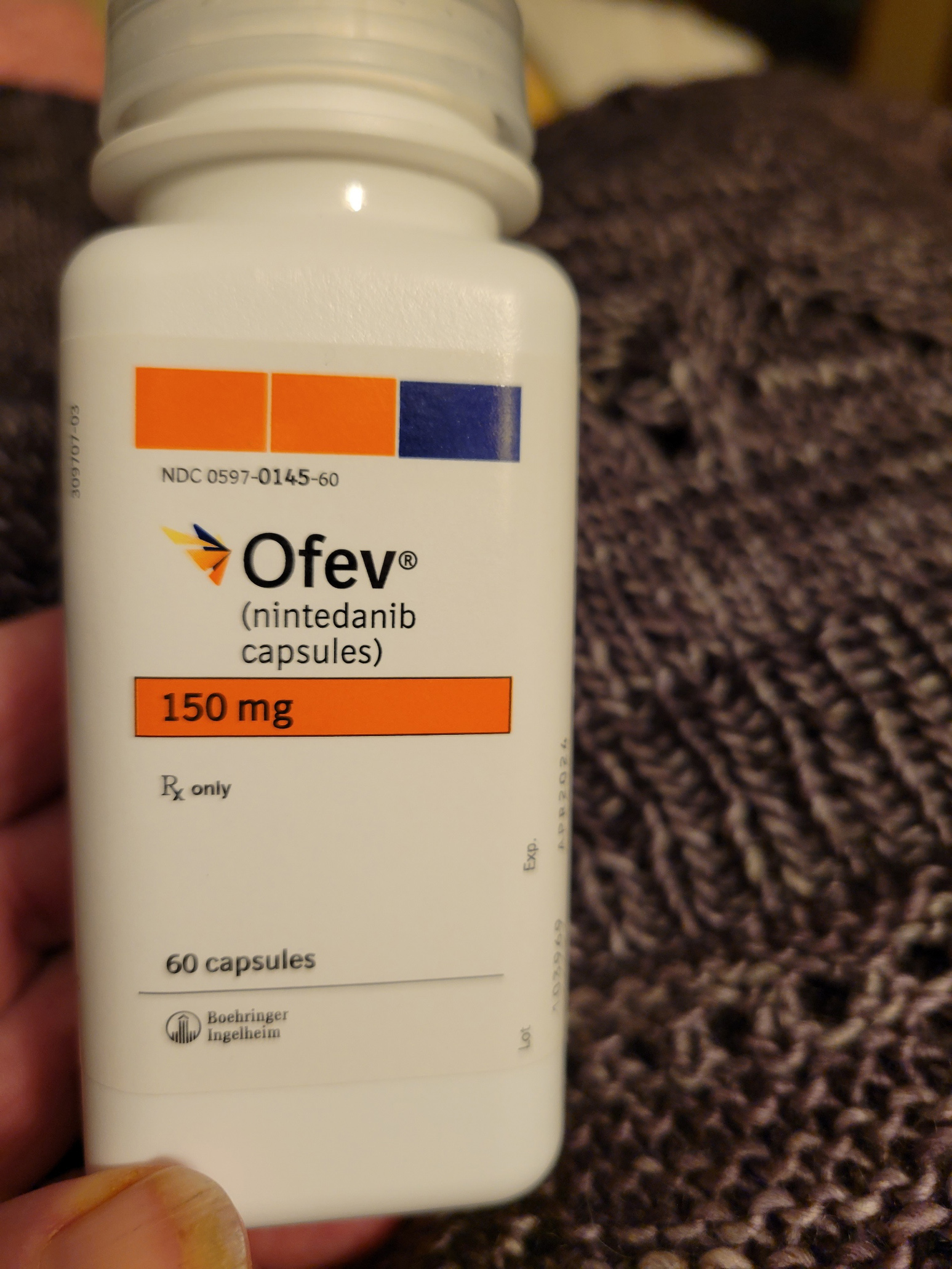
This is the new drug, just recently approved for the direct treatment of scleroderma-associated interstitial lung disease. Yay Ofev!

Ofev entered the scene just recently. I first heard about it in the early years of my scleroderma journey, and it was approved for use about three years ago. It took a few weeks for me to get enrolled to receive this drug and I need to go for mandatory blood testing each month before I can get my next month’s supply.

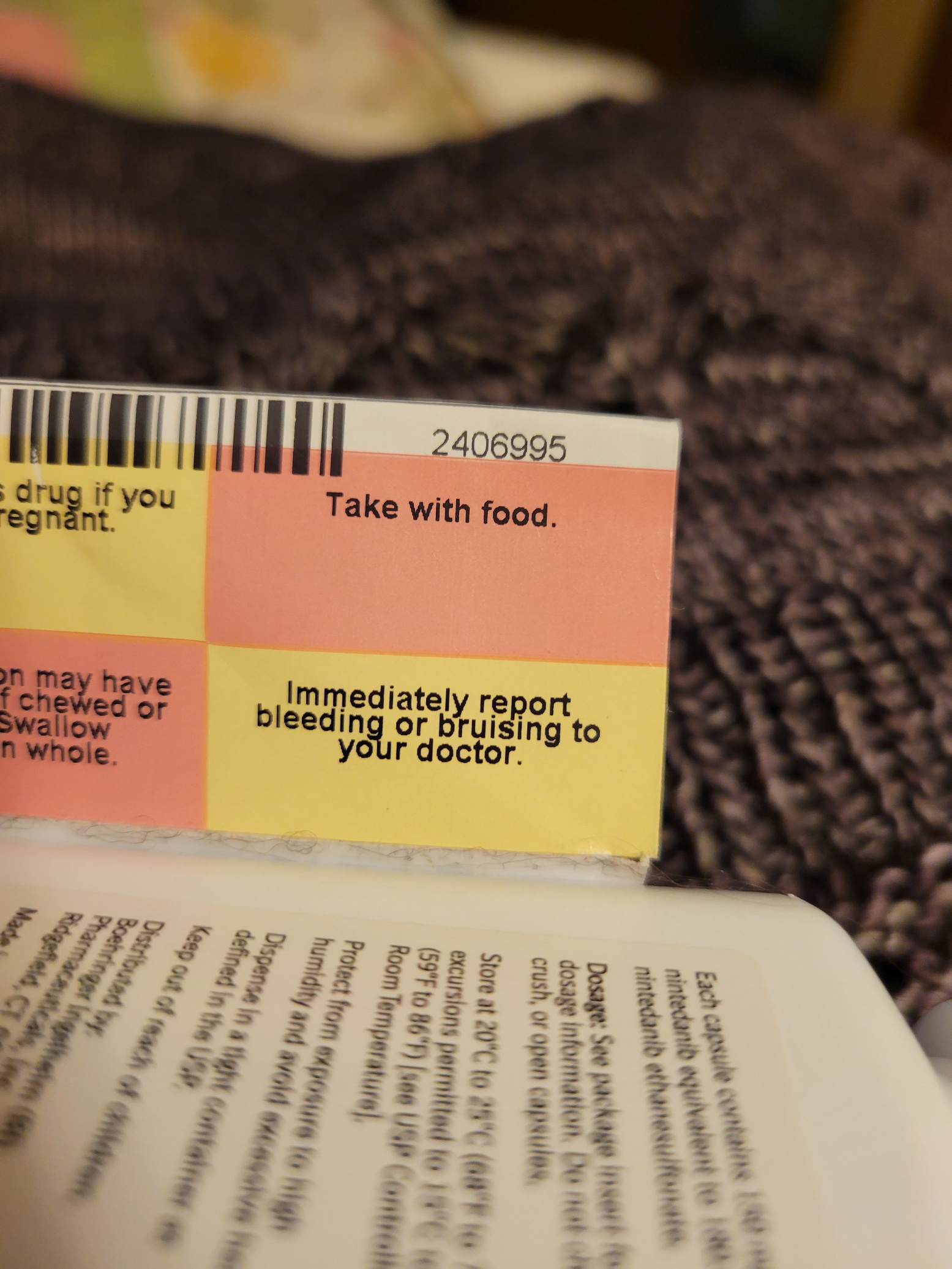
There is a significant risk of blood clots, and the pharmacist really stressed that I should watch for bruising.

A few days after my appetite returned, I woke up with a sore and swollen leg; I was also bleeding from both nostrils. When I looked at my leg there was a large bruise that grew to be about 6 inches across… not good, little BLZ, not good!! Yep. There was an immediate full stop on the drug for a week, and then I was started at a half dose a week later. A week after I had restarted Ofev my pulmonologist called to check up on me. No bleeding, but I was dealing with stomach discomfort.

He gave me the Fairy Dust talk. “There is no magic cure, and this drug is not fairy dust.” he said, “Drug companies can manipulate data to make drugs look better than they really are; I can’t stand for you to be miserable on this drug. There is a case to be made for focusing on quality of life as opposed to quantity of life.” (Well, that’s not discouraging at all, right?!) As he and I talked I remembered my conversation with the pharmacist; she had stressed how important it was to take the pills exactly 12 hours apart to maintain a steady blood level… I was taking the high dose only once a day at that point, so I was probably experiencing a spike every day in my bloodstream. I asked for a script for the lower dose and convinced him that I should try that for a month even though the total amount each day would be more. Over the last few weeks, I’ve had a little bleeding and a couple of little bruises, but nothing like I saw on the higher dose.

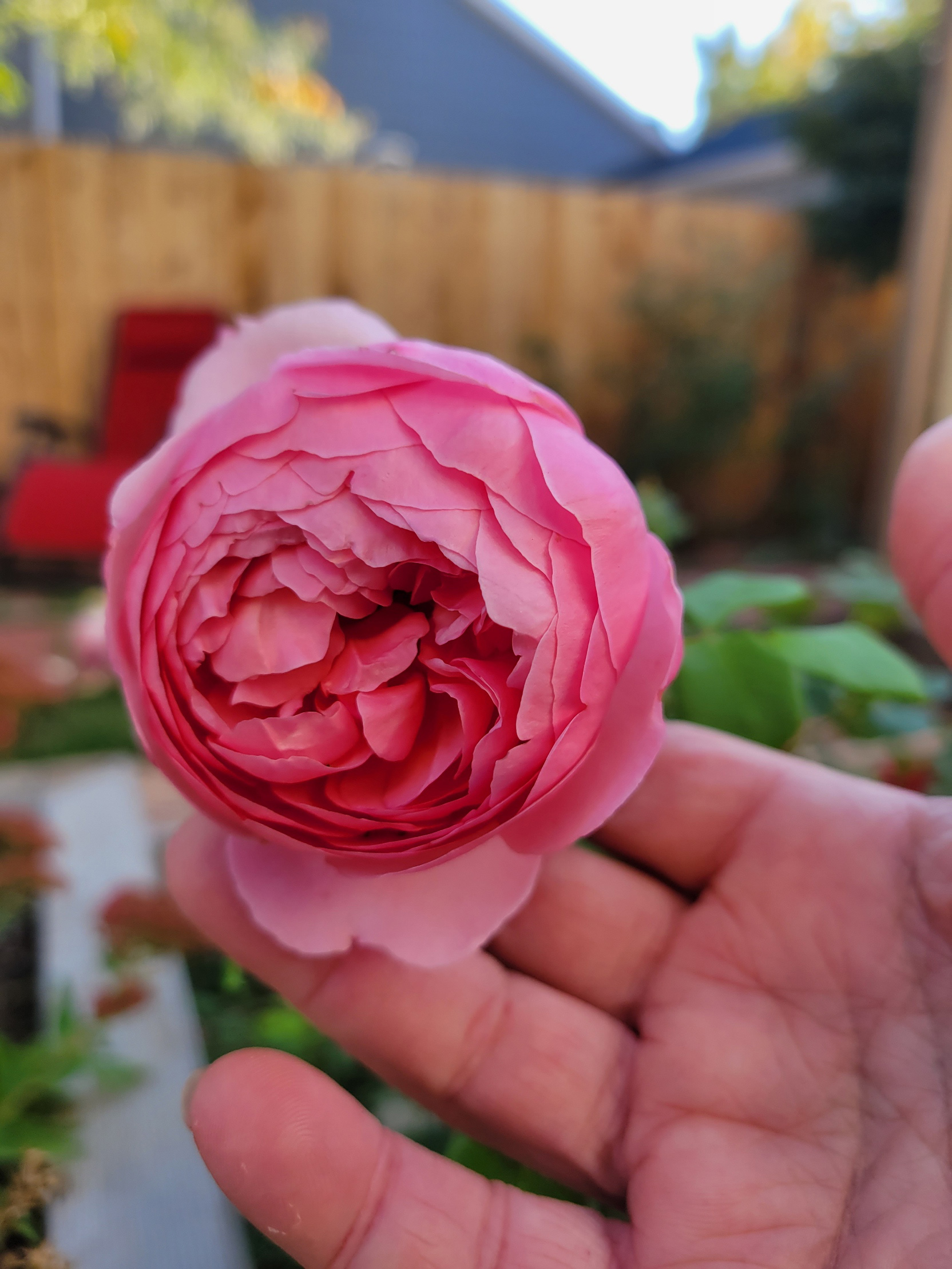
I moved to the lower dose twice a day three weeks ago. While that was going on my roses started blooming again.

A week ago, I went for more lung and heart testing. I bought green chili cheese fries and a chocolate shake on my way home because… my GI tract has decided that it loves me and I’m hungry again! Besides… green chile cheese fries!!! The results came in last Friday. My oxygen is better, and I can walk farther than a year ago! My pulmonologist doesn’t need to see me for 6 months. My heart testing and bloodwork was used by my cardiologist in a predictive model that returned a result of… low risk of pulmonary hypertension progression at this time. My heart failure numbers did double, but he isn’t all that concerned; he doesn’t need to see me for another 6 months.

I hung up the phone after the last call and thought to myself… maybe Ofev is Fairy Dust after all, because… I. Am. Better. This has been 2 months of NOT FUN, but the proof is in the pudding.

By the way, chia seed pudding, highly recommended by my pulmonologist, is just plain nasty! Chia seeds, without any doubt, are not fairy dust!!!

To be fair, it probably isn’t all Ofev; after all, it has been pointed out to me that it is not a magic cure. I started other drugs to control my pulmonary hypertension over the last year. I have made a lot of adjustments on my end to handle my lung disease. All of my down products are out of the house. I bought a new humidifier that can be easily cleaned each week. I put a high-grade filter into the furnace and bought an air purifier. I take all my drugs right on schedule and I do gulp down fiber-rich foods that are keeping any symptoms under control (except chia pudding… see above).

Okay, Reaper. You won a couple of the tosses, but this one is totally mine.

Pass the Fairy Dust and roll the dice.

This BLZ is ready to play!

The BioGeek Memoirs: Pampas Grass

It’s fall now in Colorado. The evenings are crisp, the trees are glowing in autumn hues, the crickets have gone silent, and only the bunnies remain in the yard. The last of the plants in my gardens are bravely blooming still, but tomorrow there is a frost warning, and their last days are upon them.

Here and there among the glowing trees the plumes of ornamental Pampas grass wave in the wind. These showy grasses, indigenous to the Pampas region of South America, have become more and more popular over the last few years and different varieties of them wave in the wind at me as I drive by on errands. Each time I see one I’m hit with a wave of good feeling: my mother loved Pampas grass.

Remember my mom, born in Yokohama, Japan, to Swedish-American parents? Well, she spent her high school years in Buenos Aires, Argentina, at the edge of the South American Pampas. How did that happen, you ask. Well… my grandfather was an engineer who worked for a canning company that operated internationally, which is why my mom learned 4 different languages during her life. Let’s get back to the Pampas grass…

Early in the summer the grasses have these showy white plumes…
Now the plumes are brown as the seeds ripen. Do you see how tall these grasses are?
That stop sign is taller than me, so that grass is at least 8 feet tall!!

Every time my mother saw Pampas grass growing, she would exclaim about how wonderful it was, how it came from the Pampas, and then the stories about the Pampas would start. The grasslands, the Gauchos, Yerba Mate tea, ropes and cows, and then all her memories of Buenos Aires. (We tried to love the Pampas grass too, for her sake, but the edges of the grass had little buzzsaw edges that could give us a nasty cut on our fingers. Those grasses are better admired from afar!) She made us Yerba Mate tea and we could try to drink it out of her special little gourd with its silver straw.

My mom used to wear this silver brooch of a Gaucho hat with an attached rope and knife.

Now I live at the edge of the North American Great Plains which is similar to the Pampas of my mother’s formative years. Many of the animals that live here echo the animals that my mother told us about when I was young (but not all… we have bison!), and instead of Gauchos we have a Cowboy culture. There are tall grasses here, and sagebrush, but nothing like the Pampas grass. Still, there are the open skies, the gentle hills covered with waving grass, raptors soaring overhead, and the occasional sighting of an antelope or deer. I understand why my mother evidently longed for the open vistas of the Pampas after she had left them, and each time I drive past open prairielands I feel connected through time with her.

And every time I see Pampas grass.

Hannah and the CoalBear: Caturday Catch-up

Hi. I’m Mateo (AKA the CoalBear).

I’ve been helping the Mother of Cats with her knitting this week.

Hannah has been getting all of the attention for weeks and weeks while she was flying around on Sharon Air, so the Mother of Cats has been spending lots of time with me since Hannah came home from her adventures. She has been knitting and knitting on a smoky brown blob of yarny *something* and I have been extremely vigilant about attacking any stray ends that try to get away from her. I mean, I have sat by her side for hours watching intently… this is just exhausting! Finally, the Mother of cats got all of the stitches off the needles this afternoon and I could take a little nap while she tried it on.

Whew! She is pretty happy with how it is going, but she says that she needs to block it to see how long it will be. Whatever. All I care about is how long I get to nap before she puts this sweater monster back onto her needles. Oh, yeah. This sweater is called Lace & Fade by Joji Locatelli.

The Mother of Cats has also been busy sewing this week. Hannah decided to help her with this, which was totally okay with me because I think that the sewing machine is a little bit scary. Hannah kind of likes it and always spends all of her time in the sewing room when the mother of cats is busy in there.

Anyway, I hope that you can understand what this sewn stuff is. I think that it would be good if Hannah adds some notes here, so here she goes:

Hannah: Okay, here are my notes on the sewing we did.
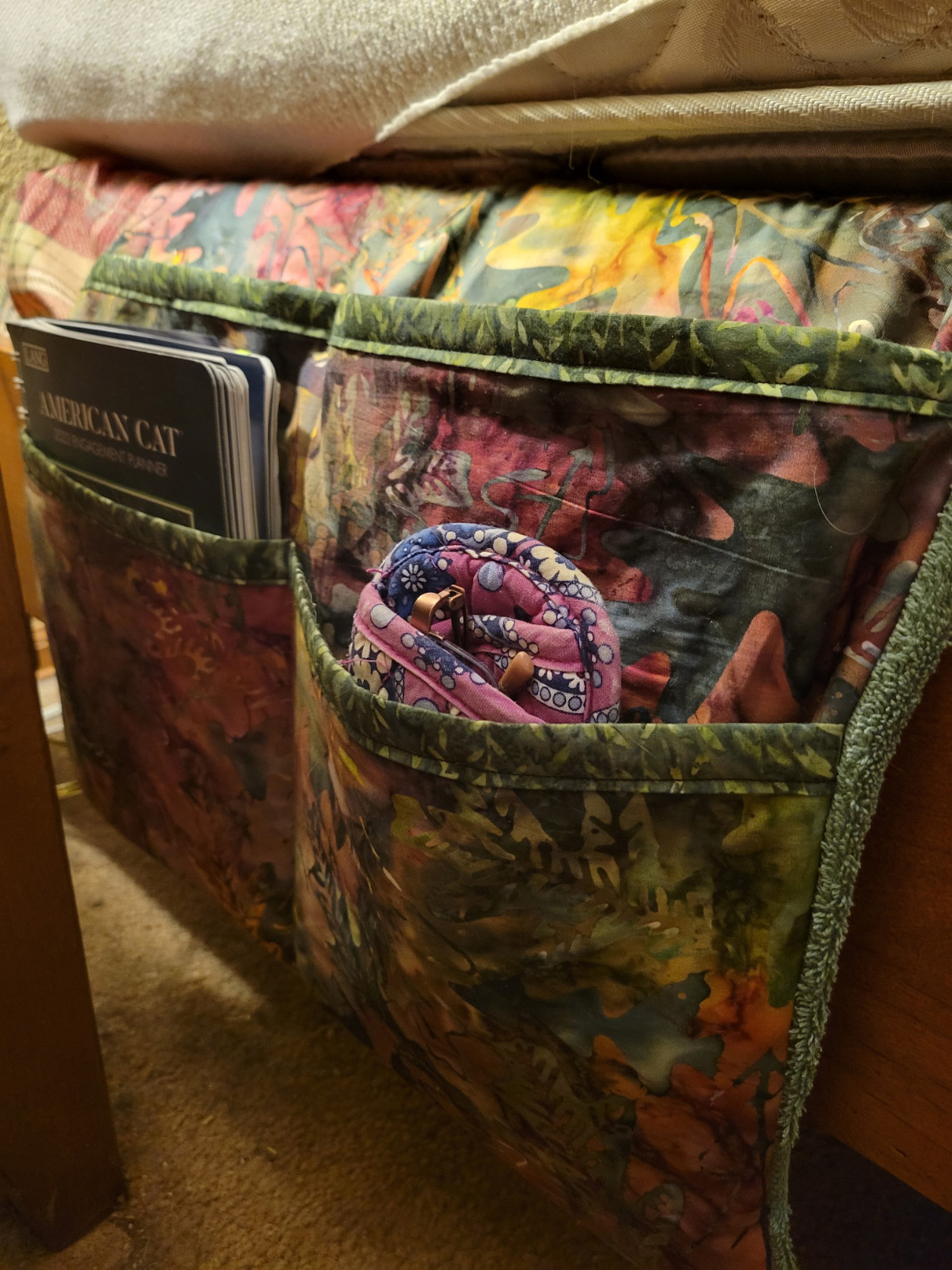
  • The first picture is of the bedside caddy that the Mother of Cats and I sewed a few weeks ago. It is sewn to a towel that goes under the mattress (MY IDEA!!) and those nice pouches hold lots of things for the Mother of Cats.
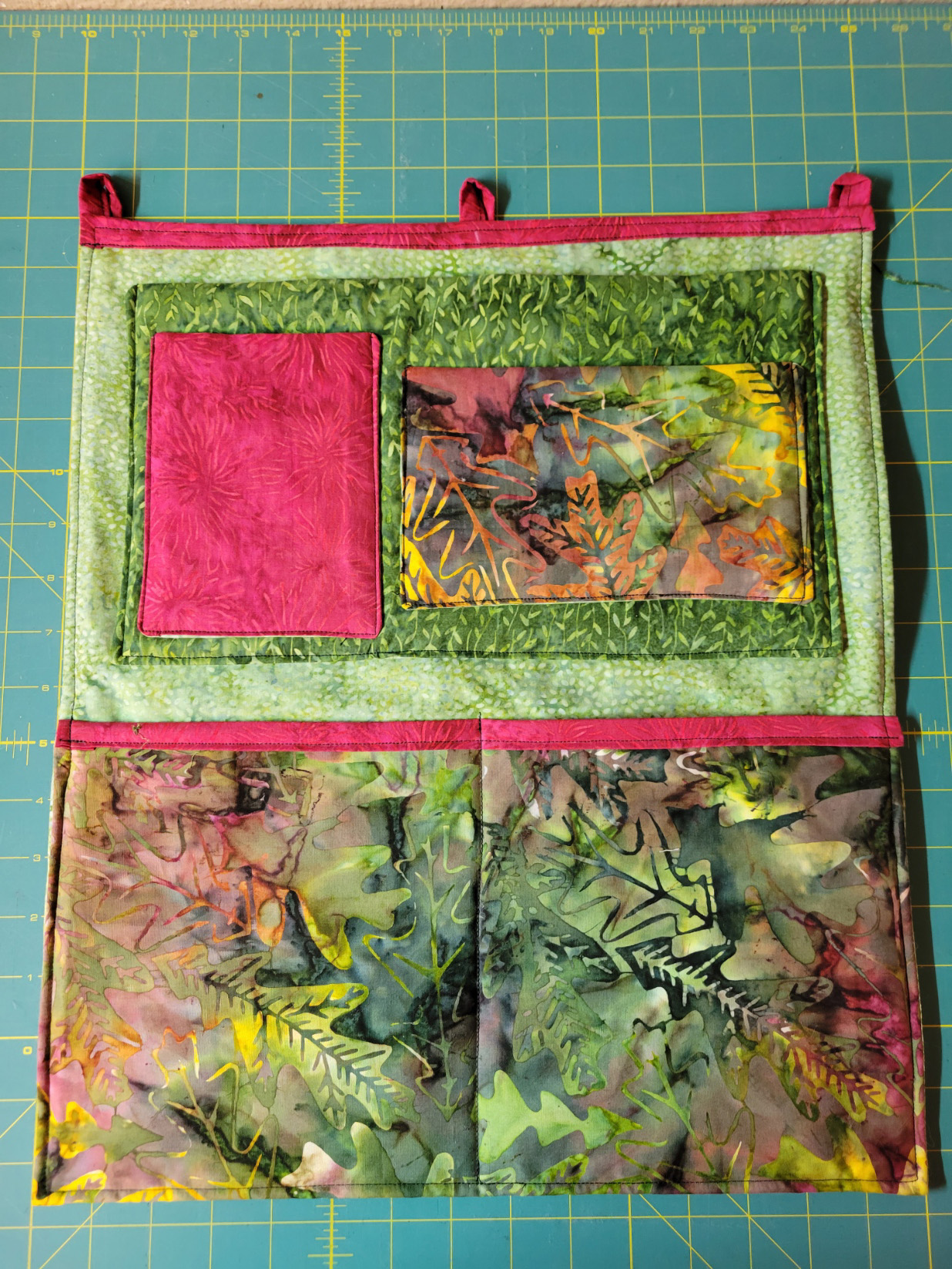
  • Last week the Mother of Cats sewed the little caddy (middle picture) that is designed to hang from Command hooks on her bedside table. Isn’t it nice? The little pouches hold her glasses and phone, and the back pouch is exactly right for her Kindle tablet. It works great, but she is still thinking of how to improve it.
  • The last caddy is much larger, has two larger pouches at the bottom, and is kind of a mix-up of both bedside caddies. The Mother of Cats sent if off to her sister this week. The sister plans to do some trickery with grommets and stuff to hang it onto her bedside table.
Mateo: Hannah is asleep, so I’m taking over again.

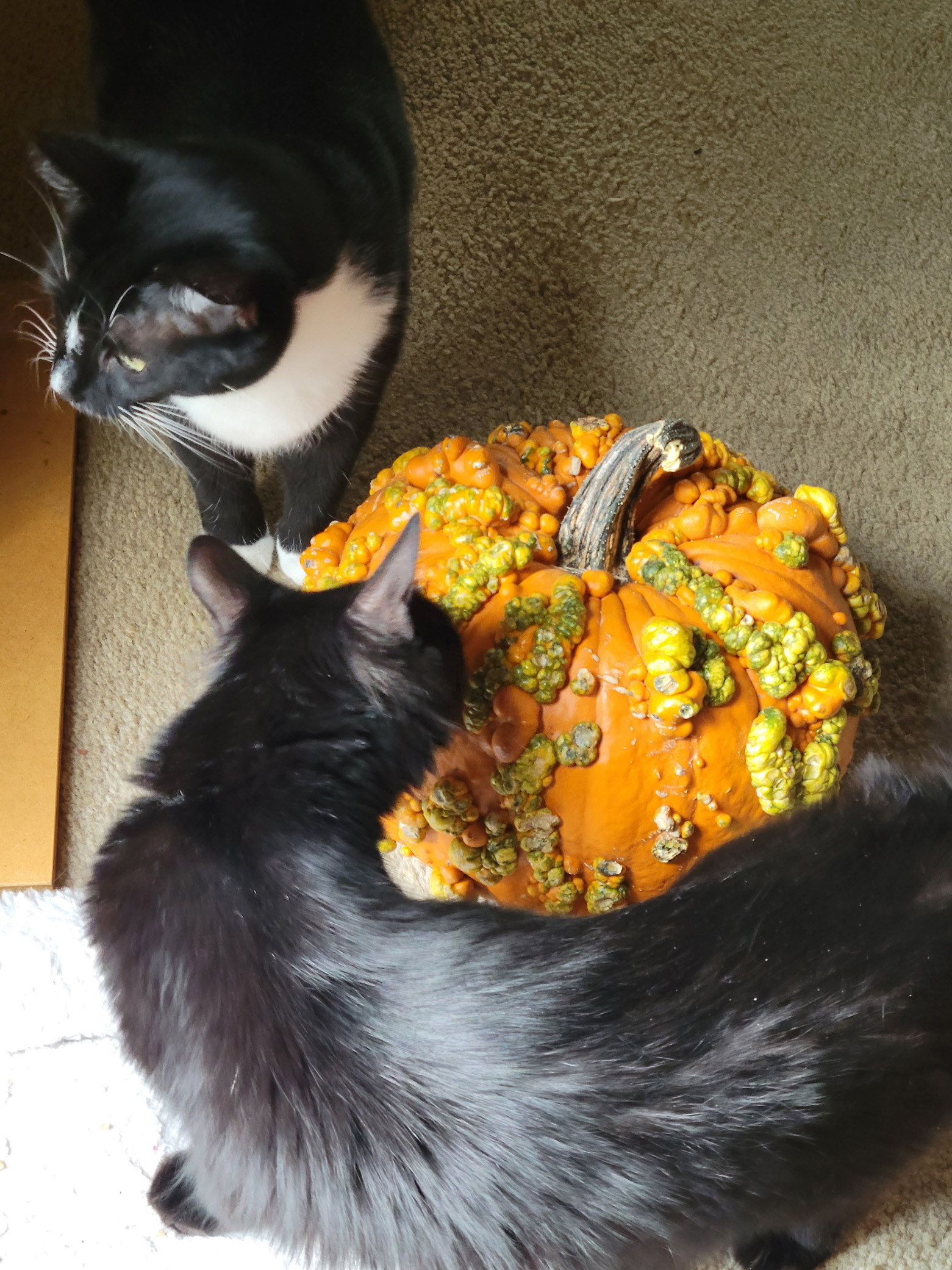
The only other stuff that is going on around here is that trip the Mother of Cats took to the local garden and farm store. She came back with some crazy stinky roasted green chiles and also a funky pumpkin. Hannah and I stayed completely away from the kitchen while the chiles were roasting away in their boxes, but we did check out the pumpkin.

This is one ugly, scary pumpkin!!! Hannah and I don’t understand why this came home to stay with us. The Mother of Cats put it on the table with some other pumpkins and stuff. The Mother of Cats says that this is all about Halloween, but we just want our table back! Hannah likes to take naps up there, and now there is this stoopid, lumpy-ass pumpkin in the way…

It’s okay. I’d rather nap on the bed anyway. Also, soon there will be more knitting, too!

Happy Caturday, everyone!

This is Mateo, the CoalBear, signing off.

Notes from the Mother of Cats:

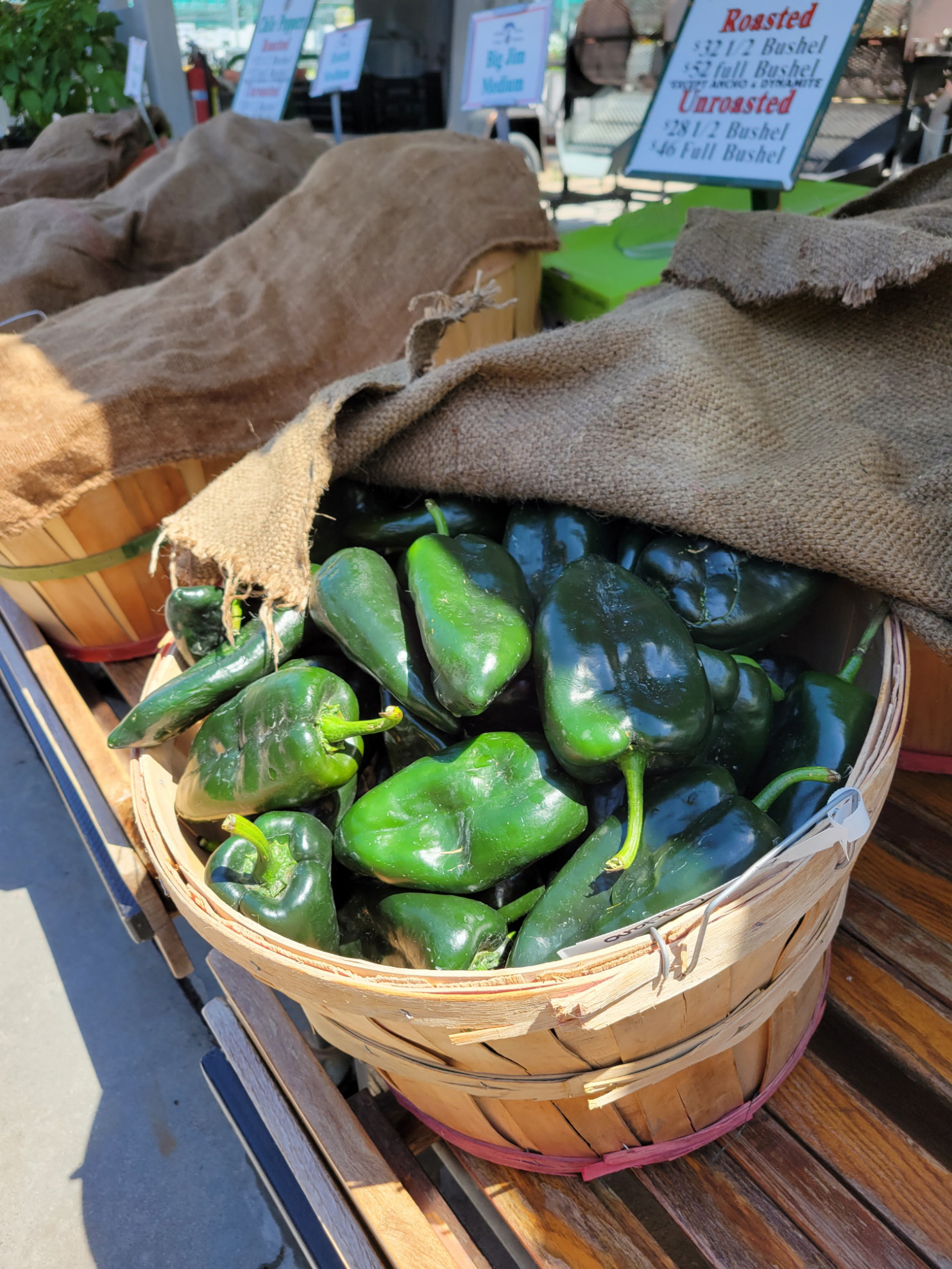
It is green chile season!!! Every year I get a bushel of chiles roasted and then I freeze them to use all during the winter. This year I bought two different types of green chile peppers and made two trips that netted me a total of a bushel and a half of peppers in the freezer.

If you’ve never done this, the process is really simple. The chile peppers are grouped by how hot they are… I buy chiles that are mild and avoid ones that have names like Ghost or Dynamite. This year I got a bushel of Ancho chile (the meaty green ones) and a half bushel of Marconi chile peppers. The peppers are washed, then dumped into a rotating drum that is turned over a flame until all of the skin is blackened and the peppers are roasted. They are then poured into a heavy plastic bag and packed into a box that is taken home to continue roasting for the next few hours. When they are finally cool enough to handle, I put 6-8 peppers into a freezer bag and then these are moved to the freezer when cooled. This year I froze 24 bags of chili pepper. I sure hope that’s enough to get through the winter. 🙂

When I use the peppers later on that blackened skin will just wash off, but the smoky flavor will linger. Green chile is good stuff; versatile, anti-inflammatory, and extremely addictive. I’ve already eaten two of my cached bags of chile this fall…

Green chile is also serious business in this part of the country. There is a rivalry between the governor of my state (Colorado) and New Mexico’s governor over who has the best chile crop. We do, of course. Pueblo chile forever!!

That pumpkin is called a Warty Goblin pumpkin. I think that they are so ugly they are cute!!